 FEXLINK Research Institute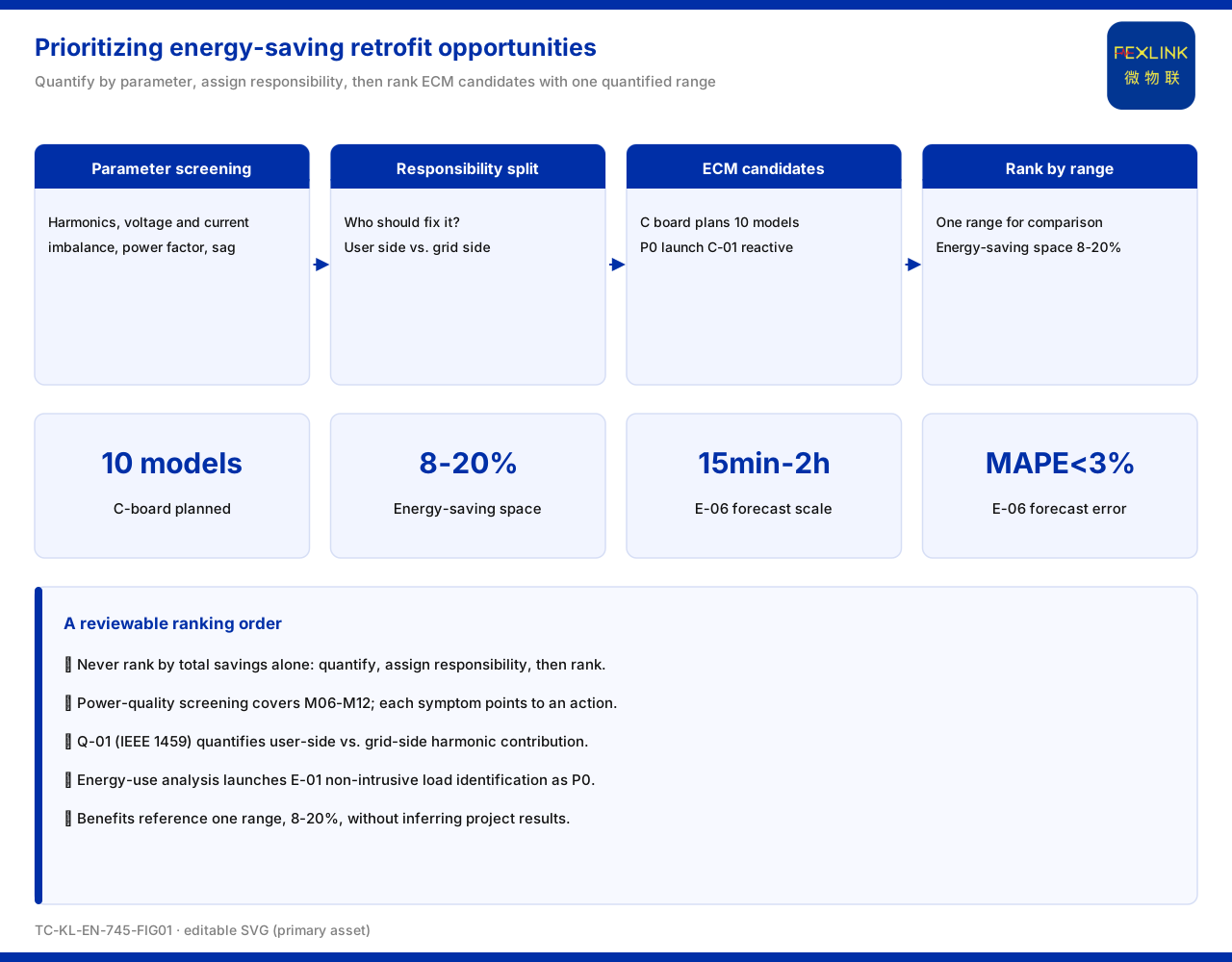
Direct Answer
When several energy-saving retrofit opportunities appear at once, the point of ranking them is not "do whichever saves the most first", but to align three things in order: first quantify the problem through a parameter-level health check, then judge who should bear the problem through responsibility allocation, and finally let the energy-saving measures section propose candidate actions and compare their benefits against a unified quantitative range. According to the existing product material, the energy-saving measures section of the Tianyan engine lists ten models in the V2.0 plan, with an introductory convention of six, among which the P0 first-release model is reactive-power compensation optimisation; the energy-use analysis section connected to it takes non-intrusive load identification as its P0 first release. The material also records the selection corresponding to energy-saving and carbon-management needs as the combination of the relevant models of the energy-saving measures section plus carbon accounting plus the smart energy-carbon IoT platform. On quantified benefit, the Taiyi intelligent control hub system lists a comprehensive energy-saving space of eight to twenty percent. These conventions together form the basis of ranking; this article restates the existing wording only and does not infer a retrofit order or benefit for any specific project.
1. Why Ranking Cannot Look Only at Total Savings
The most common mistake in energy-saving retrofit is to equate "large total" directly with "do it first". Yet the ranking material provided by the product material is not limited to the total: the power-quality health-check sub-model of the Qianzhi engine covers parameters such as harmonics, voltage imbalance, current imbalance, power factor and voltage sag, each pointing to a different treatment action and each with a different technical threshold. Looking only at the total may postpone responsibility problems or split coupled retrofits into disconnected investments. The first basis of ranking is therefore the parameter-level health check, which turns "where is the problem and how big is it" into comparable items rather than a vague energy-consumption figure.
2. Parameter-Level Health Check: the Input to Ranking
The power-quality health-check sub-model in the product material covers harmonics (the second to the fiftieth order and total harmonic distortion), voltage imbalance, current imbalance (characterised by sequence components), power factor and voltage sag. Their significance is to provide a parameter-level basis for ranking energy-saving retrofit priorities. "Parameter-level" means splitting the phenomenon into measurable quantities: for harmonics, the order distribution and distortion level; for imbalance, the sequence-component relation; for power factor, the reactive share; for voltage sag, the frequency and amplitude of occurrence. Once listed separately, the retrofit opportunities become a set of items with concrete symptoms rather than a vague list. Ranking thus gains its first comparability: problems on different circuits and different devices can be examined under one parameter convention.
3. Responsibility Allocation: Answering "Who Should Fix It" First
Knowing where the problem is is not enough; one must also judge where it comes from. The harmonic responsibility-allocation model in the product material uses relevant standards as its criterion, quantifies the respective contributions of the user side and the grid side to harmonics, and gives a verified practical figure: the rectification cost fell from eight hundred thousand yuan to two hundred and eighty thousand yuan. The value of this figure is not the amount itself but that it shows responsibility allocation directly affects the retrofit scope and investment. If it comes mainly from user-side equipment, treatment should fall on the user side; if from the grid side, the cost-effectiveness of large user-side equipment must be reassessed. Putting this judgement first avoids spending the budget in the wrong direction and lets the later energy-saving measures land where there is real responsibility and room for improvement.
4. The Candidate List from the Energy-Saving Measures Section
After problem quantification and responsibility allocation, ranking moves to the candidate actions. The product material records that the C energy-saving measures section of the Tianyan engine has ten items in the V2.0 plan, with an introductory convention of six, and the P0 first-release model is C-01 reactive-power compensation optimisation. The planning number is for internal scheduling and technical layout, the introductory convention for external statement; the two should not be mixed. For ranking, what matters is that the C section types the energy-saving actions: reactive-power compensation optimisation is the first action, and the other models around it form a candidate set to be unfolded in turn. In ranking, the candidate actions can be matched one by one with the parameter symptoms above: power-factor problems correspond to the compensation direction, harmonic problems to the treatment direction, imbalance problems to the balancing direction.
5. Energy-Use Analysis Adds the Device-Level View
The parameter-level health check faces circuits and busbars; device-level information still needs another capability. The E-01 non-intrusive load identification in the product material needs no extra hardware and identifies specific devices through the current waveform, with the criterion formed jointly by start-up characteristics, steady-state power and harmonic features. Its role in ranking is to split "this circuit consumes a lot" further into "which devices consume and in what state". In addition, the ultra-short-term load forecasting model aims at a scale of fifteen minutes to two hours and an error below three percent, and can be used to grasp short-term load fluctuation. Placing them with the C section action list lets ranking answer both "which circuit to retrofit" and "which device to retrofit".
6. How the Quantitative Range Enters the Ranking
Ranking needs a common benefit scale, otherwise different actions cannot be compared. The comprehensive energy-saving space listed by the Taiyi intelligent control hub system is eight to twenty percent, and this is the only range convention used in this article when citing benefit. Its use is to provide a comparison range, not to replace on-site measurement: after placing the candidate actions by parameter symptom, the same range is used to estimate the benefit band into which each kind of action may fall. It must be noted that the range itself does not distinguish action types, nor guarantee that a single retrofit will reach any value inside it; it states only the existing system-level wording for comprehensive energy-saving space. In ranking, the range should be treated as a common background for comparison, not as the upper bound directly taken as one action's expected benefit.
7. Reducing the Ranking to a Reviewable Order
Combining the sections above, energy-saving retrofit priorities can be organised in the following order. First, use the health-check sub-model to obtain harmonics, voltage imbalance, current imbalance, power factor and voltage sag, forming a symptom-bearing problem list. Second, for problems involving the attribution of harmonic contribution, use harmonic responsibility allocation to judge the user and grid shares, avoiding investment in the wrong direction. Third, match the problem symptoms to the candidate actions of the C energy-saving measures section, taking reactive-power compensation optimisation as the established first-action reference and evaluating the rest in turn. Fourth, use E-01 load identification to add device-level information and refer to the short-term scale of ultra-short-term load forecasting. Fifth, close the argument with eight to twenty percent comprehensive energy-saving space as the benefit comparison range. Each step can thus return to a concrete item in the product material, reducing the room for cross-stage inference.
8. Ranking Results Still Need On-Site Confirmation
It must be stressed that the above order gives an argumentative framework that organises the existing material; it is not a fixed sequence recommended for any project. The same parameter symptom, under a different supply structure, load characteristic or responsibility allocation, has different retrofit feasibility and input-output relation. What the product material can provide is conventions, models and quantitative ranges; for a particular distribution system, on-site measurement and scheme approval still prevail. Laying them out in layers means that, when on-site conditions change, only one layer need be replaced without overturning the whole judgement.
Applicability and Limits
- The content is limited to the existing wording of the product material on the energy-saving measures section, the energy-use analysis section, the power-quality health-check sub-model, harmonic responsibility allocation and the comprehensive energy-saving space range.
- The model counts (ten and six), the comprehensive energy-saving space (eight to twenty percent), the ultra-short-term load forecasting scale (fifteen minutes to two hours, error below three percent) and the rectification-cost figure (from eight hundred thousand yuan to two hundred and eighty thousand yuan) are as listed in the product material and are not a commitment to any project's results.
- The parameter coverage (harmonics from the second to the fiftieth order including total harmonic distortion, current imbalance characterised by sequence components, and so on) is restated from the product material; no unlisted algorithm or threshold is inferred from it.
- The standard criteria on which harmonic responsibility allocation relies are limited to those listed in the product material, and this article does not state them as a determination of any product's compliance.
- This article is not a commitment to any unlisted indicator; actual capability is governed by the latest product material and project scheme.