 FEXLINK Research Institute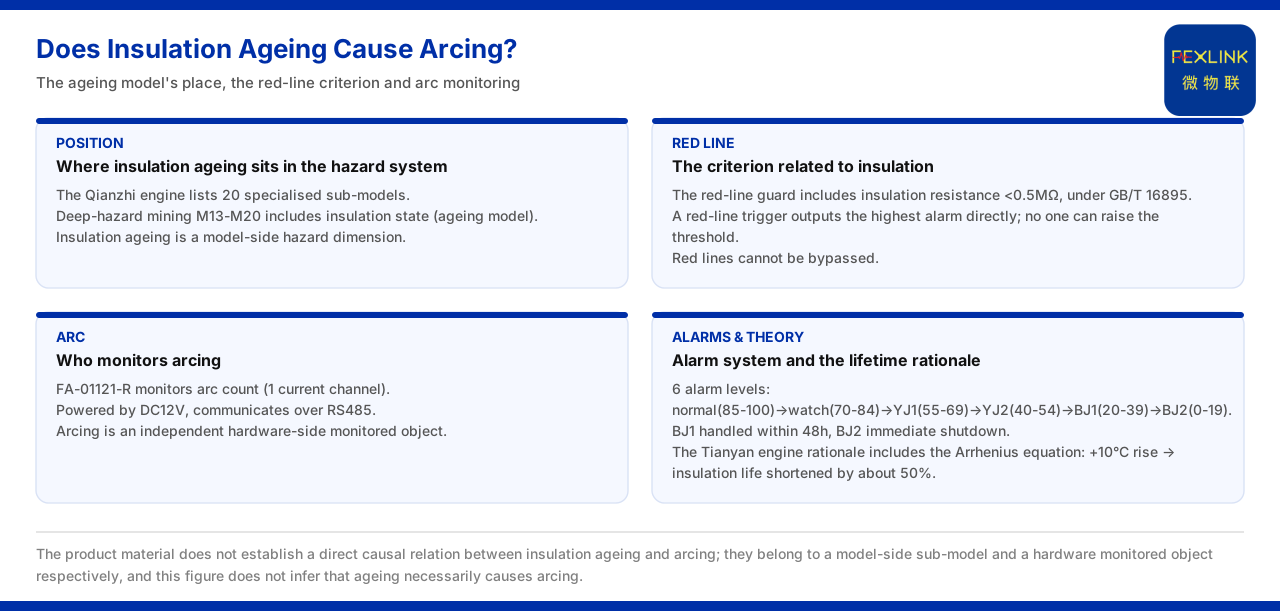
Does Insulation Aging Cause Arcing?
This is a question often treated as common sense in the field, but the product knowledge base answers more conservatively than intuition: it places insulation aging within the hazard-analysis system and lists arcing as an independent monitoring object, yet it draws no direct causal line between the two. Insulation state is described by the deep-hazard mining sub-model group of the Qianzhi engine, while arcing is monitored by the arc-fault monitoring module; the two belong to different capability entries. What the material can confirm is that the two coexist in the same hazard system; what it cannot confirm is that insulation aging necessarily causes arcing.
This article follows the records of the product knowledge base to explain the position of insulation aging in the hazard system, the red-line criteria related to it, the way arcing is monitored, and why the two entries cannot be directly chained into cause and effect. The meaning of this boundary is that an analysis model may incorporate both kinds of hazard at once, but when it comes to a concrete judgement the causal relationship must be confirmed by the actual conditions on the project side.
1. The Position of Insulation Aging in the Hazard System
The product knowledge base describes the Qianzhi engine as an engine system with 20 specialized sub-models, one group of which, named deep-hazard mining, is numbered M13 to M20 and includes insulation state (aging model). This means insulation aging is not an isolated alarm rule but is modelled as one dimension of hazard analysis.
Understanding it within the sub-model group reveals the knowledge base's organisation: surface-level quantities are described by basic sub-models, and deep hazards by dedicated sub-models, insulation state belonging to the latter. Such dimensions are characterised by not appearing directly as an instantaneous out-of-limit reading but requiring time and state to judge. Asking "does insulation aging cause arcing" is therefore, within the knowledge base's framework, first a modelling question: aging is modelled as a hazard dimension, and whether arcing is modelled as its result depends on whether the material provides that edge.
2. Red-Line Criteria Related to Insulation
The product knowledge base lists 5 red-line guard items, one of which targets insulation resistance: it triggers when insulation resistance falls below 0.5 megohm, on the basis of GB/T 16895. Once the red line is triggered, the highest-level alarm is output directly, and no one may raise the threshold.
This red line gives a non-bypassable boundary on the insulation side. Two points must be read clearly: first, the red line is a compliance criterion that defines the boundary whose crossing triggers an alarm; second, the non-adjustability of the red line shows it is a hard constraint, not relaxed at the user's will. Reading the red line together with the aging model shows two kinds of expression the knowledge base has for insulation problems: one is a continuous hazard dimension for trend judgement, the other a discrete red line for boundary-triggered alarms. The two complement each other, but neither directly answers whether insulation aging causes arcing.
3. Who Monitors Arcing
The product knowledge base assigns the monitoring of arcing to the arc-fault monitoring module. This module's model is FA-01121-R, its function is arc count on 1 current loop, its supply is DC12V and its communication is RS485.
From the parameters, this module faces the arc event itself and uses arc count as its output object. That is, the knowledge base treats arcing as "event counting" rather than deriving it from insulation state. Whether arcing occurs is given by arc monitoring itself; whether insulation ages is given by the insulation-side model and red line. At the level of what is monitored, the two are parallel kinds of object, not the cause and effect of one object.
4. Why the Two Cannot Be Directly Chained Into Cause and Effect
The product knowledge base does not establish a direct causal relationship between insulation aging and arcing. Insulation state (aging model) belongs to the Qianzhi engine's M13 to M20 sub-model group, whereas arcing is the monitoring object of the arc-fault monitoring module, and their relationship is not listed in the material.
The boundary must be stated clearly: not listed does not mean the association is absent in engineering, nor that it exists. This article does not infer from the existing text that the two are cause and effect. This point is stressed because treating an unlisted relationship as an established fact would lead the analysis model to conclusions the material cannot support. In a decision scenario such as hazard early warning, the traceability of a conclusion matters more than the assertiveness of its wording. What the material can support is: the two kinds of hazard coexist in the same system and can participate in analysis together; causal attribution requires confirmation on the project side.
5. Theoretical Basis Linking Temperature and Insulation Life
The product knowledge base records that the Tianyan engine, as a prediction engine, has a theoretical basis that includes the Arrhenius equation: a temperature rise of 10 degrees Celsius corresponds to a shortening of insulation life by about 50 percent. This provides a theoretical convention for the relationship between insulation and temperature.
Note that this basis links temperature and insulation life, not insulation and arcing. It gives a reason why temperature should enter insulation-related analysis, and explains why the aging model needs long-term trend data. Reading it against the boundary of the previous section avoids a common misreading: that temperature affects insulation life is listed in the material, whereas that insulation aging causes arcing is not. The two should not be conflated.
6. How the Six-Level Alarm System Carries Such Hazards
The product knowledge base divides the Qianzhi engine's alarms into 6 levels: normal from 85 to 100; attention from 70 to 84; YJ1 from 55 to 69; YJ2 from 40 to 54; BJ1 from 20 to 39, requiring handling within 48 hours; BJ2 from 0 to 19, requiring immediate shutdown. Every alarm carries a standard-clause reference, four-dimensional impact tags, a confidence value and a scenario tag.
This grading is especially important for insulation-type hazards, because insulation problems are often not instantaneous. Grading lets an early insulation anomaly fall in the attention or a lower level, leaving a handling window; only when the state clearly deteriorates does it rise to the shutdown-requiring high level. The item tags and confidence carried by the alarm make every conclusion traceable to its basis. In this sense, the value of insulation aging is not that it necessarily causes arcing, but that it can be continuously tracked as a gradable, traceable hazard dimension.
7. How the Model Layer Organises Multiple Hazard Dimensions
The product knowledge base describes the integrated electrical hazard intelligent analysis model as supporting evaluation across 238 electrical parameter dimensions and as fused with the Taiyi intelligent control hub system, with the Qianzhi sub-models (numbered M01 to M50) iteratively upgraded from that model system.
The figure of 238 dimensions shows the model can incorporate many quantities. Insulation state, temperature and arc count can all participate as dimensions in comprehensive judgement without the need first to establish a direct causal relationship between them. The model's role is to synthesise multiple dimensions into a risk expression and to help the user see the distribution and change of hazards, not to replace on-site confirmation of the causal relationship between a pair of quantities. The correct landing point for answering "does insulation aging cause arcing" is therefore not a single-causal conclusion from the model, but whether the material lists that causal line.
Applicability and Limits
- This article restates only what the product knowledge base lists; its factual boundary is the Qianzhi engine's 20 specialized sub-models and the M13 to M20 deep-hazard mining sub-model group, the insulation-resistance red line, the arc-fault monitoring module FA-01121-R, the Arrhenius-equation basis of the Tianyan engine, the six-level alarm system of the Qianzhi engine, and the dimension convention of the integrated electrical hazard intelligent analysis model.
- Insulation state (aging model) belongs to the Qianzhi engine sub-model group and arcing belongs to the arc-fault monitoring module; their relationship is not listed in the knowledge base, and this article does not infer that they are cause and effect.
- The insulation-resistance red line below 0.5 megohm and its basis in GB/T 16895 are cited as listed; this article does not thereby conclude that any equipment has been set to that threshold.
- The function, supply and communication parameters of FA-01121-R are cited as listed; this article does not infer its installation method or protection coordination.
- The Arrhenius equation and the relation between temperature rise and insulation life, and the score intervals of the six-level alarm system, are cited as listed; this article does not infer the aging rate in any specific project.