 微物联研究院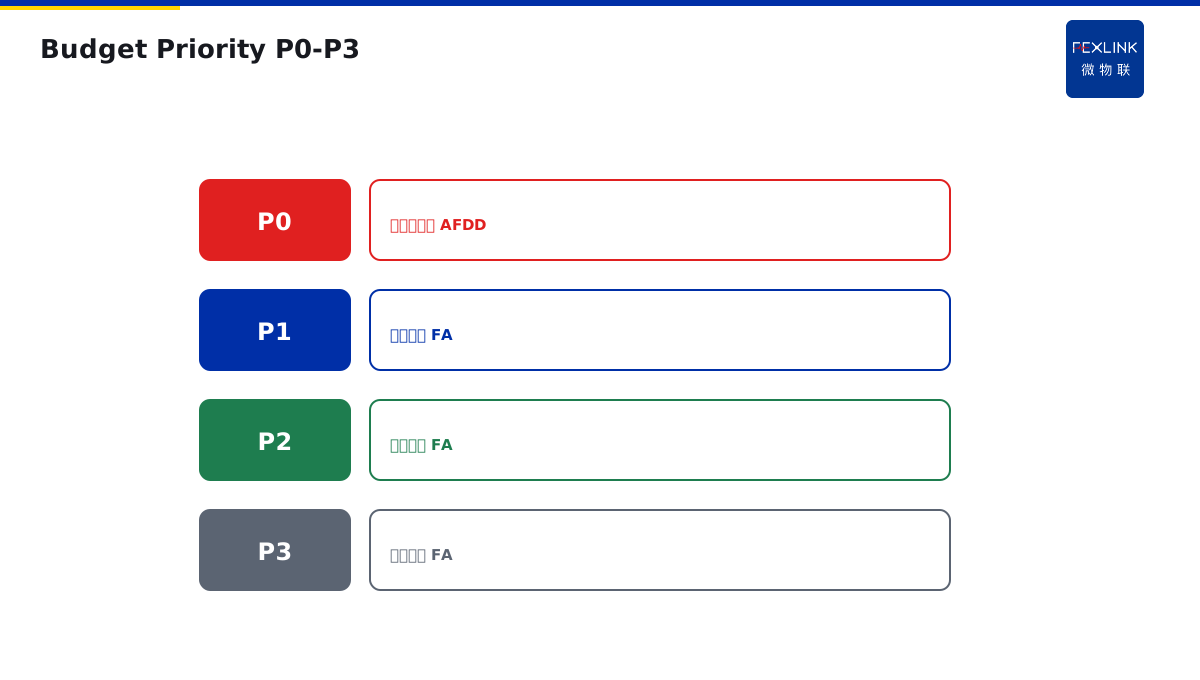
Direct Answer
When a project shows both FA monitors and AFDD devices and budget is limited, which goes in first? The answer is simple: these two are not either/or—they are layers.
- AFDD sits on the end circuit and trips directly on dangerous arcs—trading supply continuity for safety;
- FA sits on feeders or critical circuits, monitoring arc count and trend and alarming but never cutting power—keeping supply, letting people decide.
Continuous-process sites (data centres, hospital ORs, production lines) start with FA monitoring networks; high fire-risk ends where supply can be interrupted (residential sockets, school dorms, elderly homes) get AFDD. When budget is tight: AFDD first on high-risk ends, FA on critical feeders.
1. What Each Actually Protects
Many treat FA and AFDD as two tiers of the same product. Wrong. Their action logic is opposite:
AFDD (Arc Fault Detection Device)
- Role: end-circuit protective switch
- Action: dangerous arc detected → immediate trip
- Sacrifice: supply continuity
- Gain: absolute safety, whether anyone is watching or not
- Standard: GB/T 31143 (identical IEC 62606) type-tested
FA module (fault arc online monitor)
- Role: online monitoring sensor
- Action: arc event logged, waveform captured, alarm uploaded—never trips
- Sacrifice: may wait for human confirmation
- Gain: supply not interrupted, O&R has lead time
- Form: in-series current waveform sampler, uploaded to Qianzhi for trend analysis
An analogy: AFDD is a smoke alarm plus automatic sprinkler—it sprays when it sees fire. FA is a temperature sensor plus remote call—when it gets hot it phones you, and you decide whether to fight.
2. Three-Layer Project Configuration
A complete project should be configured in three layers:
Layer 1: Feeder FA monitoring network
Starting at the LV incomer busbar, fit FA-01121-R on every bus section and every feeder main switch. This layer is not for tripping—it is for whole-site awareness:
- Which circuits are producing frequent arc events?
- Which circuit's event frequency is rising?
- Which circuit's temperature is climbing?
This layer never cuts power. It feeds data to Qianzhi, which runs trend analysis and alarms on anomalies. Its value is early discovery—telling you before the arc becomes a fire.
Layer 2: High-risk end-circuit AFDD
On end circuits with high fire risk and where supply can be interrupted, fit AFDD. Typical locations:
- Residential sockets (bedrooms, living rooms);
- School classrooms and dorms;
- Hospital wards (not ORs);
- Museums and archives;
- EV charging sockets.
If these circuits fail, the consequence is fire—they must cut out immediately. The AFDD here is the last line of defence: even if FA monitoring misses an alarm, the AFDD trips as a backstop.
Layer 3: Critical production circuits—FA only, no AFDD
On circuits that cannot lose power, fit FA only, not AFDD. Typical locations:
- Data centre IT load;
- Hospital ORs and ICUs;
- Continuous production lines (semiconductor, chemical);
- Fire pumps and emergency lighting.
If an AFDD nuisance-trips on these circuits, the damage exceeds the arc itself. So FA only, with human judgement on whether to cut. On an FA alarm, Taiyi generates a work order; O&R fixes it during a suitable window (night, shutdown).
3. Budget-Priority Order
Projects rarely have budget for everything. Prioritise in this order:
P0: AFDD on high fire-risk ends. Start where fire consequences are worst. Homes, schools, hospital wards—weak evacuation capability, must backstop. Non-negotiable.
P1: FA on critical feeders. Then FA on LV incomer, bus-tie and large feeders. This is the site's "eyes"—without it, you only see end-circuit trips, not feeder deterioration.
P2: FA on production circuits. Then add FA on data centres and production lines—"cannot lose power" circuits. Can be phased, but cannot be absent.
P3: FA on ordinary ends. Ordinary office sockets and lighting can rely on AFDD alone.
4. Common Configuration Mistakes
Mistake 1: Fit AFDD everywhere. Commercial buildings and data centres with AFDD on every circuit nuisance-trip daily—VFDs, SMPSs and LED drivers stack high-frequency content. O&R disables the AFDDs. Pointless. Correct: AFDD on high-risk ends, FA on production circuits.
Mistake 2: Fit FA only, no AFDD. Homes and schools with FA monitoring only, relying on people watching dashboards. At night no one is watching—arc from inception to fire may take hours, and you see the alarm next morning. Too late. Correct: in occupied, weak-evacuation sites, ends must have AFDD backstop.
Mistake 3: FA on ends, not feeders. FA on ends only, feeders bare. A feeder busbar joint loosens; the end FA cannot see it. By the time end-circuit temperature rises, it is late. Correct: start FA at the incomer busbar and cover feeders.
Mistake 4: AFDD and FA on the same circuit expecting synergy. Same circuit with both—after AFDD trips, FA keeps alarming. Messy. Actually:
- When AFDD trips, FA on that circuit should auto-switch to "event-log" mode and stop alarming;
- When FA alarms but AFDD does not act, it is a "trend anomaly" not a "dangerous arc"—handle manually.
This coordination needs Taiyi policy configuration, not just stacking devices.
5. Real Project Cases
One airport terminal commercial retrofit, 120,000 m²:
- P0: AFDD on all shop socket circuits (shops have kitchens, EV charging, high fire risk);
- P1: FA-01121-R on four 0.4 kV bus sections and 24 feeder mains;
- P2: FA only on "cannot lose power" circuits—terminal lighting, advertising screens, baggage conveyors;
- P3: AFDD only on ordinary office sockets.
Two years on, FA warned 11 feeder busbar-joint loosening events—all fixed at night, zero outage. AFDD tripped three times in shops, all real arcs (a coffee-shop socket loosened), no fire.
A tertiary hospital project:
- OR and ICU circuits: FA only, no AFDD (cannot lose power);
- Ward corridors and nurse-station sockets: AFDD;
- LV incomer and bus-tie: FA.
One year on, FA warned a temperature climb in an ICU circuit (outdoor-AC wiring loosened); O&R fixed it at a weekend window—no surgery affected.
6. Cost Comparison: FA vs AFDD
For a 100-circuit project:
| AFDD | FA module | |
|---|---|---|
| Unit price (approx.) | RMB 200–400/pole | RMB 1500–3000/circuit |
| 100 circuits | RMB 20k–40k | RMB 150k–300k |
| Data retention | Trip logs only | Continuous waveform trend |
| O&R integration | Manual investigation | Auto work order |
| Nuisance-trip impact | Direct outage | No supply impact |
AFDD looks cheap, but it can only trip—it cannot tell you why or whether it will recur. FA costs more, but it gives trend and data, shifting from "after-the-fact firefighting" to "before-the-event prevention."
Long term, FA is infrastructure investment—it monitors voltage, current, temperature and harmonics as a by-product, feeding energy management and predictive maintenance.
Scope and Limitations
Applies to AFDD/FA configuration strategy in 0.4 kV LV systems. HV, DC PV and hazardous areas follow dedicated standards. Unit prices are industry-typical; refer to vendor quotes. FA-01121-R is a FEXLINK capability reference; configuration follows the latest catalogue.