 微物联研究院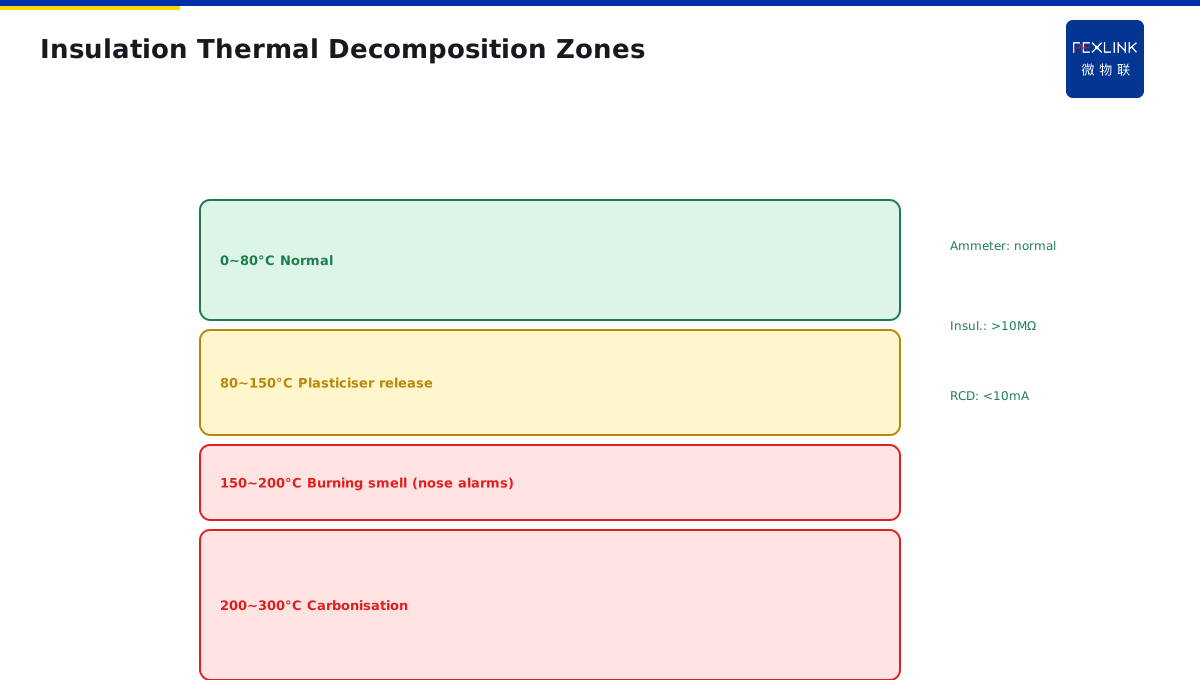
Direct Answer
An inspector smells a burning smell inside the switchgear. Voltage reads normal, current reads normal, IR shows no hotspot—this is one of the most insidious on-site hazards. The smell itself is evidence: insulation is already off-gassing visible decomposition products. This is not early stage—it is already near smoke stage.
The correct response is neither "watch it for a few more days" nor "black out the whole board for overhaul." It is three steps: use online monitoring to lock the suspect circuit, power off that one circuit and inspect every joint, then confirm whether arcing is continuing via waveform or re-ignition test.
Old boards without online monitoring degrade to: partial-supply interruption by trial, close-range IR on every joint, and listening rods for hiss—slow, error-prone and requiring power-down.
1. Why the Nose Beats the Multimeter
First understand why the nose detects fault before the instruments do.
Insulation (PVC, XLPE, epoxy) thermally decomposes under sustained heat. PVC starts releasing plasticisers and HCl at 80–100 °C, gives off acrid fumes above 150 °C, and carbonises above 200 °C. That decomposition temperature is far below ignition, and below insulation breakdown.
When you smell burning, the fault point is already at 120–180 °C. At that temperature:
- Insulation resistance may still exceed 10 MΩ—insulation monitors do not alarm;
- Circuit current may be 60–80% of rated—ammeter sees nothing;
- MCB thermal release needs 1.13× In—far away;
- RCD leakage may be under 10 mA, far below the 30 mA threshold.
All instruments nominal. The nose wins. This is the signature of a series contact arc—hidden in the blind spot of every protection, its only external signal is hot decomposition gas.
2. Step 1: Narrow Down—Which Circuit Is Arcing
A board has dozens of feeders; you cannot strip them all. Use online monitoring to narrow the range.
Boards with FA online monitoring: open the Qianzhi event list. The FA-01121-R module is wired in series on each feeder and records every arc event: time, duration in ms, high-frequency magnitude. Series contact arcs show:
- Arc events on one feeder jump from "0–1 per week" to "3–5 per day";
- Event intervals shrink (loosening progressing, contact resistance rising);
- Event duration grows (tens of ms to hundreds of ms).
Pick the feeder with the fastest rise in event frequency—that is your suspect. One park switchgear: FA logged feeder 7 (lighting) rising from 2/month to 6/day; Qianzhi auto-flagged it. O&R isolated and opened that feeder.
Old boards without online monitoring: use partial-supply interruption.
- Trip feeders one by one; after each trip, sniff whether the burning smell disappears;
- When a trip makes the smell fade, that feeder is suspect;
- Note: this affects supply—do it in off-peak hours with user notice.
Aid: close-up IR thermography. Do not scan the enclosure—open the door and scan every busbar joint, terminal block, breaker line and load-side lug. A series contact-arc hotspot is pinhead-sized (one lug cross-section); you need to be within ~10 cm to resolve it. At board distance, the hotspot is masked by uniform busbar temperature.
3. Step 2: Locate the Fault—Joints, Lugs, Flexible Connections
Once the circuit is locked, power off, test dead, apply lockout. Inspect every connection on that feeder. 90% of series contact arcs occur here:
1. Breaker line/load-side lugs. Loose screws are the most common cause. Tug each conductor; retorque in diagonal order. M6 lug screw torque is 2.5 N·m—over-torque crushes copper. Look for:
- Blackened copper strands inside the lug hole (oxidation);
- Green-blue verdigris under the screw washer;
- Brittle, cracked insulation at the jacket end.
2. Busbar joints. An oxide layer on the contact face raises contact resistance and heats the joint. Look for black powder (corrosion product); IR-check temperature on both sides of the joint—a delta over 10 °C is abnormal.
3. Flexible multi-strand leads with crimped lugs. Motors, VFDs and transformers often use flexible cords crimped to copper lugs. Poor crimp, oxidised lug or loose screw all arc between cord and lug. Check the cord root for broken strands and discolouration.
4. Pluggable connectors. Aviation plugs, plug-in breaker terminals, modular sockets—"live connections" whose contact pressure degrades with vibration and thermal cycling. Look for dull, oxidised pins; wiggle for play.
When you find the source of the burning smell, you will typically see: carbonised tracks around the lug, scorched jacket ends, blackened copper, verdigris under the screw. This is physical evidence—no need to "observe further"; process it now.
4. Step 3: Confirm Whether Arcing Continues
After retorquing and replacing damaged conductors, do not re-energise immediately. Confirm two things:
1. Insulation-resistance test. Megger L-N, L-PE, N-PE on the suspect circuit at 500 V. Insulation should exceed 10 MΩ. If still below 1 MΩ, a damaged segment remains—find and replace it.
2. Post-energisation arc events. FA continues recording. If the repair is good:
- Arc events within 24 h should be zero or near zero;
- High-frequency baseline should return to normal-load level;
- Qianzhi stays quiet.
If events continue, another loose point remains. Keep searching on that feeder.
5. A Burning Smell Must Be Treated On the Spot
A familiar on-site error: smell burning, but current and voltage are normal, so "log it and fix it at next maintenance."
That decision can be fatal.
Series contact-arc progression is not linear. It has a self-accelerating phase: contact resistance rises → heating → oxide thickens → resistance rises further → more heating → insulation carbonises → carbon layer conducts → sustained arc → fire. From "smell" to "fire" may take hours to days.
One shopping mall board: the duty manager said "fix it next week." It caught fire on the third night, burning through a wall. Forensics: a lighting-circuit lug loosened—56 hours from smell to fire.
Rule: a burning smell means same-day treatment. Do not wait for the maintenance window.
6. Without Online Monitoring
Many old boards have no FA. In that case, rely on people—but upgrade three things:
1. Move IR thermography from quarterly to monthly. Without online monitoring, IR is your eye. Track temperature trends on every joint. A joint climbing from 30 °C to 45 °C—even if still "within spec"—warrants retorque at once.
2. Keep a burning-smell inspection log. Have duty electricians sniff inside every board each shift. Log location, time and intensity immediately. Do not wait for smoke.
3. Retorque all lugs during the annual outage. The brute-force fix, but effective. The catch: annual overhaul cannot catch day-to-day loosening—which is exactly why online monitoring exists: it turns "discovered at annual overhaul" into "real-time event warning."
7. How FEXLINK Deploys on This Scenario
A standard deployment:
- FA-01121-R arc monitor in series on each feeder, below the breaker;
- EST-22920-R multi-channel temperature monitor with wireless node WB-TM-01 on busbar joints;
- FA and temperature data uploaded to Qianzhi for trend analysis;
- Arc-event frequency rise or temperature climb triggers a Taiyi work order to nearest O&R;
- O&R brings a tool kit and follows the three-step process above.
One port substation (10 kV/0.4 kV) used this stack for three years: 47 loosening-arcing events warned, all caught in their infancy, no fire.
Scope and Limitations
Applies to series contact-arc troubleshooting in 0.4 kV LV switchgear. HV, hazardous-area and DC cabinets follow dedicated rules. Temperature decomposition figures are typical for PVC/XLPE; refer to manufacturer datasheets for specific materials. FA-01121-R and EST-22920-R are FEXLINK capability references; selection follows the latest catalogue.