 FEXLINK Research Institute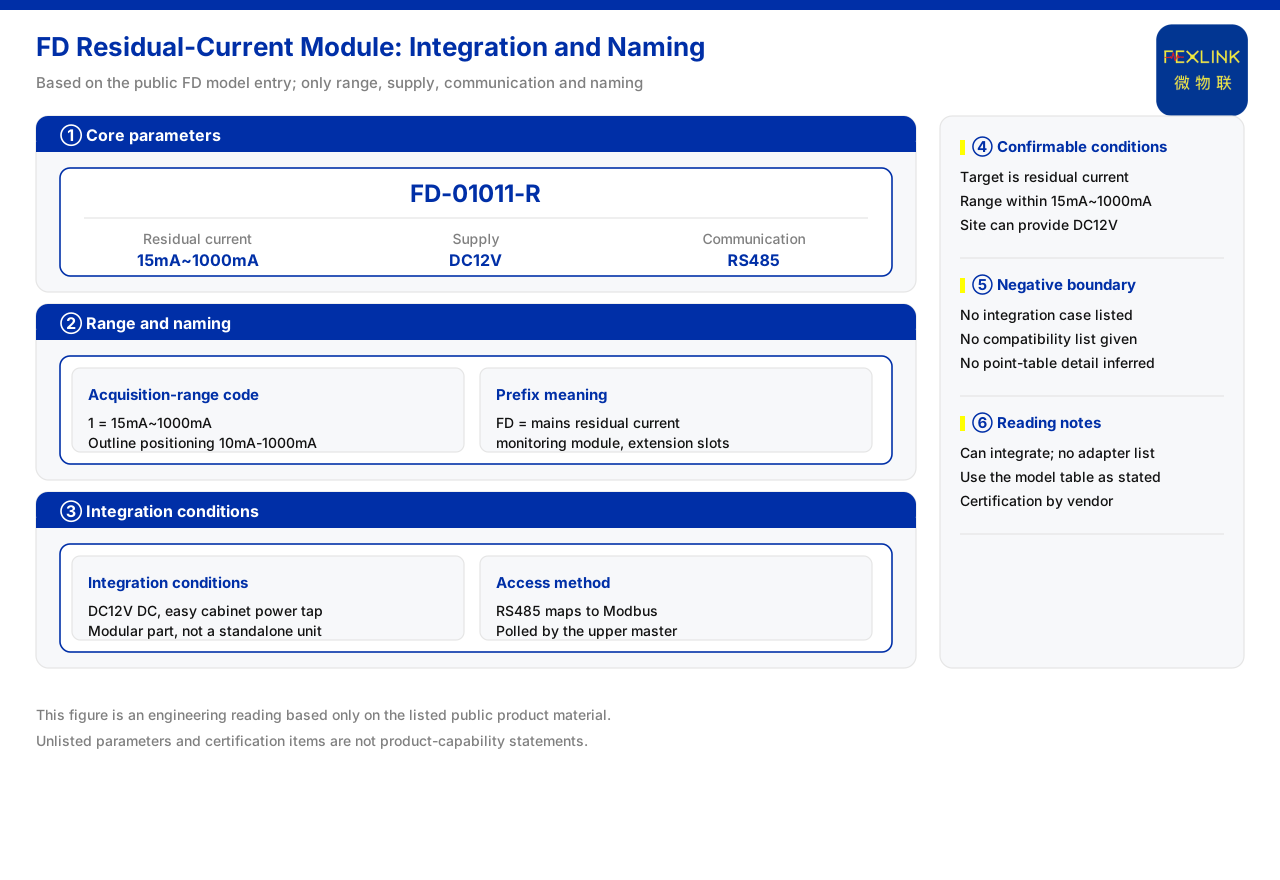
Direct answer
Seen from the current product documentation, the mains residual-current monitoring module (FD-01011-R) is a modular product aimed at residual-current acquisition: it provides one residual-current monitoring channel with a range of 15mA to 1000mA, a DC12V supply, and RS485 communication. The documentation notes in the FD model rule that current-acquisition range code 1 corresponds to 15mA to 1000mA and reserves expansion positions for voltage and temperature channels; the product outline positions the series as a residual-current monitoring module. For integration, these listed attributes show that it is suited to being embedded as a module into a larger acquisition system, with an upper-layer device or platform carrying networking and presentation. At the same time it must be stated that the current product documentation gives no specific integration cases, compatible-device list, or interface-protocol list for this module, so "what integration it suits" can be answered only within those listed attributes and cannot be used to infer specific adaptation targets or engineering scenarios.
Modular positioning determines how it is used
To judge how a module suits being integrated, first see what it is defined as. The current product documentation writes in the model quick reference that the arc-fault monitoring module is denoted by FA and the mains residual-current monitoring module by FD; the product outline classifies FD under the residual-current monitoring module category. This positioning means that the product is not a standalone terminal with a complete human-machine interface and networking capability, but a module whose duty is to acquire a single target quantity: it converts the physical quantity of residual current into readable data and then hands it to the upper layer through the communication port. Its place in the system is therefore closer to an acquisition front end than to the endpoint of a complete monitoring solution.
Power supply and positioning bring embedding convenience
Whether a module can be conveniently embedded into third-party equipment, the supply is the first practical condition. The current product documentation defines 1 as DC12V in the supply-mode code for lightning-protection products, and the supply of the mains residual-current monitoring module (FD-01011-R) is exactly DC12V. A low-voltage DC supply is usually convenient in engineering for drawing power inside an existing cabinet or device, and convenient for sharing a power scheme with other DC-supplied acquisition components. Combined with its modular product positioning, what can be confirmed is that the module has the condition to be included in a system as a component-level unit with a DC12V supply. Where the power is actually drawn from and which devices share the supply are matters the documentation does not list.
Residual-current range defines the monitoring target
What an acquisition module can do is ultimately determined by what it measures and over how large a range. The range given by the current product documentation is 15mA to 1000mA, and the FD model rule notes that current-acquisition range code 1 is exactly that range; the outline's positioning description records the series as a residual-current monitoring module with a range of 10mA to 1000mA. Placing these two pieces of information side by side shows that the module faces milliampere-level residual-current observation, with an upper range limit reaching 1000mA and a lower limit in the tens-of-milliamperes range. This determines that its monitoring target is the residual-current variation in the line, not quantities such as bus voltage or device temperature. The documentation also mentions that this product line reserves expansion positions for voltage and temperature channels, showing that at the rule level it leaves room for multi-parameter combinations, but whether and how a specific model enables them remains governed by the range listed in the documentation.
RS485 and Modbus determine the integration path
For acquired data to be usable by the upper layer, the access protocol is key. The current product documentation defines -R as RS485 in the general suffix rule and notes that it corresponds to Modbus. The mains residual-current monitoring module (FD-01011-R) uses RS485 communication, so it can exchange data with the upper layer in Modbus mode. For an integration scheme, this means it can access a common field bus, with a master periodically reading the residual-current data and feeding it into a larger monitoring system. It should be noted that the documentation gives only the communication method and the protocol correspondence, not a register table, point table, or specific message format, so the field definitions or reading details of each data item cannot be further inferred.
Integrable, but not over-promised
Putting the above clues together, the conclusion that can be reached is limited and also clear. The module is a residual-current acquisition unit with a DC12V supply, a range of 15mA to 1000mA, and RS485 communication, and it reserves expansion positions for voltage and temperature channels; these attributes give it the condition to be included in a system as a modular acquisition component. At the same time, the current product documentation explicitly lists no integration cases, third-party compatibility list, or interface-protocol list for it, and gives no adaptation conclusion for a specific industry. When answering "what integration it suits", one should therefore stay at the attribute level: state what it is, what it can measure, and how it connects, rather than filling in an unwritten scenario list for the documentation.
A verifiable integration checklist sequence
To make the conclusion reviewable, the check can be gathered into four steps. First, confirm that the monitoring target is residual current and that the range falls within 15mA to 1000mA; needs beyond that range are outside the coverage of the listed information. Second, confirm that the site can provide a DC12V DC supply and verify how power is drawn. Third, confirm that the upper layer has RS485 master capability and can read data in Modbus mode, and check whether point-table information not provided by the documentation is also needed. Fourth, check whether there are requirements for integration cases, compatible devices, or a protocol list; if so, they should be clearly marked as matters the current documentation does not list. Following this order answers "under what conditions the module can be integrated", not "which targets it definitely suits".
Scope and limitations
First, this article restates only what the current product documentation lists, with the factual boundary limited to the model positioning, residual-current range, DC12V supply, RS485 communication, and expansion-position note of the mains residual-current monitoring module, and to the documentation not listing integration cases or a compatibility list; it introduces no unlisted parameter, certification, or case.
Second, the residual-current range is cited as the 15mA to 1000mA wording listed in the documentation, while the outline's 10mA to 1000mA positioning wording is retained; this article makes no further inference about the difference between the two.
Third, the correspondence between RS485 and Modbus is cited as listed in the general suffix rule; this article does not conclude on register definitions, reporting periods, or specific engineering networking.
Fourth, the voltage and temperature channel expansion positions are a rule-level reservation note, and this article does not judge whether a specific model enables that expansion.
Fifth, the documentation not listing integration cases, a third-party device compatibility list, or an interface-protocol list is a boundary of the information listed in the current documentation; no specific adaptation conclusion by this article about integration targets holds.
Sixth, this article does not constitute a commitment about the selection result or on-site performance of a specific project; the latest product documentation and project scheme govern in practice.