 FEXLINK Research Institute
The short answer
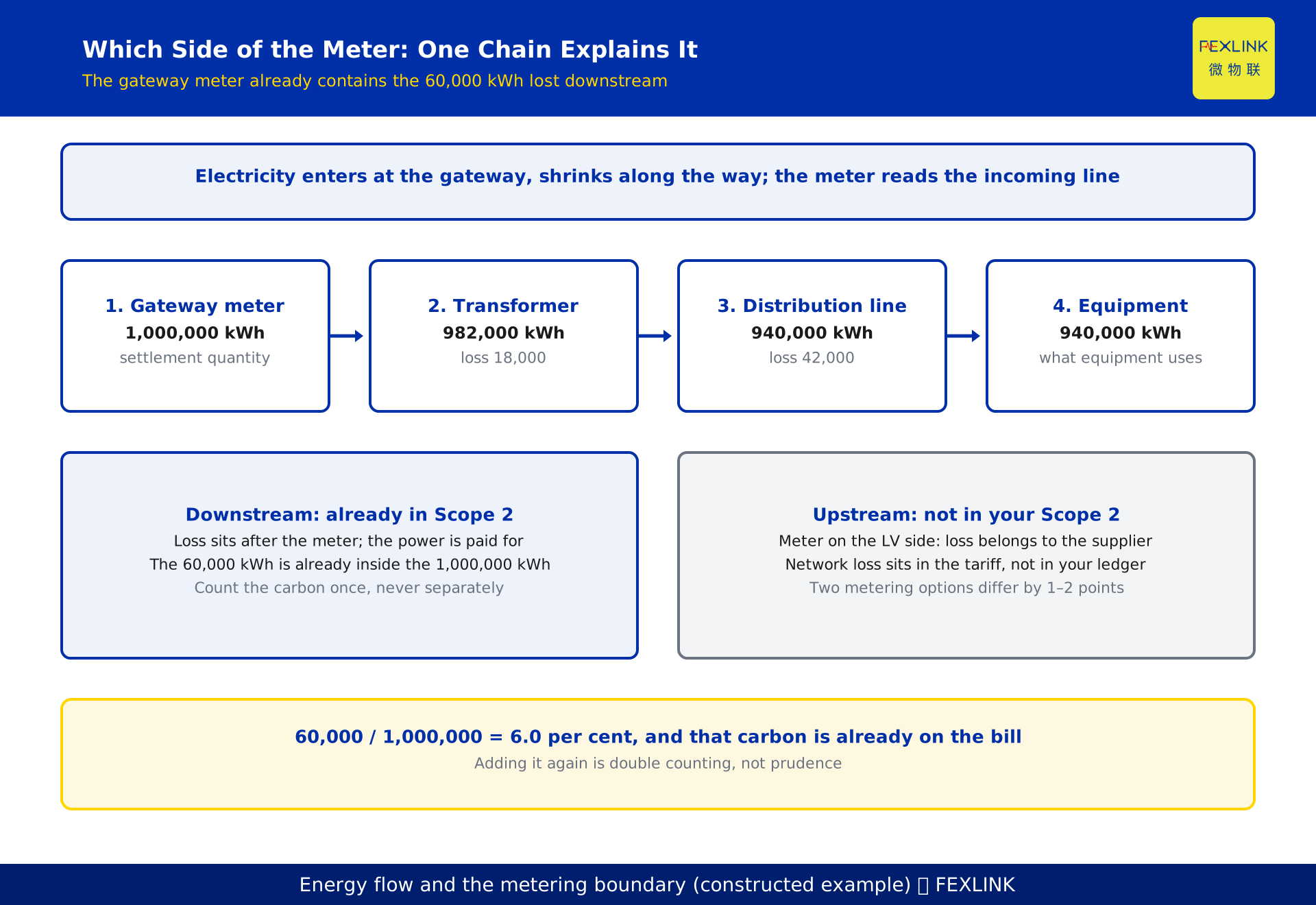
Line loss is electricity that turns into heat in the conductors on its way to your equipment. Transformer loss is electricity consumed by the core and windings. Both happen *inside* your meter: as long as the loss sits downstream of the metering point, you have already bought that electricity and paid for it — it is on your bill, and it is already in your Scope 2 figure.
So do not add it again, and you cannot add it again — a second entry is double counting. The opposite error is just as common: counting only production sub-meters makes the ledger too small and breaks reconciliation with purchased electricity. Distribution loss is not an extra parcel of carbon; it is a slice of purchased kilowatt-hours you have already paid for.
1. Two kinds of invisible electricity
No-load loss (iron loss). Alternating flux magnetises and re-magnetises the core; hysteresis and eddy currents heat it. It has nothing to do with load: once the primary is energised, the loss is there with the secondary open. Nameplate symbol: P0.
Load loss (copper loss). Current through winding resistance, plus stray loss from leakage flux in the tank and clamps. It varies with the square of current — double the load, quadruple the copper loss. Nameplate symbol: Pk, at rated load and a reference temperature; the nameplate and factory test report govern.
Line loss is simpler: I²R, current squared times conductor resistance, set by length, cross-section and material. In a four-wire system the neutral heats up too — near zero when phases are balanced, not zero when they are not.
2. One boundary decides ownership
Every argument about whether a loss "counts" ends at a question of position: where is the metering point? A customer buys electricity through a settlement meter — the gateway meter — and that meter's location is the point of ownership demarcation.
| Metering point | Transformer belongs to | Loss sits | Whose ledger it enters |
|---|---|---|---|
| High-voltage side of the transformer | The customer | Downstream of the meter | The customer, already inside purchased kWh |
| Low-voltage side (some resupply arrangements) | The supplier or reseller | Upstream of the meter | Not in the customer's purchased kWh |
The same transformer, metered on the HV or LV side, can move the ledger by one to two percentage points. Read the ownership demarcation in the supply contract and the metering wiring diagram.
Loss upstream of the meter stays out of your Scope 2 not because it is not an emission, but because it is not in your activity data. Network losses are carried by the grid company and already sit in the tariff; your Scope 2 answers only for the electricity you bought.
3. Why counting it a second time is wrong
The Scope 2 formula is one line: emissions = purchased electricity × emission factor, and the activity data has exactly one source — the settlement quantity. Once purchased kWh already contain the downstream loss, a separate loss line counts the same kilowatt-hour twice.
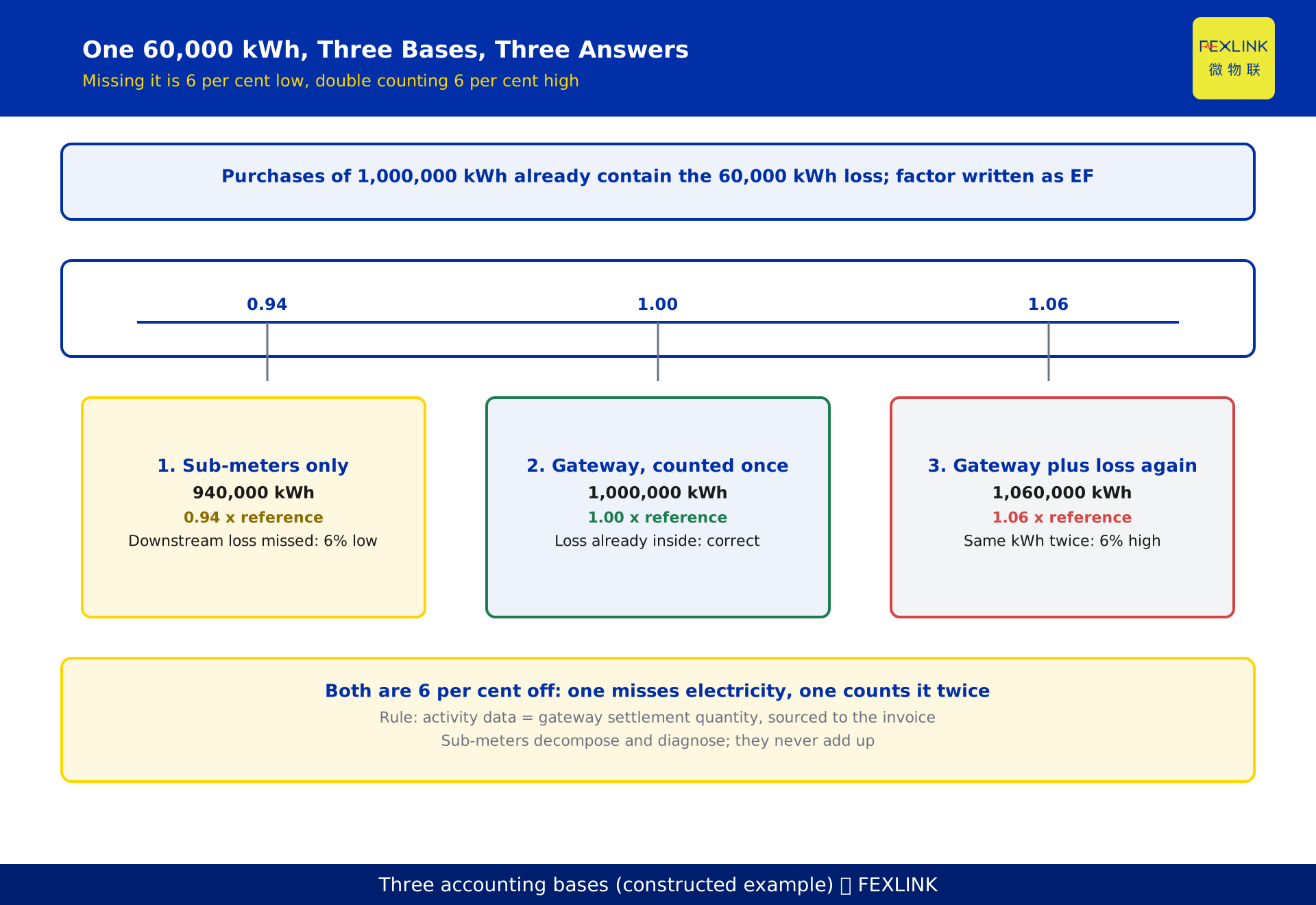
See section 8: the gateway meter reads 1,000,000 kWh and already contains 60,000 kWh of loss. The correct figure is 1,000,000 × factor; "adding back" the loss gives 1,060,000 × factor and inflates the ledger by 6%.
That 6% is not safer for being conservative. A verifier reconciles against the invoice first, and being 60,000 kWh above it with no traceable origin is a hard defect.
The opposite direction is more common. Summing only production sub-meters gives 940,000 kWh — a ledger 6% too small, plus a 60,000 kWh gap nobody can explain. Sub-meters measure what equipment used, not what you purchased; the difference is distribution loss plus lighting, HVAC and office loads.
One rule: take the gateway settlement quantity as the Scope 2 activity data, sourced to the same invoice; use sub-meters for decomposition and diagnosis, never for summation.
4. How large is the loss? A magnitude, not a standard value
In-plant distribution loss typically runs to a few per cent of purchased electricity; this article uses 6% as a reference magnitude. It is not a constant. Short runs, a sensible load factor and good power factor can put a site at 2%–3%; long feeders, a light-loaded transformer and severe phase imbalance can push past 8%.
This is an empirical range, not a mandatory value. No Chinese national standard sets a maximum line-loss rate for an industrial customer; a fixed threshold quoted as a compliance line is a grid company's performance target transplanted onto the customer side. And the grid's "comprehensive loss rate" is not your loss rate — that figure is (energy supplied − energy sold) ÷ energy supplied across the whole network, with different denominators, boundaries and responsible parties.
5. What drives the loss up: four variables
Power factor. For the same active power, a lower power factor means more current, and copper and line loss both follow the square of current. The physics of reactive power is covered in KD-0436, so only the conclusion is used here: local compensation raises the power factor, cuts conductor current, and removes I²R.
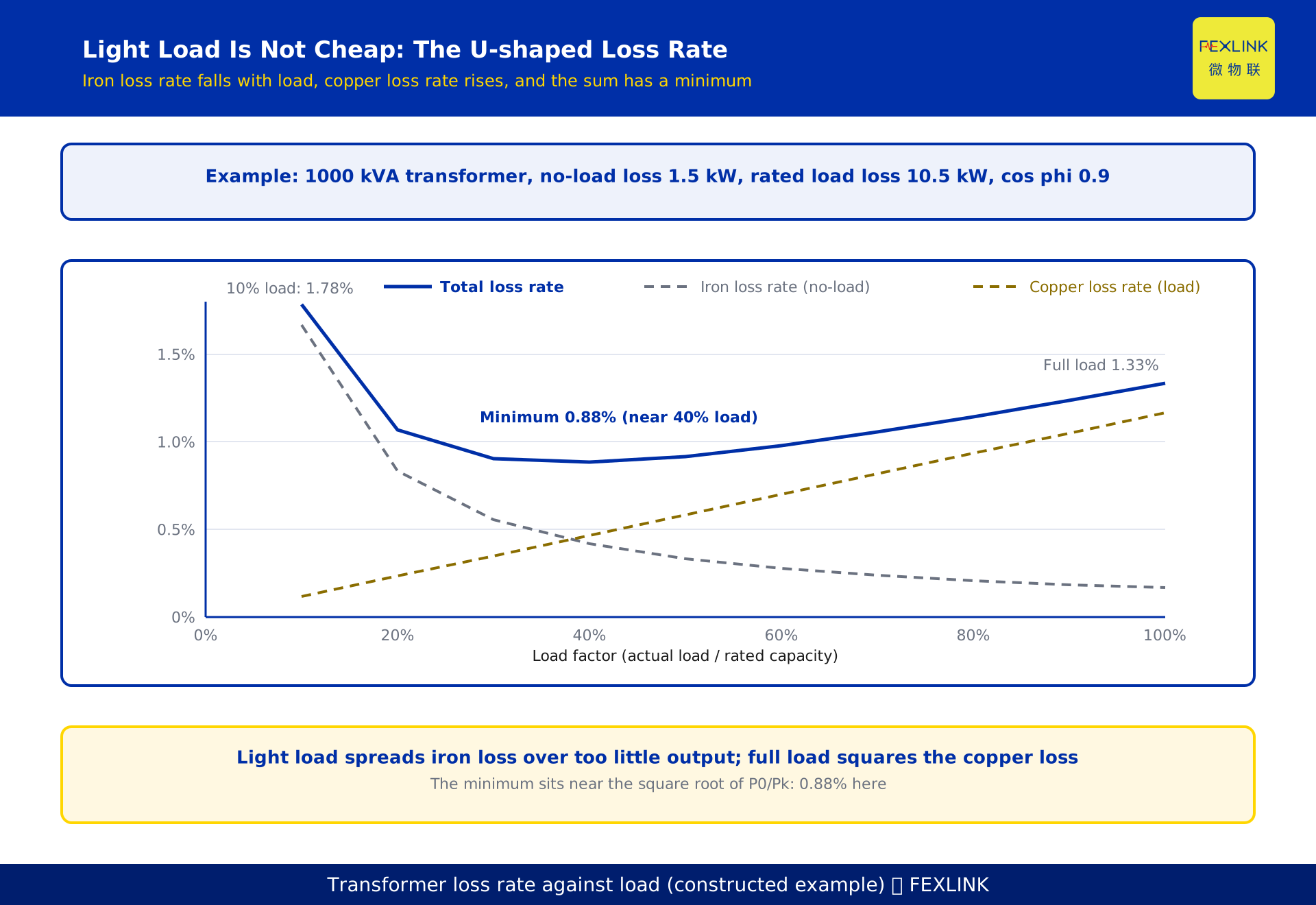
Load factor. At light load the iron loss is a constant spread over a small output, so the loss *rate* rises; at overload the copper loss climbs with the square. Both ends are expensive, and the minimum sits near √(P0/Pk), usually between 40% and 60% of rated load.
Phase imbalance. Imbalance produces negative- and zero-sequence components, current appears in the neutral, additional loss follows, and usable transformer output falls. Workshops with many single-phase loads show it most clearly.
Sizing and voltage. Undersized conductors and overlong runs raise resistance; an oversized transformer runs permanently light-loaded; a high voltage raises iron loss (roughly with the square of voltage); a low voltage raises current and with it both copper and line loss.
6. Cutting loss is cutting carbon
Every kilowatt-hour saved downstream of the meter is one not purchased, and Scope 2 falls by the associated emissions. This route needs no green power purchase and no carbon allowance.
The levers, ordered by investment: operating practice — de-energise idle transformers during shutdowns, nights and maintenance windows, and consolidate load off chronically light-loaded units; reactive compensation — compensate locally, sizing stages against the actual load curve; phase balancing — redistribute single-phase load; sizing and retrofit — match efficiency class and capacity when replacing, and fix undersized conductors and overlong routes first.
The carbon reduction is the drop in the gateway meter reading; no separate method is needed. To report it as a verifiable energy saving, the measurement and verification framework applies — see KD-0446. Where self-consumed PV sits downstream of the meter, part of the loss is fed by self-generation and carries no Scope 2 emissions: deduct self-consumption first, then apply the factor.
7. Three moves at the metering level
Make the gateway meter the primary source. Use the settlement quantity as Scope 2 activity data, with a fixed reading date, a traceable series across periods, and reconciliation to the invoice.
Decompose the loss with sub-meters. Subtract the sum of outgoing sub-meters from the incoming main meter; the difference approximates transformer loss plus busbar and line loss. Two details decide whether it is usable: both must freeze readings at the same instant, or time-shift error enters the difference; and the accuracy classes of sub-meters and current transformers must be recorded, because their errors land in that difference.
Run a balance check. If the loss rate rises by more than one percentage point at the same load level, investigate: metering wiring, CT ratio settings, unmetered branches, a reactive step, severe imbalance. The same check doubles as an electrical-safety and metering-accuracy inspection.
Gateway and branch circuits can be covered by the ESA all-factor smart meter (ESA-22111-R to ESA-22161-R, 3×220/380V, RS485 Modbus), with synchronised freezing and per-circuit statistics; phase imbalance and neutral current are watched by the ESB three-phase imbalance monitor. Feeding an electricity-carbon system keeps energy and emissions on one source, and the same data starts a distribution-loss investigation in an energy-saving diagnosis.
8. A worked example
The figures below are constructed to illustrate the accounting basis and represent no real customer.
Find the gap. A plant's gateway meter reads 1,000,000 kWh for the year and matches the invoice; its production sub-meters total 940,000 kWh, and the ledger had been built on that sum. The gap is 1,000,000 − 940,000 = 60,000 kWh, or 6.0% of purchases. Circuit-level measurement splits it into 18,000 kWh of transformer loss (1.8%) and 42,000 kWh of line loss (4.2%); the rest is lighting, HVAC and office load.
Compare. Writing the emission factor as EF (taken from the factor published or applicable in the local jurisdiction; no numeric value asserted):
| Basis | Activity data | Relative to correct | Problem |
|---|---|---|---|
| Production sub-meters only | 940,000 kWh | 0.94 | Omits downstream loss and auxiliary load |
| Gateway meter, counted once | 1,000,000 kWh | 1.00 | Correct |
| Gateway meter plus loss again | 1,060,000 kWh | 1.06 | Same kWh counted twice |
Both wrong bases are off by 6%, but not in the same way: one misses electricity, the other counts it twice. Missing it breaks reconciliation with the energy ledger; double counting leaves a gap that cannot be explained at verification.
Make the loss manageable. Left inside "other", 60,000 kWh is nobody's job. Split into 18,000 kWh of transformer loss and 42,000 kWh of line loss, it produces actions: load factor and idle hours for the transformer, power factor, phase balance and conductor cross-section for the lines.
FAQ
Q: Should the loss appear as a separate line in Scope 2?
No. Scope 2 has one activity line: purchased electricity. Loss can be tracked as a management indicator, but the emissions cannot be added separately.
Q: We are HV metered and own the transformer. Whose loss is it?
Yours, and already inside the purchased quantity. HV metering puts the metering point on the primary side, so the loss occurs downstream of the meter. That explains why "equipment consumption plus loss" exceeds the sum of sub-meters: the sub-meters sit downstream of the loss.
Q: What about a leased building or a resupply arrangement?
Use your settlement meter. What you pay the reseller already contains the loss, and it enters Scope 2 once. A markup is a pricing matter and does not change the emissions basis. Confirm only which side of the transformer your meter sits on.
Q: With rooftop PV, how is the carbon in the loss treated?
Deduct first, then multiply. Self-consumed generation is deducted from purchases, and the remainder is multiplied by the factor; loss fed by self-generation carries no Scope 2 emissions, and exports do not offset purchases.
Q: Sub-meters total 8% below the main meter. Is someone stealing power?
Rule out three things first: readings taken at the same instant, a mis-set CT ratio, adequate sub-meter accuracy. Much of an 8% gap is usually normal distribution loss and auxiliary load. What deserves attention is a loss rate that suddenly rises at the same load level — a change, not a level.
Q: What loss rate counts as abnormal?
No national red line. Test against yourself: at the same load band and season, a rate more than one percentage point above your own baseline is worth investigating. Cross-company comparison is of limited value, since voltage level, feeder length and load characteristics differ.
Scope and limitations
- The article follows the accounting framework of GB/T 32150, Greenhouse gases emissions accounting and reporting requirements for industrial enterprises. The current edition is the 2025 version (issued 2025-12-31, effective 2026-07-01, replacing the 2015 version); clause text is governed by the version in force, and no clause numbers are cited.
- All electricity figures (gateway 1,000,000 kWh, transformer loss 18,000 kWh, line loss 42,000 kWh, equipment consumption 940,000 kWh, loss share 6.0%) and transformer parameters (1000 kVA, no-load loss 1.5 kW, rated load loss 10.5 kW) are constructed to illustrate the basis. They represent no real customer and no specific product's factory data.
- The loss share is an empirical magnitude (a few per cent; 6% used here), varying with voltage level, load characteristics, feeder length and power factor. No Chinese national standard sets a mandatory ceiling on a customer's line-loss or transformer-loss rate; a grid company's comprehensive loss rate is a network-side indicator, not a customer benchmark.
- EF is used only as a symbol, with no numeric value asserted; take the factor published or applicable in the enterprise's jurisdiction and state its source and year.
- This article addresses how loss electricity is treated in the carbon ledger. The physics of reactive power and reactive-power tariff adjustments are covered in KD-0436; baseline adjustment and measurement and verification of energy savings in KD-0446. Carbon reduction verification, green power and certificate offsetting, allowance compliance and resupply pricing are outside scope.
- Product side: model range, electrical parameters and communication interfaces of the ESA all-factor smart meter, and the functional scope of the ESB three-phase imbalance monitor, follow the latest selection manual and product knowledge base; range, circuit count, supply method and communication method are configurable. Electricity-carbon system functions follow the current version documentation.
Frequently Asked Questions
Should the loss appear as a separate line in Scope 2?
No. Scope 2 has one activity line: purchased electricity. Loss can be tracked as a management indicator, but the emissions cannot be added separately.
We are HV metered and own the transformer. Whose loss is it?
Yours, and already inside the purchased quantity. HV metering puts the metering point on the primary side, so the loss occurs downstream of the meter. That explains why "equipment consumption plus loss" exceeds the sum of sub-meters: the sub-meters sit downstream of the loss.
What about a leased building or a resupply arrangement?
Use your settlement meter. What you pay the reseller already contains the loss, and it enters Scope 2 once. A markup is a pricing matter and does not change the emissions basis. Confirm only which side of the transformer your meter sits on.
With rooftop PV, how is the carbon in the loss treated?
Deduct first, then multiply. Self-consumed generation is deducted from purchases, and the remainder is multiplied by the factor; loss fed by self-generation carries no Scope 2 emissions, and exports do not offset purchases.
Sub-meters total 8% below the main meter. Is someone stealing power?
Rule out three things first: readings taken at the same instant, a mis-set CT ratio, adequate sub-meter accuracy. Much of an 8% gap is usually normal distribution loss and auxiliary load. What deserves attention is a loss rate that suddenly rises at the same load level — a change, not a level.
What loss rate counts as abnormal?
No national red line. Test against yourself: at the same load band and season, a rate more than one percentage point above your own baseline is worth investigating. Cross-company comparison is of limited value, since voltage level, feeder length and load characteristics differ.