 FEXLINK Research Institute
Direct Answer
Should the basic charge be paid by transformer capacity or by maximum demand? The judgment basis is the ratio of the actual maximum demand to the transformer capacity (the load factor) — when the average load factor is high (the demand is close to the capacity), billing by capacity is cheaper; when the transformer is lightly loaded for a long time (low load factor), switching to demand saves more; before the change, you must calculate a full billing cycle with historical load data, and then decide.
A scenario: A company has always paid the basic charge by capacity — it has never calculated whether demand would be cheaper — it does not know the change conditions and risks — it overpays every month without knowing. The logic is that the two billing methods are not "about the same" — with different load factors, the monthly amount differs a lot — use one ratio for a rough judgment, then calculate precisely with historical data, and you know whether to switch.
1. The Cost-Formula Comparison of the Two Billing Methods
Billing by capacity — the capacity cost: transformer capacity (kVA) times the capacity price; Billing by demand — the demand cost: the month's maximum demand (kW) times the demand price; The difference between the two prices — different unit prices: the demand price is usually about 1.2-1.4 times the capacity price; The decisive quantity of the cost — capacity is fixed and demand floats: capacity is set, demand follows the month's peak.
In one sentence: by capacity = capacity x capacity price (fixed); by demand = demand x demand price (follows the peak).
The reference range of the price difference — the demand price is usually about 1.2-1.4 times the capacity price: it varies by region, subject to the local catalog price — the larger the unit-price difference, the more carefully the ratio must be calculated — the critical point of the ratio changes with the price ratio.
An example: A company has 2000 kVA capacity and a monthly maximum demand of 1200 kW: the capacity price is 23 yuan and the demand price 32 yuan — by capacity 46,000 yuan, by demand 38,400 yuan — demand saves 7,600 yuan. The logic is that "demand is not always cheaper" — the demand price is higher, and only when the demand is low enough is it worth it — the ratio is the key — the smaller the demand/capacity, the more demand saves.
2. The Key Ratio: the Load Factor (Demand/Capacity)
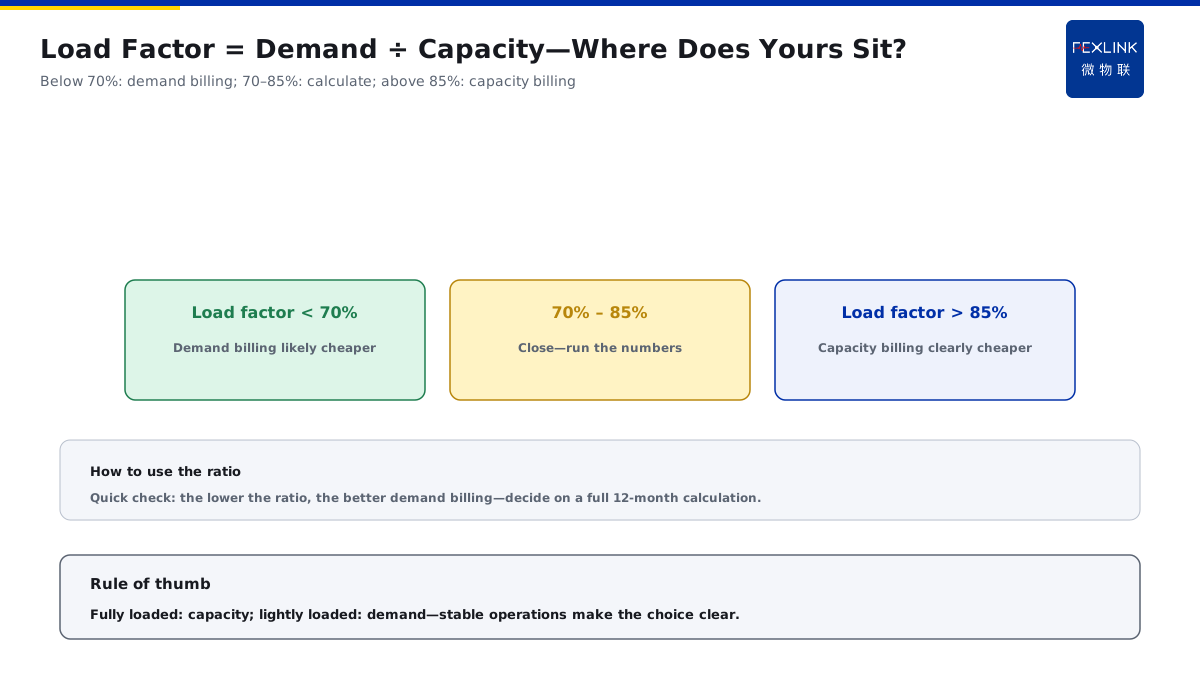
The definition of the ratio — the load factor: the monthly maximum demand divided by the transformer capacity; The meaning of the ratio — the utilization: how much of the transformer capacity is used; The critical interval — a rough reference: at a load factor of 70%-85%, the two methods are close in amount; The use of the ratio — a rough judgment first: below the critical interval, demand is likely cheaper.
In one sentence: the load factor is demand divided by capacity — the lower it is, the more demand saves.
The reference of load-factor grading — above 85%: capacity is clearly cheaper; 70%-85%: the two are close and precise calculation decides; below 70%: demand is probably cheaper — the grading is a rough judgment and the formal decision is based on the annual calculation.
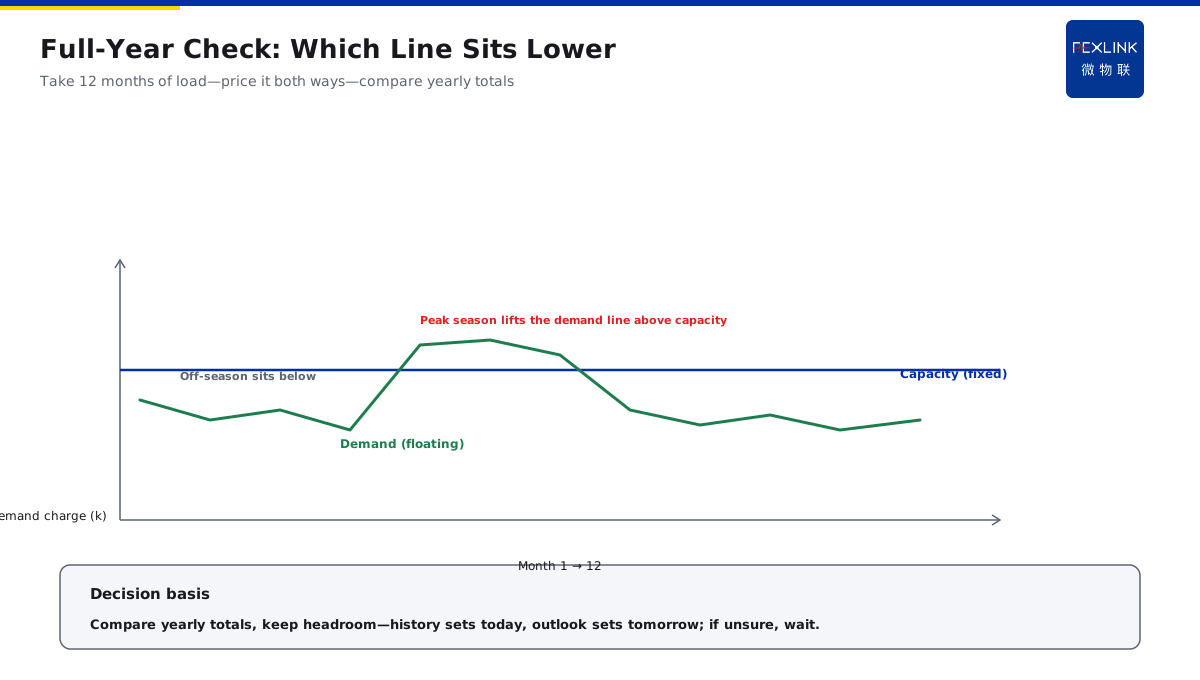
An example: A company in two periods: in period one the load factor is 90% and capacity saves; in period two it is 60% and demand saves. The logic is that the same company changes its optimal method when the load factor changes — the production valley has a low load factor and the peak season a high one — demand is cheaper in the valley and may be more expensive in the peak — judge by the full year.
3. The Choice of High-Load-Factor vs Low-Load-Factor Users
High-load-factor users — the demand is close to the capacity: capacity is cheaper, because the demand price is higher; Low-load-factor users — the demand is far below the capacity: demand is cheaper, because it is billed by actual occupation; Middle-load-factor users — the two are close: precise calculation decides, with dynamic evaluation; The memory phrase — full use chooses capacity, partial use chooses demand.
In one sentence: when the demand approaches the capacity, capacity saves; when the demand is far below, demand saves — the middle calculates precisely.
The judgment table of the choice scenarios:
| Scenario | Load factor | Cheaper method |
|---|---|---|
| Three-shift continuous production | High | By capacity |
| Single-shift intermittent production | Low | By demand |
| Seasonal production | Fluctuating | By annual calculation |
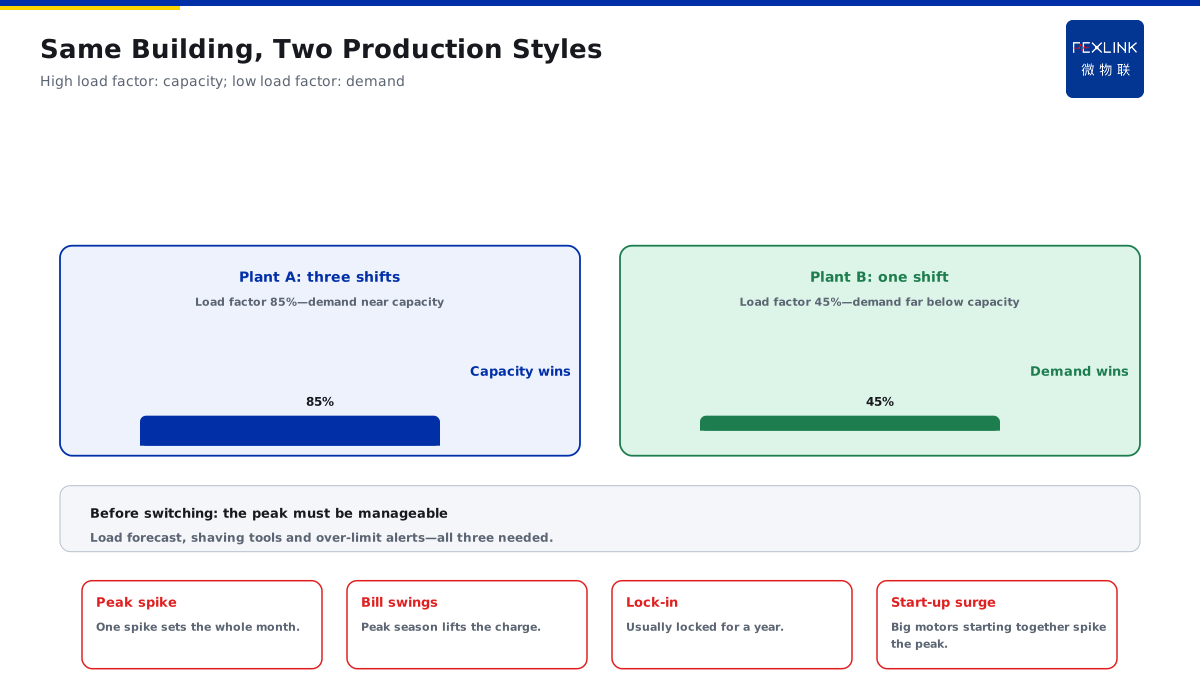
An example: A park: factory A runs three shifts with a load factor of 85% and capacity saves; factory B runs a single shift with a load factor of 45% and demand saves. Another example: A company switches to demand for a year — because it deployed E-06 prediction and storage peak shaving in advance — the peak is controlled — it saves 12% against capacity for the year. The logic is that the choice of the billing method is essentially "betting on your peak" — a high peak chooses capacity and a low peak chooses demand — the more stable the production, the clearer the choice. And the saving of demand is not free — once the peak is managed, the demand charge really falls — without peak management, demand is more expensive — with prediction and shaving ability, you can choose demand.
4. The Risk of Switching to Demand: Peak Surge
Risk one, a peak surge raises the charge — one high peak in a month is billed for the whole month; Risk two, the bill fluctuates sharply — a high peak-season demand raises the basic charge; Risk three, a binding period after the change — usually cannot be changed repeatedly within a year; Risk four, the start impact of large equipment — large motors starting together raise the peak instantly.
In one sentence: the risks of demand are the peak surge, bill fluctuation, the binding period and the start impact.
The main sources of a peak surge — concentrated commissioning: multiple devices tested at the same time; start impact: large motors starting together; misoperation: equipment started simultaneously off-plan; extreme weather: air-conditioning load stacking — check the four sources before switching to demand.
An example: After a company switches to demand, a large device is commissioned in a concentrated way in one month and the peak soars — the monthly basic charge is higher than by capacity. The logic is that the saving of demand is built on "controllable peaks" — when the peak loses control, the saving becomes an overpay — before switching, confirm the peak-management ability — without scheduling and storage, do not switch easily.
The self-check of peak-management ability — is there load prediction: can the peak window be foreseen; is there a shaving means: are storage and scheduling available; is there an over-limit warning: can it remind when the peak approaches — with the three abilities, you are qualified to switch to demand.**
5. The Method of Calculating with Historical Data before the Change
Step one, take the historical load data — at least 12 months: the monthly maximum demand and capacity; Step two, calculate the two methods month by month — bill separately: once by capacity and once by demand; Step three, compare the annual totals — choose the lower total: the annual view, not a single month; Step four, leave a peak margin — consider the extreme: predict the future peak change, then decide.
In one sentence: the five calculation steps are taking data, calculating two amounts, comparing the year, leaving a margin and then changing.
The basis to note in the calculation — the demand takes the "actual maximum demand": the monthly maximum automatically recorded by the meter; the capacity takes the "installed capacity": the transformer capacity agreed in the contract; the price takes the current local catalog price — with the wrong basis, the calculation result is distorted.
The flow of the change application (reference) — submit an application to the supply company: state the reason; provide the calculation basis: the historical load data; confirm the effective time: usually the next month; note the binding period: generally not changeable within a year after the change — the four steps, subject to the local rules.
An example: A company calculates with 12 months of data: demand saves 84,000 yuan a year — but expansion next year will add load — it evaluates and postpones the change, and calculates again after the expansion. The logic is that the change decision uses the "history + expectation" dual view — history decides the present and expectation the future — leave a margin for the peak and calculate conservatively — if it is not certain, do not switch yet.
Back to the TIANYAN engine E-06 match — the TIANYAN E-06 (very-short-term load prediction) predicts the load curve for the next few hours in advance — identifies the peak window and warns in advance — the enterprise staggers production or discharges storage to press down the monthly maximum demand — billing by demand becomes steadier and cheaper — the change decision moves from "betting on the peak" to "managing the peak".
By capacity or by demand, first look at the load factor — a low demand/capacity ratio favors demand — a high load factor chooses capacity and a low one chooses demand — before switching to demand, manage the peak first — calculate with 12 months of historical data and leave a future margin — the TIANYAN E-06 predicts the peak in advance and storage discharges off-peak — with the right billing method, a fixed amount saves every month.
Scope and Limitations
- The conclusions in this article are intended for LV distribution and electrical-safety sites. Criteria are compiled from public codes and FEXLINK product documentation, and product parameters follow the latest selection handbook and product knowledge base.
- Quantitative criteria (protection zone, discharge and residual voltage, earth resistance, thresholds and grading) hold under the preconditions stated in this article. Where the site voltage level, earthing arrangement, environmental category or load profile differs, the figures must be recalculated. Specific configurations involving Tianyan engine E-06(very-short-term load forecast) should be verified against actual circuit parameters.
- Specific product models and parameters are subject to the latest selection handbook and product knowledge base; this article does not constitute selection or procurement advice.
- Standard numbers cited here refer to the currently effective editions; when a standard is revised, the related quantitative conclusions must be re-checked.
- Deployment and implementation for specific projects must be carried out by qualified engineers based on site survey and design drawings.
Frequently Asked Questions
Pay the Basic Charge by Transformer Capacity or by
The judgment basis is the ratio of the actual maximum demand to the transformer capacity (the load factor) — when the average load factor is high (the