 FEXLINK Research Institute
Direct Answer
The TOU shifting or the demand management: which one moves the needle on the factory bill? The structure first and the direction after — with the two-part tariff, the factory with the demand charge big starts with the demand management; the energy charge big then the TOU shifting — the price gap big and the load movable, the shifting; the demand charge big and the peak concentrated, the shedding — the bigger account first — the blind, the small saving.
A scenario: The bill not down — the equipment manager the storage — the investment in, the annual small. The logic is that the bill structure first — the energy and the demand — the structure unclear, the direction wrong. An analogy — The bill two legs: the energy the distance and the demand the width — the thick the width, the long the distance — the thicker first.
1. The Two-Part Tariff: Two Legs
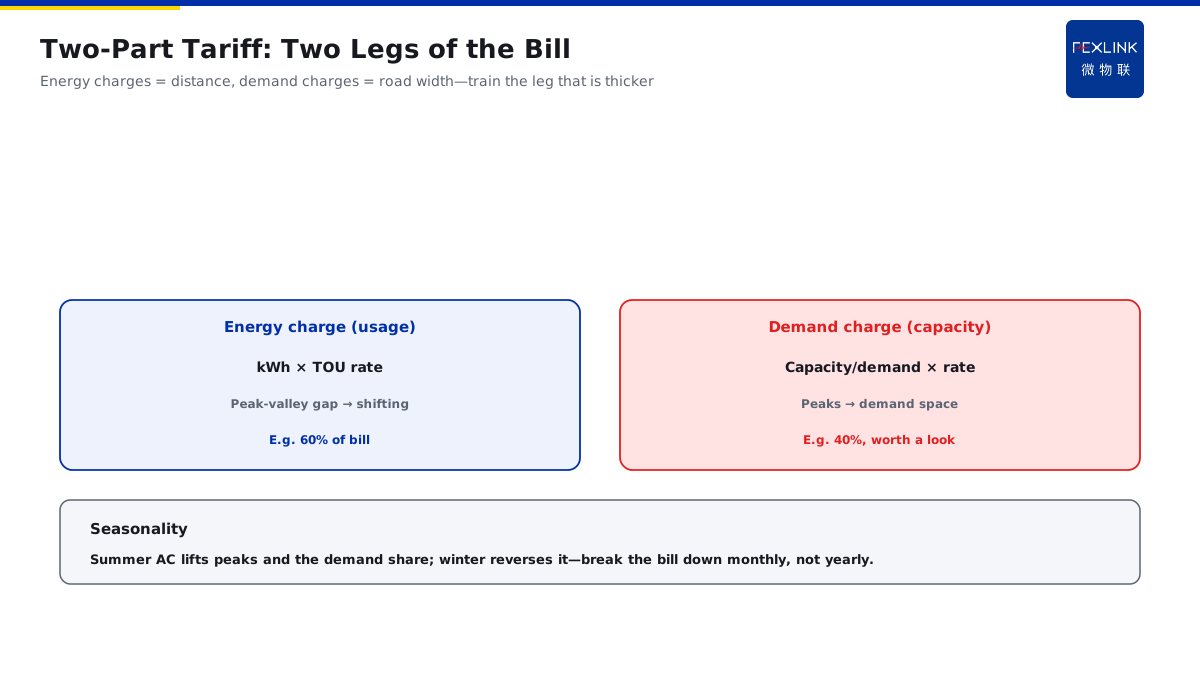
The energy charge — by the usage: the peak, the flat and the valley — the usage paid; The demand charge — by the capacity or the demand: with or without the use — the small use also paid; The share — by the industry and the load: the continuous the demand big, the office the energy big; The structure first — the big first, the direction.
In one sentence: the two-part = the energy (how much) + the demand (how wide) — the structure first, the direction.
The table:
| Item | Formula | Feature |
|---|---|---|
| Energy | Use × TOU price | Shifting |
| Demand | Capacity/demand × price | Use-free |
The season — the summer air: the peak up and the demand bigger — the monthly, not the yearly.
The breakdown — the monthly the seasonal: the air conditioning, the heating and the production — the monthly shares — the direction per month, the accurate.
The logic behind — the demand charge the "one peak the month": the monthly the seasonal and the production — the summer the air and the winter the heating — the season the peak, the target.
An example — The 500k: 300k (60%) and 200k (40%) — the 40%, the demand first. The logic is that the two-part is "two legs" — the structure unclear, the direction wrong — the share first.
2. The Price Gap and the TOU Shifting
The gap — the peak and the valley: the larger, the shifting value; The shifting — the peak to the valley: the scheduling, the storage and the shifting; The saving — the energy charge: the more at the valley, the less at the peak; The boundary — the movable only: the fixed, the no value.
In one sentence: the shifting saves "the energy charge" — the gap and the movable — the fixed, the wasted.
The table:
| Condition | Value |
|---|---|
| Gap large (3:1+) | High |
| Load movable | High |
| Gap small | Low |
| Load fixed | Zero |
The reality — the storage expensive and the life limited: the gap enough — the free first: the scheduling.
The storage case — the price gap 3:1 or more: the charging at the valley and the discharging at the peak — the cycle daily — the gap, the economics. An example — The 0.6 gap and the 200k movable — 120k monthly — the movable only.
The feasibility — the process first: the batch the movable and the line the fixed — the audit, the movable confirmed.
The audit result — the schedule the batch to the valley and the storage for the rest — the energy charge down — the confirmed, the plan.
The logic is that the shifting is "the gap × the movable" — the small or the fixed, the zero — the movable confirmed first.
3. The Demand Charge and the Management
The demand — the monthly peak: the simultaneous — the higher, the charge higher; The management — the shedding: the staggered start, the rotation and the limit — the peak down; The saving — the demand charge: 8000 to 7000, the difference saved; The feature — "one peak the month": the single high, the month by the peak — the peak guarded, the money kept.
In one sentence: the management saves "the demand charge" — the single peak the month — the shedding, the charge down.
The table:
| Scene | Charge |
|---|---|
| Peak 8000 kVA | By 8000 |
| To 7000 kVA | By 7000 |
| Occasional high | The month by it |
An example — The 8000 and the 40 yuan: 320k — to 7000, 40k saved.
The peak finding — the demand profile daily: the peak moment, the peak cause and the offender — the profile, the target clear.
The control after — the stagger and the limit: the peak down — the demand charge down — the loop, the continuous.
The logic is that the demand is "the peak pricing" — one high, the month — the shedding the peak, not the usage.
4. The Investment and the Payback
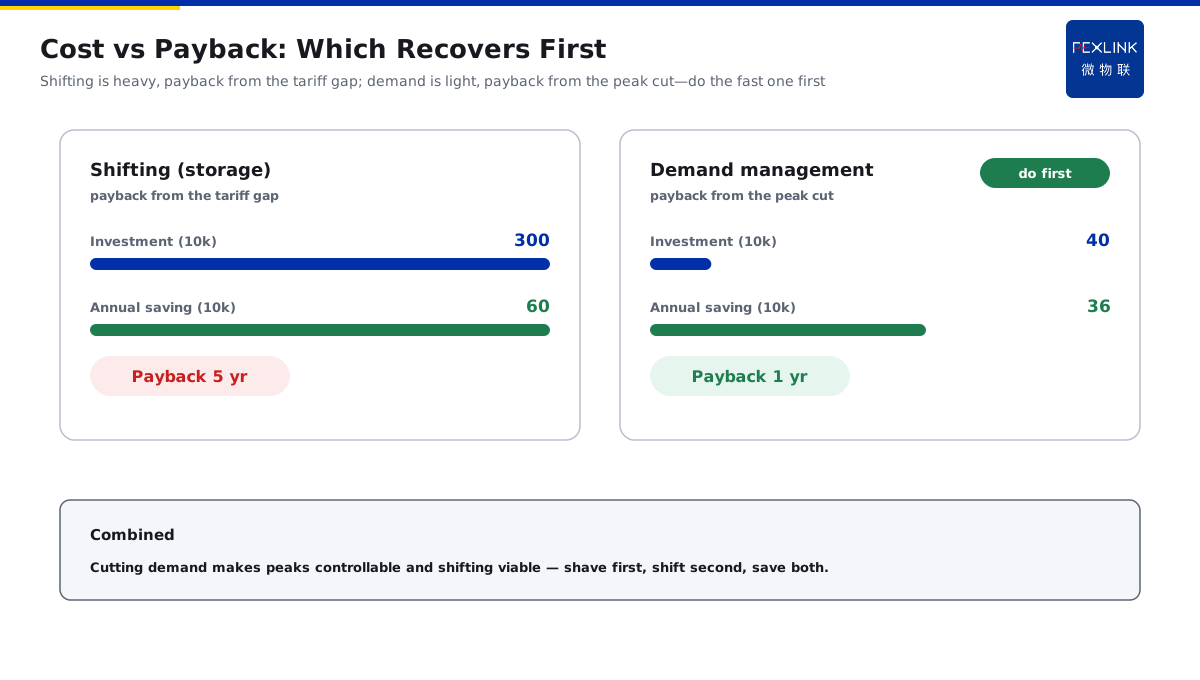
The shifting — the storage or the automation: the battery and the retrofit — the large; The shifting payback — the gap and the movable: the large, the fast; The management — the metering and the control: the sub-metering and the prediction — the medium; The management payback — the peak room: the larger, the faster.
In one sentence: the shifting the large and the gap; the management the medium and the peak — the payback first, the money after.
The table:
| Item | Shifting | Demand |
|---|---|---|
| Investment | Storage/auto | Meter+control |
| Level | Large | Medium |
| Source | The gap | The peak |
| Payback | The gap | The peak room |
The combination — the peak down, the shifting room out — the shedding then the shifting — both saved.
The order — the free first: the scheduling and the rotation — the paid after: the storage — the ROI the gate.
The planning — the peak by the forecast: the weather and the production — the scheduling ahead — the proactive, the peak avoided.
The intelligence — the forecast the next 15 minutes: the peak warning — the load shifted — the automation, the peak impossible.
An example — The 3,000k and the 600k (5 years); the 400k and the 360k (1 year) — the demand first. The logic is that the payback first — the large not always the more — the fast first.
The guard — the demand charge the peak once the month — the investment the monthly check — the guard, the risk low.
5. The Decision Tree
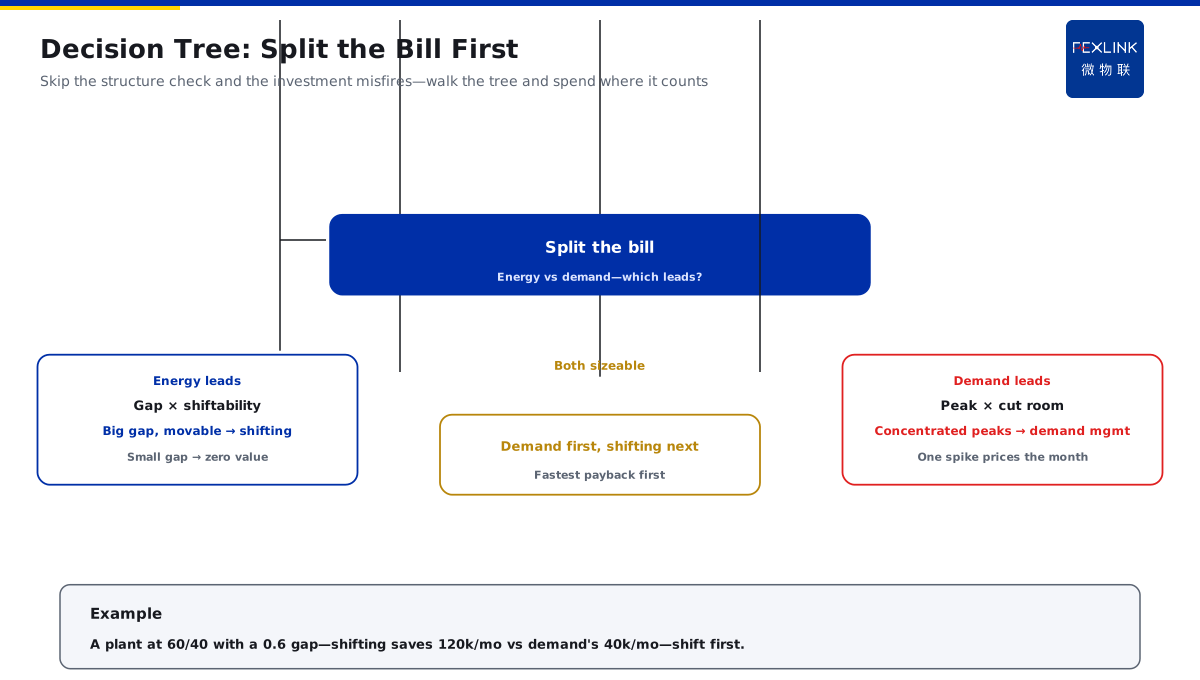
Step 1 — the bill split: the shares — the big first; Step 2 — the energy big: the gap and the movable — the shifting; Step 3 — the demand big: the peak and the room — the management; Step 4 — both: the fast first, the large after — the ordered.
In one sentence: the split → the conditions → the order — the big first, the fast first.
The table:
| Structure | Priority |
|---|---|
| Energy big + gap | The shifting |
| Demand big + peak | The management |
| Both | The demand, then the shifting |
An example — The 60% and the 0.6 gap: the shifting 120k and the demand 40k — the shifting first.
The verification — after the investment, the monthly bill compared: the shift, the demand and the total — the verified, the adjusted.
The reporting — the management the monthly numbers: the shift saving, the demand saving and the total — the board the report — the value visible.
The logic is that the tree is "the account first" — the structure without the conditions, the biased — by the tree, the edge.
Back to the ESA family — the landing: the ESA for the sub-metering and the demand, the Tianyan E-06 for the forecast and the supervision for the closed loop — from the bill to the shedding, one line.
The entry — the sub-metering the structure first: the energy and the demand split — the data the decision — the three products, the one flow.
Scope and Limitations
- The conclusions in this article are intended for LV distribution and electrical-safety sites. Criteria are compiled from public codes and FEXLINK product documentation, and product parameters follow the latest selection handbook and product knowledge base.
- Quantitative criteria (protection zone, discharge and residual voltage, earth resistance, thresholds and grading) hold under the preconditions stated in this article. Where the site voltage level, earthing arrangement, environmental category or load profile differs, the figures must be recalculated. Specific configurations involving ESA all-element smart meter, Tianyan E-06 (very-short-term load forecast) should be verified against actual circuit parameters.
- Specific product models and parameters are subject to the latest selection handbook and product knowledge base; this article does not constitute selection or procurement advice.
- Standard numbers cited here refer to the currently effective editions; when a standard is revised, the related quantitative conclusions must be re-checked.
- Deployment and implementation for specific projects must be carried out by qualified engineers based on site survey and design drawings.
Frequently Asked Questions
TOU Shifting vs. Demand Management: Which One Moves the Needle on Your Factory Bill?
The TOU shifting or the demand management: which one moves the needle on the factory bill