 FEXLINK Research Institute
Direct Answer
For automatic demand control, which device should you choose — a relay that switches off loads or an energy-storage system that offsets the peak? It depends on load interruptibility: for interruptible load choose the relay-based demand control (small investment, quick payback, suitable for textiles, injection molding, heat treatment); for uninterruptible load or high continuity requirements choose energy storage (no production-stop risk, suitable for precision manufacturing and continuous chemical processes) — the two routes can be combined: first switch off the interruptible load with the relay, then press the remaining peak with storage.
A scenario: A company's demand always exceeds the limit and the basic charge is high — it wants automatic demand control — someone says use a relay to switch off the load, someone says install storage — it does not know which to choose. The logic is that demand control is not an "either-or" — the relay route relies on "switching" and the storage route on "offsetting" — interruptible load can be switched and uninterruptible load can only be offset — classify the load first, then choose the device.
1. The Principle and Applicable Scenes of the Relay-Based Load-Switching Device
The principle — when the monitored demand approaches the threshold, it automatically switches off the interruptible load: in the preset priority order; The applicable load — interruptible production load: injection molding machines, heating furnaces, mixers and auxiliary fans; The advantage — small investment and fast response: controlled by circuit, no large new equipment needed; The limitation — switching off has a production cost: cutting too much affects output and the core process cannot be switched.
In one sentence: the relay device relies on "switching" — suitable for interruptible load, small investment and quick effect, but with a production-stop cost.
The priority-setting principles — switch auxiliary before process: auxiliary equipment first and the core process last; switch single machines before whole lines: single equipment first and the line last; switch low-value before high-value output: ordered by output value — the three principles keep the load switching from hurting the output.
An example: A company connects auxiliary fans and heating furnaces to the demand control — when the demand exceeds the threshold, they are switched automatically by priority — the monthly maximum demand falls 8%. The logic is that the relay device switches "interruptible load" — what is cut is the auxiliary equipment, not the core process — the more interruptible load, the bigger the demand-control space.
2. The Principle and Applicable Scenes of Energy Storage
The principle — storage discharges at the demand peak to hold the load: charges in the valley and discharges at the peak; The applicable load — uninterruptible load or high continuity requirements: precision manufacturing, continuous chemical processes and data centers; The advantage — no production-stop risk: the load is not cut, and the power gap is filled by storage; The limitation — large investment and footprint: the battery system is costly and needs operation, maintenance and life management.
In one sentence: storage relies on "offsetting" — suitable for uninterruptible load, no production-stop risk, but with a large investment.
The economy judgment of storage demand control — is the discharge power enough: whether the demand gap is within the storage power range; is the discharge duration enough: whether the sharp period is within the storage duration; is the price difference enough: whether the charge/discharge spread covers the battery degradation — the three judgments decide whether the storage investment is worth it.
An example: A precision manufacturer installs storage — storage discharges at the peak and presses the demand peak — the monthly maximum demand falls 12% and the basic charge saves 30,000 yuan. The logic is that storage offsets "load that cannot be cut" — the load runs as usual and the gap is filled by storage — the more uninterruptible the load, the more necessary the storage.
3. The Key Comparison of the Two Routes
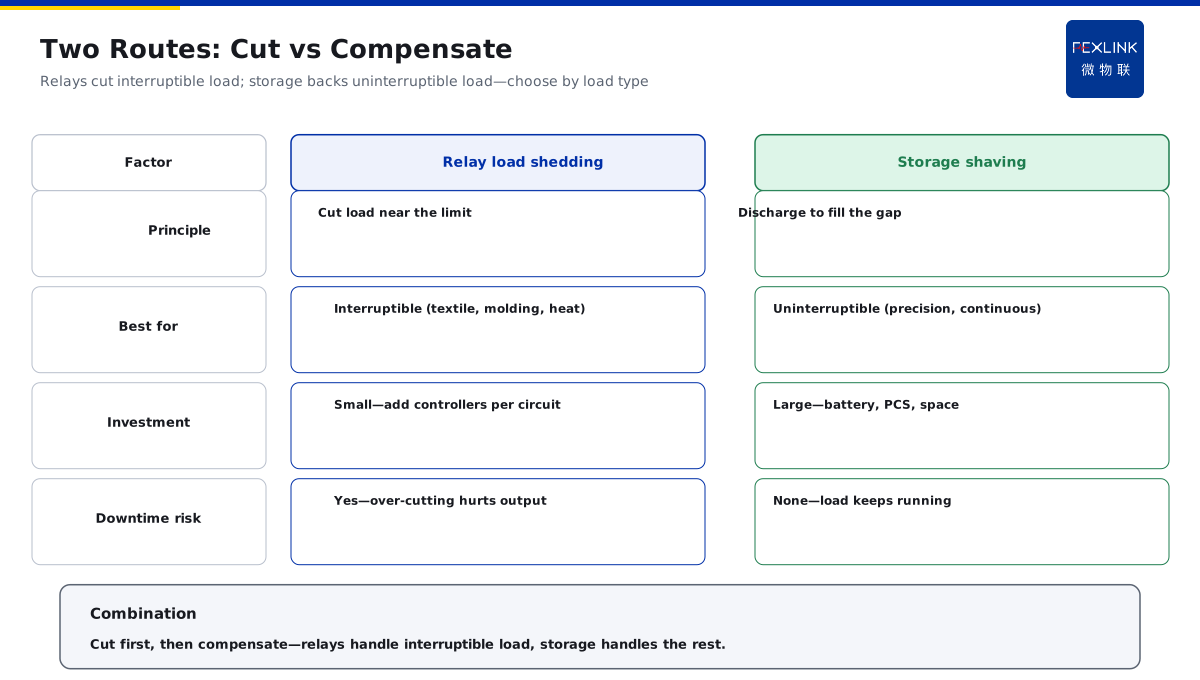
The investment — the relay device is small: adding controllers by circuit; the storage system is large: battery plus PCS plus site; The effect — the relay relies on switching: good if there is much interruptible load; storage relies on discharge offsetting: more stable and does not sacrifice output; The risk — the relay has a production-stop cost: wrong priority affects production; storage has no production-stop risk: but the battery degrades and needs maintenance; The combination — switch first and offset later: the relay switches the interruptible load and storage presses the remaining peak, and the effects add up.
In one sentence: comparing investment, effect and risk — choose the relay for much interruptible load, storage for uninterruptible load, and the combination gives the best effect.
The comparison table:
| Item | Relay switching | Storage offset |
|---|---|---|
| Principle | Switch interruptible load | Discharge to fill the power |
| Applicable load | Interruptible | Uninterruptible |
| Investment | Small | Large |
| Production-stop risk | Yes | No |
An example: A company uses both routes at the same time — the relay switches the auxiliary fans and storage presses the remaining peak — the demand falls 15% and the output is unaffected. The logic is that switch-first-offset-later is a common combination — cut what can be cut and let storage fill the rest — the two routes are not competing but cooperating.
4. How to Choose: Classify the Load First, Then Decide the Device Route
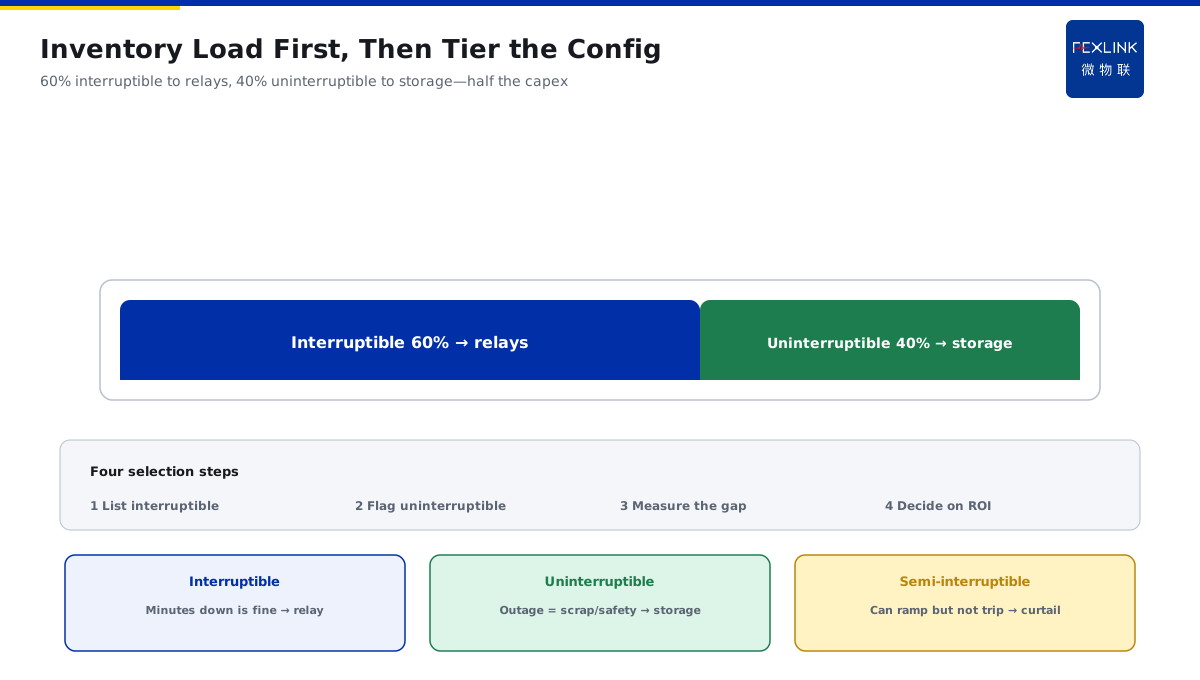
Step one, inventory the interruptible load — list the switchable production equipment: auxiliary equipment and storable steps; Step two, identify the uninterruptible load — mark the equipment that cannot be cut: core processes, continuous production and precision equipment; Step three, measure the demand gap — see how much the demand exceeds: a small gap first uses the relay and a large gap considers storage; Step four, decide by cost and benefit — calculate the payback: the relay is fast and storage is slow but stable.
In one sentence: classify the load, measure the demand gap and calculate the cost-benefit — choose the relay for much interruptible load and add storage for a large gap.
The load-property judgment table — interruptible: a few minutes of outage does not affect the quality, choose the relay; uninterruptible: an outage means scrap or a safety incident, choose storage; semi-interruptible: can reduce the load but not cut it, use load shedding — the three classes correspond to three strategies.
An example: After the inventory, a company has 60% interruptible load and 40% uninterruptible — first install the relay to switch the 60% and storage to offset the remaining 40% — the total investment is half of installing storage alone. The logic is that the selection is not a guess — inventory the load first, then measure the gap — use the cheap relay for the interruptible part and storage only for the uninterruptible part — the graded configuration saves the most investment.
5. The Roles of the Smart Circuit Breaker and the Edge Gateway in Demand Control
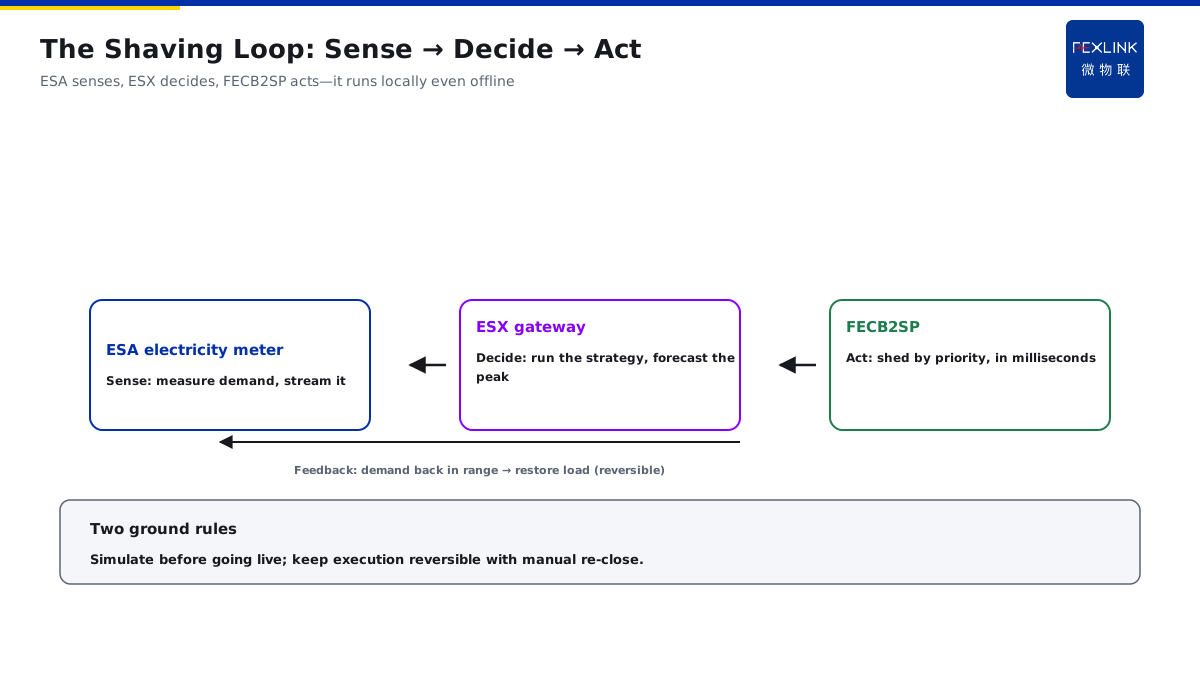
The role of the smart circuit breaker — the FECB2SP/FECB2SLP supports remote on/off: as the execution end of the relay, switching the load by priority; The role of the edge gateway — the ESX edge gateway runs the local strategy: collecting the load, judging the threshold and issuing the switching command, executable even without the network; The role of the platform — the energy supervision center issues the strategy uniformly: predicting the demand in advance and avoiding "last-minute action"; The effect of the combination — the sensing-to-decision-to-execution loop: the meter senses, the gateway decides and the circuit breaker executes.
In one sentence: the meter senses, the gateway decides and the circuit breaker executes — with the three devices connected, demand control closes the loop automatically.
The three links of the loop — sensing: the ESA meter measures the demand by the settlement basis and uploads the data in real time; decision: the ESX gateway runs the demand-control strategy and anticipates the peak window; execution: the FECB2SP circuit breaker switches the load by priority with a millisecond response — with the three links aligned, the demand control is automatic.
An example: A company uses the ESA meter to sense the demand, the ESX gateway to run the demand-control strategy and the FECB2SP circuit breaker to execute the switching — it anticipates 5 minutes before the demand exceeds, switches the auxiliary load automatically — the monthly maximum demand falls 10%. Two landing notes — simulate the strategy before going live: back-test the demand-control effect with historical data to avoid wrong switching; keep the execution recoverable: the switching action needs a restoration mechanism and the production can be closed manually in an abnormal condition — the two notes make the loop more stable. And the logic is that demand control is a "closed-loop action" — sensing, decision and execution are all indispensable — buying only the circuit breaker without a strategy is "manual switching" and having only a strategy without execution is "armchair talk".
Back to the selection main line — the relay switching suits interruptible load: small investment and quick payback, with the FECB2SP/FECB2SLP smart circuit breaker as the execution end; storage offsetting suits uninterruptible load: no production-stop risk and presses the remaining peak; inventory the load first, measure the demand gap and decide by cost-benefit — choose the relay for much interruptible load, add storage for a large gap and combine switch-first-offset-later — the ESA meter senses, the ESX gateway decides and the FECB2SP executes — automatic demand control moves from "either-or" to "graded combination" — choose the demand-control device right and the basic charge falls.**
Scope and Limitations
- The conclusions in this article are intended for LV distribution and electrical-safety sites. Criteria are compiled from public codes and FEXLINK product documentation, and product parameters follow the latest selection handbook and product knowledge base.
- Quantitative criteria (protection zone, discharge and residual voltage, earth resistance, thresholds and grading) hold under the preconditions stated in this article. Where the site voltage level, earthing arrangement, environmental category or load profile differs, the figures must be recalculated. Specific configurations involving FECB2SP/FECB2SLP smart breaker, ESX edge gateway should be verified against actual circuit parameters.
- Specific product models and parameters are subject to the latest selection handbook and product knowledge base; this article does not constitute selection or procurement advice.
- Standard numbers cited here refer to the currently effective editions; when a standard is revised, the related quantitative conclusions must be re-checked.
- Deployment and implementation for specific projects must be carried out by qualified engineers based on site survey and design drawings.
Frequently Asked Questions
For Automatic Demand Clipping
For automatic demand control, which device should you choose — a relay that switches off loads or an energy-storage system that offsets the peak