 FEXLINK Research Institute
Direct Answer
Thinking filling the night shift wins the TOU spread? Several load types actually cannot be shifted. Not every load is shiftable — continuous-process equipment (kilns, reactors), processes continuously sensitive to temperature and humidity, and load bound to order delivery cannot be freely moved out of the peak — what can be moved is load that runs intermittently and can be buffered (air compressors, refrigeration, charging) — do a process verification before shifting, and blindly filling the night shift is not worth the loss.
A scenario: A company hears that the valley rate is low — it fills the night shift with production to win the spread — but the process does not allow it and the quality fails — not worth the loss. The logic is that the premise of shifting is "the load can move" — some equipment can stop by day and run by night, while some cannot stop at all — first classify which load can be shifted and which cannot, then talk about the night shift.
1. The Boundary between Shiftable and Non-Shiftable Load
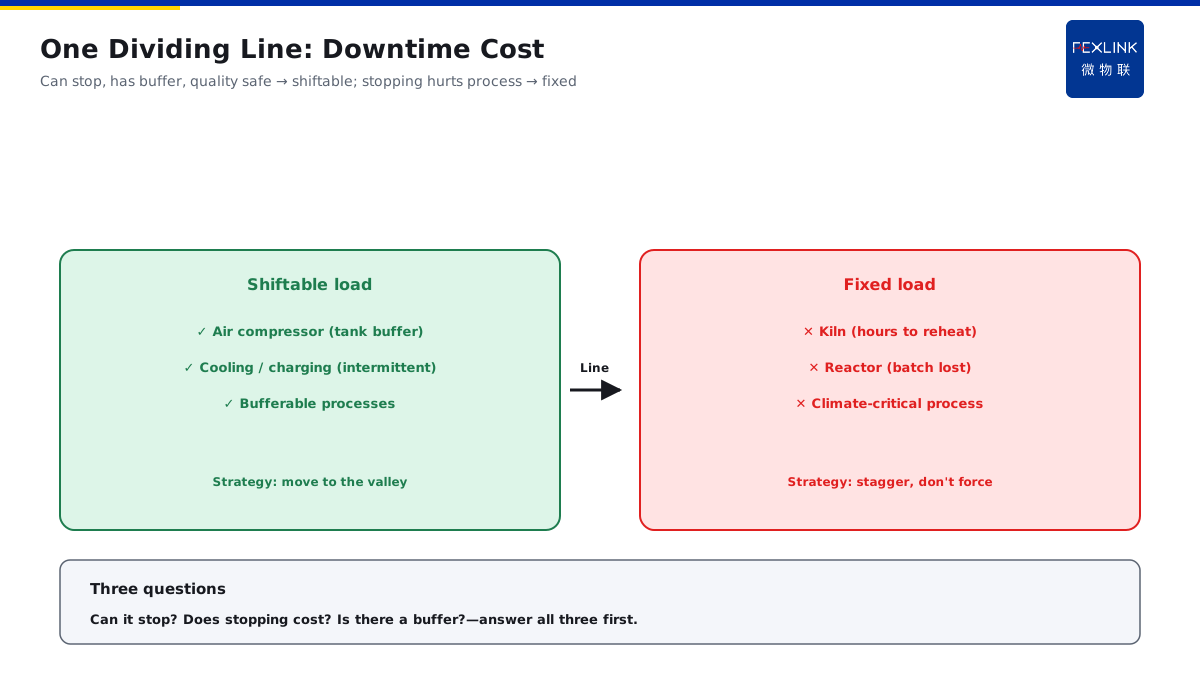
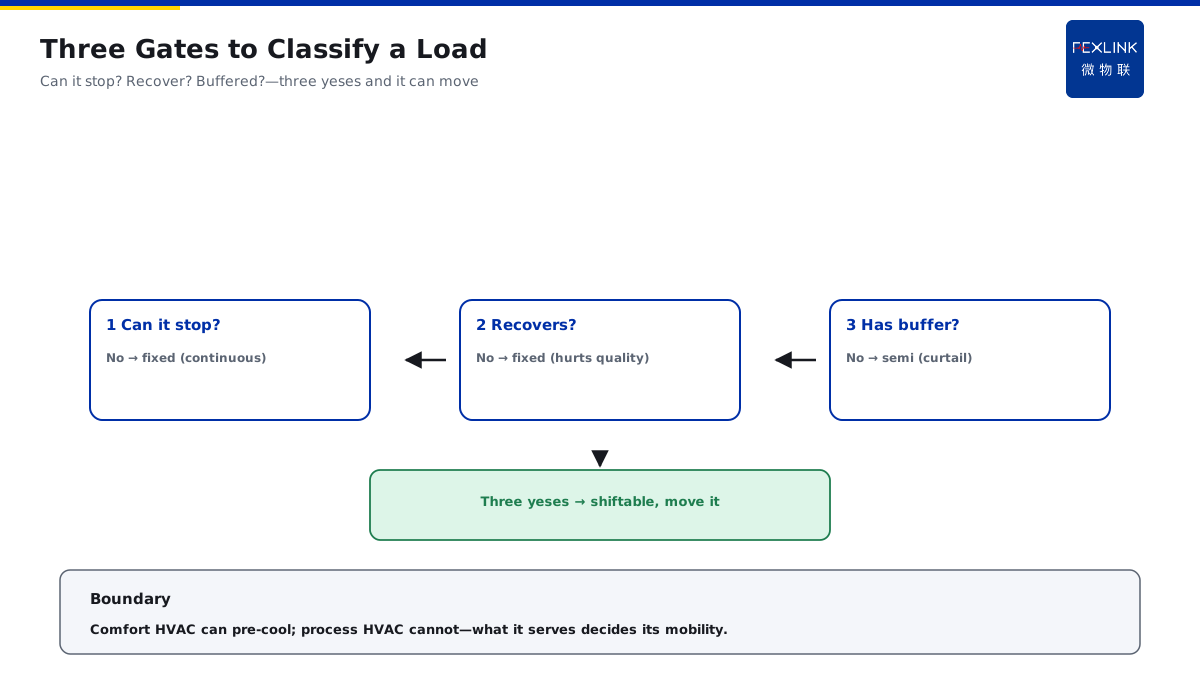
The shiftable load — runs intermittently and can be buffered: air compressors, refrigeration, charging and storable steps; The non-shiftable load — continuous process, process-sensitive and order-bound: kilns, reactors and temperature-humidity-sensitive processes; The core of the boundary — the stop cost: if stopping can recover without hurting the quality, it is shiftable; otherwise it is not; The judging method — ask three questions: can it stop? does stopping lose anything? can it be buffered?
In one sentence: what can stop, can be buffered and does not hurt the quality is shiftable — otherwise, shifting is lifting a rock onto your own feet.
The comparison table of the two load types:
| Item | Shiftable load | Non-shiftable load |
|---|---|---|
| Typical device | Air compressor, refrigeration, charging | Kiln, reactor |
| Running feature | Intermittent | Continuous process |
| Stop effect | Recoverable | Hurts quality |
| Shifting strategy | Move to the valley | Stagger, no forced move |
An example: A company wants to shift the kiln load — the kiln cools when stopped and takes over ten hours to heat up again — the electricity saved by the shift does not compensate for the energy loss. The logic is that the "stop cost" of the non-shiftable load is far higher than the spread benefit — it is not that it does not want to move, but that it cannot afford to — calculate the stop cost first, then decide whether to move.
2. Why Continuous-Process Equipment Cannot Be Stopped Freely
The feature of the continuous process — the equipment must run continuously: once stopped, it must restart and reach the process condition again; The cost of the kiln — cooling and reheating: an energy loss of over ten hours, far larger than the spread benefit; The cost of the reactor — the process interruption: the temperature, pressure and reaction progress are broken and the batch may be scrapped; The cost of the line — the rhythm is broken: the upstream and downstream steps are disconnected and the whole-line output is affected.
In one sentence: continuous-process equipment needs a restart after stopping, the restart costs energy and the interruption hurts the batch — the small money saved by the shift cannot cover the big money of the restart.
A quantitative way to think about the stop cost — the restart energy: the energy to reheat/re-pressurize to the process condition; the batch loss: the value of the batch scrapped by the interruption; the output loss: the output lost during the stop — the three items add up to the stop cost — if the stop cost is greater than the spread benefit, it cannot be shifted.
An example: A chemical company wants to shift the reactor load — the reaction in the reactor cannot be interrupted — one interruption scraps the whole batch — shifting is unthinkable. The logic is that the "continuity" of the continuous process is its lifeline — the reactor cannot stop, and stopping means scrap — this load can only be staggered at the start, not stopped for shifting.
3. The Constraint of Process Temperature and Humidity Continuity
The temperature-humidity constraint — some processes are continuously sensitive to temperature and humidity: an interruption affects the quality; The cost of the environment — temperature and humidity out of control: materials deform, reactions become abnormal and products fail; The air-conditioning exception — comfort air-conditioning can be shifted: for scenes with loose temperature requirements, precool in advance; The process air-conditioning exception — precision workshops cannot be shifted: constant temperature and humidity are process conditions, and stopping exceeds the limit immediately.
In one sentence: process temperature and humidity are a "process condition", not a "comfort need" — stopping a precision workshop exceeds the quality limit immediately.
The method to judge whether the air-conditioning is shiftable — look at the served object: does it serve people or the process; look at the precision requirement: what is the allowed deviation of temperature and humidity; look at the stop tolerance: how long can it stop — the three judgments make it clear whether the air-conditioning can be shifted.
An example: A precision workshop wants to shift the air-conditioning load — the constant temperature and humidity are the process requirement — the air-conditioning stops for 1 hour, the temperature and humidity exceed the limit and a batch of products deforms. The logic is that the same air-conditioning — "comfort" can be shifted but "process" cannot — before shifting, first see what the air-conditioning serves — what serves people can move and what serves the process cannot.
4. Identifying the Shiftable Load: Intermittent Running and Buffer
The intermittent-running load — can stop and start without affecting the quality: air compressors, pumps and storable steps; The buffered load — with a material/storage buffer: air tanks, water tanks and batteries, a short interruption has no effect; The reorderable load — the step order can be adjusted: do this first and that later without hurting the rhythm; The identifying method — ask three questions: can it stop? can it recover after stopping? is there a buffer?
In one sentence: intermittent running, buffer and reorderability — the three features identify the shiftable load — the shifting space is here.
The identifying steps of the shiftable load — list all the equipment: judge the running feature one by one; compare the three features: intermittent/buffer/reorder; tag and archive: shiftable/non-shiftable/semi-shiftable — the three steps do not miss the shiftable load.
An example: A company moves the air compressor to run in the valley — the air tank buffers and a short stop does not affect the air supply — the valley rate is low and the air compressor consumes much power — the monthly bill falls 5%. The logic is that the common feature of the shiftable load is "a buffer" — the air tank, water tank and battery are the buffers — the larger the buffer, the bigger the shifting space — identifying the shiftable load is finding the buffer.
5. The Process Verification Required before Shifting
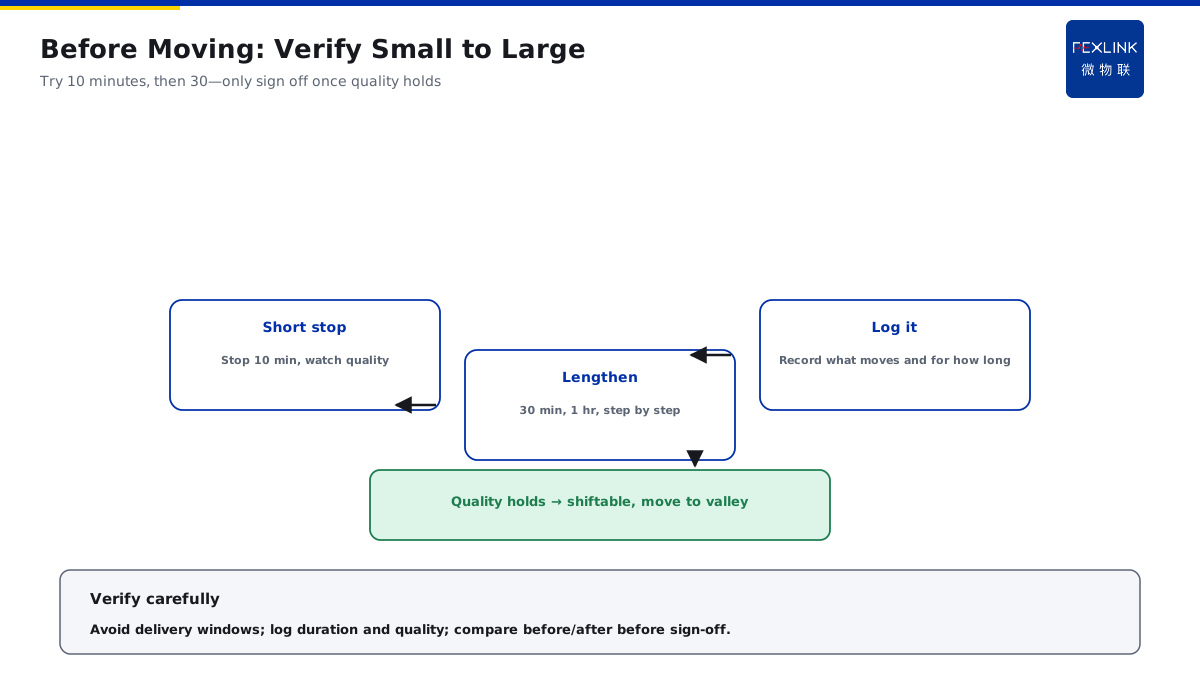
The necessity of the verification — theoretically shiftable is not actually shiftable: only a process verification can confirm; The content of the verification — the stop test: a short stop to see whether the quality is affected; The duration of the verification — verify from small to large: stop 10 minutes first, then 30 minutes, increasing step by step; The record of the verification — form a ledger: which load can be shifted and how long, recorded to guide the scheduling.
In one sentence: do the process verification before shifting — the stop test from small to large confirms no quality impact before moving.
The check list of the verification — before the verification: confirm that the verification period does not affect the order delivery; during the verification: record the stop duration and observe the quality indicators; after the verification: compare the quality data and release only after confirming no impact — the three-step check does not miss anything.
An example: A company first stops the air compressor for 10 minutes: the air supply is normal — then stops for 30 minutes: still normal — confirmed shiftable, and only then arranged into the valley. The logic is that the verification is a "low-cost trial" — stop for a short time first, see the effect, then lengthen gradually — without verification, a blind shift means regretting after the quality fails — verified load can be shifted with confidence.
Back to the energy supervision center match — the platform first classifies the load into shiftable/non-shiftable: identifying the shiftable load and marking the non-shiftable one; then it calculates the shift for the shiftable load: the valley period, the buffer duration and the scheduling suggestion; finally it manages the non-shiftable load by staggering: avoiding the sharp periods and not forcing the shift — shift what can be shifted and stagger what cannot — verify before shifting, and the night shift will not step into a pit.**
Not every load can be shifted — continuous-process equipment (kilns, reactors) needs a restart after stopping and an interruption hurts the batch — process temperature-humidity-sensitive load exceeds the limit when stopped — what can be shifted is the load that runs intermittently and can be buffered (air compressors, refrigeration, charging) — can stop, can recover and has a buffer: the three features identify the shiftable load — do a process verification before shifting: the stop test from small to large and form a ledger — the energy supervision center first classifies shiftable/non-shiftable, then calculates the shift for the shiftable load and staggers the non-shiftable one — shift what can be shifted and stagger what cannot — before filling the night shift to win the spread, first ask whether the load can move.
Scope and Limitations
- The conclusions in this article are intended for LV distribution and electrical-safety sites. Criteria are compiled from public codes and FEXLINK product documentation, and product parameters follow the latest selection handbook and product knowledge base.
- Quantitative criteria (protection zone, discharge and residual voltage, earth resistance, thresholds and grading) hold under the preconditions stated in this article. Where the site voltage level, earthing arrangement, environmental category or load profile differs, the figures must be recalculated.
- Specific product models and parameters are subject to the latest selection handbook and product knowledge base; this article does not constitute selection or procurement advice.
- Standard numbers cited here refer to the currently effective editions; when a standard is revised, the related quantitative conclusions must be re-checked.
- Deployment and implementation for specific projects must be carried out by qualified engineers based on site survey and design drawings.
Frequently Asked Questions
Thinking Filling the Night Shift Wins the TOU Spread
Several load types actually cannot be shifted