 FEXLINK Research Institute
The short answer
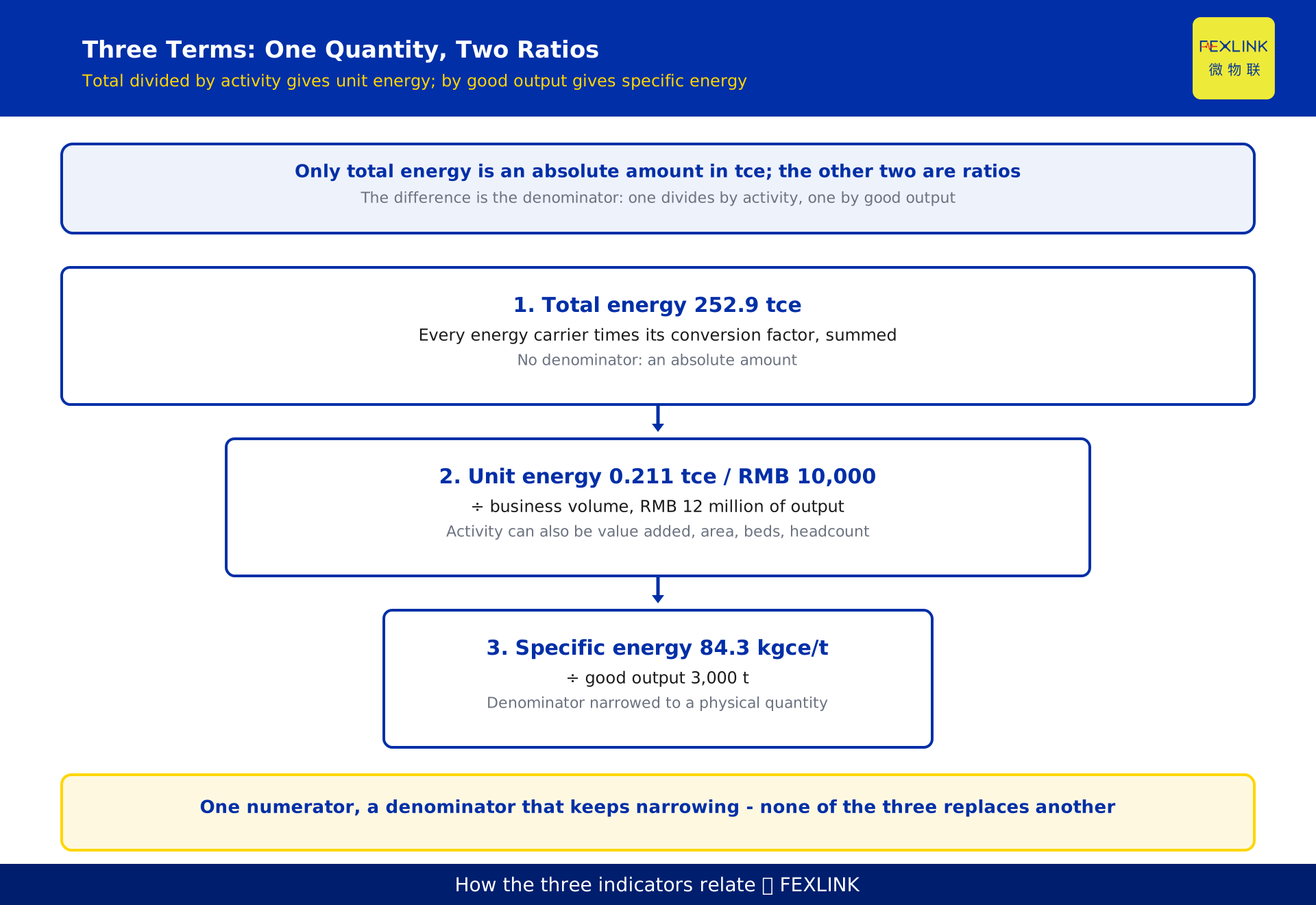
Only one of the three terms is a quantity. Total energy consumption is an absolute amount in tonnes of coal equivalent (tce): how much energy a defined boundary used. Unit energy consumption and specific energy consumption are both ratios, and the only difference between them is the denominator — unit energy divides by a business volume (output value, value added, floor area, beds, headcount), specific energy divides by good output.
The conclusion: the three narrow in sequence and cannot substitute for one another. Total = every energy carrier converted to coal equivalent. Unit = energy ÷ a business volume. Specific = energy ÷ good output. Mix them on one report and you are measuring the same cloth with three rulers, then claiming it grew or shrank.
Two kinds of number, not three
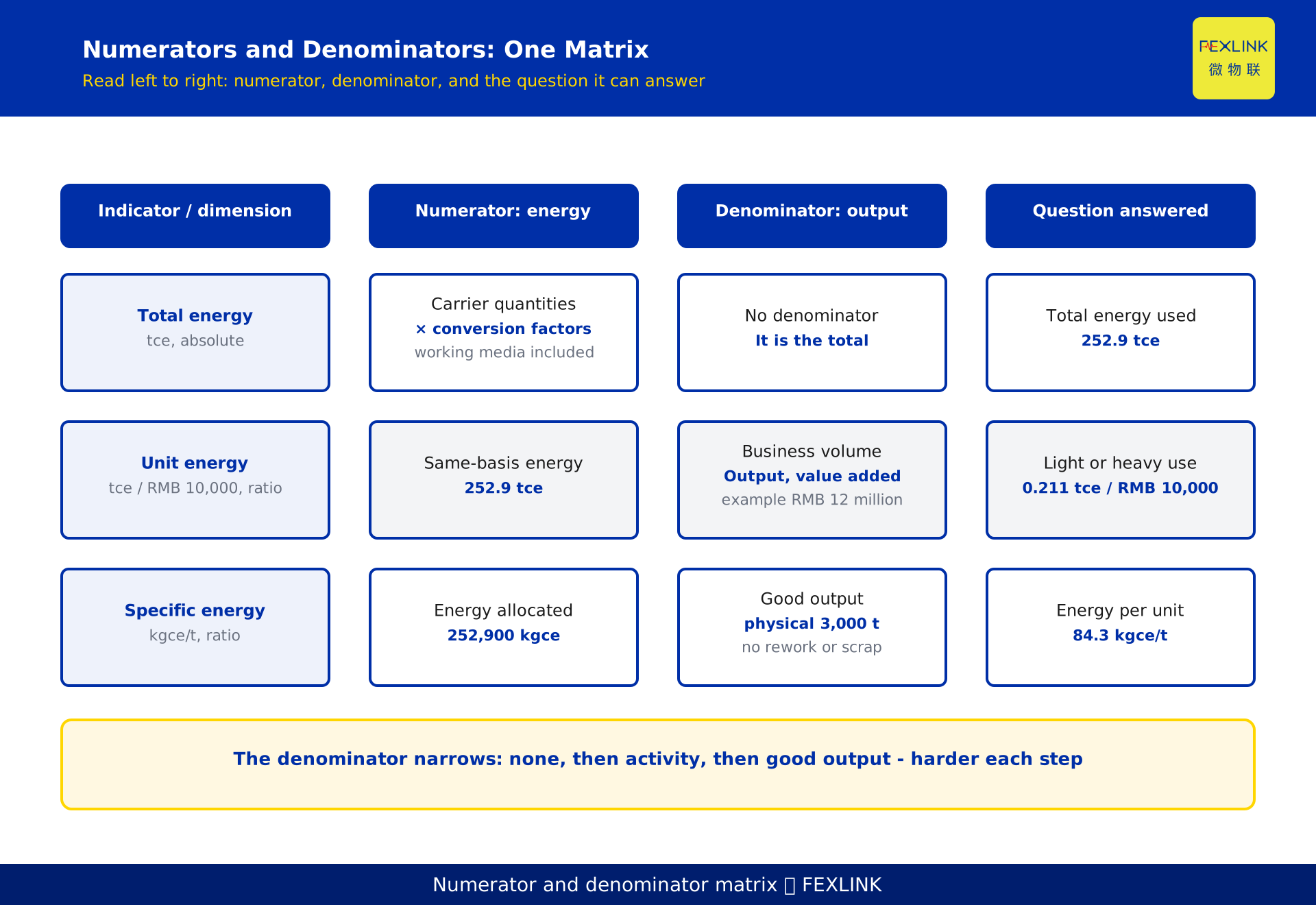
Dimension is the first divide. Total energy carries tce or kgce and answers "how much". Unit and specific energy carry compound units and answer "how much per".
Read the slash as "per": kgce per tonne of good product. Whatever sits after the slash is the denominator, and the denominator decides what the indicator can and cannot answer.
The second divide is the nature of that denominator. Unit energy divides by a business volume — money, area, beds, headcount — none of which converts to output at a fixed rate. Specific energy divides by good output, a physical quantity. That narrows the denominator and hardens the indicator, because output value moves with price and physical output does not.
Total energy consumption: putting different fuels on one scale
Coal is counted in tonnes, electricity in kilowatt-hours, gas in cubic metres, steam in tonnes. Those four cannot be added directly; converting to coal equivalent puts them on one scale.
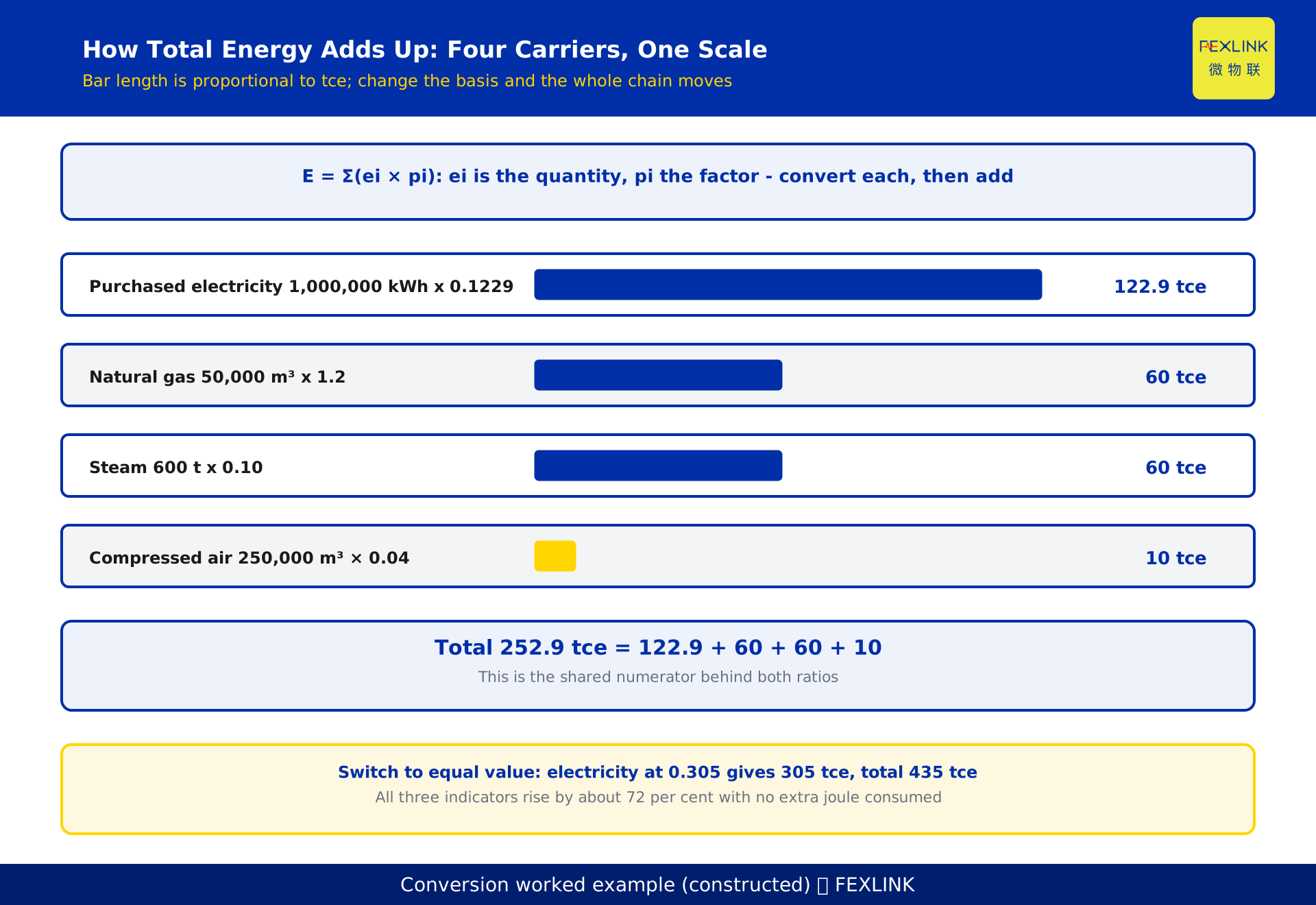
The formula is one line: E = Σ(ei × pi), where ei is the physical quantity of energy carrier i, pi its conversion factor, E the total in tce or kgce. The governing Chinese standard is GB/T 2589, General rules for calculation of the comprehensive energy consumption; the current edition is GB/T 2589-2020.
Factors worth memorising (GB/T 2589-2020 basis; final values follow the text in force and actual measurement):
- Electricity, equivalent value: 0.1229 kgce/kWh. A hard number, not an estimate: 3.6 MJ ÷ 29.3076 MJ/kgce = 0.1229. It does not change by year or province.
- Electricity, equal value: the previous year's national thermal-power supply coal rate, roughly 0.30–0.31 kgce/kWh in recent years. Not the current year's rate but the previous year's, and not a constant — it moves annually.
- Natural gas: roughly 1.1–1.3 kgce/m³, on net calorific value, varying with gas quality; the precise figure comes from the supply's calorific test report.
- Steam: roughly 0.09–0.12 kgce/kg, on actual enthalpy. Low- and medium-pressure saturated steam sits in that band; one tonne of steam as one tonne of coal equivalent is an order-of-magnitude error.
- Working media must be included: compressed air, oxygen, nitrogen, fresh water, demineralised water. Not fuels, but producing them consumes energy, so they are converted and counted. This is the number-one omission: electricity, gas and steam come out right and compressed air and water stay outside the fence.
At 0.1229 against 0.305 the same kilowatt-hour differs by about 2.5 times, so a total without a stated conversion basis is not a figure at all.
Unit energy consumption: the denominator is a business volume
Unit energy consumption = total energy ÷ business volume. The numerator is the total for a boundary; the denominator is the scale of activity.
Output value. Easiest to obtain, already produced by finance, good for comparing similar firms and for trend. The weakness is price: when products get dearer the denominator grows and unit energy "falls" without a joule being saved.
Value added. Closer to the real increment in output and widely used in energy-intensity assessment, but it moves with depreciation, labour and material prices.
Floor area, beds, headcount, room-nights. Service capacity rather than product, comparable only alongside degree-days or occupancy.
Unit energy answers "relative to this scale of activity, is the site energy-light or energy-heavy". It cannot answer "how much energy does one product take", because business volume and output do not convert at a fixed rate.
Specific energy consumption: the denominator narrows to good output
Specific energy consumption = energy ÷ good output, in kgce/t, kWh/t or m³/t. The denominator is physical and must be good output. Three words need care.
Good. Only inspected, deliverable output counts. Rework, scrap, trials and returns stay out of the denominator while the energy they consumed stays in the numerator. The easiest place to "optimise": count scrap and the specific figure improves while resource efficiency does not.
Allocated. A plant making three products has one energy figure and three output figures. Energy must first be allocated by a verifiable rule — output share, theoretical energy, running hours — written into the methodology and held constant.
Bounded. Numerator and denominator must share a boundary. Divide plant energy by main-product output and utilities, offices and canteen land on the main product, inflating the figure; strip the utilities and keep plant output and it deflates instead.
Specific energy is the hardest of the three: benchmarkable against sector limits, usable in quota standards, convertible into savings. Being hard, it demands the strictest consistency.
The comparison table
| Indicator | Dimension | Numerator | Denominator | Question it answers | Most common error |
|---|---|---|---|---|---|
| Total energy | tce / kgce | Physical quantities × conversion factors, working media included | None (absolute) | How much energy did this boundary use | Missing working media; mixing equivalent and equal value |
| Unit energy | tce per RMB 10,000, kgce/m², tce per person | Total energy on one basis | Business volume: output value, value added, area, beds, headcount | Relative to activity, is energy use light or heavy | Current-price output value, so a price rise reads as savings |
| Specific energy | kgce/t, kWh/t | Energy allocated to that product | Good output (physical) | How much energy per unit of good product | Rework, scrap and trials left in the denominator |
What goes wrong when the three are mixed
Equal value this year, equivalent value last year. Electricity at 0.305 against 0.1229 makes total energy "rise by seventy per cent" with not one extra kilowatt-hour consumed. The basis changed and history was never restated.
Unit energy reported as specific energy. A customer asks how much electricity goes into a tonne of product; the answer comes back as 0.211 tce per RMB 10,000 of output value. Neither answers the question, so the benchmark will not reconcile.
Scrap in the denominator. Specific energy "improves" from 84.3 to 76.6 kgce/t and management credits a retrofit, when a rising scrap rate moved the denominator from 3,000 to 3,300 tonnes. List rework, scrap and trial output separately and recompute.
Working media omitted. Electricity, gas and steam are added up and compressed air, nitrogen and fresh water are not converted. The more automated the plant, the worse the omission: a smaller numerator, a lower specific figure, an apparent advantage that is really uncounted energy.
Each is individually "not wrong"; together they make the report contradict itself. Loose terminology costs the reader the ability to tell which sentence is true.
A constructed example: one plant, three numbers
Constructed to illustrate the basis; not a real client.
A plant, one month: purchased electricity 1,000,000 kWh, natural gas 50,000 m³, steam 600 t, compressed air 250,000 m³; good output 3,000 t; output value RMB 12 million.
Total energy (electricity at equivalent value; gas at 1.2, steam at 0.10, compressed air at the annex reference 0.04):
- Electricity: 1,000,000 × 0.1229 = 122,900 kgce = 122.9 tce
- Natural gas: 50,000 × 1.2 = 60,000 kgce = 60 tce
- Steam: 600,000 kg × 0.10 = 60,000 kgce = 60 tce
- Compressed air: 250,000 × 0.04 = 10,000 kgce = 10 tce
- Total: 122.9 + 60 + 60 + 10 = 252.9 tce
Unit energy: 252.9 ÷ 1,200 = 0.211 tce per RMB 10,000. Specific energy: 252,900 kgce ÷ 3,000 t = 84.3 kgce/t. All three come from the same 252.9 tce; only the denominator differs.
Change the basis: electricity at 0.305 becomes 305 tce, total energy 305 + 60 + 60 + 10 = 435 tce, unit energy 0.363, specific energy 145 kgce/t. All three rise by about 72 per cent, with not one extra joule consumed — the basis is a common factor on the numerator.
Drop the omission: without the 10 tce of compressed air, total energy is 242.9 tce and the specific figure 81.0 kgce/t, about 4 per cent below the true 84.3 — which reads as "better than peers" and is one uncounted item.
Fixing the three numbers on the report
Fix the basis in the header. Beside every energy figure state three things: the conversion standard and edition (GB/T 2589-2020), the electricity basis (equivalent or equal value, with the previous year used), and whether working media are included. Without those lines even an accurate number cannot be re-performed.
Keep numerator and denominator on one boundary. Build an energy-to-output reconciliation table: each row names the meters behind the numerator and the output table behind the denominator, signed by an owner. When the boundary moves, both sides move.
Get data from meters, not estimates. The numerator is a sum over four media, and one estimated medium softens the chain. Sub-circuits can be fitted with the FEXLINK ESA full-parameter smart meter (models ESA-22111-R through ESA-22161-R, six current ratings, 3×220/380V, RS485 Modbus) so consumption is read per circuit on a fixed cycle and archived. A meter answers where the numerator comes from; the denominator and the basis still depend on ledgers and rules.
FAQ
Q: Can we keep only one of unit energy and specific energy?
No. Unit energy shows whether a site is energy-heavy relative to its scale of activity, which is what cross-company comparison needs. Specific energy shows how much energy one product takes, which is what quota benchmarking and savings calculation need. Keep both, on separate rows — never merge them into one column called "energy indicator".
Q: Should total energy use the equivalent value or the equal value for electricity?
Follow the reporting system and the regulator. The equivalent value is a hard 0.1229 based on the thermal equivalent, comparable across years and firms. The equal value uses the previous year's national thermal-power supply coal rate and reflects how much coal the grid burned for that kilowatt-hour, roughly 0.30–0.31 in recent years. State whichever you use and keep it consistent; mixing them distorts every year-on-year figure.
Q: Do working media really have to be counted in total energy?
Yes. Compressed air, oxygen, nitrogen, fresh water and demineralised water are not fuels, but producing them consumes energy, and GB/T 2589-2020 requires them to be converted and included. These are the usual omissions, and the more automated the plant the larger the compressed-air effect.
Q: Should output be the warehoused quantity or sales?
Good output, normally the inspected quantity put into the warehouse. Sales include last year's stock and exclude this year's, so they do not match the period's energy. Output that includes rework and scrap dilutes the specific figure.
Q: Can the three be converted into each other?
Only where the denominators convert. Given output value and unit price you can move from output-value intensity to specific energy; where the denominators have no reliable conversion, any "conversion" is an estimate. For cross-company benchmarking, standardise on specific energy, because physical output is the hardest thing to bend with a definition.
Q: Group companies report on different bases. What then?
Fix a basis dictionary at group level: conversion standard and edition, electricity basis, list of working media, denominator source table, allocation rule — five items, written down. Each site reports against the dictionary and the group only adds up.
Scope and limitations
- This article follows GB/T 2589-2020, General rules for calculation of the comprehensive energy consumption. Clause text and annex factors follow the edition in force; no clause numbers are cited.
- Conversion factors move with year, gas source and steam parameters: electricity at equal value uses the previous year's national thermal-power supply coal rate (roughly 0.30–0.31 kgce/kWh in recent years), natural gas roughly 1.1–1.3 kgce/m³, steam roughly 0.09–0.12 kgce/kg. Use measured values or the standard in force; the figures here indicate magnitude only.
- The example in section seven is constructed to illustrate the basis. It does not represent any real client and supports no conclusion about energy performance. The compressed-air factor is the annex reference value 0.04 kgce/m³; the value in force governs.
- This article distinguishes the three concepts and their bases only. It does not cover how to calculate specific energy consumption — how to correct numerator and denominator, how to strip start-stop and trial conditions — which belongs to KD-0411.
- Model range, electrical parameters and interfaces of the FEXLINK ESA full-parameter smart meter follow the current selection manual; range, circuit count and supply method are customizable.
- The choice of denominator for unit energy consumption is constrained by sector statistical rules; the regulator's reporting system governs.
Frequently Asked Questions
Can we keep only one of unit energy and specific energy?
No. Unit energy shows whether a site is energy-heavy relative to its scale of activity, which is what cross-company comparison needs. Specific energy shows how much energy one product takes, which is what quota benchmarking and savings calculation need. Keep both, on separate rows — never merge them into one column called "energy indicator".
Should total energy use the equivalent value or the equal value for electricity?
Follow the reporting system and the regulator. The equivalent value is a hard 0.1229 based on the thermal equivalent, comparable across years and firms. The equal value uses the previous year's national thermal-power supply coal rate and reflects how much coal the grid burned for that kilowatt-hour, roughly 0.30–0.31 in recent years. State whichever you use and keep it consistent; mixing them distorts every year-on-year figure.
Do working media really have to be counted in total energy?
Yes. Compressed air, oxygen, nitrogen, fresh water and demineralised water are not fuels, but producing them consumes energy, and GB/T 2589-2020 requires them to be converted and included. These are the usual omissions, and the more automated the plant the larger the compressed-air effect.
Should output be the warehoused quantity or sales?
Good output, normally the inspected quantity put into the warehouse. Sales include last year's stock and exclude this year's, so they do not match the period's energy. Output that includes rework and scrap dilutes the specific figure.
Can the three be converted into each other?
Only where the denominators convert. Given output value and unit price you can move from output-value intensity to specific energy; where the denominators have no reliable conversion, any "conversion" is an estimate. For cross-company benchmarking, standardise on specific energy, because physical output is the hardest thing to bend with a definition.
Group companies report on different bases. What then?
Fix a basis dictionary at group level: conversion standard and edition, electricity basis, list of working media, denominator source table, allocation rule — five items, written down. Each site reports against the dictionary and the group only adds up.