 FEXLINK Research Institute
The short answer
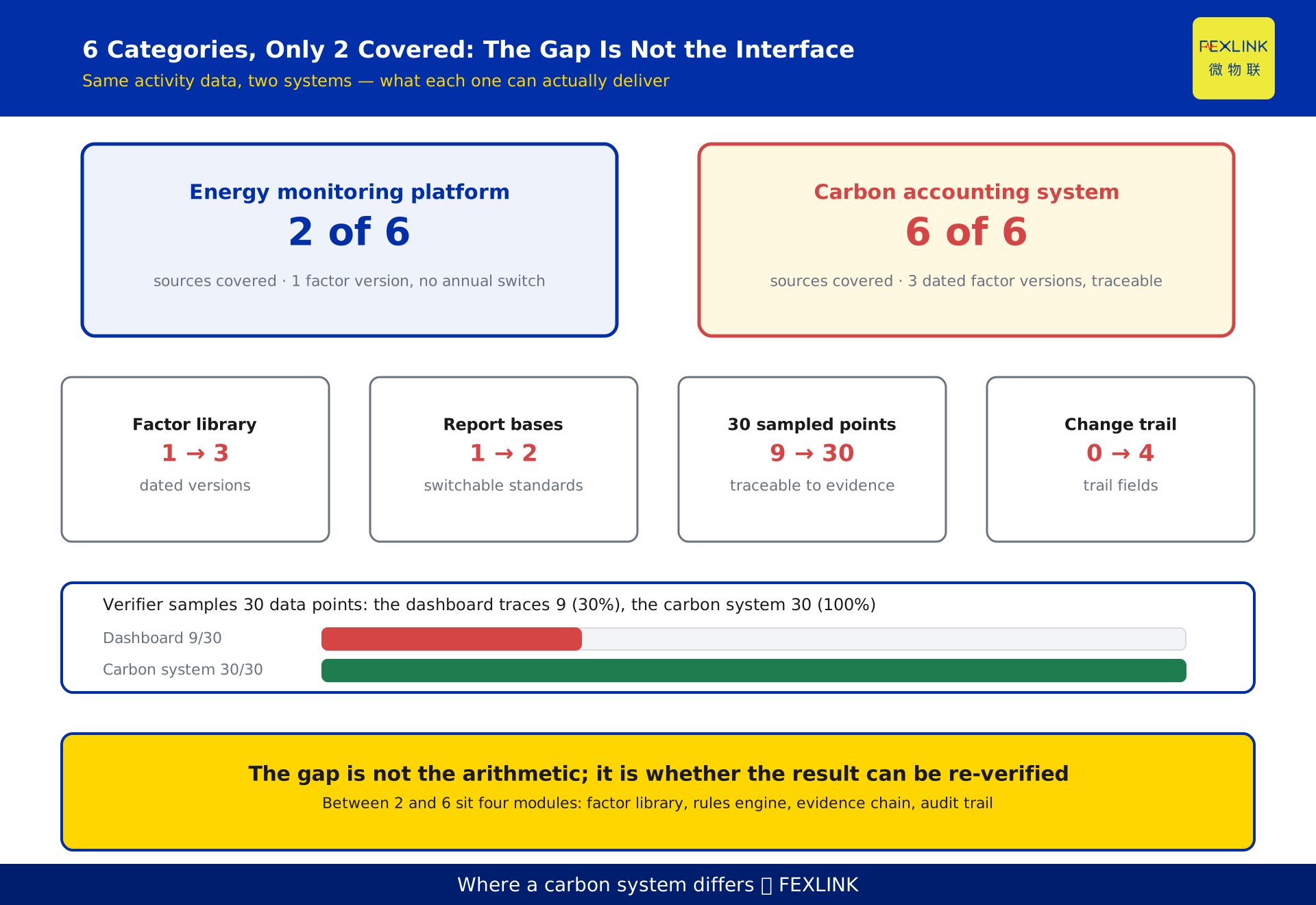
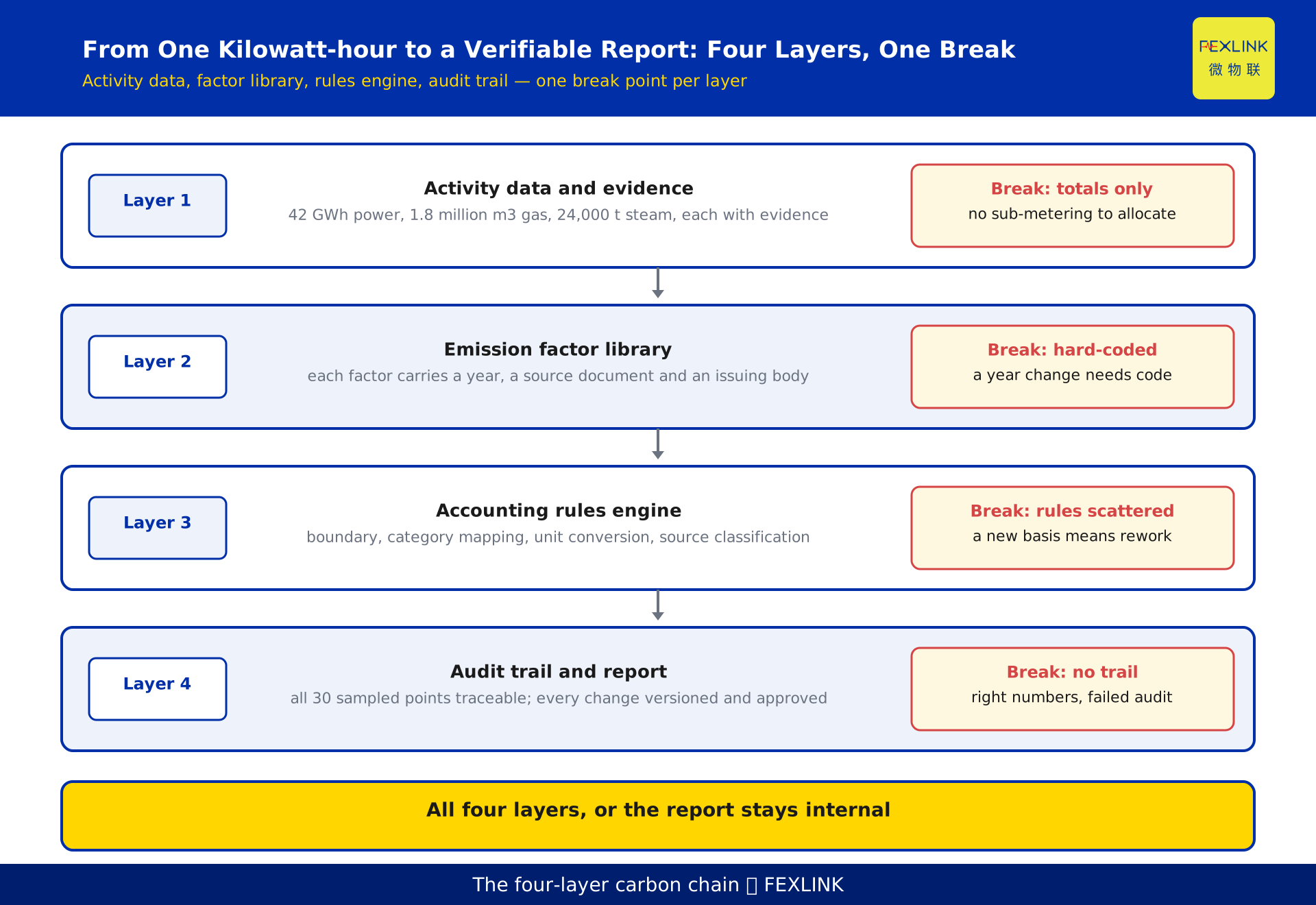
ISO 14064-1 is the international standard for quantifying and reporting greenhouse gas emissions at organisation level; GB/T 32150 is the Chinese general rule on the same subject. Both ask for a number you can compute, explain and trace. An energy monitoring tool and a carbon accounting system are therefore not the same product: the first turns electricity, water and gas into curves and operating information; the second converts each activity datum using the reporting year's factors and the boundary rules of a standard, and keeps a record an auditor can trace to a source document. One test settles it: can you export a year's emissions with the factor version, the boundary statement and the evidence? Without that, the interface is a data input, not an accounting system.
1. One counts kilowatt-hours. The other counts tonnes, and can defend them.
Energy monitoring answers operating questions: how much power this month, which line is running hot, when the peak arrives. Its outputs are kilowatt-hours, specific consumption and load curves, for the shift team and the plant engineer.
Carbon accounting answers a disclosure question: how many tonnes of CO2 equivalent this year, where the boundary was drawn, which document each figure came from. Its output is a report a third party can verify; its audience is the regulator, the verifier and the investor.
Both run on the same activity data and keep different books. Multiplying a load curve by a factor is only the first step; behind it sit boundary definition, source categorisation, warming potential versions and the evidence trail. The commonest mistake is buying the first step and expecting it to deliver the last.
2. Module one: does the factor library carry versions, and does it switch by year?
Emission factors are not constants. For purchased electricity the factor is the regional grid factor or the national average factor most recently published by the competent authority, updated annually, and the value applied must correspond to the reporting year. Which year's factor was used belongs in the report, in writing.
This is the first and easiest thing to test. Ask the vendor to export a factor list and read three columns: applicable year, source document, issuing body. Three columns and it is a factor library; one column of numbers and it is a spreadsheet.
Factors hard-coded into an application, or scattered across worksheet cells, do not produce wrong numbers so much as frozen ones. Changing the reporting year means changing code; prior reports then cannot be reproduced, and two years of the same company's data stop being comparable — which is the first thing a verifier tests.
The Tianyan E-09 carbon accounting engine holds factors as versioned entries carrying year and source. Switch the reporting year and the factors follow; earlier versions stay queryable. Three years of comparison means 3 annual versions; a hard-coded platform has 1.
3. Module two: can every activity datum be traced to a document?
Activity data is consumption: kilowatt-hours, cubic metres of gas, tonnes of steam. Evidence supports it: invoices, meter readings, contracts, lab certificates, warehouse slips. A carbon system must bind the two, and the binding must work in reverse: from a figure in the report to the documents behind it.
Sub-metering is the precondition. A main meter gives one total; sub-metering lets emissions be attributed to a facility, a process and a source category. Circuit-level metering can use the ESA all-element smart meter (for example ESA-22131-R, 3×400A, 3×220/380V, RS485 Modbus), installed per circuit and read on a fixed time stamp. Fuels and steam still depend on ledgers and invoices, and the system must hold both in one activity table.
The test is concrete: pick 10 data points at random and require each to be located, with its evidence, within 3 minutes. If that fails, the system produces estimates, not accounts.
4. Module three: can the rules engine produce a second set of numbers?
The same activity data does not necessarily yield the same emissions under two standards. How the boundary is drawn, which category a source falls into, which warming potentials apply, how units convert — each moves the result.
For industrial enterprises in China the enterprise-level basis is GB/T 32150, the general rules for greenhouse gas emission accounting and reporting — the 2025 edition has applied since 2026-07-01 and replaces the 2015 edition, so the edition must always be stated — with sector-specific parts issued as the GB/T 32151 series. At organisation level the international basis is ISO 14064-1:2018. Needing both means two sets of numbers from one dataset, plus an explanation of the difference.
A rules engine makes boundary, category mapping, unit conversion and source classification configuration rather than formulas buried in cells. The test: can one dataset produce two reports within half an hour, with every difference attributed to a rule?
If not, the system has one set of conventions — enough for internal reading, stalled at external disclosure.
5. Module three's boundary test: ISO 14064-1's six categories
ISO 14064-1:2018 groups an organisation's sources into 6 categories: category 1 direct emissions, category 2 indirect emissions from imported energy, category 3 indirect emissions from transportation, category 4 indirect emissions from products used by the organisation, category 5 indirect emissions associated with the use of products, and category 6 other indirect emissions.
Those 6 are the boundary test. Plenty of tools claiming to do carbon cover only categories 1 and 2 — fuel combustion and purchased electricity — the two that multiply out of energy data most easily.
Have the vendor tick all 6, marking each included, not applicable, or not covered, with a reason for anything marked not applicable. In an honest list the last two are separate lines: one means the assessment found nothing there, the other means the product cannot do it.
6. Module four: the audit trail — being right is not the same as proving it
The Interim Regulations on the Administration of Carbon Emission Trading (State Council Decree No. 775, in force 2024-05-01) established the reporting and verification regime for key emitting entities. Under it an enterprise hands over not just a number but the history of that number.
Four elements at minimum: data version, change log (who changed what, when, why), approval flow, export snapshots. Asked what a figure was last month, or why it changed, the system must answer.
Many systems are empty here. Reports come out, but changed figures leave no trace and exported files carry no version number. That is fine for an internal meeting and fatal on site: the number may be right, and you still cannot show that it is. An audit trail cannot be added after the fact.
7. A worked example: same data, two systems, two deliverables
What follows is an illustrative scenario, not any real customer.
A plant buys 42 GWh of electricity a year, 1.8 million cubic metres of natural gas and 24,000 tonnes of steam. Converted at the electricity equivalent value of 0.1229 kgce/kWh, the purchased electricity alone corresponds to about 5,162 tonnes of coal equivalent. An energy platform computes that, and the arithmetic is correct.
Carbon accounting has further to go. Electricity becomes emissions through the grid factor for the reporting year; gas through net calorific value and carbon content per unit of heat; steam through the heat supplier's factor; refrigerant leakage through charge volume and leak rate. 4 source categories, 4 algorithmic sources, each needing evidence.
The plant assesses all 6 ISO 14064-1 categories and includes 4, the other 2 confirmed not applicable. A verifier samples 30 data points: the energy platform traces 9 back to evidence, the carbon system all 30. The gap is not in the arithmetic but in whether it can be re-verified.
8. Five moves, 30 minutes
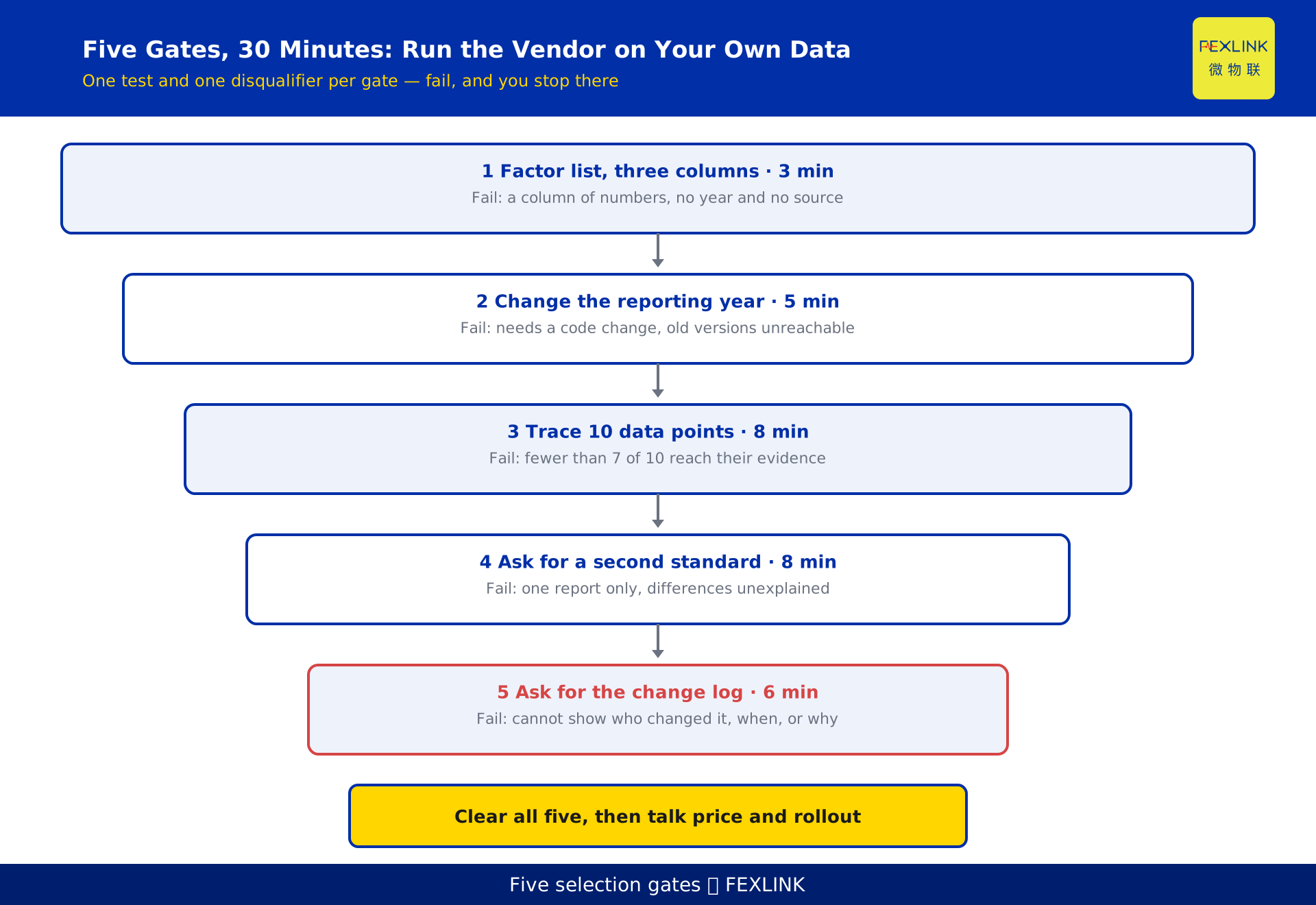
Do not watch a demo. Ask the vendor to do five things on your data, 30 minutes in total.
Ask for the factor list, read three columns (3 minutes). Applicable year, source document, issuing body. If one is missing, stop there.
Change the reporting year once (5 minutes). Move the year by one; see whether the factors follow and the earlier version survives. If it takes a code change, rule the product out.
Trace 10 data points (8 minutes). Each must be located, with evidence, within 3 minutes. 10 out of 10 is the bar; 7 is workable if you get a straight answer about the other 3.
Ask for a second standard (8 minutes). Same dataset under GB/T 32150 and ISO 14064-1:2018, with the edition stated and the differences explained. A system that produces only one is a single-convention system.
Ask for the change log (6 minutes). Time, operator and reason for the most recent data change. If it cannot, verification becomes an open question.
After five moves you know which you are looking at: an energy platform with a carbon module bolted on, or a carbon accounting system with a data connection.
9. Where the energy platform ends and the carbon system begins
These two are not substitutes. They divide the work.
The energy management platform owns operations: real-time monitoring, exception alarms, peak and demand management, specific-consumption benchmarking, saving opportunities. A carbon system does these badly and should not try.
The carbon system owns disclosure: factors, boundary, conventions, evidence, audit trail, report. An energy platform cannot do these, because it was never designed with the concepts of a version or a piece of evidence.
In practice it is one dataset and two application layers: the endpoint metered by devices such as the ESA all-element smart meter, the middle layer the smart energy-carbon IoT platform holding energy and carbon under one set of conventions, carbon accounting and reporting with Tianyan E-09, and the electricity-cost and emissions views merged in the electricity-carbon synergy solution.
Sequence the selection by purpose. For internal operations, the carbon module of an energy platform is enough; for external disclosure, the four modules above must be in place first.
10. FAQ
Q: Our vendor says their energy platform can produce a carbon report. Is that enough?
Look inside the report. A total with no factor version, no boundary statement and no evidence chain is an internal reference document, not a disclosable result. Ask for a sample and turn to the appendix.
Q: How large does the factor library need to be?
Large is not the point. It must cover the carriers you actually use, and every factor needs an applicable year and a source. Version management and annual switching matter more than entry count.
Q: We only have a main meter. Can we start with a carbon system anyway?
Yes, but only for category 2 electricity and category 1 fuels. Until sub-metering is added, emissions cannot be attributed to facilities or processes, and the report stops at the enterprise total.
Q: We do not trade carbon. Do we still need an audit trail?
Yes. Its value is internal as much as external: recalculating this year's figures next year, answering a customer or an investor. Without it, every year starts from zero.
Q: Can one system manage both energy and carbon?
Yes, if the underlying activity data is shared and the two sets of books stay separate. One data source with two sets of conventions works; one set of conventions producing both results usually distorts the carbon side.
Scope and limitations
- This article concerns selection of organisation-level carbon accounting systems, for industrial enterprises reporting under GB/T 32150 (current edition) or ISO 14064-1:2018 and undergoing third-party verification. Product carbon footprint and project-level reduction accounting are out of scope.
- No specific emission factor values are given. Use the regional grid factor or national average factor most recently published by the competent authority, matching the reporting year, and defer to the current published document.
- The electricity equivalent value of 0.1229 kgce/kWh is quoted from the conversion basis of GB/T 2589-2020 to show that energy conversion and carbon accounting are two different chains. It is not an emissions conclusion.
- The plant figures here (42 GWh, 1.8 million cubic metres, 24,000 tonnes, 4 source categories, 30 sampled data points, 9 traceable) are constructed to illustrate the problem. They represent no real customer and no verification result.
- Standard numbers and editions are current as of writing. The current edition of GB/T 32150 is the 2025 edition, in force since 2026-07-01 and replacing the 2015 edition; state the edition and do not mix them. The GB/T 32151 series is issued in sector-specific parts; confirm which part applies to your industry.
- Model numbers and configurations for the ESA all-element smart meter, Tianyan E-09, the smart energy-carbon IoT platform and the electricity-carbon synergy solution are subject to the latest selection manual and product knowledge base. This is not a procurement recommendation.
Frequently Asked Questions
How to Select Carbon Management Software
ISO 14064-1 is the international standard for quantifying and reporting greenhouse gas emissions at organisation level