 FEXLINK Research Institute
Direct Answer
How is the monthly "basic charge" for large industrial users calculated? The basic charge is the "capacity cost" compensation for transformer capacity or maximum demand — it is billed in one of two ways, by transformer capacity (fixed) or by actual maximum demand (tied to the usage peak), one of which is chosen — it has little to do with how much energy is actually used but is tied to how much supply capacity is occupied, and it is the object of demand management.
A scenario: A company gets its monthly electricity bill — besides the energy charge, there is a basic charge — a considerable share — but no one understands how it is calculated — it is paid without clarity. The logic is that the basic charge is not based on "how much is used" but on "how much supply capacity is occupied" — once the billing rule is understood, you know whether and how to save.
1. The Structure of the Electricity Bill: Energy Charge + Basic Charge + Power-Factor Charge
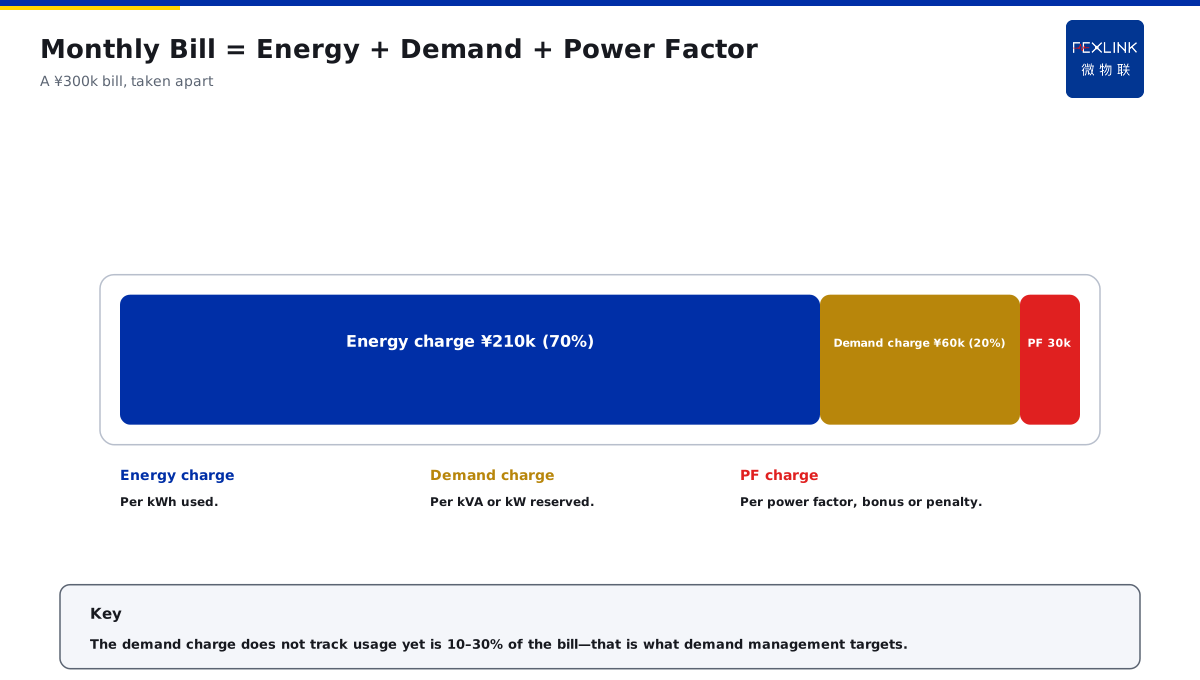
Component one, the energy charge — by actual usage: how much energy is used and how much is paid; Component two, the basic charge — by capacity or demand: how much supply capacity is occupied and how much is paid; Component three, the power-factor charge — by power factor: the power-factor level discounts or adds to the bill; The relationship of the three — billed separately: the three charges are calculated independently and add up to the monthly bill.
In one sentence: the electricity bill is the energy charge (usage), the basic charge (capacity) and the power-factor charge (power factor).
The concept of the two-part tariff — large industrial users follow a two-part tariff: the energy price (by usage) plus the basic price (by capacity/demand) — the energy charge follows usage and the basic charge follows capacity — the two parts are calculated separately — this is the institutional background of the "basic charge".
An example: A company's monthly bill is 300,000 yuan: the energy charge is 210,000, the basic charge 60,000 and the power-factor charge 30,000 — the basic charge is one fifth. The logic is that the bill is not simply "one price per kWh" — the three charges each have their own calculation — although the basic charge does not follow usage, its share is not small — without reading the bill, you do not know where the money goes.
2. The Two Billing Methods of the Basic Charge
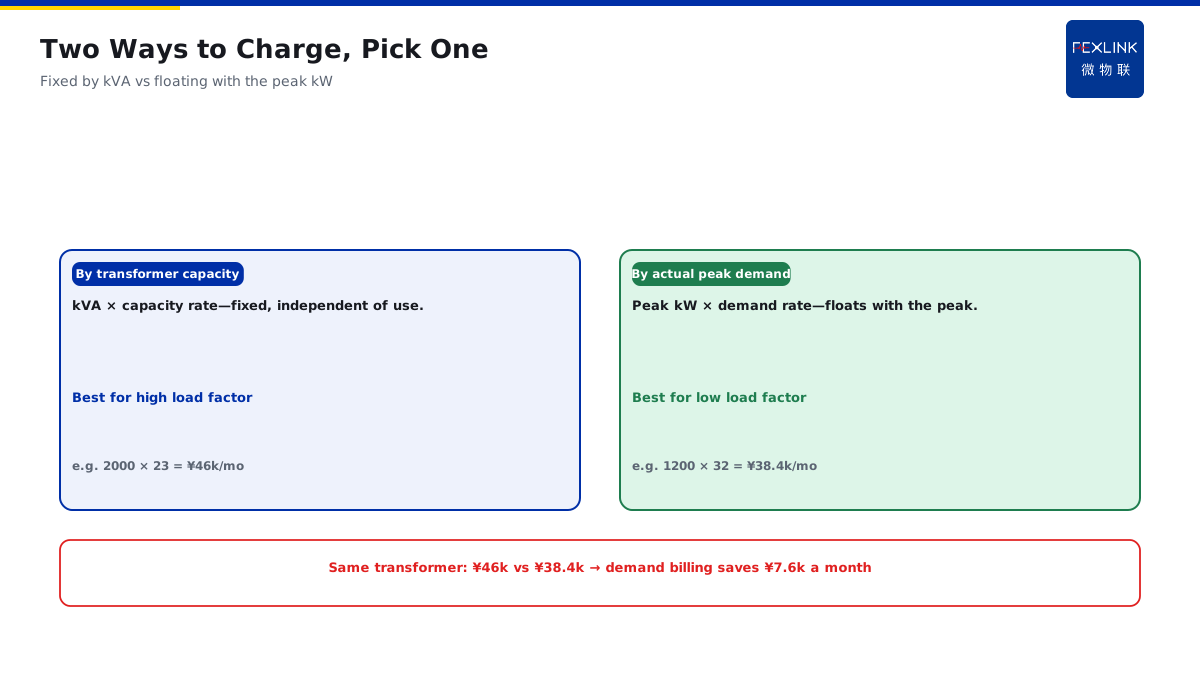
Method one, by transformer capacity — fixed billing: installed transformer capacity (kVA) times the capacity price; Method two, by actual maximum demand — peak billing: the month's maximum demand (kW) times the demand price; One of the two — user's choice: the two methods are chosen one by one and the choice can be changed by application; The basis of the choice — the load shape: a high load factor favors capacity, a low load factor favors demand.
In one sentence: the basic charge is by capacity (fixed) or by demand (peak) — one of the two is chosen and can be changed.
The comparison table of the two billing methods:
| Item | By transformer capacity | By actual maximum demand |
|---|---|---|
| Billing unit | kVA | kW |
| Is the charge fixed | Fixed | Floats with the peak |
| Suitable load factor | High | Low |
| Management space | Small (capacity change) | Large (peak shaving) |
An example: A company has a 2000 kVA transformer: by capacity, 2000 x 23 = 46,000 yuan per month; by demand, the actual maximum demand of 1200 kW x 32 = 38,400 yuan — choosing demand saves 7,600 yuan per month. The logic is that the same transformer yields different amounts under the two methods — a company with a low load factor saves more by demand — choosing the right method saves a fixed amount every month.
3. The Difference between the Capacity Price and the Demand Price
The capacity price — by kVA: unrelated to usage, fixed once the capacity is set; The demand price — by kW: related to the peak, the higher the peak the higher the charge; The billing units — kVA and kW: capacity uses apparent power, demand uses active power; The elasticity of the charge — capacity is fixed, demand floats: capacity is uncontrollable, demand is controllable.
In one sentence: the capacity price is fixed by kVA and the demand price floats by kW — demand is the manageable object.
The reason for the difference — capacity is "how much is installed" and demand is "how much capacity is used" — the supply company builds capacity by need: capacity corresponds to equipment investment and demand to peak occupation — so the capacity price is fixed and the demand price follows the peak — the two billing logics differ.
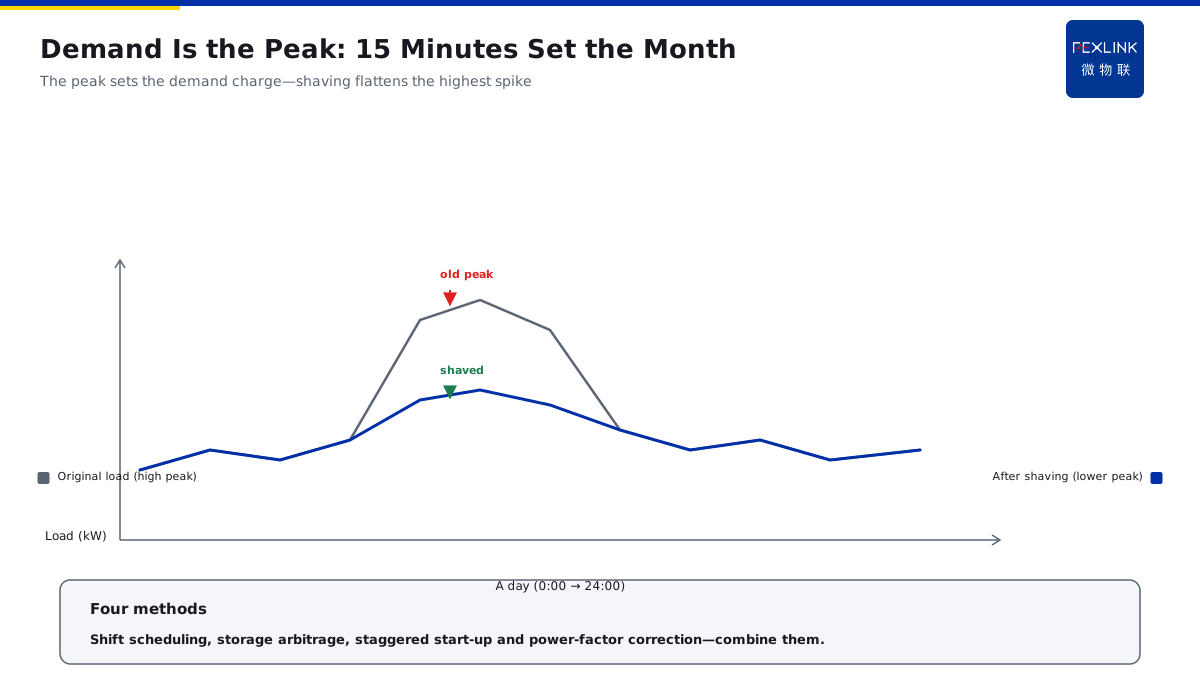
An example: A company in two months: the February peak is 1400 kW and the March peak 1000 kW — billed by demand, the March basic charge is 12,800 yuan less. The logic is that capacity is "set in stone" and demand is "movable" — pressing down the peak lowers the demand charge — this is the space of demand management — capacity can only be adjusted by capacity increase or reduction.
4. Why the Basic Charge Has Little to Do with Actual Energy Usage
Reason one, the compensated object differs — the basic charge compensates "capacity": the cost the supply company invests to guarantee capacity; Reason two, the billing basis differs — by capacity/demand: not by kWh but by kVA/kW; Reason three, unrelated to the duration of use — charged even when equipment is idle: the occupied supply capacity always exists; Reason four, demand sees only the peak — one peak per month: usage beyond the peak does not affect the basic charge.
In one sentence: the basic charge compensates the "occupied supply capacity", not the "used energy" — so it has little to do with usage.
An example: A company uses only 500,000 kWh in a month, but the transformer capacity is 2500 kVA — the basic charge is still fully billed by 2500 kVA — low usage, and the basic charge is not reduced by a cent. Another example: A company has two workshops: A runs steadily with a low peak; B concentrates production with a high peak — with the same usage, B is billed higher by demand — the peak decides the basic charge. The logic is that the basic charge looks at the "highest point", not the "total" — the 15-minute peak of a day decides the whole month's basic charge — peak control is basic-charge control.
5. Why This Charge Deserves Dedicated Management
Reason one, the share is not small — usually 10%-30% of the bill: worth dedicated attention; Reason two, the billing method is selectable — one of capacity/demand: choosing right saves; Reason three, the peak is controllable — shaving the peak lowers the demand charge: production scheduling and storage can cooperate; Reason four, the change cost is low — apply for a change: apply by the rule and it takes effect next month.
In one sentence: the basic charge has a meaningful share, a selectable method, a controllable peak and a low change cost — so it deserves dedicated management.
The common methods of demand management — production scheduling: stagger peak processes to flatten the peak; storage peak shaving: charge storage in the valley and discharge at the peak; load linkage: start large equipment in batches to avoid simultaneous start; retrofit cooperation: raise the power factor and lower the apparent current — the four methods are combined by the site.
The common mistakes — mistake one: thinking the basic charge is by usage (actually by capacity/demand); mistake two: thinking the billing method cannot be changed (actually one of two can be changed by application); mistake three: thinking the demand is uncontrollable (actually scheduling and storage can shave the peak) — correct the three mistakes first, then manage.
An example: A company changes its billing method from capacity to demand and cooperates with peak shaving — the monthly basic charge drops from 50,000 to 36,000 yuan — saving about 170,000 yuan a year. The logic is that the basic charge is not "impossible to save" — choosing the right method and pressing down the peak saves every month — every saved yuan is net profit — this account deserves to be calculated clearly.
Back to the ESA all-element smart meter match — the ESA smart meter automatically records the monthly maximum demand by the demand-measurement rule — the energy supervision center platform automatically compares the two billing amounts of capacity/demand — recommends the cheaper method — automatically warns when the demand exceeds the limit — the enterprise chooses the right method and presses down the peak, and the basic charge saves every month.
The basic charge is billed by capacity or demand, one of the two — it compensates the occupied supply capacity, not the used energy — capacity is fixed and demand is controllable — a low load factor chooses demand, and pressing the peak lowers the demand — the ESA meter and the energy supervision center calculate the billing clearly — this basic charge deserves dedicated management.
Scope and Limitations
- The conclusions in this article are intended for LV distribution and electrical-safety sites. Criteria are compiled from public codes and FEXLINK product documentation, and product parameters follow the latest selection handbook and product knowledge base.
- Quantitative criteria (protection zone, discharge and residual voltage, earth resistance, thresholds and grading) hold under the preconditions stated in this article. Where the site voltage level, earthing arrangement, environmental category or load profile differs, the figures must be recalculated. Specific configurations involving ESA all-element smart meter should be verified against actual circuit parameters.
- Specific product models and parameters are subject to the latest selection handbook and product knowledge base; this article does not constitute selection or procurement advice.
- Standard numbers cited here refer to the currently effective editions; when a standard is revised, the related quantitative conclusions must be re-checked.
- Deployment and implementation for specific projects must be carried out by qualified engineers based on site survey and design drawings.
Frequently Asked Questions
How Exactly Is the Monthly "Basic Charge" for Large Industrial Users Calculated?
The basic charge is the "capacity cost" compensation for transformer capacity or maximum demand — it is billed in one of two ways, by transformer capacity (fixed) or by actual maximum demand (tied to the usage peak), one of which is chosen — it has little to do with how much energy is actually used but is tied to how much supply capacity is occupied, and it is the object of demand management.