 FEXLINK Research Institute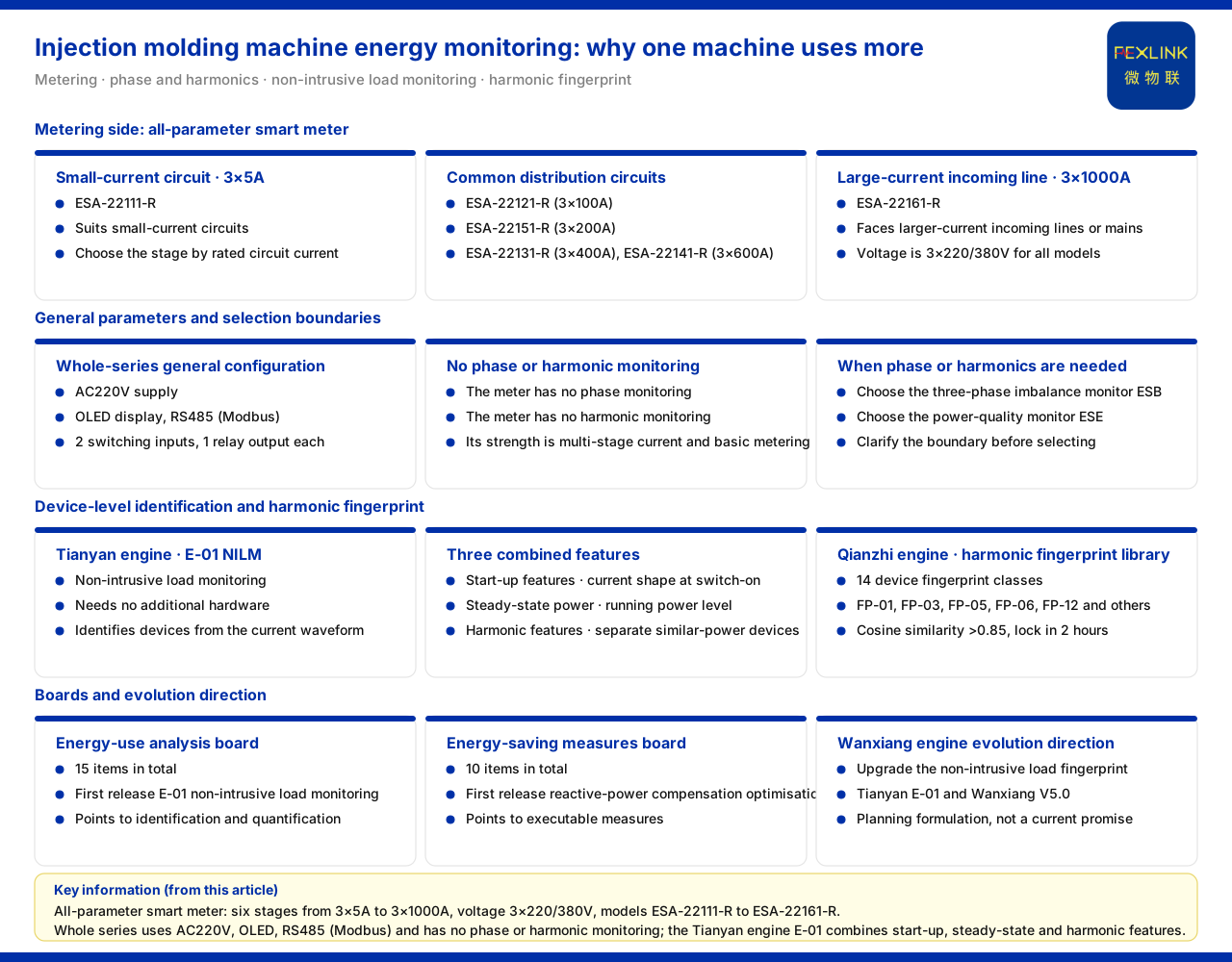
Direct answer
For the same product made by several injection-moulding machines, the month-end total electricity bill often shows a few machines clearly higher, yet the total alone cannot say where the extra consumption is. The product material's path is to break the problem down to the equipment level: the all-parameter smart meter (ESA) provides energy data such as current and voltage on the metering side; the three-phase imbalance monitor (ESB) or power-quality monitor (ESE) supplements phase or harmonics; the Tianyan engine's non-intrusive load monitoring makes the device-level judgement; and the Qianzhi engine carries the harmonic fingerprint. The all-parameter smart meter covers six current stages from 3×5A to 3×1000A, and the Tianyan engine's signature model E-01 is non-intrusive load monitoring needing no additional hardware.
Why the total electricity bill cannot explain higher consumption
A bill gives the total and the cost; it answers how much was used, not which machine or stage used it. Making the same product, two machines may differ in heating and holding energy, hydraulic or servo-drive efficiency, cycle time and idle duration, and grid-side reactive-power and harmonic losses. Mixed in one total meter, these cannot be distinguished.
Comparing totals alone makes energy-saving measures miss: without knowing the high-consumption machine, it is hard to decide whether to service, retune or replace; without knowing whether loss is active power or phase and harmonics, an electrical problem is treated as a process problem. To explain higher consumption, consumption must be broken down to the machine level with the necessary electrical-quality distinction.
Metering side: specifications and selection boundaries of the all-parameter smart meter
The product material records six current stages, all at 3×220/380V, supporting meter monitoring, each with 2 switching inputs and 1 relay output, for energy metering of a single machine or circuit.
| All-parameter smart meter model | Current stage |
| --- | --- |
| ESA-22111-R | 3×5A |
| ESA-22121-R | 3×100A |
| ESA-22131-R | 3×400A |
| ESA-22141-R | 3×600A |
| ESA-22151-R | 3×200A |
| ESA-22161-R | 3×1000A |
Looking at the range, 3×5A suits small-current circuits, 3×100A to 3×600A covers common distribution circuits, and 3×1000A faces larger-current incoming lines or mains. For an injection-moulding machine, first determine the model by the stage the rated current falls into, then confirm voltage and switching and relay contacts meet on-site needs.
A boundary is easily confused: the general configuration is whole-series AC220V supply, OLED display and RS485 (Modbus) communication, and the series has no phase and no harmonic monitoring. Thus it is strong at multi-stage current coverage and basic energy metering, while phase and harmonics are another need. Treating the all-parameter meter as measuring everything leads to the wrong model when phase or harmonic data is needed.
When phase and harmonics are needed: two kinds of monitor
For the same product, if the consumption difference comes with current imbalance or high harmonic content, basic energy data alone cannot locate it. The product material records that the three-phase imbalance monitor (ESB) adds phase monitoring on the same architecture but no harmonic monitoring; the power-quality monitor (ESE) adds harmonic monitoring on top of phase, covering the 2nd to 31st harmonics at an accuracy of ±1%. Both have 2 switching inputs, 1 relay output and RS485 (Modbus) communication.
Distinguishing them matters: phase data shows whether three phases are balanced, harmonic data whether the current waveform is distorted. Choose the imbalance monitor if only phase is needed, the power-quality monitor if harmonics are also needed. Accuracy and order range describe the measurable formulation, not a judgement about a particular circuit's loss.
Device-level identification: non-intrusive load monitoring of the Tianyan engine
Once metering data exists, the next question is breaking the total load down to equipment. Installing a separate sensor per device has high hardware and construction cost and scales poorly. Non-intrusive load monitoring offers another path: instead of adding hardware, it infers devices from the current waveform at the main incoming line.
The product material records that the Tianyan engine's signature model E-01 is non-intrusive load monitoring (NILM), needing no additional hardware and identifying devices through the current waveform; the basis is the combination of start-up features, steady-state power and harmonic features. Start-up features capture the current shape at switch-on, steady-state power reflects the steady running level, and harmonic features distinguish devices similar in power but different in harmonic structure.
Combining the three separates loads that look alike: by steady-state power alone, two machines of similar power are hard to tell apart; adding start-up and harmonic features removes the single-dimension dependence. Consumption differences can then be attributed at the equipment level without a sensor per machine. Needing no additional hardware describes the method, not a promise about identification accuracy, which still depends on wiring, data quality and equipment conditions.
Harmonic fingerprint: why identical equipment behaves differently
Even identical machines may differ internally, so the waveform's distortion signature differs. The product material records that the Qianzhi engine has a harmonic fingerprint library with 14 equipment-fingerprint types, for example the three-phase rectifier (FP-01), 6-pulse frequency converter (FP-03), UPS (FP-05), charging pile (FP-06) and photovoltaic inverter (FP-12), matched at a cosine similarity greater than 0.85, locking the pollution source within 2 hours where the traditional way needs weeks.
When several machines differ in consumption, the fingerprint can attribute the difference to a specific electrical-feature type instead of an empirical judgement that this machine uses more. The covered types and matching threshold describe the identification basis; attribution still needs on-site inspection and operating data, and the 2-hour comparison is not a promise about a specific site.
From identification to countermeasure: energy-use analysis and energy-saving measures
After identification, a countermeasure is still needed. The product material records that the Tianyan engine has, in planning, two boards: energy-use analysis with 15 items, first release E-01 non-intrusive load monitoring, and energy-saving measures with 10 items, first release reactive-power compensation optimisation.
Energy-use analysis points to identification and quantification, answering which machine, time period and feature type consumes electricity; energy-saving measures point to executable actions, with reactive-power compensation optimisation facing reactive-power-related loss improvement. For an injection-moulding workshop, reliable device-level energy-use analysis gives energy-saving measures a clear landing point.
Evolution direction: load fingerprint of the Wanxiang engine
On identification capability, the product material records that the Wanxiang engine's evolution direction is upgrading the non-intrusive load fingerprint; related documents include the Wanxiang engine upgrade technical scheme V5.0 and the Wanxiang V5 non-intrusive load monitoring roadmap. In the selection comparison, non-intrusive load identification (NILM) corresponds to the Tianyan E-01 and the Wanxiang V5.0 load fingerprint.
Non-intrusive identification is thus not an isolated single-model capability but continuous work in the engine evolution direction; a richer fingerprint covers more equipment types. The evolution direction describes planned work, and the existence of the scheme and roadmap is not a promise about the current version.
Several boundaries that need to be stated
- Meter model, current stage and general parameters follow the product material; a specific selection should be determined with the circuit's rated current and on-site needs.
- Non-intrusive load monitoring describes an identification method and its basis, not a promise about identification accuracy or energy-saving effect.
- The energy-use analysis and energy-saving measure boards, their first releases, and the Wanxiang engine evolution direction describe a planning formulation, not a promise about the current version's functions.
Scope of application and limitations
- This article is limited to the product material's existing statements on the all-parameter smart meter, the three-phase imbalance monitor and power-quality monitor, the Tianyan engine and non-intrusive load monitoring, the Qianzhi engine harmonic fingerprint, the energy-use analysis and energy-saving measure boards, and the Wanxiang engine evolution direction.
- The six current stages, 3×220/380V, 2 switching inputs and 1 relay output, AC220V supply, OLED display and RS485 (Modbus) communication, the boundary of no phase and no harmonic monitoring, and the harmonic-monitoring formulation of the 2nd to 31st order and ±1% are all product-material formulations.
- The combined identification of start-up features, steady-state power and harmonic features by the Tianyan engine E-01, and the 15 items of the energy-use analysis board and the 10 items of the energy-saving measures board with their first releases, are cited from the product material.
- This article explains the connection from metering and identification to countermeasures in energy-efficiency monitoring of injection-moulding machines; it gives no specific engineering scheme, wiring method or energy-saving benefit promise, and actual implementation should be determined with the on-site distribution, equipment and project scheme.