 FEXLINK Research Institute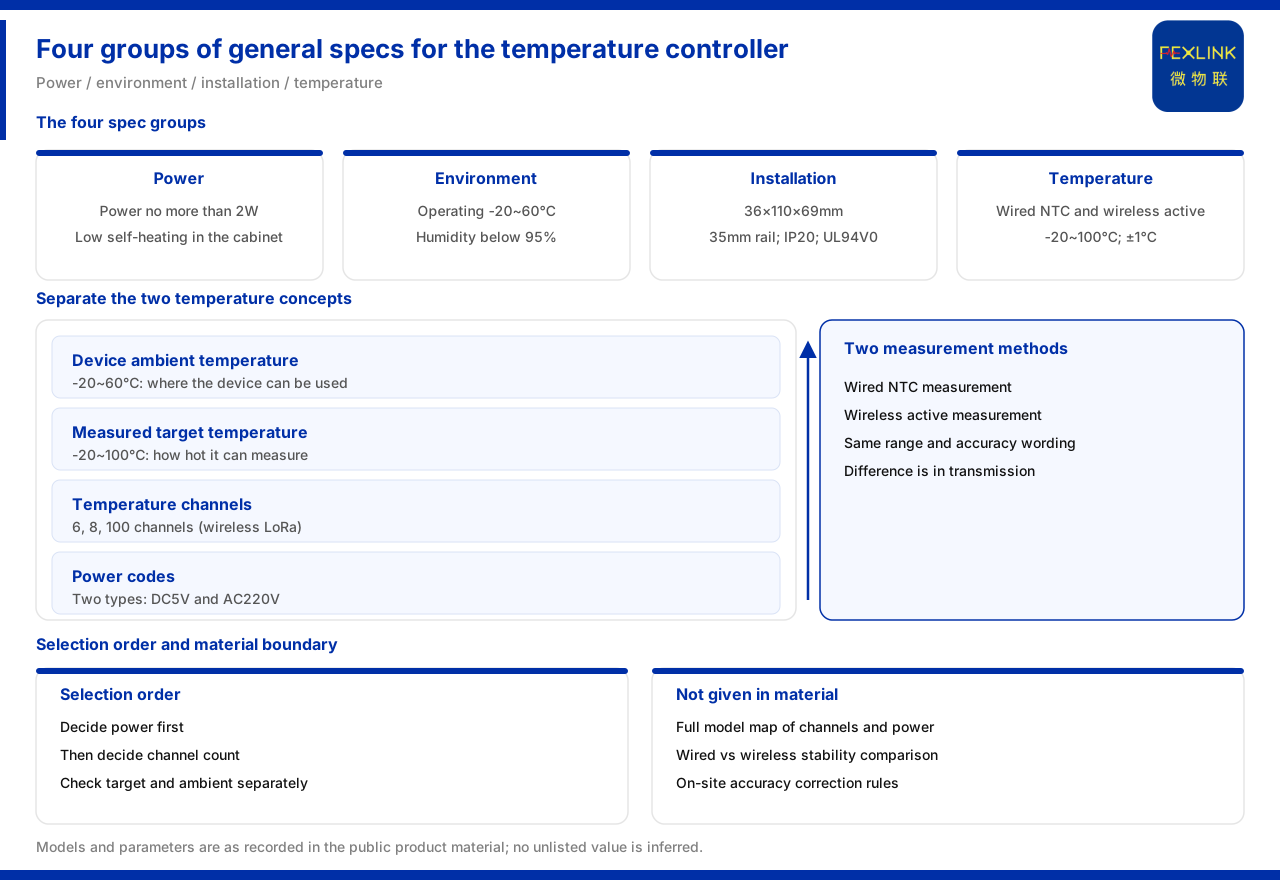
How should the general specifications of a multi-channel temperature controller be read?
Direct answer: the general specifications of the multi-channel temperature controller (for example EST-12920-R) can be read in four groups — power, environment, installation and temperature measurement. For power, consumption is no more than 2 W; for environment, the operating temperature is -20 to 60°C and humidity below 95%; for installation, the dimensions are 36 × 110 × 69 mm, mounting is 35 mm rail, the enclosure flame-retardant rating is UL94V0 and the protection rating is IP20; and for temperature measurement, both wired NTC and wireless active methods have a measurement range of -20 to 100°C and an accuracy of ±1°C. In addition, the model rule provides two supply codes, DC 5 V and AC 220 V, and the temperature path counts include specifications such as 6 paths, 8 paths and 100 paths (wireless LoRa). Looking at the four groups together prevents selection from fixing on only one item.
It should first be stated that these values are general product specifications and are confirmable formulations given by the material. What the material does not give is the complete specific models for every combination of path count and supply, nor a description of the performance differences between the specifications. The following therefore only organises the specifications and suggests a selection order, without filling in for a specific project beyond the material.
Power and environment: look at consumption first, then operating conditions
Consumption of no more than 2 W is a relatively low level. Its direct meaning is that, when the multi-channel temperature controller operates for long periods inside a distribution cabinet, its own heat generation is limited and it is unlikely to affect the temperature distribution in the cabinet through device heating. For situations with a compact cabinet space that still need multi-point temperature measurement, low consumption is a practical precondition.
The operating temperature of -20 to 60°C and humidity below 95% together describe the environmental window in which the device works normally. Two different temperature concepts must be distinguished here: -20 to 60°C is the device's own operating environment temperature, while -20 to 100°C is the range of object temperature it can measure. The former says "where the device can be used", the latter says "how hot a thing the device can measure". Confusing the two is a common selection error — the cabinet environment may be only 30°C, while the contact temperature to be monitored may approach 100°C.
Appearance and installation: size and protection must be read together
The dimensions of 36 × 110 × 69 mm and 35 mm rail mounting are definite information at the mechanical level. Rail mounting means it can be arranged side by side with other rail-mounted devices in a distribution cabinet, making wiring and maintenance easier. The size figures are used to check the arrangement space in the cabinet: where many devices are already installed, the volume of 36 × 110 × 69 mm needs to be reserved in advance.
The protection rating IP20 and the enclosure flame-retardant rating UL94V0 convey two different kinds of safety information. IP20 indicates that it mainly faces in-cabinet installation and does not have protection capability in outdoor or heavy-dust-water environments; UL94V0 indicates that the enclosure material reaches the corresponding level of flame retardancy. One is "whether external intrusion is prevented", the other is "how the material behaves when exposed to fire"; they cannot substitute for each other. For in-cabinet application, these two indicators together with 35 mm rail mounting form a relatively complete description of environmental adaptability.
Measurement range and accuracy: both methods give the same formulation
The material confirms that both wired NTC and wireless active measurement methods have a measurement range of -20 to 100°C and an accuracy of ±1°C. This deserves separate emphasis: it shows that, in temperature-measurement capability, the wired and wireless routes do not trade accuracy for wiring convenience. For a project that was hesitating over wireless points because of wiring difficulty, this is valuable information.
The ±1°C accuracy should be understood as a formulation given by the material, not as a guarantee for any field condition. The actual performance of accuracy is affected by the sensor mounting method, the contact condition of the measured point and the field electromagnetic environment. When writing ±1°C into a scheme, the prudent wording is "accuracy ±1°C according to the material formulation, with actual performance subject to field installation and measurement", rather than treating it as an unconditionally valid conclusion.
Temperature paths and supply: two dimensions of supply and demand
The multi-channel temperature controller provides two supply codes, DC 5 V and AC 220 V. The supply system is determined by field conditions: whether the cabinet can provide DC or AC directly decides the choice of model segment. In selection, confirm the field power first and then look at the path count under the same supply system, which avoids choosing a model that cannot be connected.
The temperature path counts include specifications such as 6 paths, 8 paths and 100 paths, of which the 100 paths correspond to the wireless LoRa method. The path count determines how many temperature points a single device can connect. From 6 paths and 8 paths to 100 paths the span is large, showing that the product line covers both "nearby monitoring of a small number of points" and "centralised monitoring of a large number of points". Note that the path-count specification and the supply code are two independent dimensions; a chosen path count does not by itself determine the supply. The correct order is to fix the supply, then the path count, and finally check that the two fall within one selectable model.
A clear selection order
Stringing the above specifications together gives a concise selection order. First, confirm the field power and choose between DC 5 V and AC 220 V. Second, count the temperature points and judge whether 6 paths, 8 paths or 100 paths is more suitable, and decide accordingly between wired NTC and wireless LoRa. Third, check whether the measured-object temperature falls within -20 to 100°C, and confirm whether the cabinet environment temperature falls within -20 to 60°C and whether humidity is below 95%. Fourth, check the cabinet space and the mounting method, confirm that the volume of 36 × 110 × 69 mm and 35 mm rail mounting can be implemented, and check whether IP20 satisfies the in-cabinet environment requirement.
The value of this order is that it puts "power" before "path count" and checks "measured-object temperature" and "device environment temperature" separately. A common site problem is to look at the path count first and only later discover a power or environment mismatch. Following the order above markedly reduces rework.
Parts the material does not give
First, the material gives no complete model correspondence table for the different path-count and supply combinations, so a specific model cannot be filled in by inference. Second, the material gives no comparison of wired and wireless in communication stability or installation cost; these need to be assessed according to field conditions. Third, the material gives no field correction rule for accuracy, and how deviations beyond ±1°C are counted falls within field measurement. Fourth, the material gives no implementation details such as wiring and address allocation when 100 paths are fully configured. Treating these as established conclusions in a scheme goes beyond the boundary of the product material.
Summary
The general specifications of the multi-channel temperature controller can be summarised as a set of definite values: consumption no more than 2 W, operating temperature -20 to 60°C, humidity below 95%, dimensions 36 × 110 × 69 mm, 35 mm rail mounting, UL94V0 enclosure and IP20 protection; wired NTC and wireless active measurement both with a range of -20 to 100°C and an accuracy of ±1°C; supply with two codes DC 5 V and AC 220 V; and temperature path counts of 6 paths, 8 paths and 100 paths (wireless LoRa).
For selection staff, the prudent approach is to fix the supply first, then the path count, then check the measured-object temperature and the device environment temperature separately, and finally implement installation and protection; for review and delivery, it should be checked whether the scheme treats model correspondence, communication comparison or accuracy correction not given by the material as definite conclusions. Keeping "where the device is used" and "what the device measures" separate in the wording is what prevents the specifications of the multi-channel temperature controller from being misread.