 FEXLINK Research Institute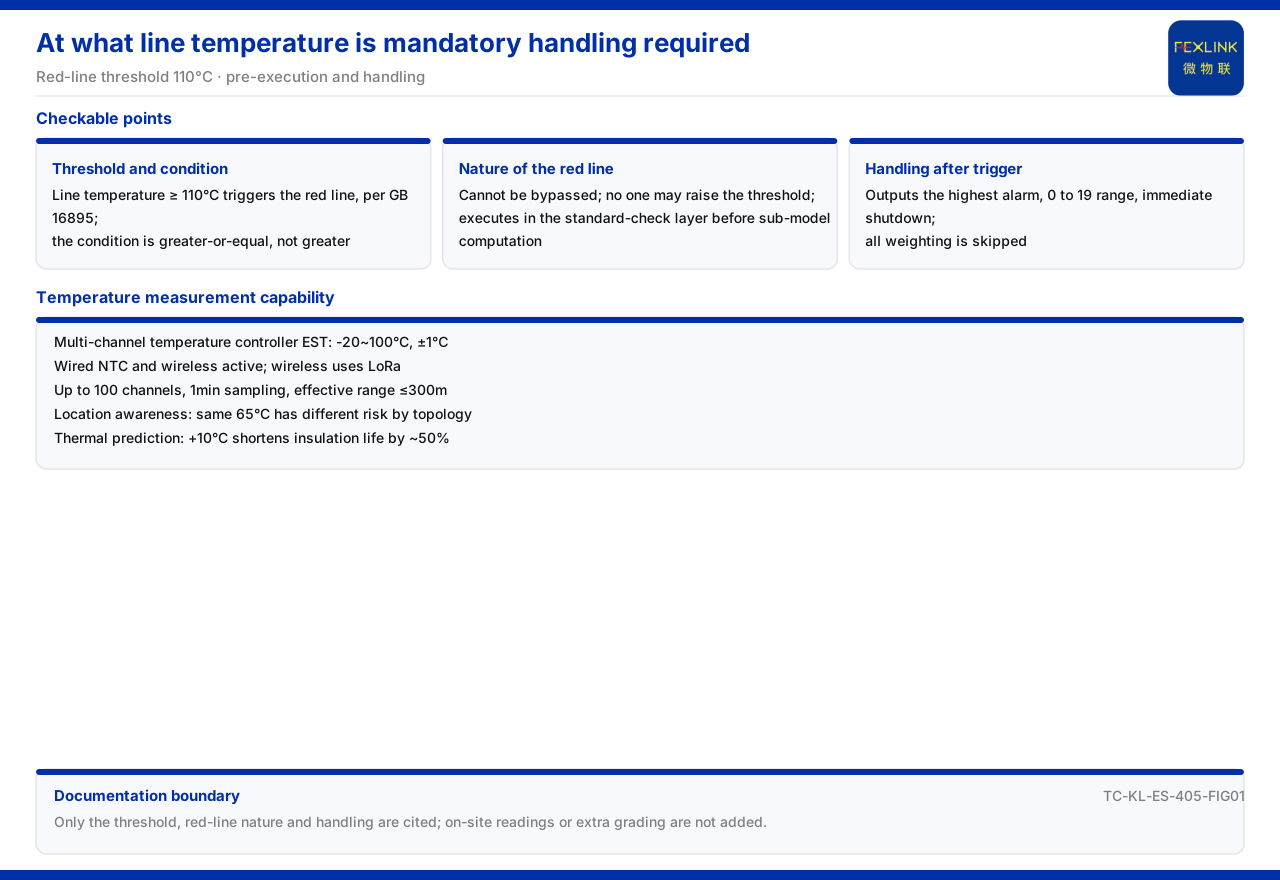
Direct Answer
The line-temperature threshold that mandates compulsory handling is 110°C. In the safety red-line guard of the product documentation, one rule is triggered when the line temperature is greater than or equal to 110°C, with GB 16895 as its standard basis, and it is one of several non-bypassable red lines. This red line executes in the standard-verification layer before the sub-model calculation; once triggered, it outputs the highest-level alarm and skips the weighted calculation, and the highest-level alarm corresponds to an immediate shutdown. Line temperature is therefore not an ordinary monitoring item that merely prompts at some value, but one that is brought into compulsory handling. This article cites only the threshold, the red-line property, and the handling definition; it does not infer a specific on-site temperature reading and does not supplement unlisted standards or thresholds.
1. The Threshold for Compulsory Handling: Line Temperature at or Above 110°C
Temperature monitoring and temperature alarming are two different things. Monitoring answers "what is the temperature," while alarming answers "when a condition is met, what must be done." The documentation states the compulsory line-temperature threshold explicitly as greater than or equal to 110°C and places it inside the safety red-line guard framework. The meaning of this number is that it is no longer an adjustable reminder line but a handling line that must be responded to once triggered.
Two points need attention when reading this threshold. First, the condition is "greater than or equal to," not "greater than," and the two differ at the critical point. Second, 110°C is the threshold of the line-temperature object, not a universal threshold for all temperature measuring points; different monitored objects may correspond to different criteria, and the line-temperature threshold cannot be applied to other points. The documentation gives no other temperature grading beyond this threshold, so this article cites only this explicit compulsory threshold and does not add speculative gradings.
2. The Nature of This Red Line: Non-Bypassable and Executed in Advance
The safety red-line guard is not an ordinary rule but a set of non-bypassable rules. The documentation states that no person can raise the threshold of these red lines, and the line-temperature red line is one of them. "Non-bypassable" has two meanings: the threshold may not be adjusted inside the system to make it easier to pass, and the red line itself does not accept manual exemption.
More important is the execution position. The documentation states that the red line executes in the standard-verification layer before the sub-model calculation; once triggered, it directly outputs the highest-level alarm and skips all weighted computation. This means the temperature red line is not one factor among many weighted items but a gate placed up front: it occurs before the composite score and, when triggered, terminates subsequent computation, preventing an event that has crossed the red line from being diluted by later weighting. The value of understanding this is that line-temperature handling should not be treated as a score item that can be traded off against other dimensions.
3. Handling After Triggering: Highest-Level Alarm and Immediate Shutdown
The alarm system in the documentation is a graded structure, and the highest-level alarm corresponds to the 0 to 19 point interval, with immediate shutdown as the required handling. Once the line-temperature red line is triggered, this highest-level alarm is output. Reading "non-bypassable" together with "directly outputs the highest level" makes the handling path clear and single: the condition is met, the level is highest, and shutdown is immediate.
The scope to hold is that this article cites only the trigger condition, the standard basis, the non-bypassable property, the advance execution position, and the handling level after triggering; it does not restate finer scoring rules and does not infer shutdown procedure details for different sites. The documentation already states the chain "reaching 110°C outputs the highest level," and this article neither adds nor removes steps on that basis.
4. Temperature-Measurement Capability: The Multi-Channel Temperature Controller
For the temperature red line to be triggered, temperature must first be acquired. The documentation records that the multi-channel temperature intelligent controller (EST series) provides wired NTC temperature measurement and wireless active temperature measurement; both have a measurement range of -20~100°C and an accuracy of ±1°C. The wireless method uses LoRa communication, supports a maximum of 100 channels, has an adjustable sampling period of 1min, and an effective distance of no more than 300m.
The model rule encodes power supply, display, channel count, temperature-measurement method, and humidity by digit, where the measurement-method position contains wired NTC and wireless 433, and the channel-count position contains 6 channels, 8 channels, and 100 channels. These parameters show that temperature acquisition is scalable in channel count and access method: it supports dense wired points with a limited channel count and larger wireless networks. This article cites only the listed measurement range, accuracy, channel maximum, sampling period, and effective distance, and does not infer the measurement coverage or response actually achievable at a site.
5. The Same Temperature Carries Different Risk at Different Positions
The same temperature value does not necessarily mean the same risk. The location-aware mechanism in the documentation states that the same 65°C corresponds to different risks at different electrical topology positions: normal at transformer windings, medium risk at the main busbar, high risk at outgoing terminals, and dangerous at cable sheaths. This mechanism shows that temperature handling cannot look only at the absolute value but must also consider the topology position of the measuring point.
This distinction matters equally for understanding the 110°C threshold. The 110°C is the trigger line of the line-temperature red line, while location awareness describes risk stratification of the same temperature at different positions; the two act differently and cannot replace each other. The documentation gives no conversion between location correction and the 110°C threshold, so this article does not derive one from the other and cites the two mechanisms separately.
6. The Lifetime Dimension of Temperature-Rise Prediction
Beyond the immediate threshold, temperature also relates to insulation lifetime. The temperature-rise prediction mechanism in the documentation takes the Arrhenius equation as its theoretical basis and states that for every 10°C increase in temperature rise, insulation lifetime shortens by about 50%. This relationship provides a lifetime dimension for temperature handling: it explains why temperature must be dealt with early rather than only after crossing the red line.
The boundary to hold especially is that this is the theoretical basis of a prediction mechanism, not an exact calculation of on-site lifetime. The documentation gives the relationship "temperature rise plus 10°C, lifetime shortened by about 50%," and this article cites it on that basis only; it does not calculate the remaining lifetime of a specific device under a specific temperature rise, and does not combine it with the 110°C red line into a new decision rule.
Scope and Limitations
First, this article restates only what the product documentation lists, and its factual boundary is limited to the line-temperature entry in the safety red-line guard, the models and parameters of the multi-channel temperature intelligent controller, and the location-aware and temperature-rise prediction mechanisms.
Second, the trigger condition of line temperature greater than or equal to 110°C, the GB 16895 basis, the non-bypassable property, and the advance execution position are cited as listed in the safety red-line guard; this article does not restate the other red lines and does not supplement other temperature gradings.
Third, the 0 to 19 point highest-level alarm and immediate shutdown are cited as listed in the alarm system; this article does not expand shutdown procedure details.
Fourth, the -20~100°C, ±1°C, LoRa, maximum 100 channels, adjustable 1min sampling period, and effective distance of no more than 300m of the multi-channel temperature intelligent controller (EST series), together with the measurement-method and channel-count values in the model rule, are cited as listed; this article does not supplement unlisted models.
Fifth, the 65°C risk examples at different topology positions in location awareness and the relationship of a 10°C rise to about 50% shorter insulation lifetime in temperature-rise prediction are cited as listed; this article does not calculate a specific device lifetime from them.
Sixth, a concrete temperature-monitoring scheme must be fixed against the site topology, measuring-point layout, and operation requirements; this article provides no selection or decision calculation, and the latest product documentation and formal documents prevail in practice.