 FEXLINK Research Institute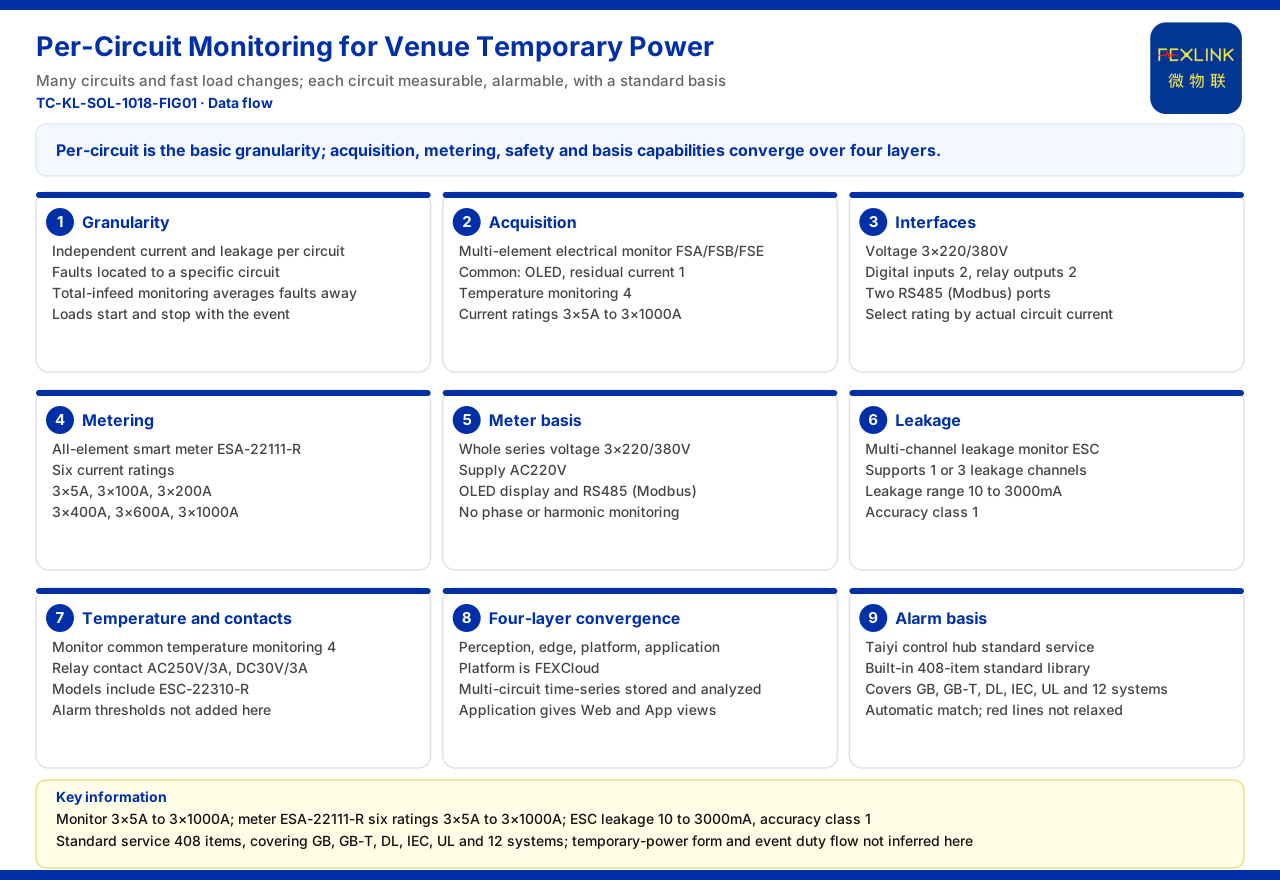
Direct answer
Temporary power at a sports venue has many circuits, fast load changes and a mixed workforce, so monitoring focuses on three things: whether every circuit can be measured, whether an anomaly raises an alert, and whether the alert has a standard basis. The capability combination given by the product knowledge base is: on the acquisition side, the multi-parameter electrical intelligent controller (FSA/FSB/FSE series) selected by circuit current, together with an embedded or all-parameter smart meter for metering; on the safety side, the multi-channel leakage-current monitoring and control device (ESC) for leakage monitoring; on the platform side, aggregation along the general four-layer architecture; and on the basis side, clause matching from the standard service of the Taiyi intelligent control hub system. One boundary must be written first: the product knowledge base does not define a dedicated product form for sports-venue temporary power, and gives neither the monitoring configuration of a temporary distribution box for a large event nor the specific clauses of GB 50054, so this article describes only the product and platform capabilities usable for temporary-power monitoring, and infers no dedicated temporary-power device or event duty process.
1. Why temporary power needs per-circuit monitoring
Temporary power at a sports venue is usually drawn from the existing distribution system to serve audience services, event broadcasting, lighting and temporary catering. These loads are temporary and the circuits are many with unclear boundaries. If only one point at the main incoming line is monitored, anomalies across multiple loads are averaged out: neither which circuit is overloaded nor where leakage occurs can be seen.
"Per circuit" is therefore the basic granularity of temporary-power monitoring: every circuit needs independent current and leakage observations, so an anomaly can be located to a specific circuit. In the selection comparison of the product knowledge base, the combination for smart-building multi-circuit power management is the multi-parameter electrical intelligent controller (selected by circuit current) plus an embedded or all-parameter smart meter, precisely an expression of this granularity.
2. Acquisition side: the multi-parameter controller selected by circuit current
The mainstay of the acquisition side is the multi-parameter electrical intelligent controller. The product knowledge base records that the common functions of the multi-parameter electrical intelligent controller (FSA/FSB/FSE series) include an OLED display, one residual-current channel, a voltage of 3 × 220/380 V, 4 temperature-monitoring channels, 2 switching-value inputs, 2 relay outputs, meter monitoring and two RS485 (Modbus) channels, with a current range from 3 × 5 A to 3 × 1000 A.
These parameters show the series can take current, residual current, temperature and switching-value signals at once and suits per-circuit deployment. The current range from 3 × 5 A to 3 × 1000 A means the grade is chosen against the actual circuit current at selection. Note that the product knowledge base gives the common-function definition of the whole series; the function combination of a specific model follows its model table, and this article infers no parameter difference of unlisted models.
3. Metering side: the meter supplements energy
Beyond the controller, the metering side is taken by the smart meter. The product knowledge base records that the all-parameter smart meter (ESA-22111-R) has six current grades, namely 3 × 5 A, 3 × 100 A, 3 × 200 A, 3 × 400 A, 3 × 600 A and 3 × 1000 A; the whole series has a voltage of 3 × 220/380 V, supports meter monitoring, is supplied at AC220V, and has an OLED display and RS485 (Modbus); this all-parameter smart meter has no phase or harmonic monitoring, and if such capability is needed one may choose a three-phase imbalance monitor or a power-quality monitor.
For temporary power, the meter's energy metering and the controller's circuit monitoring complement each other: the controller looks at circuit state, the meter at energy. The product knowledge base gives no specific meter quantity or accuracy for the temporary-power scenario, and this article adds none. In the selection comparison, smart-building multi-circuit power management lists both the controller and the meter, showing they are a matched pair in circuit management.
4. Safety side: how leakage and temperature are covered
Among temporary-power safety risks, leakage and temperature rise need separate coverage. The product knowledge base records that the multi-channel leakage-current monitoring and control device (ESC) supports one or three channels of leakage monitoring, with a leakage range of 10 to 3000 mA and accuracy class 1; relay contact ratings of AC250V/3A and DC30V/3A; and leakage controller models ESC-22310-R, ESC-12111-R, ESC-12311-R, ESC-22111-R and ESC-22311-R. In addition, the common functions of the multi-parameter controller include one residual-current channel and 4 temperature-monitoring channels, supplementing residual-current and temperature observation on the circuit side.
These are given verbatim: leakage monitoring offers two densities, one and three channels, while temperature monitoring is provided with 4 channels on the controller. The product knowledge base gives no leakage alarm threshold or temperature-rise decision line for the temporary-power scenario, so this article adds none of these unlisted values.
5. Data link: how the four-layer architecture aggregates temporary circuits
The product knowledge base gives the general four-layer architecture of the monitoring system: the perception layer consists of monitoring modules, smart meters and sensors; the edge layer consists of gateways, industrial wearables and cloud PLCs; the platform layer is FEXCloud, handling device access, a time-series database and an AI reasoning engine; and the application layer provides Web and App visualisation, alert management, analysis reports and mobile inspection.
The per-circuit data of temporary circuits is aggregated along this link from the perception layer to the application layer. For the event site, the application layer's visualisation and alert management are what duty staff touch directly; the platform layer stores and analyses multi-circuit time-series data. The product knowledge base gives no protocol or site-network detail between the layers, and this article does not add any.
6. Basis side: how standard clauses link to alerts
For a temporary-power alert to be used in on-site handling, it must correspond to a standard clause. The product knowledge base records that the Taiyi intelligent control hub system includes a standard service with a built-in library of 408 standards, covering 12 systems such as GB, GB-T, DL, IEC and UL, supporting automatic clause matching, with red-lines that cannot be relaxed. This means an anomaly from temporary-power monitoring can be matched to a corresponding clause as the alert basis.
Note that the product knowledge base records only the scale, system range and matching mechanism of the standard library, and gives neither the specific clause list for sports-venue temporary power nor the content of GB 50054, so this article cites no specific clause number and makes no compliance judgement.
7. Common misreadings and reading order
The first misreading is to monitor only the main incoming line and ignore per-circuit granularity, so an anomaly cannot be located. The second is to mix the roles of controller and meter and ignore that the former stresses state and the latter stresses energy. The third is to treat the one- and three-channel leakage-monitoring densities as freely expandable and ignore that the product knowledge base gives no expansion rule. The fourth is to understand the standard service as a red-line that can be relaxed and ignore its non-relaxable nature. The fifth is to treat temporary power as a dedicated scenario the knowledge base has already defined and ignore that it gives no dedicated form or configuration.
The corresponding reading order is: first determine the controller grade by circuit current, then determine the meter configuration, then add leakage and temperature monitoring as needed, confirm data aggregation along the four-layer architecture, and finally return to the standard service to match the alert basis.
Scope and limitations
First, the factual basis of this article is the product knowledge base, and all product parameters are limited to what it lists. Second, the product knowledge base does not define a dedicated product form for sports-venue temporary power and gives neither the monitoring configuration of a temporary distribution box for a large event nor the specific clauses of GB 50054, and this article infers no dedicated temporary-power device or event duty process. Third, the common functions and the 3 × 5 A to 3 × 1000 A current range of the multi-parameter electrical intelligent controller (FSA/FSB/FSE series) are cited as listed. Fourth, the one- or three-channel leakage monitoring, 10 to 3000 mA, accuracy class 1 and relay contact ratings of the multi-channel leakage-current monitoring and control device (ESC) are cited as listed, and this article adds no alarm threshold. Fifth, the six current grades, 3 × 220/380 V, AC220V, OLED and RS485 (Modbus) of the all-parameter smart meter (ESA-22111-R) are cited as listed. Sixth, the 408-standard library and 12 systems of the Taiyi intelligent control hub system standard service are cited as listed, and this article makes no compliance judgement. Seventh, this article does not constitute a commitment to a site temporary-power scheme or duty process; the actual situation is subject to the latest product material and formal documents.