 FEXLINK Research Institute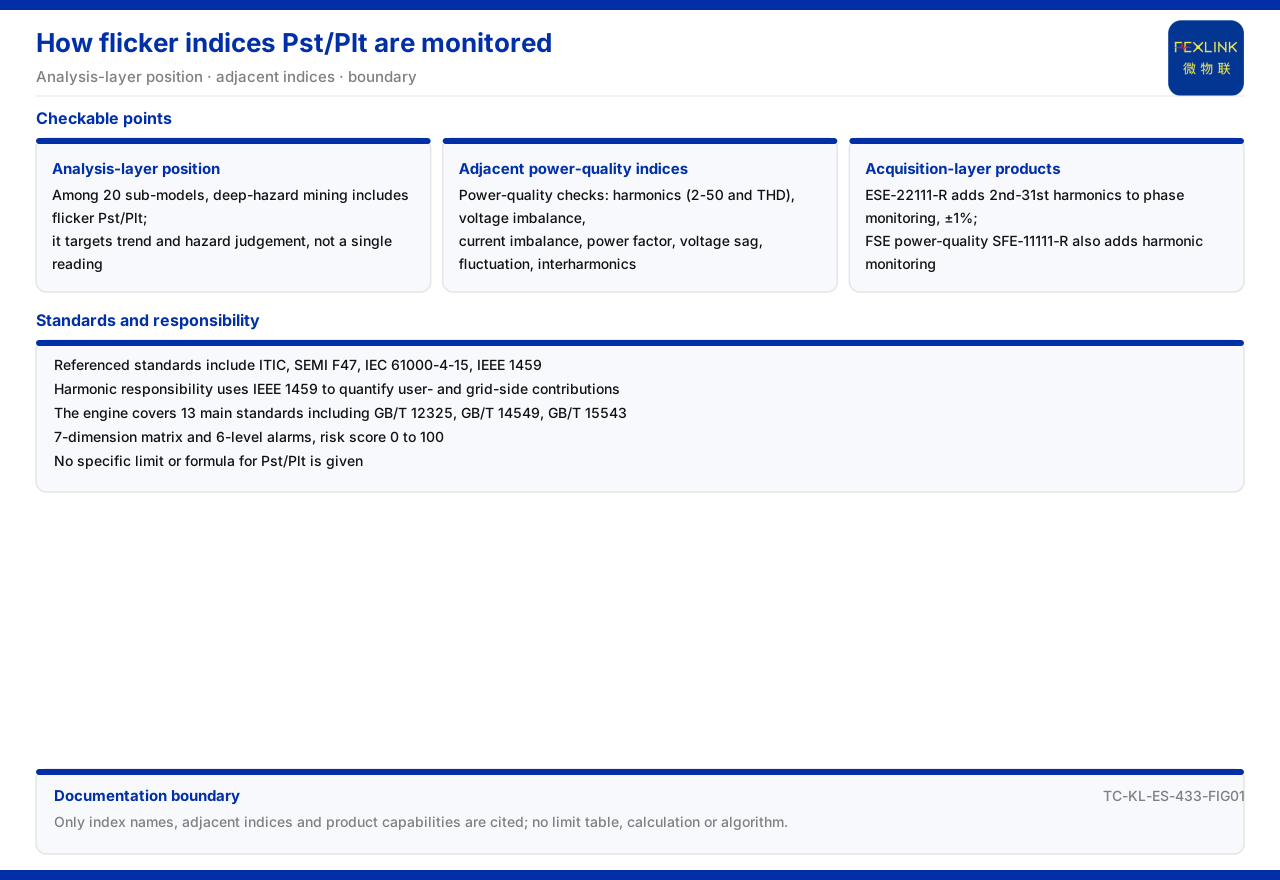
Direct Answer
On how the flicker indicators Pst/Plt are monitored, the product documentation gives an analysis-layer positioning rather than a set of measurement methods. The documentation divides the 20 specialized sub-models of the Qianzhi engine into several groups, among which deep hazard mining contains flicker synthesis (Pst/Plt), that is, Pst and Plt are listed as monitoring and analysis indicators. At the same time, the documentation gives no specific limit or calculation formula for Pst/Plt. The power-quality indicators adjacent to flicker are distributed within the Qianzhi power-quality physical examination, covering harmonics (orders 2-50 and THD), voltage imbalance, current imbalance, power factor, voltage dips, voltage fluctuation, and interharmonics. On the field-product side, the ESE power-quality monitor (ESE-22111-R) adds harmonic monitoring on top of phase monitoring, for harmonics of orders 2~31, at ±1% accuracy.
This article can therefore confirm that Pst/Plt belongs to the flicker-synthesis analysis indicators and its adjacency to harmonics and other indicators; it cannot give limits or algorithms, because the latter is outside the documentation boundary.
1. The Position of Pst/Plt in the Qianzhi Engine
The documentation divides the specialized sub-models of the Qianzhi engine into 20, and the deep hazard mining group contains flicker synthesis, whose indicators are recorded as Pst/Plt. Flicker is therefore not an isolated function but a composite analysis within deep hazard mining.
This positioning shows that Pst/Plt faces trend and hazard judgment rather than a single-point reading. Placing it in the deep hazard mining group means it serves deeper analysis of power-quality problems. The 20 sub-models are grouped, showing that the Qianzhi engine places judgments of different natures in different groups. Flicker synthesis sits in deep hazard mining and belongs to a different group from harmonic indicators in power-quality physical examination, and this grouping is itself positioning information given by the documentation.
2. The Power-Quality Examination Items Adjacent to Flicker
The documentation defines one group of Qianzhi sub-models as power-quality physical examination, covering harmonics (orders 2-50 and THD), voltage imbalance, current imbalance, power factor, voltage dips, voltage fluctuation, and interharmonics. Voltage dips cite ITIC and SEMI F47, voltage fluctuation cites IEC 61000-4-15, and interharmonics is one item among them.
Placing flicker synthesis alongside these examination items shows that power quality is a multi-indicator set. Flicker concerns the visual perception of voltage fluctuation, harmonics and interharmonics concern waveform distortion, imbalance concerns three-phase difference, and power factor concerns reactive power. They are independent yet together form a power-quality picture. Power-quality physical examination covers both steady-state and transient quantities. Steady-state quantities include imbalance and power factor; transient quantities include voltage dips and voltage fluctuation. Reading flicker alongside these confirms it belongs to the multi-indicator set of power quality.
3. Field-Side Power-Quality Products
At the acquisition layer, the documentation lists the ESE power-quality monitor (ESE-22111-R) with harmonic monitoring added on top of phase monitoring, measuring harmonics of orders 2~31 at ±1% accuracy, with 2 switching-value inputs, 1 relay output, and RS485 (Modbus) communication. Another related product is the FSE multi-parameter electrical intelligent controller (power-quality type) (SFE-11111-R), which likewise adds harmonic monitoring on top of phase monitoring.
Acquisition and analysis must be distinguished: the ESE and FSE handle field acquisition of harmonics and other quantities, while Pst/Plt appears at the analysis layer of the Qianzhi engine. Field products provide data, and analysis models give conclusions.
4. Harmonic Responsibility Division
The documentation records one specialized analysis of the Tianyan engine as harmonic responsibility division, using IEEE 1459 to quantify the harmonic contribution of the user side and the grid side. It belongs to power-quality specialized analysis and complements the examination items of the Qianzhi engine: one performs condition assessment, the other assigns responsibility.
Placing harmonic responsibility division alongside Pst/Plt shows that power-quality analysis includes both indicator evaluation and responsibility determination. The two face different questions and should be matched separately in selection and treatment. Using IEEE 1459 for responsibility division shows that harmonic treatment is not only a monitoring issue but also involves quantifying responsibility. Placing this analysis alongside flicker synthesis shows that power-quality analysis covers both status indicators and responsibility attribution.
5. Technical Specifications and the Alarm System
The documentation lists the technical specifications of the Qianzhi engine, covering 13 main standards including GB/T 12325, GB/T 14549, and GB/T 15543, and configures the 7-dimension perception matrix and the 6-level alarm system; the 7-dimension perception matrix includes the time-series risk score, with values from 0 to 100. These specifications provide the standard basis and alarm grading for power-quality indicators.
For Pst/Plt, the listing of these standards shows that the analysis system containing flicker has a corresponding normative background, but the documentation lists only standard names and does not expand to the flicker limit clauses. The 13 main standards standing alongside the 7-dimension perception matrix and the 6-level alarm system show that the Qianzhi engine has perception and alarm layers beyond the standard basis. The time-series risk score from 0 to 100 is one form of quantitative expression.
6. Reading from Indicator to Monitoring Configuration
Linking the analysis layer and the acquisition layer yields a reading supported by the documentation. On the analysis layer, the Qianzhi engine lists power-quality physical examination as a group of sub-models covering harmonics, imbalance, power factor, voltage dips, voltage fluctuation, and interharmonics, and lists flicker synthesis as one of the deep hazard mining indicators. On the acquisition layer, the ESE power-quality monitor and the FSE multi-parameter electrical intelligent controller (power-quality type) add harmonic monitoring on top of phase monitoring, and the former can measure harmonics of orders 2~31.
Two kinds of need can thus be distinguished: to obtain field quantities such as harmonics, compare against the monitoring capability of field products; to obtain analysis conclusions such as flicker, compare against the sub-model grouping of the Qianzhi engine. The documentation lists the two kinds of information separately, and selection should not treat an indicator name directly as a function of a specific product. In other words, acquisition capability and analysis indicators belong to different products or modules, and a requirement should first be classified as a quantity or a conclusion.
7. The Documentation Boundary
The documentation gives no specific limit or calculation formula for Pst/Plt and lists only flicker synthesis (Pst/Plt) as a deep hazard mining analysis indicator. This article therefore provides no limit table or calculation process.
If measurement and pass/fail judgment are required, an applicable measurement method and standard clause should be used separately. This article's boundary stops at the listed indicator names, adjacent indicators, and related product capabilities.
Scope and Limitations
First, this article restates only what the product documentation lists. The Qianzhi engine sub-model grouping, the power-quality examination items, the harmonic capability of the ESE and FSE, harmonic responsibility division, and the Qianzhi technical specifications are cited as written.
Second, this article does not infer the limit, calculation formula, or measurement method of Pst/Plt, and does not derive an algorithm from an indicator name.
Third, ITIC, SEMI F47, IEC 61000-4-15, IEEE 1459, and the national standards are cited as listed; this article does not expand their clauses.
Fourth, this article does not conclude that a specific field product already has flicker-measurement capability, because the documentation does not map the flicker indicator to a specific model.