 FEXLINK Research Institute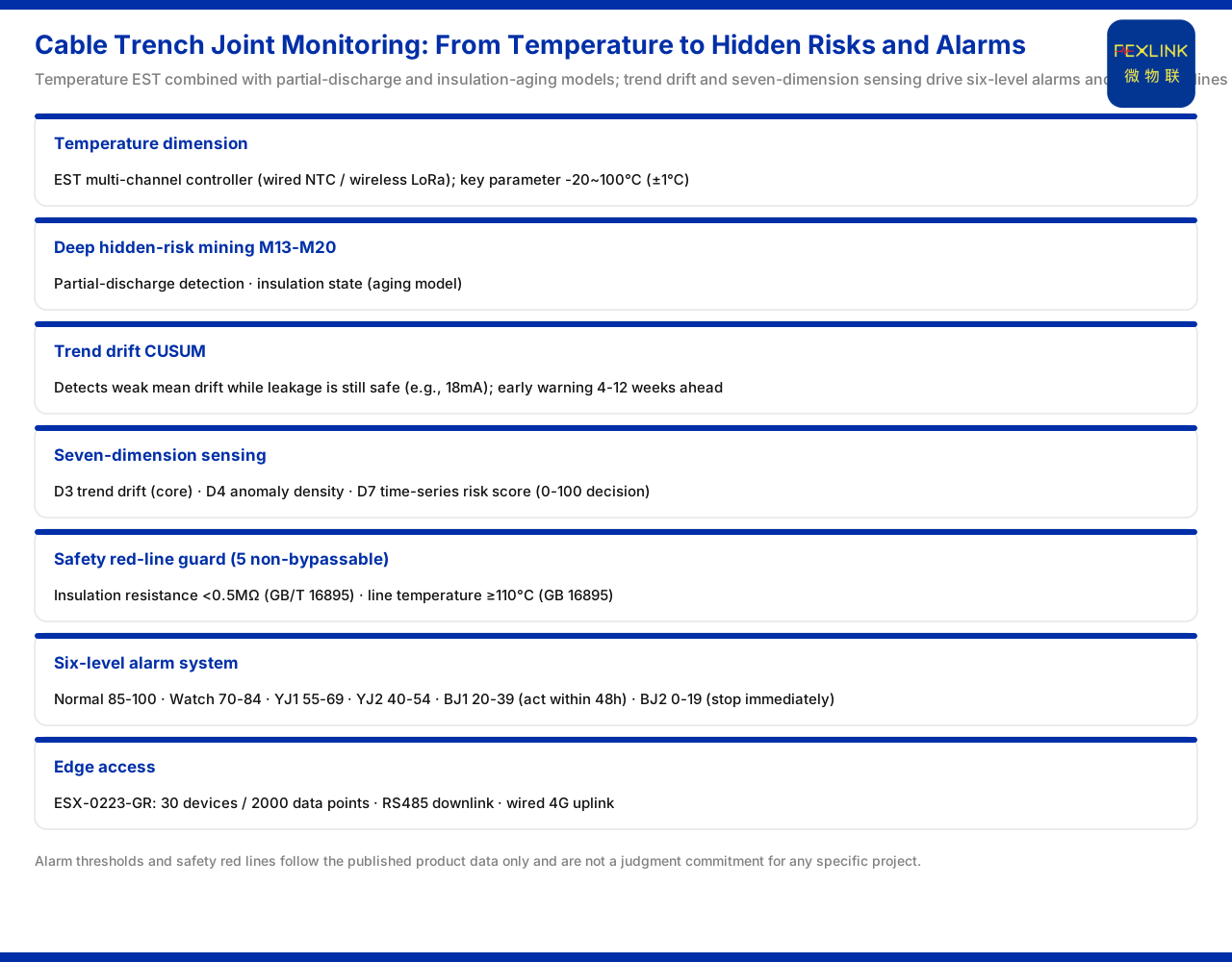
Direct answer
Distribution-line hazards have a quiet form: insulation ages slowly, contacts heat up slowly, values remain within the permitted range, and yet the system is already sliding toward danger. Catching this kind of hazard relies on keeping the two dimensions of temperature and insulation in continuous view and making the trend itself the basis for alarm. Based on the wording listed in the product documentation, this article explains how temperature monitoring, deep hazard mining, trend-drift early warning, seven-dimensional perception, the six-level alarm system, and the safety red-line guard connect, and what the aggregation role of the edge gateway is in all of this; it infers no assessment conclusion for any specific line.
1. Temperature is only the starting point: joint cable-trench monitoring
The product documentation states that the multi-channel temperature intelligent controller (EST series) provides temperature monitoring through two paths, wired NTC and wireless LoRa, with the key temperature parameters being minus 20 to 100 degrees Celsius and an accuracy of plus or minus 1 degree Celsius, forming the temperature dimension of joint cable-trench monitoring. The emphasis here is not on temperature itself but on the word dimension: temperature is one coordinate in joint monitoring, not the whole.
The risks of cable trenches and distribution cabinets are often compound: abnormal current, degraded insulation, and contact temperature rise accompany one another. Measuring only temperature shows the thermal result; measuring only current shows the electrical result. Only by including temperature as one dimension in joint monitoring can the problem be located when several signals move abnormally at the same time. The product documentation gives the collection wording for this temperature dimension, and this article does not infer the threshold settings of the other dimensions in joint monitoring.
2. Deep hazard mining: partial discharge and insulation ageing
The product documentation states that the Qianzhi engine has 20 dedicated sub-models, among which the deep hazard mining group covers M13 to M20 and includes partial-discharge detection and insulation state (ageing model). The word deep means these models are not satisfied with surface over-limit judgement but model degradation mechanisms that are hard to observe directly.
Partial-discharge detection focuses on the signs of partial discharge inside insulation; the insulation-state model focuses on the ageing process. Together they point at the same class of hazard: insulation degradation usually appears long before failure and does not always manifest as an obvious over-limit value. Listing them in the deep hazard mining group shows that the duty of this layer of modelling is to derive invisible states from visible quantities. The product documentation gives only the model grouping and names, and this article does not expand the inputs and algorithms of each model.
3. Trend drift: why CUSUM can alarm within the safe range
The product documentation states that the residual-current trend-drift model (S-02) of the Tianyan engine uses the cumulative sum (CUSUM) method, which can detect a weak mean shift while the leakage is still within the safe range (for example, 18 mA) and give early warning 4 to 12 weeks in advance. This is the point most worth developing in this article.
Traditional threshold alarms act only after a value crosses the red line, whereas CUSUM captures the slope of a slowly shifting mean. When leakage quietly rises from a steady value, a single point may still be within the safe range, but the cumulative deviation has already stayed positive, and the model can issue early warning on that basis. The meaning of 4 to 12 weeks in advance is that this window is exactly the time to arrange maintenance, replacement, or rotation. The product documentation gives the method and the lead-time wording, and this article does not infer the actual remaining life of any line from it.
4. Seven-dimensional perception and risk scoring
The product documentation states that the Qianzhi engine has a seven-dimensional perception matrix, which includes trend drift (core), anomaly density, and time-series risk scoring. The time-series risk score is a comprehensive decision value from 0 to 100. The existence of the matrix shows that a single indicator is not enough to support judgement and that multiple dimensions must be weighted together.
Among these dimensions, the reason trend drift is marked as core is consistent with the logic of the previous section: it answers where things are heading, while anomaly density answers how dense they are, and the time-series risk score compresses this information into a comparable score interval. A score from 0 to 100 lets risks at different points and times be compared horizontally. The product documentation does not give the specific weight or formula of each dimension, and this article makes no inference.
5. The six-level alarm system and response rhythm
The product documentation states that the alarm system is divided into six levels: normal (85 to 100), watch (70 to 84), YJ1 (55 to 69), YJ2 (40 to 54), BJ1 (20 to 39, requiring action within 48 hours), and BJ2 (0 to 19, requiring immediate shutdown). These six levels map the risk score to an executable response rhythm.
From normal to watch is a prompt; YJ1 and YJ2 are early warning; BJ1 and BJ2 are alarm. The two time limits of 48 hours and immediate shutdown turn score intervals into time constraints. Understanding this mapping explains why the risk score should be made as continuous as possible: only a continuous score can correspond smoothly to actions of different urgency. The product documentation gives the grading wording, and this article does not infer the score attribution of any specific point.
6. Safety red-line guard
The system also has a set of non-bypassable safety red-line guards, stated in the product documentation as five in total, including insulation resistance below 0.5 MΩ (based on GB/T 16895) and line temperature reaching or exceeding 110 degrees Celsius (based on GB 16895). Non-bypassable means that such judgements take priority over the general scoring logic.
Placing the red lines together with the trend early warning above reveals two lines of defence: the red-line guard provides the backstop, acting by hard rules once touched, while trend early warning provides lead time, giving a window before the red line is crossed. The two are not substitutes but a division of labour. The product documentation gives the red-line items and their basis standards, and this article does not infer the thresholds and applicable conditions of the remaining three.
7. How data converges: the role of the edge gateway
For data to take part in the above analysis, it must first converge. The product documentation states that the intelligent edge-computing gateway (ESX-0223-GR) has an access capability of 30 devices and 2000 data points, communicates downward over RS485 and upward over wired 4G. This up-and-down channel determines how field temperature and current data enter the platform-side analysis chain.
One must distinguish collection and aggregation from analysis and judgement. The gateway solves how data is collected and sent upward; deep hazard mining, trend drift, and risk scoring happen on the platform side. Putting the edge gateway into the scheme is to have the temperature dimension and the data of other dimensions converge on the same platform, thereby supporting joint judgement. The product documentation gives the access-capability wording, and this article does not infer the specific topology or data volume on site.
Scope and limitations
First, this article restates only the wording listed in the product documentation, and its factual boundary is limited to: the temperature monitoring method of the multi-channel temperature intelligent controller (EST series) and its minus 20 to 100 degrees Celsius range with plus or minus 1 degree Celsius accuracy; the deep hazard mining group M13 to M20 among the 20 dedicated sub-models of the Qianzhi engine, including partial-discharge detection and insulation state (ageing model); the seven-dimensional perception matrix including trend drift (core), anomaly density, and time-series risk scoring (0 to 100 comprehensive decision); the safety red-line guard of five items including insulation resistance below 0.5 MΩ (based on GB/T 16895) and line temperature reaching or exceeding 110 degrees Celsius (based on GB 16895); the six-level alarm of normal 85 to 100, watch 70 to 84, YJ1 55 to 69, YJ2 40 to 54, BJ1 20 to 39 (action within 48 hours), and BJ2 0 to 19 (immediate shutdown); the intelligent edge-computing gateway (ESX-0223-GR) accessing 30 devices and 2000 data points, downward RS485 and upward wired 4G; and the residual-current trend-drift model (S-02, CUSUM) of the Tianyan engine, which can give early warning 4 to 12 weeks in advance while the leakage is still within the safe range (for example, 18 mA).
Second, this article does not infer the specific weights, algorithms, or input parameters of each model, nor the temperature, insulation, or residual-current assessment conclusion of any specific line.
Third, the temperature and access capabilities are product-documentation wording, and the engineering values of field points, sampling frequency, and red-line thresholds belong to design judgement.
Fourth, specific selection and configuration should follow the latest product documentation, the relevant standards, and the project scheme.