 微物联研究院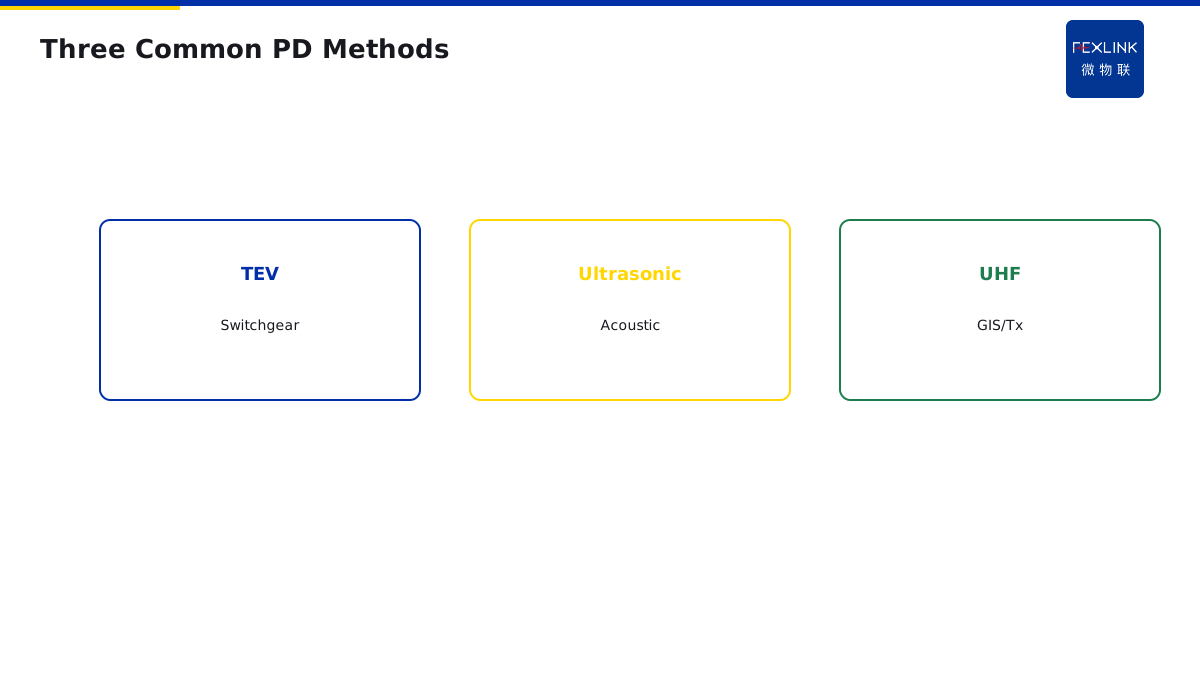
Direct Answer
Partial Discharge (PD) is a localized electrical discharge that only partially bridges the insulation between conductors. It does not puncture the whole insulation, but it is already "leaking sparks" at that point. PD is known as the first signal of insulation degradation—months or years before a cable, switchgear, or transformer actually fails, PD has already begun.
Key insight: PD is not the accident; it is the accident's precursor. By the time breakdown occurs, the equipment is ruined. If you catch it at the PD stage, the insulation can usually keep running.
A 10 kV switchgear in an underground substation: routine PD testing found an abnormal signal on Phase B contact box. The PRPD pattern showed a "clustered distribution"—typical internal void discharge. At the time, everything looked normal: temperature, current, voltage all within range. Operations scheduled a planned outage two weeks later, found a ~2 mm void inside the contact box slowly discharging, and replaced the insulator. The unit has run since. Without PD testing, experience says that void would have developed into a through-discharge in 6–12 months, potentially destroying the entire switchgear panel.
1. What PD Actually Is
Insulation is not perfect. XLPE cable insulation may contain microscopic voids; cast epoxy insulators may have bubbles; transformer oil-paper insulation may be damp or contaminated.
When voltage is applied, these voids/bubbles have a different permittivity, so the electric field concentrates inside the void. When the field exceeds air breakdown strength (~3 kV/mm), a discharge occurs. It is extremely short (nanoseconds), local—hence "partial."
But here is the problem: discharge eats insulation. Each strike leaves a carbonized spot on the void wall; the void grows. Larger void → more concentrated field → more frequent discharge → faster carbonization—a positive feedback loop. Over months to years, the void becomes a through-channel, and breakdown follows.
2. Three Main PD Types
By location, three dominate in engineering:
1. Internal Void Discharge Inside the insulation material. Common in cast epoxy insulators and cable joints. Signature: symmetric "clustered" PRPD pattern, signals on both half-cycles.
2. Surface Discharge On the insulation surface—usually from dirt, moisture, or field concentration near contacts. Common in bushings and cable terminations. Signature: asymmetric PRPD, strong on one half-cycle.
3. Corona Discharge In the air around a high-voltage conductor—usually from sharp edges or burrs. Common on overhead lines and busbars. Signature: strongest near voltage peaks, "needle-tip" distribution.
Severity differs: corona is mildest; void discharge is moderate; surface discharge is most dangerous because it accelerates rapidly once damp.
3. How to Detect PD
Three mainstream methods, complementary rather than substitutes:
Ultrasonic (20–100 kHz) Acoustic sensor on the cabinet wall. Pros: no shutdown, simple, immune to EM noise. Cons: only catches surface/void discharge reaching the wall; insensitive to internal cable defects. Best for: switchgear patrol.
UHF (300 MHz–1.5 GHz) UHF sensor receives EM waves from discharge. Pros: high sensitivity, can localize to a specific bay. Cons: sensors need to be installed inside or with windows; retrofitting live cabinets is complex. Best for: continuous monitoring at critical substations.
HFCT (1–30 MHz) Clamped around the cable ground lead, measures pulse current. Pros: catches internal cable discharge. Cons: sensitive to surrounding noise. Best for: cable-specific surveys.
In practice: ultrasonic for screening, UHF for continuous monitoring, HFCT for cable lines.
4. Why Most Companies Skip PD Testing
PD testing is standard in the West but rare in China. Reasons:
1. "Equipment looks fine." PD is silent—voltage, current, temperature all normal during discharge. Operators see nothing on the meter and conclude no testing is needed.
2. Testing cost looks high. A professional PD survey costs thousands to tens of thousands of RMB per substation. Compared to "replace a switchgear," it is pricy. Compared to "burn down a panel and lose a day of production," it is a rounding error.
3. No trend management. You test once, find an anomaly, and then what? Most companies have no continuous monitoring, so the finding is forgotten by next quarter. FSE edge gateway with UHF sensors is built for this: it continuously logs PD signals, uses the Tianyan S-02 engine to track PRPD trend (pulse repetition rate rising? amplitude growing?), and warns before discharge accelerates.
5. Three Common Field Mistakes
Mistake 1: one clean test = safe forever. PD is progressive. Clean today does not mean clean in three months. Void discharge may grow slowly (years) or suddenly accelerate when damp. Must test periodically or monitor continuously.
Mistake 2: any PD = immediate shutdown. Not all PD needs emergency action. Mild void discharge (<100 pC) can be watched and scheduled for a planned outage; severe surface discharge (>1000 pC and growing) needs urgent shutdown. Treating every PD as emergency causes unnecessary production loss.
Mistake 3: voltage/current normal = insulation healthy. Normal voltage only means insulation hasn't broken down yet, not that it is healthy. PD is the pre-breakdown warning; voltage/current are post-breakdown results. By the time voltage looks abnormal, the insulation is already ruined.
Scope and Limitations
Applies to insulation assessment of 10 kV+ equipment. FSE edge gateway and Tianyan S-02 are FEXLINK references. Thresholds follow IEC 60270 and site equipment specs. The case is anonymized as "an underground substation."