 微物联研究院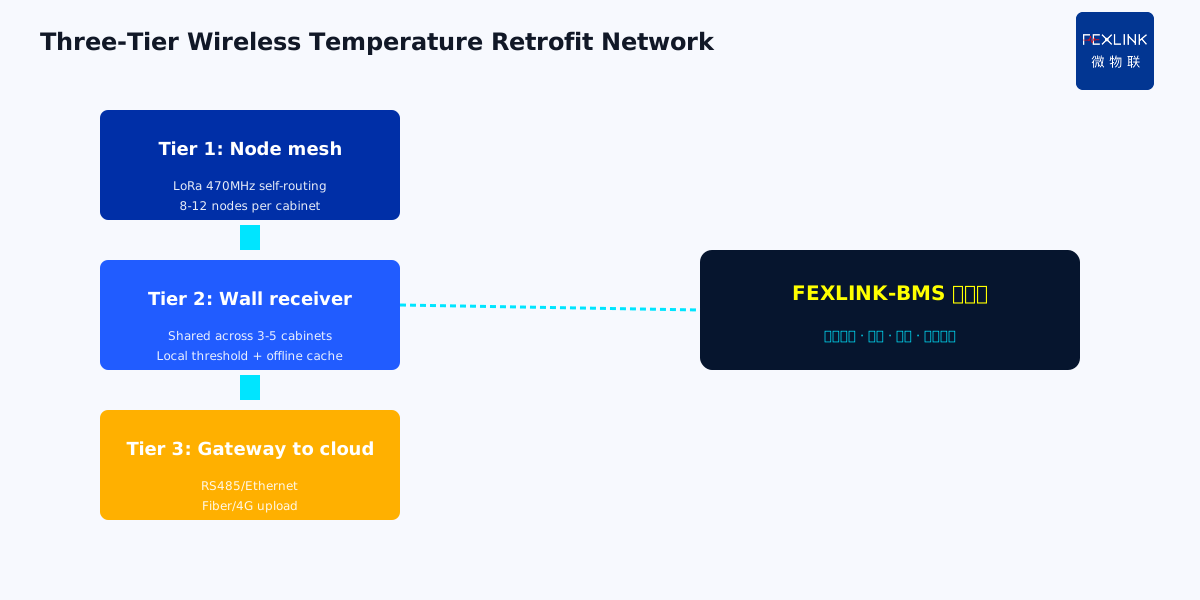
Direct Answer
Yes, and without shutdown. The retrofit strategy is: sensors stick to joints, communication goes wireless, power needs no cabling. LoRa/433 MHz wireless temperature nodes adhere to busbar lap faces and breaker terminals, powered by CT pickup or battery. A wall-mounted receiver in the cabinet streams via RS485/Ethernet to the cloud. Only one power-down window is needed — for node pairing and host bring-up. The main circuit stays live; no cable holes, no panel modification, no replacement of existing equipment.
An electronics plant with 12 aged 0.4 kV switchgear cabinets (14 years in service, no on-line temperature monitoring) initially balked when told retrofit would mean two weeks of shutdown. They nearly cut the budget entirely. The wireless solution ended up deploying 36 temperature nodes on main busbar laps and heavy-load feeder terminals: 28 CT-powered nodes and 8 battery-powered nodes for low-current circuits. Three wall-mounted receivers aggregated data and streamed through a gateway to the FEXLINK-BMS busbar monitoring platform. Installation happened in an 8-hour weekend window — only node pairing and host bring-up. The main circuit stayed live throughout. In the first month, the system flagged phase-A terminal temperature on B-section cabinet 3 climbing from 42 °C to 71 °C. The plant was mid-production on a customer order; waiting for the next quarterly infrared inspection would have meant three more months of risk.
1. First tier cabinets by risk — not every cabinet needs retrofit
Not every existing cabinet is worth wireless sensing. Rank by risk:
| Cabinet type | Typical points | Action | Why |
|---|---|---|---|
| Main incoming / bus-tie | Main busbar lap, incoming terminals | Must retrofit | High current, high outage cost |
| Heavy feeder (>400 A) | Feeder terminals, capacitor switching | Should retrofit | Heavy load, wide impact if fault |
| Ordinary feeder (<250 A) | Feeder terminals | Optional | Infrared inspection covers it |
| Standby / lighting | — | Skip | Low risk |
In the plant case, only 4 main incoming and 3 heavy feeder cabinets were retrofitted — 7 cabinets out of 12. The budget dropped from an assumed 280,000 CNY for full-cabinet coverage to 96,000 CNY, while covering 100% of the high-risk population.
2. Where to stick the nodes: three critical locations
Busbar lap faces. This is the hottest location. Use insulating ties or high-temperature adhesive to mount the node 10–20 mm from the lap bolt — not directly on the bolt, which would block future maintenance. Point the sensor probe toward the contact face; put a thermal spacer on the back to block ambient convection. The FEXLINK-BMS WB-TM-01 wireless node (38 × 28 × 15 mm) is designed for exactly this; it adheres to the side of the busbar without reducing phase-to-phase clearance.
Breaker line and load terminals. Terminals sit below the breaker in tighter space. Use the smaller WB-TM-02 patch node (25 × 20 × 10 mm) on the side of the cable lug, probe aimed at the crimp. Keep at least 5 mm of insulation clearance from the breaker body.
Cable heads and Cu-Al transition plates. These are the most overlooked. Electrochemical corrosion on Cu-Al plates is a slow drift — a few K per year, but over ten years it can climb from 30 K to 80 K. Mount the node on the back of the transition plate, away from the front-side maintenance space.
Typical deployment is 3–8 nodes per cabinet, based on circuit count. The 12-cabinet plant used 36 nodes — average 3 per cabinet.
3. Power: CT pickup vs battery
This is the most debated choice in retrofit design.
CT pickup (current-induced power): Clamp an open-core CT around the busbar or cable; the load current induces electromagnetic power. Advantage: permanent power, no battery replacement. Disadvantage: below ~50 A the pickup is insufficient and the node sleeps. Suitable for main incoming and heavy feeders.
Battery power: High-temperature lithium-thionyl chloride cells (ER18505), rated 5–8 year life — but at 60 °C inside the cabinet, plan for about 3 years. Advantage: works on any circuit. Disadvantage: scheduled battery replacement. Suitable for low-current circuits and standby cabinets.
Field practice is roughly 70% CT-powered / 30% battery. The plant case used 28 CT-powered + 8 battery. The EST-22920-R multi-channel temperature controller supports both; choose per-node based on actual current, no separate collector needed.
4. Network: in-cabinet wireless → wall receiver → gateway → cloud
Don't have every node talk to the cloud directly. Cabinet nodes are numerous, and the signal must penetrate the steel cabinet door — direct-to-cloud causes packet loss. Standard architecture is three tiers:
Tier 1: Self-organizing node mesh. 8–12 nodes per cabinet form a LoRa (470 MHz) mesh with self-routing. Each node transmits at 20 dBm; penetrating one steel door attenuates by about 12 dB, well within budget at 5 m range.
Tier 2: Wall-mounted receiver. Every 3–5 cabinets share one EST-22920-R receiver, mounted on top of or beside the cabinet run. The receiver aggregates node data, applies local thresholds, and caches offline data.
Tier 3: Gateway to cloud. The receiver connects via RS485 or Ethernet to the in-cabinet gateway, which uploads over plant fiber or 4G to FEXLINK-BMS cloud. On network loss, the receiver buffers 7 days locally and backfills on recovery.
5. Shutdown-free installation steps
The only step that technically needs power-down is first-time node pairing. Everything else is live.
Step 1 (one week before shutdown): Site survey; define node count and positions per cabinet; draw the layout; pre-select open-core CT sizes for CT-powered nodes.
Step 2 (within the 4-hour window):
- Open cabinet doors (no shutdown, just opening)
- Stick nodes per layout, power on and pair
- Hang wall receivers, pair with nodes
- Connect gateway to fiber/4G, verify cloud uplink
Step 3 (no shutdown): Observe 24 hours; confirm all nodes are streaming with no packet loss. Adjust weak-signal node angles or add repeaters as needed.
The electronics plant: 8-hour weekend window, 4 electricians + 1 engineer completed 12 cabinets, 36 nodes, 3 receivers, 1 gateway. Monday morning production ran normally with the system already live.
6. Relationship to existing monitoring
Many old cabinets already have an electrical fire monitoring system (residual current + ambient temperature). Should it be replaced?
No. The existing system monitors loop-level residual current and cabinet air temperature; the new wireless nodes monitor joint-level temperature at specific positions. The data is complementary:
- The existing ESF electrical fire controller watches loop-level residual current
- FEXLINK-BMS nodes watch joint-level temperature
- The Wanxiang engine correlates both: residual current spike + temperature rise = insulation degradation; temperature rise alone with normal residual current = loose contact
Both systems feed the same cloud platform, viewed in one interface. This is not redundant investment — it fills a blind spot.
7. Investment and payback
Per the electronics plant actual pricing:
- Wireless temperature node (CT-powered): ~800 CNY/point × 28 = 22,400
- Wireless temperature node (battery): ~600 CNY/point × 8 = 4,800
- Wall receiver: ~3,500 CNY/unit × 3 = 10,500
- Gateway: ~6,000 CNY/unit × 1 = 6,000
- Installation and commissioning: ~50,000
- Total: ~93,700 CNY
Compare one unplanned busbar outage: at the plant's annual output of 230 million CNY, one day of lost production is ~600,000 CNY. A single avoided outage pays for the retrofit. In the first month, the system flagged the B-section temperature anomaly in time to prevent what would likely have been an erosion event.
Scope and Limitations
This article applies to 0.4 kV low-voltage switchgear retrofit. High-voltage cabinets (10 kV and above) require nodes with higher insulation ratings, selected per manufacturer spec. CT-powered versions require minimum 50 A load current; below that, use battery. Battery life at 60 °C cabinet ambient is about 3 years, with scheduled replacement. The electronics plant case is anonymized. Final installation design follows on-site electrical engineering; perform a live-work risk assessment before retrofit.