 FEXLINK Research Institute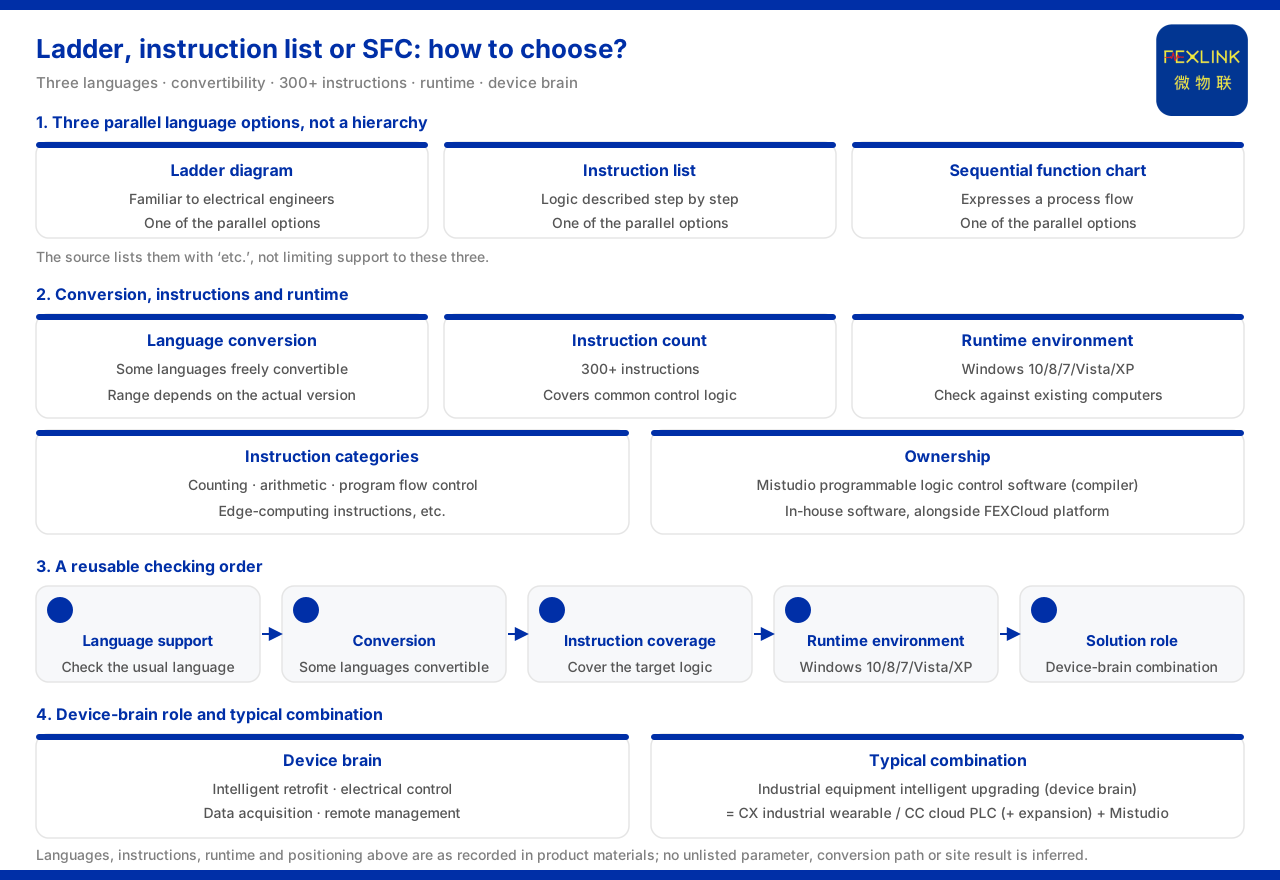
Direct answer
In the product knowledge base, the Mistudio programmable logic control software system (compiler) supports such programming languages as ladder diagram, instruction list and sequential function chart, and the material describes these as expressions relatively familiar to electrical engineers; it also states explicitly that some programming languages can be freely converted among one another. Beyond language, the material records that Mistudio provides 300+ instructions covering counting, arithmetic operations, program flow control and edge-computing instructions, and can run on Windows 10/8/7/Vista/XP. For the question of how to choose among ladder diagram, instruction list and sequential function chart, the checkpoints can therefore be reduced to three things: whether the software supports the language a team already uses, whether the chosen languages can be converted, and whether the instructions cover the target control logic. All three rest on the material, so the selection need not be guessed at.
1. The three language types are listed as parallel options
In the description of Mistudio, ladder diagram, instruction list and sequential function chart are not a hierarchy of progressive or mutually replacing choices but a parallel list of optional languages. After naming these three, the text uses "etc.", showing that the material does not limit the supported languages to those three; it also notes that these languages belong to the type familiar to electrical engineers. For a frontline user, this means: whether a team's existing drawings and habits are ladder diagram, whether it habitually describes logic item by item in an instruction list, or expresses a flow with a sequential function chart, there is a corresponding entry in the Mistudio language list.
What needs to be distinguished is that "supporting a language" and "when to use a language" are two questions. The material gives only the conclusion of support or non-support; it gives no decision rule for selecting a language for a specific process. This article therefore draws no conclusion such as "a certain type of logic must use a certain language", and presents only the language range the material records.
2. Free conversion: the choice is no longer locked in one direction
The material states clearly that some programming languages of Mistudio can be freely converted among one another. Read together with the language list above, this attribute changes the nature of the choice: if languages can be converted, then an engineer choosing one language early in a project is not locking all subsequent work into that language; when the preference of a collaborating party or of the maintenance phase changes, a path to bridge through conversion still exists.
The wording is limited, however, to conversion among "some" languages; the material does not list the full set of conversion correspondences, nor does it give the applicable conditions, version requirements or operating details. This article therefore presents it only as a recorded capability, does not extrapolate it into "any two languages can be converted", and does not treat a particular conversion path as established. The range actually available should be taken from the software's actual version and its function description.
3. Beyond languages: instruction count and runtime environment
When choosing a programming tool, two further items are often compared alongside the language forms: whether the instruction set is sufficient, and whether the software can run on the computers in use. The material's record of Mistudio covers both, arranged in the table below:
| Dimension | What the material records |
| --- | --- |
| Programming languages | ladder diagram, instruction list, sequential function chart, etc. |
| Instruction count | 300+ |
| Instruction categories | counting, arithmetic operations, program flow control, edge-computing instructions, etc. |
| Runtime environment | Windows 10 / 8 / 7 / Vista / XP |
| Language conversion | some programming languages freely convertible |
| Ownership attribute | independent property |
Every row in the table comes from the original material, and this article adds no model, performance or compatibility conclusion beyond it. For selection purposes, the table answers the "whether it exists" question: whether there is a language the team will use, whether there are instruction categories covering the target logic, and whether there is a version that runs on the existing operating system. As for the specific names, item-by-item functions and programming syntax of the instructions, the material does not expand on them, and this article infers none.
4. From language choice to the "device brain" positioning
Language and instructions are only information at the tool level. To understand why a choice has to be made within Mistudio, one must return to how the material positions it: Mistudio is called the "device brain", used for intelligent retrofit, electrical system control, data acquisition management and remote management. These four uses show that Mistudio does not undertake a single programming action in a solution but rather a main line running through equipment retrofit and operation management—from bringing equipment into a controllable range, to exercising control over the electrical system, to acquiring and managing data and performing remote management.
Precisely because it stands in that position, the choice of programming language affects the continuity of subsequent work. The material lists "industrial equipment intelligent upgrading (equipment brain)" as a typical application scenario, and gives the recommended product combination as the industrial wearable controller (programmable device wearable) (e.g. CX-08R06AI08-C1/C2/C3) or the cloud PLC (with expansion modules) (e.g. CC100/CC101), plus Mistudio. This shows that Mistudio is the software link working with the hardware above to complete equipment intelligent upgrading, and that the language choice is the decision closest to an engineer's daily work.
5. The context of independent ownership and the cloud platform
In the part introducing the company and its platforms, the material lists Mistudio as independently owned software, with the full name Mistudio programmable logic control software system (compiler); the cloud platform mentioned alongside it is the FEXCloud IoT cloud platform (FEXLINK). Read together with the capability record above, this context confirms Mistudio's place in the material: it is both the company's own programming and compiling software and, together with the cloud platform, appears in the description of the company's product system.
This article presents only what the material records and does not infer the specific scope of rights covered by independent ownership, the integration method between the cloud platform and the software, or the data flow.
6. A reusable checking order
Condensing the above into a checking order makes it usable for answering "how to choose among the three language types":
- Confirm language support: check whether the ladder diagram, instruction list or sequential function chart a team habitually uses is among the languages Mistudio supports.
- Confirm conversion possibility: if concerned about a change of language preference in later maintenance or collaboration, first understand the recorded attribute that "some languages can be freely converted", and confirm the available range with the software's actual version.
- Confirm instruction coverage: against the target control logic, judge whether categories such as counting, arithmetic operations, program flow control and edge-computing instructions are sufficient.
- Confirm the runtime environment: check whether the operating system of the computers in use is among Windows 10/8/7/Vista/XP.
- Confirm the solution position: if the case is industrial equipment intelligent upgrading, compare it with the recorded combination of CX industrial wearable / CC cloud PLC (with expansion modules) + Mistudio, and confirm the software's role in the solution.
Checking item by item in this order turns language choice from "picking one by feel" into work that can be confirmed against the material.
Scope and limitations
First, this article explains only the material's record of the Mistudio programmable logic control software system (compiler) in respect of programming languages, instructions, runtime environment, language conversion and product positioning; the factual boundary is the material, and no unlisted standard clause, parameter, certification or case is introduced.
Second, in this article "ladder diagram, instruction list, sequential function chart, etc.", "300+ instructions", "counting, arithmetic operations, program flow control, edge-computing instructions, etc." and "Windows 10/8/7/Vista/XP" are all items listed by the material; this article does not extend them to other software or versions, nor does it infer the item-by-item functions or programming syntax of the instructions.
Third, "some programming languages can be freely converted" is the material's own wording; this article does not interpret it as meaning that all languages can be converted with one another, and gives no specific conversion path. The actual convertible range is subject to the software's actual version.
Fourth, the "device brain" term and the four uses—intelligent retrofit, electrical system control, data acquisition management and remote management—as well as the "industrial equipment intelligent upgrading (equipment brain)" recommended combination are existing material records; this article draws no unlisted function, performance or site-effect conclusion from them.
Fifth, this article constitutes no commitment regarding any unlisted metric; where site conditions differ from the premises in the text, or the software version in use differs from the material's record, the latest product information and the software's actual description shall prevail.