 FEXLINK Research Institute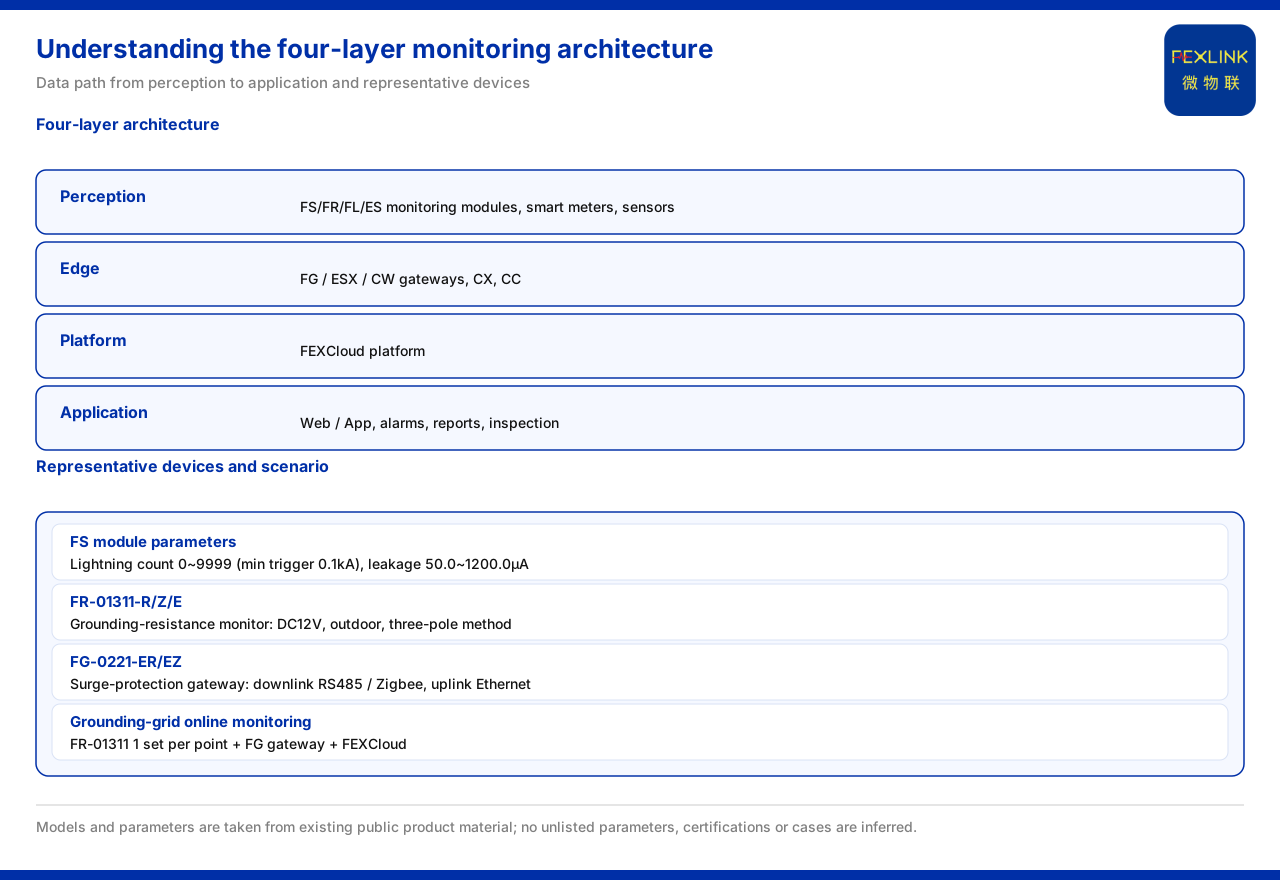
Direct answer
In lightning-protection monitoring, which elements must be online and which can be measured manually is not divided by product price but by two criteria: the consequence, and the time characteristic of the change. An element whose failure has serious consequences and cannot wait until the next inspection must be acquired online continuously; an element gone in an instant and impossible to make up afterwards must also be online, because missing it loses it permanently; a degradation quantity that changes slowly and only needs its trend observed suits online continuous recording; and periodic appearance and mechanical checks can be left to manual work. Seen through this trade-off, the listed remote-measurement elements of the surge protective device monitor, the grounding resistance monitor, the lightning-protection smart gateway, and the grounding-grid online monitoring scenario cover the must-be-online side.
This article gives a trade-off framework: classify each element, then decide the product combination; elements the product documentation does not unfold are not inferred here.
1. The two criteria for the trade-off
The first criterion is consequence. Once an element fails, if it directly touches the safety bottom line, its tolerance for time is very low and it cannot rely on looking again at the next inspection. The product documentation lists abnormal open circuit of grounding resistance as a red line that cannot be bypassed, based on GB 50057; this is a typical consequence-criterion case: grounding state concerns safety and is a high-risk item that must be monitored online.
The second criterion is the time characteristic. Elements fall roughly into two classes: one happens and ends in an instant, such as a lightning strike; the other changes slowly, such as leakage current accumulating with degradation. If the former is not recorded online, it cannot be restored afterwards; if the latter is only spot-checked, its trend cannot be seen. Together the two criteria can rank the monitoring elements by priority.
2. Must be online, part one: grounding state with no waiting margin
Grounding state is the first class of must-online item. The reason is not that it changes quickly, but that once it is open the consequence is heavy and the red line cannot be bypassed. The product documentation lists abnormal open circuit of grounding resistance as a red-line entry, based on GB 50057: once grounding is open, no matter how normal the other values are, they cannot substitute for this criterion.
The corresponding sensing device is the grounding resistance monitor. The model table records it as DC12V supply, outdoor use, three-electrode method, with communication selectable as RS485, Zigbee, or Ethernet (e.g. FR-01311-R). Outdoor use and multiple communication options show that it is aimed at on-site deployment, deployed by measurement point rather than covering the whole site with one set; the typical application scenario also lists online monitoring of the grounding grid of a substation or traction substation as its landing point, combined as a grounding resistance monitor (one set per point) plus a lightning-protection smart gateway, then connected to the IoT cloud platform.
3. Must be online, part two: the fleeting lightning strike event
Lightning is a typical instantaneous event, a direct embodiment of the second criterion. Whether a strike happened, how many times, and how strong it was all occur within an extremely short time; manual inspection can see only that it happened or did not, not the count or the intensity. Event-class elements must therefore be online.
The product documentation concentrates event-class records on two classes of devices. The remote-measurement elements of the surge protective device monitor include a lightning strike count, range 0 to 9999, with a minimum trigger of 0.1kA; only a current change as low as 0.1kA may be counted, and the count covers at most 9999 events. On the other side is the lightning current monitor; these monitors are listed together on the perception layer as the physical carriers of online continuous acquisition. One records how many times, the other how much current, and together they answer the event's whether, how many times, and how large.
4. Suitable for online: degradation quantities that need the trend
Some elements change gradually rather than abruptly, and a single spot-check value cannot explain the situation; continuous recording is needed to see the direction. Such elements suit online work, with lower urgency than the previous two classes.
Among the remote-measurement elements of the surge protective device monitor, besides the lightning strike count there are leakage current 50.0 to 1200.0μA (±10μA), voltage 0 to 400.0V (±0.1V), and temperature -20 to 100℃ (±1℃). Leakage current and temperature change slowly with the state of the device, and the value of online continuous recording lies in forming a trend; voltage gives the background of the operating condition. These may not be as fatal once exceeded as the grounding red line, but a persistent deviation likewise needs discovery, so they are classified on the online side.
5. The manual part and its boundary
By the criteria above, what can be left to manual work is the inspection that changes slowly, can be judged by visual or simple operation, and does not involve a safety red line: periodic appearance checks, installation and mechanical connection conditions, and marking completeness. Such checks share one characteristic: even if performed once after an interval, no key state is missed.
Manual inspection cannot replace the must-online side. Grounding state is a red-line criterion, and periodic manual measurement has a blind window; a lightning strike is instantaneous, and manual work cannot restore it at all. Thus can-be-manual is a division of labour, not an option: must-online items still have to be online, and manual items supplement them periodically. Drawing this boundary keeps manual spot-checking from masking the absence of online monitoring.
6. Online data must form a chain to land
An element being online is only the first step; the data must also be sent out, stored, and used. The product documentation lists the general monitoring architecture as four layers: the perception layer deploys monitoring modules, smart meters, and sensors; the edge layer has a gateway performing protocol conversion and aggregation; the platform layer is the IoT cloud platform; and the application layer faces web and mobile, alarms, reports, and inspection.
Mapped onto online elements, the perception layer corresponds to the various monitors, and the edge layer is carried by the lightning-protection smart gateway. The model table records the lightning-protection smart gateway as DC12V, protocol conversion, downlink RS485 and Zigbee, and uplink Ethernet (e.g. FG-0221-ER). It must organize data from multiple downlink interfaces before sending it upward: the perception layer measures accurately, the edge layer sends it out, the platform layer stores it, and the application layer uses it, and only then does online monitoring hold. This article does not unfold the concrete implementation of its protocol conversion.
7. The trade-off order derived from the criteria
Taken together, the trade-off can advance in four steps. First, find the elements that touch the safety bottom line, such as grounding state, and classify them as must-online; second, find the instantaneous event elements, such as lightning, and likewise classify them as must-online; third, find the gradual elements that need the trend, such as leakage current and temperature, and classify them as suitable for online; fourth, leave the periodic appearance and mechanical checks to manual work.
The value of this order is that it turns whether to install online equipment into a checkable judgement rather than a decision from experience. The general four-layer architecture, the remote-measurement elements of the surge protective device monitor, the grounding resistance monitor and lightning-protection smart gateway models, the red-line guard entry, and the grounding-grid online monitoring scenario provide the basis for these four steps.
Scope and limitations
First, this article restates only what the product documentation lists, bounded to the general four-layer monitoring architecture, the remote-measurement elements of the surge protective device monitor, the grounding resistance monitor model table, the lightning-protection smart gateway model table, the red-line guard entry, and the grounding-grid online monitoring scenario.
Second, the layering of the four-layer architecture and the product classification of each layer are cited as listed; this article does not infer unlisted products, protocols, or deployment methods.
Third, the remote-measurement elements and ranges of the surge protective device monitor are cited as listed; this article does not infer its alarm thresholds or setting methods.
Fourth, the supply, use environment, measurement method, and communication of the grounding resistance monitor are cited as listed in the model table; the red-line criterion is cited as listed in the red-line guard, and this article does not conclude on that basis that a particular monitor has been set according to that red line.
Fifth, the typical combination and the one-set-per-point wording are cited as listed in the typical scenario; this article does not infer implementation details beyond its engineering quantities.