 FEXLINK Research Institute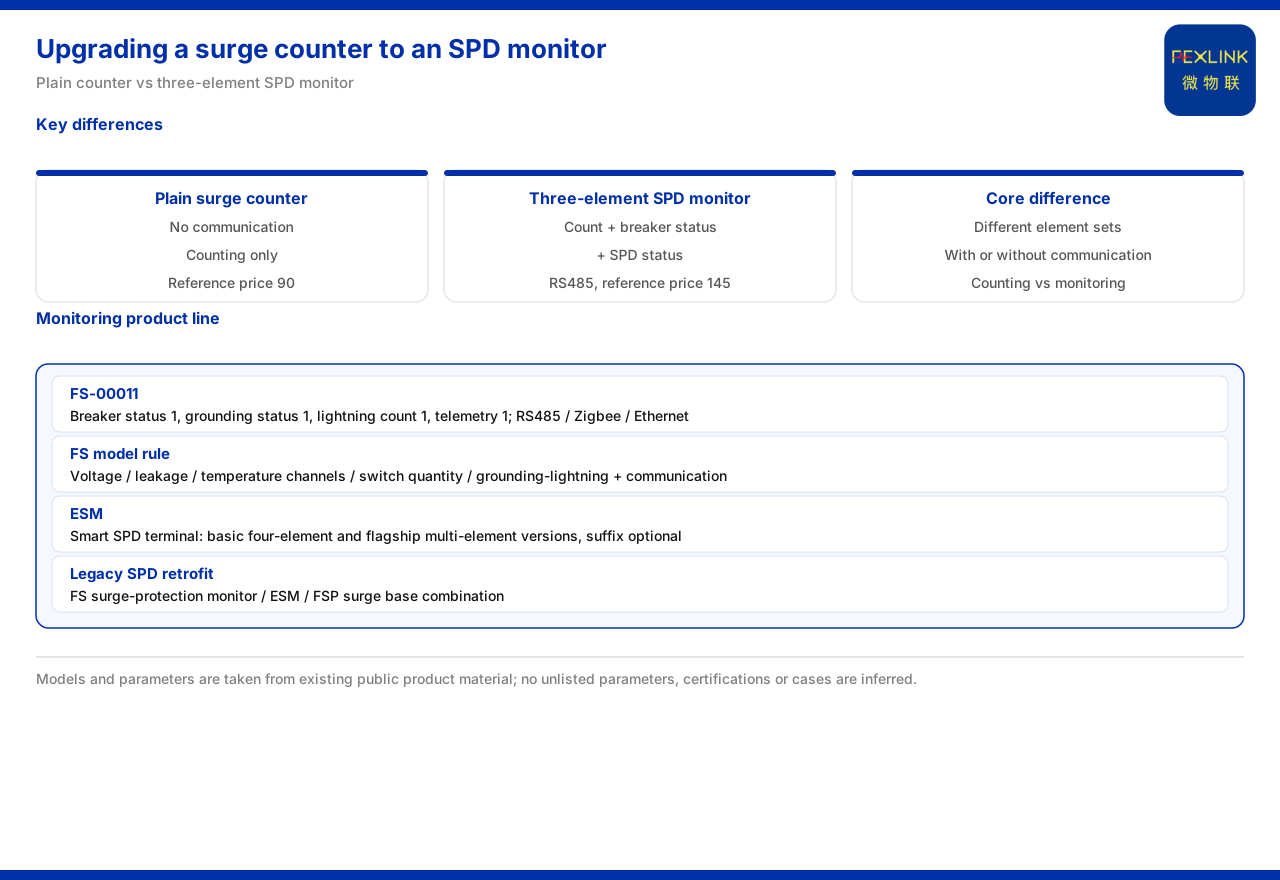
Direct answer
For surge protective device status monitoring, the knowledge base divides products into two classes: the ordinary lightning counter (no communication), which only counts lightning strikes and carries a reference price of 90; and the three-element SPD monitor, which acquires count, switch status, and SPD status at the same time and supports RS485 communication, with a reference price of 145. The difference between them is concentrated in two points, elements and communication: the former has only counting, while the latter adds switch status and SPD status and has communication capability.
Widen the scope to the whole lightning-protection product line, and the knowledge base also gives two model rules for comparison. The model rule of the surge protective device monitor (FS-00011) encodes by five position segments—voltage channels, leakage-current channels, temperature channels, switching quantity, and grounding and lightning—carrying remote signalling, switch status, grounding status, and lightning count, and belongs to the monitoring type rather than the counting type; the model rule of the ESM intelligent lightning-protection monitoring terminal (SPD monitor) encodes by power supply, display, phase count, current parameters, and edition, and includes a basic four-element edition and a flagship multi-element edition. On this basis the article explains the difference between the counting and monitoring product classes, the code reading, and the selection order, and marks the parts the documentation does not unfold.
The fundamental difference between counting type and monitoring type
The most direct difference between the ordinary lightning counter and the three-element SPD monitor is the number of elements acquired. The knowledge base records the ordinary lightning counter as "no communication", meaning it provides only local counting; the three-element SPD monitor is recorded as "count plus switch status plus SPD status", with RS485 noted at the end. The number of elements determines the range of questions it can answer.
The counting type answers "how many times has lightning struck"; the monitoring type, beyond counting, must also answer "is the switch open or closed" and "what is the state of the SPD itself". The knowledge base records their reference prices as 90 and 145 respectively, and the price gap also corresponds to the difference in elements and communication. It should be noted that the reference price is a positioning wording listed in the knowledge base, not an inference by this article about a transaction price.
Capability boundary of the ordinary lightning counter
The ordinary lightning counter is the simplest form in this product group. The knowledge base records it as "ordinary lightning counter (no communication)", with a reference price of 90. Because it does not communicate, its data requires on-site reading rather than automatic upload; because it only counts, it does not reflect switch status or SPD status.
This class of product suits situations where only a cumulative lightning strike count is needed. It narrows the question to a single number, so selection is correspondingly simple: confirm that counting is what is needed, and that on-site reading is acceptable. If a site needs to know the state remotely, the ordinary counter cannot serve, and selection should turn to a monitoring-type product with communication. In other words, the boundary of the ordinary counter is not insufficient capability but a single purpose; as long as the need is genuinely limited to counting, it remains the most direct choice.
What the three-element SPD monitor adds
Beyond counting, the three-element SPD monitor adds two classes of state quantities. The knowledge base records it as "count plus switch status plus SPD status, RS485", with a reference price of 145. Compared with the ordinary counter, it acquires "lightning strike events" and "the operating state of the protective device and its switch" on the same device.
The significance of this change is that it makes the state of the surge protective device an object that can be observed remotely. Switch status and SPD status are both state quantities, unlike the event quantity that is the lightning count. Bringing state quantities into monitoring means operations do not have to go on site to judge whether the protection chain is intact. This article does not infer the alarm logic or setting values of this monitor; it states only its listed elements and communication.
Model rule of the surge protective device monitor
The knowledge base lists the model rule of the surge protective device monitor as five position segments—voltage channels, leakage-current channels, temperature channels, switching quantity, and grounding and lightning—followed by a communication suffix, and it belongs to the monitoring type rather than the counting type. The model table lists FS-00011 as supporting switch status one, grounding status one, lightning count one, and remote signalling one, with communication selectable as RS485, Zigbee, or Ethernet.
This rule shows that a monitoring-type product can be configured position by position according to the elements needed, rather than offering only a fixed few. Taking FS-00011 as an example, it retains switching quantity together with grounding- and lightning-related records at the same time, which follows the same idea as the "count plus switch status plus SPD status" of the three-element SPD monitor: bringing event quantities and state quantities together.
Editions of the ESM intelligent lightning-protection monitoring terminal
The knowledge base lists the model rule of the ESM intelligent lightning-protection monitoring terminal (SPD monitor) as five segments—power supply, display, phase count, current parameters, and edition—followed by a communication suffix, and states that it includes a basic four-element edition and a flagship multi-element edition. Unlike the previous rule, this rule organizes the model by electrical conditions such as power supply and phase count, and by edition.
The coexistence of the two rules shows that different coding habits exist within the lightning-protection monitoring line: one leans toward element channels, the other toward electrical conditions and edition. In selection, one rule should not be applied to the other product class; the record of each in the knowledge base should govern. This article does not infer an unlisted edition list or communication codes.
Scenario-based selection: retrofit of installed SPDs
A typical application scenario in the knowledge base lists "surge protective device status monitoring (retrofit of installed SPDs)" as a landing point, recommending a combination of the surge protective device monitor, the intelligent lightning-protection monitoring terminal, and the SPD lightning-protection base (FSP). This scenario targets sites where an SPD is already installed: it adds status acquisition without overturning the existing protection structure.
In such a case the division of labor between the two product classes becomes clear. If only a cumulative lightning count is needed and on-site reading is acceptable, the ordinary counter suffices; if switch and SPD status must be known remotely, the three-element monitor or a configurable monitoring-type product should be selected. The selection order for retrofit usually starts by fixing the monitoring target, then the elements and communication, and only last the specific model.
Scope and limitations
First, this article restates only what the knowledge base lists, with the factual boundary limited to the ordinary lightning counter and three-element SPD monitor entries, the model rule and model table of the surge protective device monitor, the model rule of the ESM intelligent lightning-protection monitoring terminal, and the surge protective device status monitoring scenario.
Second, the elements, communication, and reference prices of the ordinary lightning counter and the three-element SPD monitor are cited as listed; the reference price is a positioning wording in the knowledge base, and this article does not infer a transaction price or market trend from it.
Third, the model rule of the surge protective device monitor and the elements and communication of FS-00011 are cited as listed in the model table; this article does not infer the configuration of unlisted models.
Fourth, the model rule and edition classification of the ESM intelligent lightning-protection monitoring terminal are cited as listed; this article does not infer an unlisted edition list or communication codes.
Fifth, the installed-SPD retrofit scenario and recommended combination are cited as listed in the typical scenario; this article does not infer its construction method or implementation quantities.