 FEXLINK Research Institute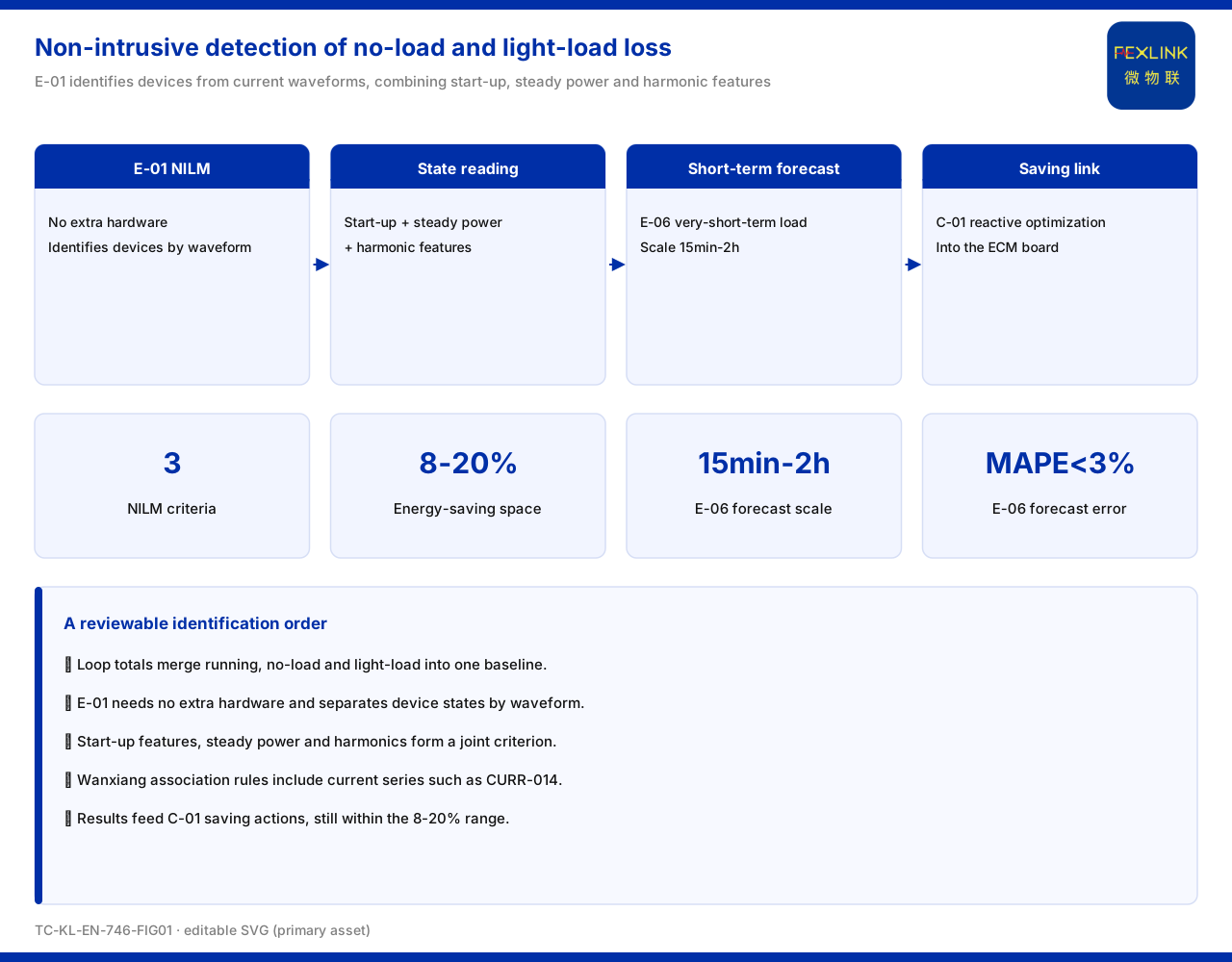
Direct Answer
No-load and light-load losses are hard to find because they are often dispersed across many devices, inconspicuous on any single one, yet continuously occupy energy once aggregated. According to the existing product material, the entry point for identifying such losses is non-intrusive load identification: it needs no extra hardware and identifies specific devices through the current waveform, with a criterion formed jointly by start-up characteristics, steady-state power and harmonic features, and can distinguish device running, no-load and light-load states. On this basis, the energy-use analysis section provides a device-level energy-use profile, ultra-short-term load forecasting grasps short-term fluctuation, and the Wanxiang engine's cross-dimensional correlation rules link current-type features with concrete hazards. On quantified benefit, the comprehensive energy-saving space listed by the Taiyi intelligent control hub system is eight to twenty percent. This article restates these existing conventions only and does not infer the loss ratio or treatment benefit of any specific site.
1. Why No-Load and Light-Load Losses Are Easily Missed
Under a metering approach that looks only at circuit totals, no-load and light-load losses appear as a continuous but inconspicuous baseline. When a device is running, no-load or lightly loaded, its current waveform and power features differ, but the total data superimposes the three states into one curve, from which the device's actual state cannot be read. A device left running no-load for a long time may then show only as the curve being slightly higher than expected; when such devices multiply, the baseline rises but no specific responsible device can be found. To find such losses, the premise is to refine the "circuit-level total" into "device-level states", that is, to push the identification granularity from the circuit down to the device.
2. How Non-Intrusive Load Identification Judges State
The E-01 non-intrusive load identification in the product material is characterised by needing no additional hardware and identifying specific devices through the current waveform. Its criterion is formed jointly by three parts: start-up characteristics, steady-state power and harmonic features. Start-up characteristics identify whether a device enters operation, steady-state power judges the current load level, and harmonic features distinguish the waveform fingerprints of different devices. Combined, the model can separate multiple devices on the same circuit and give each device's running state. For no-load and light-load losses, the key capability lies exactly here: it looks not only at "whether there is current" but at the device state corresponding to the current waveform, thereby distinguishing no-load and light-load from normal running.
3. The Position of the Energy-Use Analysis Section
The product material records that the E energy-use analysis section of the Tianyan engine has fifteen items in the V2.0 plan, with an introductory convention of nine, and the P0 first-release model is E-01 non-intrusive load identification. Placing E-01 first shows that device-level identification is the foundation of energy-use analysis: only after device states become distinguishable can energy-use analysis further answer which devices consume power, when and in what state. The two conventions must be used separately, the planned count for internal scheduling and the introductory convention for external statement. For this article's theme, what matters is the relation between E-01 and the energy-use analysis section: identifying no-load and light-load is not an isolated function but the starting point of the section's device-level view.
4. Support From Basic Vital Signs and the Perception Matrix
Besides device-level identification, the Qianzhi engine in the product material also provides basic-vital-sign sub-models and a multi-dimensional perception matrix. The basic-vital-sign sub-models cover quantities such as current (including overload factor); the seven-dimensional perception matrix includes the two features of rate of change and trend drift, of which trend drift is a core feature. Placing them with no-load identification reveals two levels of state judgement: one is whether the present state is running, no-load or light-load, and the other is whether that state drifts over a period. Rate of change reflects short-term fluctuation and trend drift reflects long-term direction. No-load and light-load losses are often not a sudden change but a persistently high baseline, so trend-type features are especially relevant to finding such losses.
5. The Short-Time Scale Provided by Ultra-Short-Term Forecasting
The ultra-short-term load forecasting model in the product material uses a gradient-boosting type algorithm, with a time scale of fifteen minutes to two hours and a mean absolute percentage error below three percent. It does not directly identify the no-load state, but provides a time-dimension reference for state judgement: on the fifteen-minute to two-hour scale, whether the load can be predicted reflects short-term explicable consumption behaviour; if a load segment stays above the predicted baseline for a long time with no matching output, it is worth checking further whether it is a device running no-load or lightly loaded. Using the predicted baseline as a comparison turns "is this curve abnormally high" from an intuitive judgement into a referenced comparison, reducing misreading of a single reading.
6. Cross-Dimensional Correlation Rules and Current Features
The product material records that the Wanxiang engine has cross-dimensional correlation rules, among which the current-related sequence contains fourteen, for example a type of rule that takes sustained zero-sequence current as the entry point and points to single-phase grounding tracing. These rules link current features with concrete hazards. For no-load and light-load identification, their value lies in connecting the identification result to a fuller reasoning: device-level states say "in what state power is consumed", while correlation rules say "what this feature usually means". Combined, no-load and light-load losses are not just an energy-efficiency figure but may relate to whether a device runs abnormally or whether an electrical hazard needs investigation, giving energy-saving actions and safety checks a common input.
7. How Identification Connects to Energy-Saving Measures
Once no-load and light-load losses are found, a corresponding measure stage is needed. The C energy-saving measures section in the product material has ten items in the V2.0 plan, with an introductory convention of six, and the P0 first-release model is C-01 reactive-power compensation optimisation. Between the device states identified by the energy-use analysis section and the candidate actions of the energy-saving measures section there is an input-and-action relation: identification gives the problem, and measures give the executable treatment direction. The comprehensive energy-saving space listed by the Taiyi intelligent control hub system is eight to twenty percent, usable as a unified range for benefit comparison. It should be noted that this range is a system-level quantitative convention, does not distinguish individual retrofits, and does not guarantee that treating one device's state will fall at any value inside it.
8. Organising the Identification Flow Into a Reviewable Order
Combining the above, the identification of no-load and light-load losses can be organised in the following order. First, non-intrusive load identification judges device state jointly by start-up characteristics, steady-state power and harmonic features, distinguishing running, no-load and light-load. Second, basic vital signs and the multi-dimensional perception matrix add rate of change and trend drift to judge whether the state persists over time. Third, ultra-short-term load forecasting gives a fifteen-minute to two-hour short-term baseline as a reference for whether the curve is high. Fourth, the current-related correlation rules of the Wanxiang engine link state features with hazards. Fifth, the energy-saving measures section carries the treatment actions, with eight to twenty percent comprehensive energy-saving space as the benefit comparison. This order lets each step return to a concrete item in the product material.
Applicability and Limits
- The content is limited to the existing wording of the product material on non-intrusive load identification, the energy-use analysis section, basic vital signs and the multi-dimensional perception matrix, ultra-short-term load forecasting, cross-dimensional correlation rules and the comprehensive energy-saving space range.
- The model counts (fifteen, nine, ten and six), the forecasting scale (fifteen minutes to two hours) and error convention (below three percent), the number of current-related correlation rules (fourteen) and the comprehensive energy-saving space (eight to twenty percent) are all as listed in the product material and are not a commitment to any project's results.
- The statement that non-intrusive load identification "needs no extra hardware" is restated from the product material, and this article does not infer its degree of suitability for any distribution structure.
- The correlation-rule example is limited to those listed in the product material, and this article does not infer the criterion details of unlisted rules.
- This article is not a commitment to any unlisted indicator; actual capability is governed by the latest product material and project scheme.