 FEXLINK Research Institute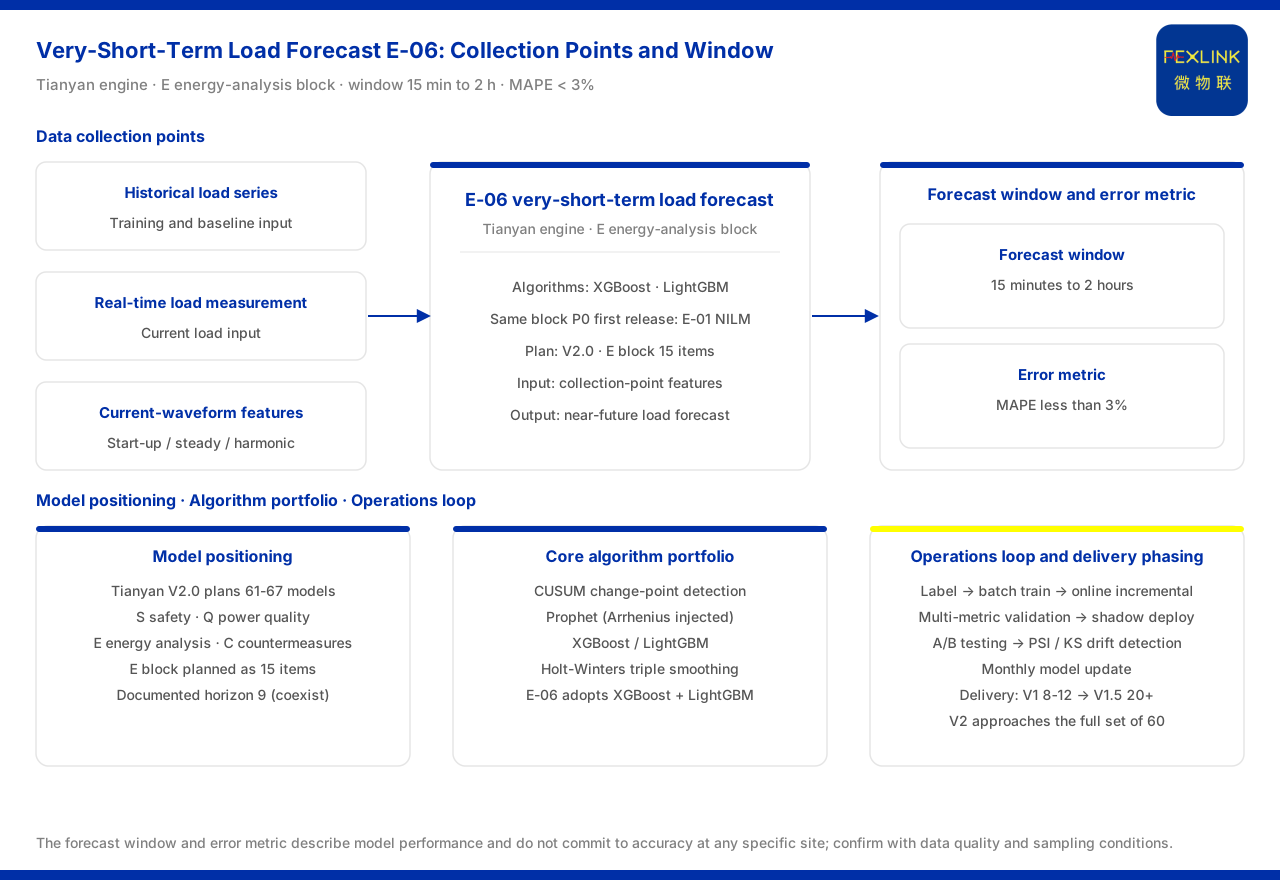
How Short-Horizon Load Forecasting E-06 Works
Direct answer
The E-06 very-short-term load forecast of the Tianyan engine (prediction, V1.0 to V2.0) uses XGBoost and LightGBM, with a forecast window of 15 minutes to 2 hours and a mean absolute percentage error (MAPE) of less than 3%. It is one of the models of the E energy-analysis block in the V2.0 plan of the Tianyan engine; the P0 first-release model of that block is E-01 NILM non-intrusive load disaggregation, and E-06 sits in the same model series as E-01. To understand how E-06 works, it should be read back into the algorithm portfolio, model phasing, and operations loop of the Tianyan engine. Each of those three frames supplies a different part of the answer, and none of them alone is enough.
Model parameters and positioning
The product knowledge base records that the E-06 very-short-term load forecast uses XGBoost and LightGBM, with a window of 15 minutes to 2 hours and a MAPE of less than 3%. This window decides that the model answers "what the load will be over the next very short period," not a medium- or long-term trend. The V2.0 plan of the Tianyan engine covers 61 to 67 models, divided into four blocks: S safety analysis, Q power quality, E energy analysis, and C energy-saving countermeasures. The model count of the E energy-analysis block is planned as 15 items under V2.0, while the documented introduction horizon is 9; the two horizons coexist, and the source of the horizon should be noted when citing. E-06 sits inside this block.
Forecast window and error metric
The window of 15 minutes to 2 hours defines the boundary of "very short term": the lower end is at minute scale and the upper end at hour scale, and any task beyond this range is not within the scope of E-06. A MAPE of less than 3% is an error metric; it measures the average percentage deviation of the forecast value from the actual value and is a statement of model performance, not a commitment to the effect at any specific site. The window and the error metric are two different dimensions: the window says over what horizon the model is valid, while the error metric says how close its output has been on average. Reading them together is what keeps the scope honest; quoting the error metric without the window would suggest a general accuracy that the entry does not assert. Only by keeping the window and the error metric together can the terms "very short term," "short term," and "medium term" be kept apart in practice, and only then does the error metric stop being misread as a general guarantee.
Algorithm portfolio
The core algorithms of the Tianyan engine are recorded as: CUSUM change-point detection, Prophet (with Arrhenius electrical knowledge injected), XGBoost and LightGBM, and Holt-Winters triple exponential smoothing. Placing several algorithms side by side means that different tasks select different tools: change-point detection is used to capture mean shifts, Prophet for trend extrapolation with an electrical prior, tree models for feature-driven fitting, and Holt-Winters for time-series smoothing with trend and seasonality. The portfolio is therefore a division of labor rather than a ranking; each method is kept for the task it fits, and no single method is presented as replacing the others. E-06 adopts XGBoost and LightGBM from this set, which is the concrete value this portfolio takes on the very-short-term load task.
Relationship to E-01 in the same block
Within the same E energy-analysis block, E-01 NILM non-intrusive load disaggregation is listed as the P0 first-release model. Its characteristic is that it requires no additional hardware and identifies specific devices from the current waveform, on the basis of a joint judgment of the start-up signature, the steady-state power, and the harmonic signature. E-06 and E-01 address different questions: the former forecasts where the load is going, the latter disaggregates which devices are drawing power. Putting the two in the same block shows that energy analysis covers both the forecast of future consumption and the disaggregation of who is using power now.
How the model iterates: the operations loop
The operations loop recorded in the product knowledge base is: expert labeling and automatic labeling, batch training and online incremental training, multi-metric validation, shadow deployment, A/B testing, PSI and KS drift detection, and a monthly model update. For E-06 this means the forecast model is not fixed after a single training run but is updated monthly, with drift detection judging whether the data distribution has shifted. Shadow deployment and A/B testing are used to compare model performance before a formal replacement, so that a change to the model is decided by measured comparison rather than by assumption. This article does not restate the scale of the training data, the details of feature engineering, or the labeling process, as the product knowledge base does not list them.
Position in the delivery phasing
Delivery of the Tianyan engine is divided into three stages: V1 selects 8 to 12 models, V1.5 expands to more than 20, and V2 approaches the full set of 60. That is, whether E-06 lands in a given stage depends on the model list selected for that stage, and this article does not infer which stage it belongs to.
Scope and limitations
This article answers only "how E-06 very-short-term load forecasting works," and its content is limited to the model algorithms, forecast window, error metric, block division, algorithm portfolio, operations loop, and delivery phasing already recorded in the product knowledge base.
"15 items" and "9" are two coexisting horizons for the E energy-analysis block; this article presents both and does not substitute one for the other.
This article provides no model training details, feature list, labeling scale, hardware configuration, or any unlisted metric; nor does it commit to the forecast accuracy at any specific site.
Practical application must be confirmed item by item in conjunction with data quality, sampling conditions, and the latest product documentation.