 FEXLINK Research Institute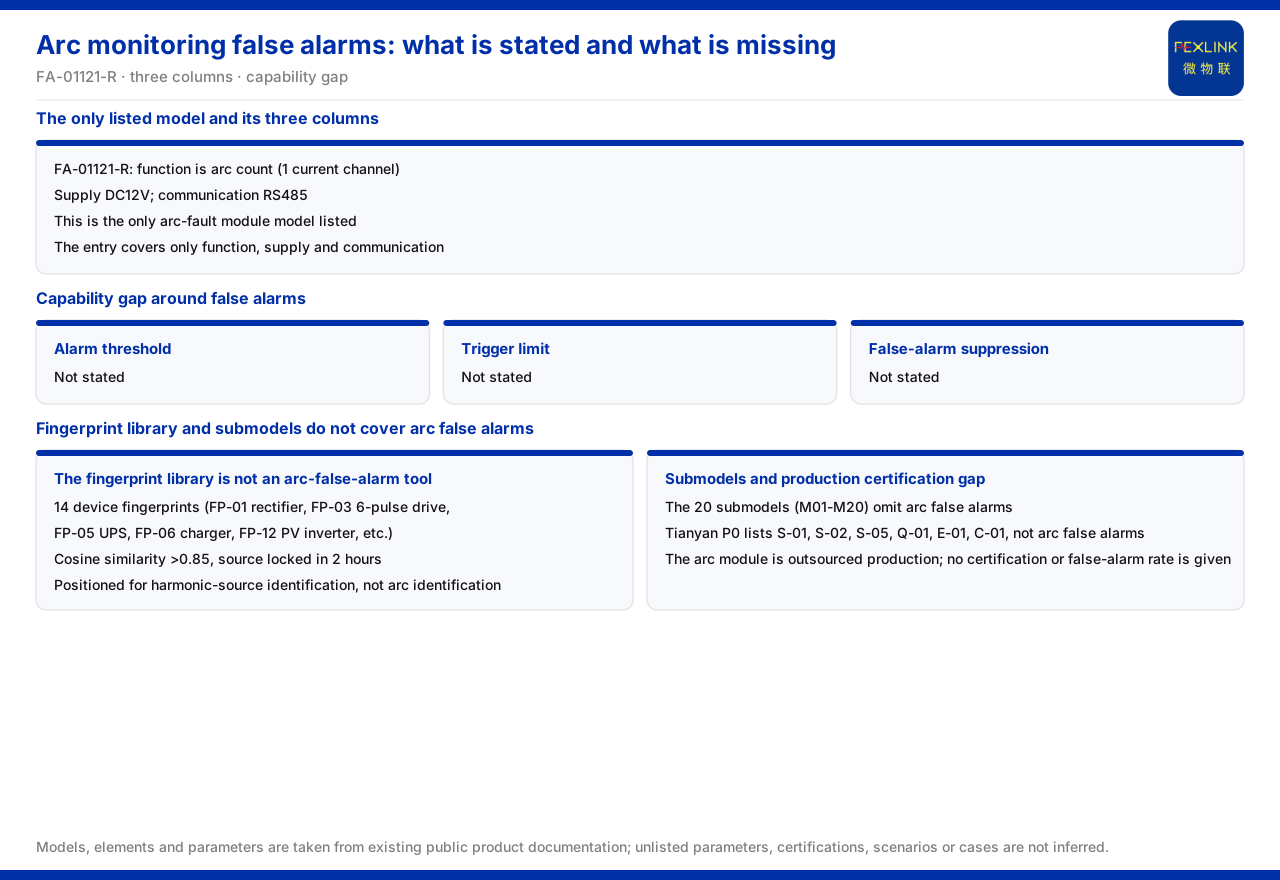
Direct Answer
The question "will arc monitoring produce false alarms" has no direct answer in the product knowledge base. What can be confirmed is that the knowledge base's entry for the arc-fault monitoring module is very narrow, containing only three columns — function, power, and communication — with no alarm threshold, trigger threshold, or false-alarm suppression method for arc counts; the only listed model is FA-01121-R, whose function is arc count (one current channel), with DC12V power and RS485 communication.
Further checking shows that the capability in the knowledge base responsible for interference tracing is the harmonic fingerprint library, which targets harmonic pollution-source identification and is not described as being used for arc-event recognition or false-alarm suppression; and the listed sub-model inventories of the Qianzhi engine and the Tianyan engine contain no dedicated model for arc monitoring or arc false-alarm handling. The false-alarm question is therefore a capability gap in the knowledge base, not a function with a clear existing conclusion. This article explains where the gap lies and how to advance verification.
I. The Only Listed Model and Its Three Columns
The knowledge base's records on arc faults are concentrated in one entry. The FA arc-fault monitoring module (FA-01121-R) has arc count (one current channel) as its function, DC12V as its power, and RS485 as its communication; it is also the only arc-fault monitoring module model listed in the knowledge base. The entry covers only the three columns of function, power, and communication, so the information is very limited.
The questions the module can answer are limited accordingly. The function column shows it can count arc events, the power column shows it needs DC12V, and the communication column shows it connects to the RS485 bus. How alarms are set, what counts as abnormal, and how false alarms are avoided must be found elsewhere and cannot be inferred from these three columns.
II. Misreporting-Related Information Is Absent From the Entry
A false-alarm question usually involves three things: the alarm threshold, the trigger threshold, and the suppression method. The knowledge base gives none of them in the FA-01121-R entry. It does not state how many arc counts should trigger an alarm, by what threshold triggering occurs, or how false alarms are suppressed.
This means the knowledge base cannot answer "will arc monitoring produce false alarms." If a threshold or suppression strategy is needed in engineering practice, it cannot be inferred from the existing entry but should be determined from equipment documentation and project requirements. Treating "can count" and "when to alarm, how to prevent false alarms" separately avoids assuming the model entry already contains complete criteria.
III. The Harmonic Fingerprint Library Is Not an Arc-Misreport Tool
The knowledge base does contain a capability for interference tracing, but its positioning must be seen clearly. The Qianzhi engine's harmonic fingerprint library holds 14 device fingerprints — for example, three-phase rectifiers, six-pulse variable-frequency drives, UPS, charging piles, and photovoltaic inverters are included; matching uses a cosine similarity threshold greater than 0.85, and the knowledge base says a pollution source can be locked within 2 hours.
The issue is the scope of application. This fingerprint library is positioned for harmonic pollution-source identification, and its 14 listed fingerprints are all harmonic-source devices; the knowledge base does not describe it as used for arc-event recognition or false-alarm suppression. Because both involve "identifying an interference source," the conclusions of the harmonic fingerprint library cannot be directly applied to arc false alarms. Harmonics and arcs are two different electrical phenomena, and the library matches device harmonic features, not the discrimination of arc events.
IV. No Arc Misreport in the Specialised Sub-Model List
From the analysis-model angle, the gap is equally clear. The Qianzhi engine has 20 core sub-models, whose deep hidden-hazard group includes resonance risk, insulation state (aging model), vibration analysis, partial discharge detection, zero-sequence current, negative-sequence component, harmonic intermodulation, and flicker synthesis; the list contains no arc-monitoring or arc-false-alarm sub-model.
This group covers several hidden-hazard dimensions — harmonics, insulation, mechanical vibration, partial discharge, and sequence components — showing that hazard analysis on the platform side has a definite inventory. Arc false alarms are not in it, so it has not been included in the listed hazard-analysis capability. For users, this means a ready-made "arc false-alarm discrimination" function cannot be assumed to exist on the platform.
V. The Tianyan Engine's Debut Models Also Lack Arc Misreport
In the knowledge base's other engine, the situation is the same. The Tianyan engine's debut models include resistive-leakage separation, residual-current trend drift (using a cumulative sum control chart), three-phase imbalance hazard, harmonic responsibility allocation, non-intrusive load identification, and reactive-power compensation optimization; none of the leakage, power-quality, energy-efficiency, and carbon lists it belongs to contains an arc-false-alarm model.
Putting the Qianzhi and Tianyan inventories together confirms one point: the analysis and prediction capabilities listed in the knowledge base have no model specifically for arc false alarms. This does not mean arc monitoring has no value; it means "how to identify and handle a false alarm" currently has no corresponding algorithm.
VI. Gaps in Outsourced Production and Certification Information
Besides the algorithm side, there are gaps on the product and certification side. The knowledge base's known information gaps place the arc-fault monitoring module in the outsourced-production category; at the same time, the knowledge base does not provide arc-fault protection certification information alongside the entry, nor content on false-alarm rate or false-alarm handling.
Regarding certification, the material boundary must be understood strictly: the existing record can only show that the module is outsourced-produced, not that it has obtained a particular arc-protection certification. Projects involving certification requirements should request certification material separately during procurement and rely on what is actually obtained, rather than drawing a certification conclusion from the current entry. The same applies to the false-alarm rate: where the material does not give it, no specific figure should be produced.
VII. How to Advance the Misreport Question
Combining the available information, the following points can advance the matter. First, make clear that the currently traceable model is FA-01121-R, whose capability boundary extends only to arc-count counting, DC12V power, and RS485 communication. Second, do not apply the tracing conclusions of the harmonic fingerprint library to arc false alarms; it targets harmonic pollution sources. Third, if an alarm threshold or trigger threshold is needed, determine it from equipment documentation and project requirements, without applying criteria the knowledge base does not give. Fourth, if a false-alarm rate or certification information is needed, request the material from the supply side and rely on what is actually obtained. Fifth, if a site is especially sensitive to false alarms, state in the plan that the discrimination and handling strategy must be defined separately and arrange physical verification.
Advancing along these points clarifies the issue within the information boundary: the knowledge base can answer what arc monitoring does, how it is powered, and how it communicates; it cannot answer whether it will produce false alarms or how to handle them. Separating these two kinds of question avoids both misusing the material and stalling because material is missing.
Scope and Limits
First, this article restates only the content listed in the product knowledge base, and its factual boundary is limited to the arc-fault monitoring module entry, the harmonic fingerprint library, the Qianzhi and Tianyan engine sub-model inventories, and the known information gaps.
Second, the function, power, and communication of FA-01121-R are cited as listed; the entry does not list alarm thresholds, trigger thresholds, or suppression methods, and this article states that boundary without inferring specific values or practices.
Third, the harmonic fingerprint library's 14 device fingerprints, cosine similarity threshold greater than 0.85, and 2-hour source lock are cited as listed; this article does not extend their scope to arc-event recognition or false-alarm suppression.
Fourth, the Qianzhi and Tianyan engine model inventories are cited as listed; this article does not infer whether unlisted arc-false-alarm models exist.
Fifth, outsourced production, certification information, and false-alarm rate are cited from the known information gaps; this article does not draw a certification conclusion or give a false-alarm-rate figure.
Sixth, this article only explains the information boundary and verification points of the arc-false-alarm question and does not provide a specific project's threshold setting or false-alarm handling scheme; related conclusions must be determined with site conditions and the project plan.