 FEXLINK Research Institute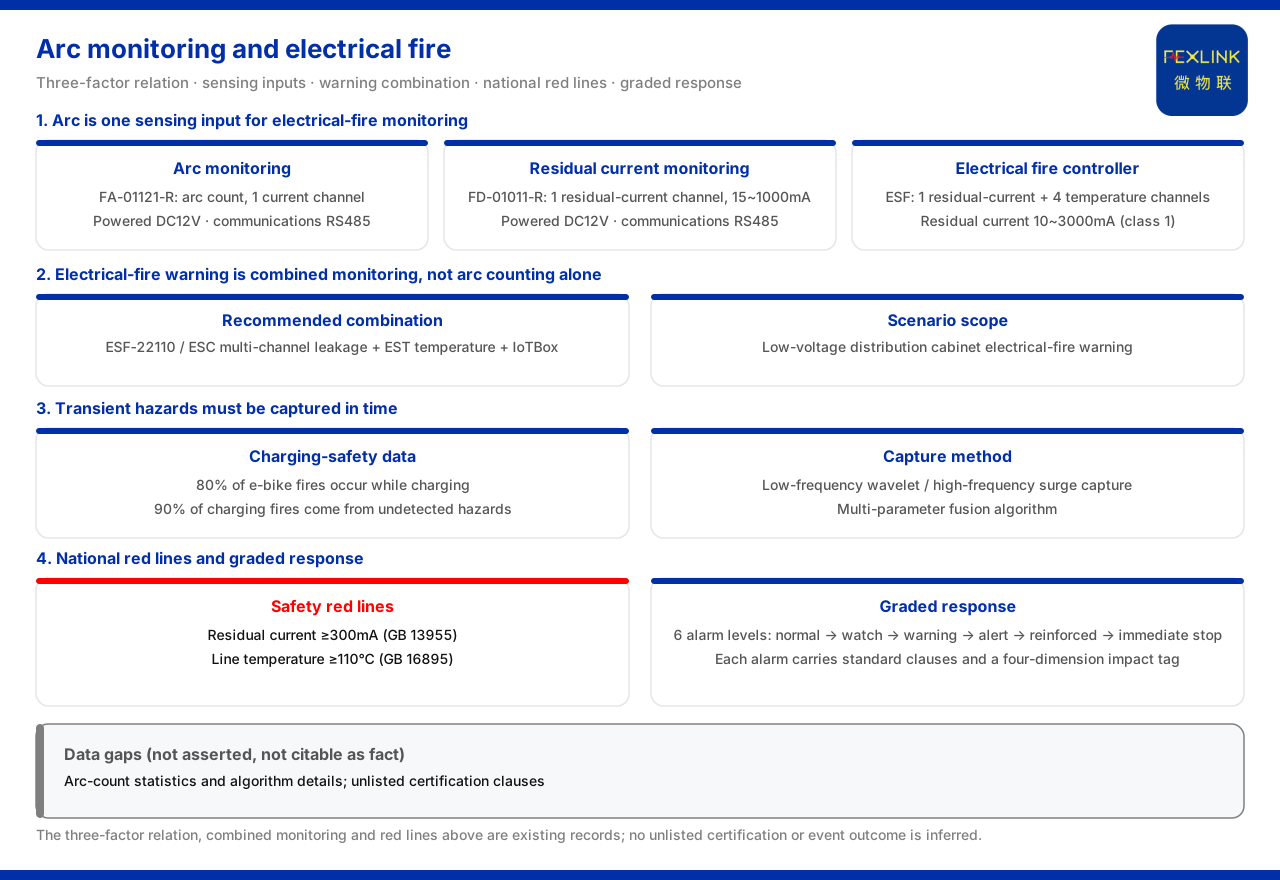
Direct answer
Under the arrangement of the product knowledge base, arc, residual current and temperature are three parallel classes of electrical fire monitoring object: the arc side corresponds to the arc-fault monitoring module (e.g. FA-01121-R), whose function is arc count (1 current channel), supplied at DC12V and communicating over RS485; the residual-current side corresponds to the electrical fire monitoring & control device (e.g. ESF-22110-R), the multi-channel leakage-current monitoring & control device and the mains residual-current monitoring module (e.g. FD-01011-R); the temperature side is carried by temperature-monitoring products. In its selection comparison, the material lists the recommended combination for "low-voltage distribution cabinet electrical fire early warning" as the electrical fire monitoring & control device, the multi-channel leakage-current monitoring & control device, plus temperature-type products and IoTBox, showing that electrical fire early warning is multi-parameter combined monitoring rather than something a single arc count can cover. The position of arc monitoring within it is therefore "one parallel cause": it joins residual current and temperature in forming the perceptual input of an electrical fire, and does not by itself replace the other two classes.
1. Electrical fire monitoring is not a single object
The product knowledge base maps "electrical fire" directly onto the electrical fire monitoring & control device: the product contains 1 residual current and 4 temperature channels, and also OLED display, 1 relay output and RS485 communication; the residual-current measurement range is 10 to 3000mA (accuracy class 1), temperature is measured by NTC with a range of -20 to 100℃ (±1℃), and the relay contact capacity is AC250V/3A and DC30V/3A. This set of configuration shows that this one product alone carries the acquisition of both residual current and temperature rather than only a single quantity. It also suggests that, before discussing electrical fire monitoring, one must first acknowledge that it is a topic constituted jointly by several physical quantities.
2. The arc side: the arc-count monitoring module
The product knowledge base records that the function of the arc-fault monitoring module (e.g. FA-01121-R) is "arc count (1 current channel)", that is, counting arcs for 1 current channel, supplied at DC12V and communicating over RS485. It is the monitoring module in the product line that faces arc-event counting directly, and it is the sensing starting point of the discussion of arc monitoring and its relation to electrical fire. It should be noted that the specification given by the material reaches only the level of "counting arcs for 1 current channel"; this article states its monitored object and access method on that basis and infers no certification, action behaviour or effect from it.
3. The residual-current side: several monitoring specifications
The product knowledge base places the arc-fault monitoring module and the mains residual-current monitoring module (e.g. FD-01011-R) in the same section: the latter provides 1 residual current with a collection range of 15mA to 1000mA, supplied at DC12V and communicating over RS485; the product outline positions it as a "residual-current monitoring module (10mA to 1000mA)". The two sitting in the same section shows that they are two classes of perceptual input for electrical-fire-related hazards. Widening the range onto distribution lines, the residual-current measurement range of the electrical fire monitoring & control device is 10 to 3000mA (accuracy class 1), while the multi-channel leakage-current monitoring & control device (e.g. ESC-22310-R) can provide 1 or 3 leakage channels, with leakage measurement likewise 10 to 3000mA (accuracy class 1). The residual-current side thus has a division of monitoring specifications: the module serves single-point supplementation, and the controller serves loop-level combination.
4. The temperature side and the necessity of combination
Temperature is the third parallel monitoring object. Alongside 1 residual current, the electrical fire monitoring & control device is fitted with 4 temperature channels, measured by NTC with a range of -20 to 100℃ (±1℃), showing that temperature and residual current are often observed on the same device. In its typical application scenarios and selection comparison, the product knowledge base gives the recommended product combination for "low-voltage distribution cabinet electrical fire early warning": the electrical fire monitoring & control device or the multi-channel leakage-current monitoring & control device, plus temperature-type products and IoTBox. This combination exactly covers the three inputs of residual current, multi-channel leakage and temperature, and connects to IoTBox. From the scenario angle it confirms the structure of the preceding sections: electrical fire early warning is not a single-point alarm but an aggregation of several classes of signal for judgement.
5. Putting the arc back into the three-element framework
Placing arc, residual current and temperature together answers the original question: arc monitoring is one class of electrical fire monitoring object, in a position parallel to residual current and temperature. It answers "how many arc events occurred"; residual current answers "is the loop-to-ground current abnormal"; temperature answers "is the line or joint overheating". Each corresponds to a different sensor and product, and if one is missing the perception is incomplete. The material placing the arc monitoring module alongside the residual-current monitoring module, and adding temperature and IoTBox in the scenario combination, is precisely the product of this parallel relation.
6. National-standard red lines and graded handling
The product knowledge base records that the basic vital-sign sub-model of the Qianzhi engine places leakage as "time-series trend plus red-line pre-position". In its red-line guard, one rule states that a residual current reaching 300mA triggers a non-bypassable alarm, with GB 13955 as the basis, and another states that a line temperature reaching 110℃ triggers a non-bypassable alarm, with GB 16895 as the basis. These two national-standard red lines are the bottom-line criteria for arc, leakage and over-temperature electrical fire hazards. Above these bottom lines, the material sets a 6-level alarm system: normal is 85 to 100, watch is 70 to 84, YJ1 is 55 to 69, YJ2 is 40 to 54, BJ1 is 20 to 39 with handling within 48 hours, and BJ2 is 0 to 19 with immediate shutdown; each alarm carries a standard-clause reference, a four-dimensional impact label (safety, efficiency, life and carbon emission, each 0 to 100 points), a confidence level and a scenario label. Red lines guard the bottom line while grading manages the routine; these are the two layers of this handling structure.
7. Why transient hazards deserve timely capture
In the charging-safety scenario of the electrical hazard early-warning system, the product knowledge base gives a group of fire-hazard figures: 80% of e-bike fires occur while charging, 85% of community fires originate in battery charging inside the home, and 90% of charging fires originate in undetected hazards. Its core technologies include low-frequency wavelet and high-frequency surge capture (microsecond-level capture of abnormal current) and a multi-parameter fusion intelligent algorithm. This group of figures shows that transient hazards such as arcing have the character of "occurring fast and lasting briefly"; if not captured in time, they easily fall into the category of "undetected". Putting arc monitoring into the three-element framework is significant precisely here: it gives a class of event that is hard to find by manual inspection a sensing entry that can record it continuously.
Scope and limitations
First, the citations in this article are limited to the product material and the corresponding fact pack, and introduce no parameter, certification or case not listed.
Second, the function "arc count (1 current channel)", the DC12V supply and the RS485 communication of the arc-fault monitoring module (e.g. FA-01121-R) are limited to the material entry; this article infers no AFCI or AFDD certification, nor its action behaviour or effect.
Third, the residual-current channel count, collection range, supply and communication of the mains residual-current monitoring module, and the channel count, range, accuracy and temperature-measurement specification of the multi-channel leakage-current monitoring & control device and the electrical fire monitoring & control device, are limited to their respective material entries.
Fourth, the recommended combination for low-voltage distribution cabinet electrical fire early warning (the electrical fire monitoring & control device or the multi-channel leakage-current monitoring & control device, temperature-type products and IoTBox) is the scenario combination listed by the material; this article extends no unlisted function or performance conclusion from it.
Fifth, a residual current reaching 300mA triggering a non-bypassable alarm with GB 13955 as the basis, and a line temperature reaching 110℃ triggering a non-bypassable alarm with GB 16895 as the basis, are cited as given; this article lists no other graded threshold.
Sixth, the steps of the 6-level alarm system and the four-dimensional impact label specification, as well as the 80%, 85% and 90% figures and the low-frequency wavelet and high-frequency surge capture wording of the charging-safety scenario, are cited as given, and this article does not treat them as a commitment for any site.
Seventh, this article explains only the position of arc monitoring within electrical fire monitoring and provides no selection, threshold setting or configuration calculation for a specific project.