 FEXLINK Research Institute
The short answer
Three terms first. Scope 2 is the indirect emission an organisation causes upstream when it buys electricity, heat or steam; the arithmetic is purchased energy multiplied by the grid emission factor. Self-consumption is the share of PV output used inside the site the moment it is generated, never passing the utility meter. Export is the surplus pushed back onto the grid and settled at a feed-in tariff. The conclusion: only self-consumed kilowatt-hours count, because they are the kilowatt-hours you did not buy; under the location-based method they reduce the Scope 2 attached to purchased electricity. Exports neither enter your inventory nor offset anything. The reduction equals displaced grid electricity multiplied by the grid emission factor, and one kilowatt-hour can only be counted once.
1. Three currents: self-consumed, exported, imported
Once a roof is covered with PV, three currents move through the distribution room. The carbon account recognises two.
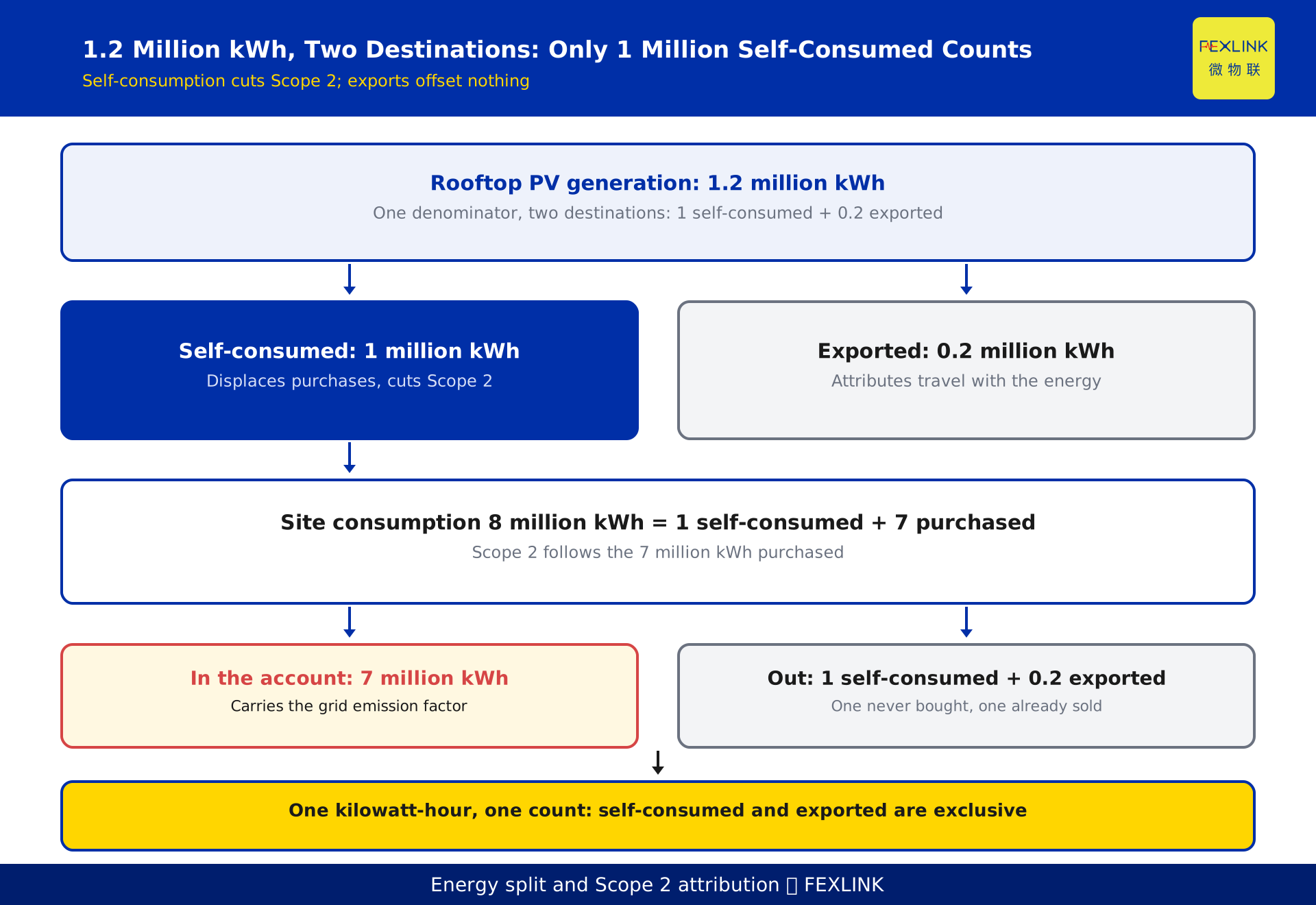
PV generation. Total output measured at the inverter terminals or at the connection point, equal to self-consumption plus export. It is not a reduction figure in itself.
Self-consumed electricity. Output absorbed by site loads without passing the utility meter. It is invisible on the bill and decisive in the account, because it displaces exactly the electricity that would otherwise have been purchased.
Purchased electricity. Forward energy registered at the point of connection. Scope 2 follows this current and nothing else.
Three identities lock the relationship: PV generation = self-consumption + export; site consumption = self-consumption + purchases; export = generation minus self-consumption. Put those lines in the ledger and every later argument about method can be settled against them. Most sites where the account does not add up fail here: one total-consumption figure, no split between self-consumption and purchases.
2. What Scope 2 counts, and why buying less is emitting less
Inventories split emissions into three scopes. Scope 1 is fuel burned on site. Scope 2 is the upstream emission from purchased electricity, heat and steam. Scope 3 covers other indirect emissions along the value chain. PV burns no fuel, so it creates no Scope 1; its only effect is that you buy less and carry less Scope 2.
That is why the mechanism is displacement, not negative emission. It also settles the method: only electricity consumed on site can be displaced.
What the standards say. The current edition of GB/T 32150, the Chinese general standard for enterprise GHG accounting, is the 2025 edition (published 31 December 2025, effective 1 July 2026, replacing the 2015 edition); per the revision notes it expands indirect-emission categories and refines non-fossil electricity factors. ISO 14064-1:2018 treats indirect emissions from imported energy as a category of its own, on the same logic: only energy crossing the boundary from outside is captured there. Self-consumed PV is not imported energy, so it never enters that category; what changes is the size of the import.
Two methods. Location-based uses the average factor of the grid you sit on, the default baseline for most domestic inventories. Market-based uses contractual instruments such as green power and certificates, an optional supplement. For self-consumed PV the location-based result is simply less electricity bought. Certificates are a separate subject, covered in the green-power article.
3. The deduction rule: self-consumption counts, exports do not
| Electricity | Inside the boundary | Offsets Scope 2 | Metering point |
|---|---|---|---|
| Self-consumed | No (never purchased) | Yes, as lower purchases | Connection point plus utility meter |
| Exported | No | No | Utility meter, reverse direction |
| Purchased | Yes | - | Utility meter, forward direction |
Why exports cannot offset. Exported energy has been sold, and the kilowatt-hours travel with their environmental attributes to the buyer. If the site also books them as a reduction while the grid side books the same kilowatt-hours as renewable generation, the same energy is used twice. That is double counting, and the first thing a verifier cuts into.
Why the deduction is not a line item. Many expect a row reading "PV reduction: so many tonnes". The correct treatment differs: purchases fall, Scope 2 falls, and the reduction lives inside the changed numbers rather than in a separate entry. A stand-alone reduction figure belongs to project-level accounting, a different ledger from an organisational inventory. Half of the title question answers itself: the PV is reflected, just in another position.
Who owns the array. A self-owned array sits inside the boundary and follows the rule above. With third-party investment, an energy performance contract or a leased roof, the site buys power at a discounted tariff; formally that energy is purchased, and it still carries the grid factor unless the project's certificates belong to the site. That clause belongs in the contract.
4. How to calculate: one multiplication, three inputs
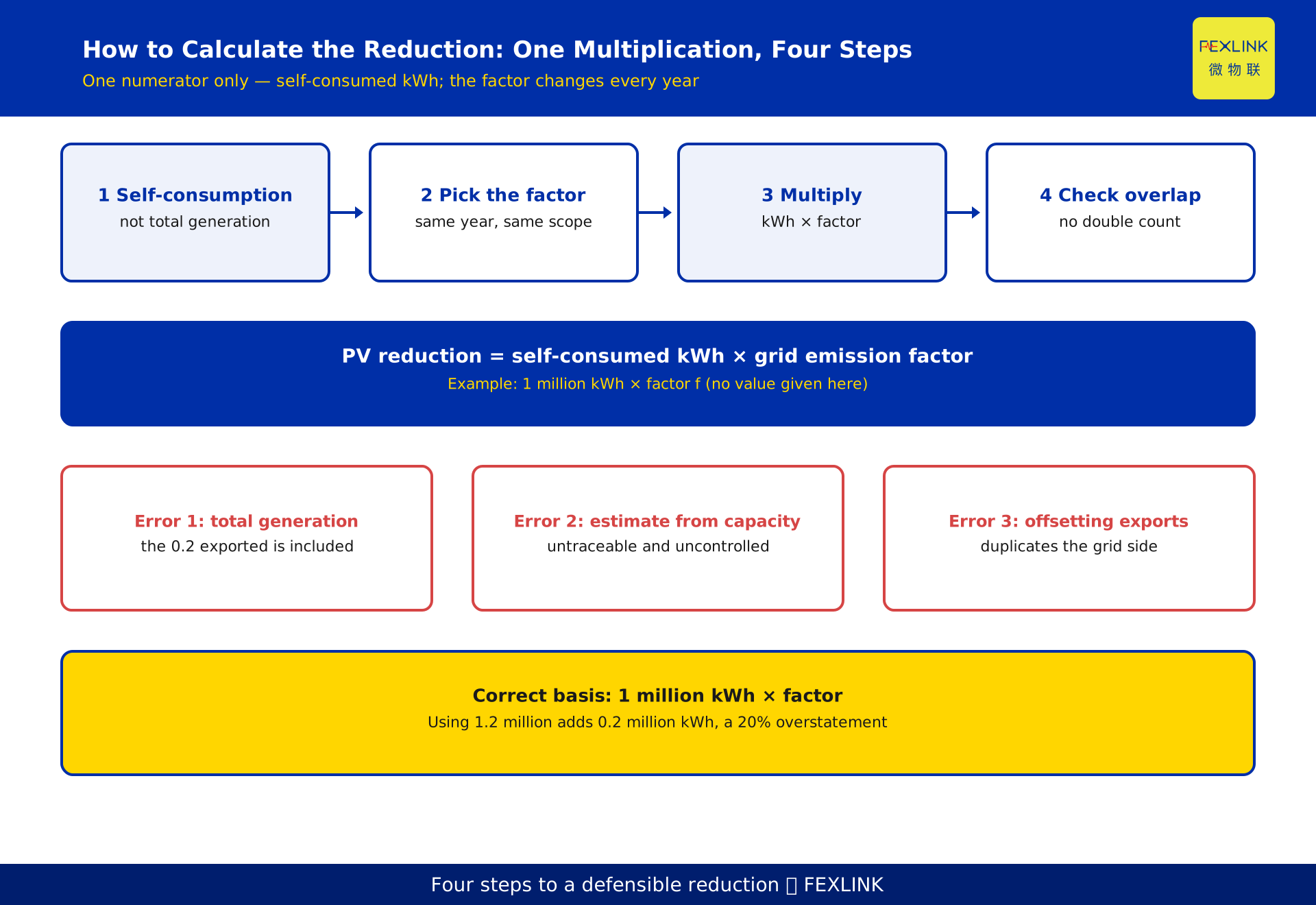
One formula: PV reduction = self-consumed electricity x grid emission factor. Three inputs, each with a trap.
Which electricity figure. Use self-consumption, not total generation, and not capacity multiplied by full-load hours. Total generation pulls the exported share into the sum, and the overstatement equals the export ratio exactly.
Which factor. Use the grid average factor published by the competent authority for the year, matched to your boundary, and state source and year. Factors are revised annually, so one report must not mix vintages. No numeric value is given here deliberately: it changes every year and differs by scope, and copying a number into a report is more dangerous than leaving it out.
Which period. Electricity and factor must cover the same period.
Three errors recur: multiplying total generation, which inflates; estimating generation from capacity, which cannot be traced; and multiplying exports as well, which duplicates the grid side.
The boundary of displacement. What is displaced is the electricity you would have bought without the array, which depends on how well the load curve matches the output curve. High daytime load displaces a lot; a site that runs at night and idles by day displaces little and exports more. Two identical arrays can produce very different reductions. That is a self-consumption problem, not a factor problem.
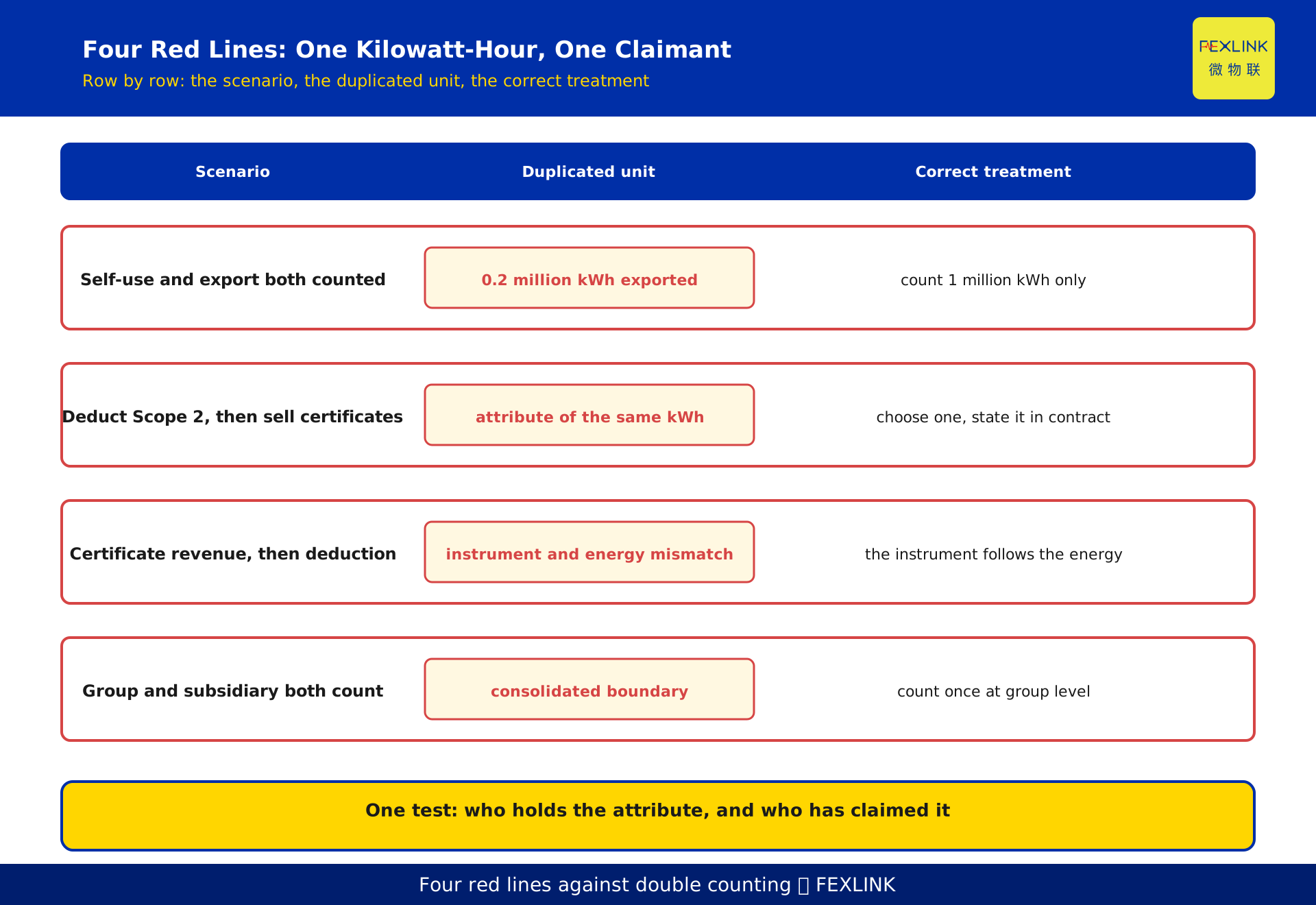
5. Four red lines of double counting
Counting both self-consumption and exports. One kilowatt-hour, one count. Exported energy has left the boundary and belongs to the grid side.
Deducting Scope 2 and then selling the certificates attached to the same kilowatt-hours. Environmental attributes can have one claimant only. Sell the certificate and you cannot claim the reduction; claim the reduction and the certificate cannot be sold.
Taking certificate revenue on exports while also deducting them. Same principle as the previous line, with the instrument flowing the other way.
Counting at both group and subsidiary level. In consolidation the subsidiary's self-consumption already shows as lower purchases; a group-level "PV reduction" line counts the same kilowatt-hour twice.
One test covers all four: for every PV kilowatt-hour, ask who holds its environmental attribute and who has already claimed it. When the answer is unique, the ledger cannot double count.
6. Metering: three points, one timestamp
The utility meter, for purchases and exports. It must be bidirectional: forward for purchases, reverse for exports. Many sites have only a unidirectional meter, or route reverse energy through a second meter, and the reading gets missed at month end.
The connection meter, for total generation. A meter at the inverter terminals and one at the connection point are separated by cabling and a step-up transformer, so the readings will not agree. The gap may be small, but state the basis so a verifier is not comparing numbers that cannot be reconciled. The third meter is the sub-meter: to split the ratio by workshop, add sub-metering on each circuit.
One timestamp. Take frozen values at the same instant across all three points rather than accumulated readings copied by hand, and align the reading cycle with the billing cycle. A one-day misalignment means the last days of a month are counted twice, or not at all.
On the product side: ESA full-parameter smart meters (ESA-22111-R through ESA-22161-R, six current ranges, 3x220/380V, RS485 Modbus) cover the utility and connection points, while ZSA embedded multi-function smart meters (ZSA-12110~22243-R, external CTs) fit cabinets with limited cut-outs. The ESX intelligent edge gateway aggregates the data, Tianyan E-09 (carbon accounting) converts it, and the electricity-carbon synergy system keeps energy, cost and emissions on one ledger: the self-consumed figure read from the meter is the figure deducted in the account.
7. A worked example: reconciling bill and account
Figures below are constructed to illustrate the method, not a real customer.
A factory consumes 8 million kWh a year. Its rooftop array generates 1.2 million kWh, of which 1 million kWh is self-consumed and 0.2 million kWh exported. After commissioning, purchases fall from 8 million kWh to 7 million kWh.
Reconcile first: 8 (total consumption) = 1 (self-consumed) + 7 (purchased); 1.2 (generation) = 1 (self-consumed) + 0.2 (exported). Both identities hold, so metering and ledger agree.
Then the reduction: 1 million kWh multiplied by the grid emission factor. Using total generation of 1.2 million would add 0.2 million kWh, an overstatement of 20 percent. This is the classic shape of over-counting, and no electricity bill will reveal it.
Then Scope 2: purchases fall from 8 to 7, a drop of 12.5 percent, and Scope 2 falls by the same proportion if the factor is unchanged. The two percentages differ: electricity falls 12.5 percent while PV generation equals 15 percent of total consumption, and the gap is exactly the 0.2 million kWh exported.
Finally the boundary: if the array is third-party owned and the certificates belong to the investor, that 1 million kWh is still purchased electricity under the location-based method, and Scope 2 does not fall just because there are panels on the roof.
One factory, one array, three treatments, three results. The difference is not arithmetic; it is method.
8. Five questions before you file
- Is self-consumption listed separately in my total consumption figure?
- Am I using self-consumed electricity or total generation?
- Have I written the factor's source, year and scope into the report?
- Who holds the environmental attributes of the exported energy?
- Has any of this electricity been claimed elsewhere, in certificates, voluntary reductions or group reporting?
Answer all five and the method holds. Miss one and the report is not ready.
Frequently asked questions (FAQ)
Q: Can I multiply total PV generation by the factor and report it as the reduction?
No. That product assumes every kilowatt-hour is consumed on site. Only the self-consumed share can be claimed; the exported share has left the boundary.
Q: Our array is entirely self-consumed with no export. Is it simpler then?
It is the simplest case, but you still have to prove the "entirely": generation at the connection point must reconcile with the utility meter, and reverse energy must be zero or explainable. Some sites still export a little at midday without the meter recording it.
Q: What is the most likely reason PV does not show up in our carbon account?
Three candidates. The ledger holds only a total consumption figure and never separates self-consumption; the number used is the settled quantity on the bill, which already nets off export credits, so two bases are mixed; or a reduction line was added without reducing purchases.
Q: Does battery storage need separate accounting?
Storage moves PV energy in time. It does not change the total and creates no new reduction, but it raises the self-consumption ratio: shifting surplus midday output to the evening means the same array yields more claimable reduction. The calculation is still self-consumption multiplied by the factor; do not count charge-discharge cycles as additional energy.
Q: What evidence is most often requested during verification?
Readings and reading records from all three metering points with timestamps, settlement statements, inverter generation exports, and the contracts or certificates establishing ownership and environmental attributes. With all four the method can be recomputed.
Scope and limitations
- This article covers self-consumed PV in organisational carbon inventories, for industrial and commercial sites and parks with self-owned or third-party-invested distributed PV. Project-level accounting for centralised plants is out of scope.
- Standard editions: GB/T 32150 is cited in its 2025 edition (published 31 December 2025, effective 1 July 2026, replacing the 2015 edition); ISO 14064-1 as the 2018 edition. Clauses follow the editions in force; this article summarises method and does not replace the standards or a verifier's opinion.
- No numeric grid emission factor is given. Factors change by year and scope and should follow the value published by the competent authority, or the value accepted by the verifier. "Factor" here is a symbol, not a constant to be quoted.
- The energy figures in section 7 (8, 1.2, 1, 0.2 and 7 million kWh, 12.5 percent, 15 percent, 20 percent) are constructed to illustrate the method. They represent no real customer and imply no commitment about any project's reduction.
- ESA full-parameter smart meters, ZSA embedded multi-function smart meters, the ESX intelligent edge gateway, Tianyan E-09 (carbon accounting) and the electricity-carbon synergy system follow the latest selection manual.
- Division of labour with the green-power article: this one covers energy volumes and the deduction basis for self-generated PV; certificate redemption is covered there.
Frequently Asked Questions
PV Is Generating Power but Your Carbon Report Doesn't
Three terms first