 FEXLINK Research Institute
Direct Answer
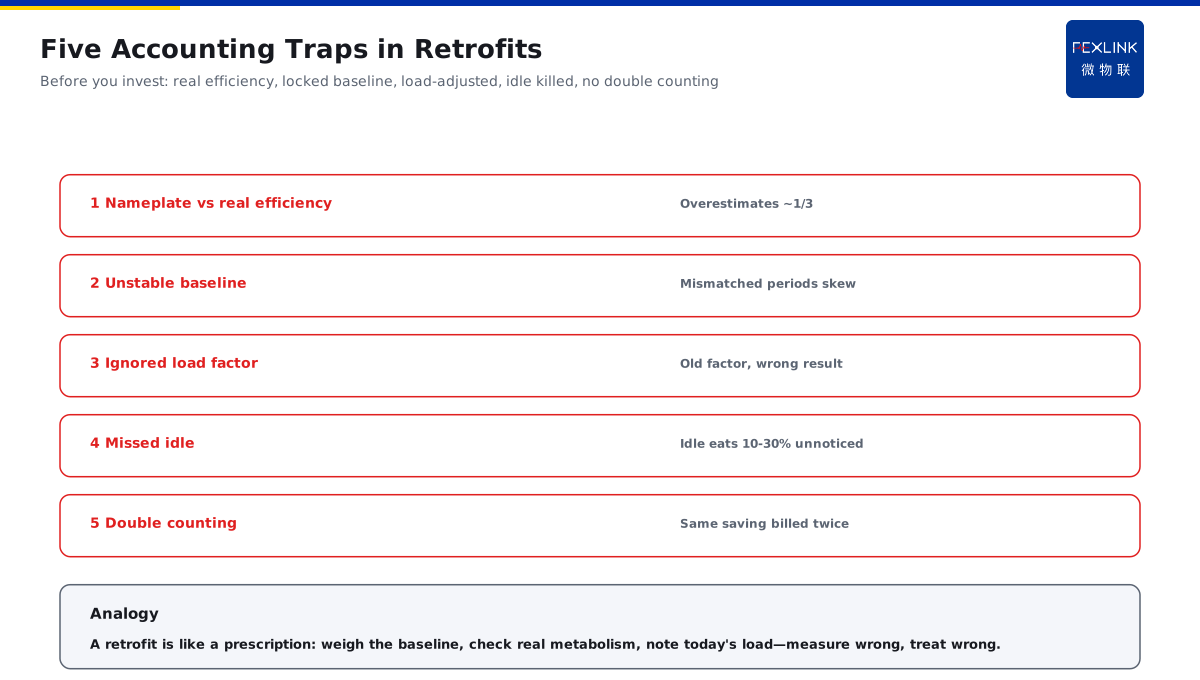
Why the retrofit not saving the bill? The common pits: the rated efficiency for the running, the baseline unstable, the load rate ignored, the idle missed and the savings double-counted — the rated the nameplate and the running the actual — the baseline the same period, the load rate the converted, the idle stopped first and the savings not repeated — the checklist, the waste avoided.
A scenario: The motor replaced — the bill not down — the report 200k, the actual 30k. The logic is that the failure is "the calculation wrong" — the equipment not, the method the pit. An analogy — The checkup: the weight (the baseline), the metabolism (the running) and the state (the load) — the wrong, the medicine wrong — the no saving, the calculation checked.
1. Pit 1: The Rated vs The Running
The rated — the nameplate: the full load and the rated — the factory; The running — the actual: the partial and the variable — the lower; The trap — the rated in the calculation: the overestimated — the below; The avoid — the measured: the current, the power and the load — the running, not the nameplate.
The measurement — the power by the meter: the active and the reactive — the efficiency the actual — the sub-metering the base.
In one sentence: the rated the "label" and the running the "actual" — the nameplate, the overestimated.
The table:
| Item | Rated | Running |
|---|---|---|
| Source | Nameplate | Measured |
| Condition | Full | Actual |
| Use | Selection | Calculation |
The difficulty — the measured needs the meter: the current, the power factor and the voltage — the sub-metering: the platform the running — the true data.
The simple start — the current clamp: the portable first — the permanent later: the sub-metering — the gradual, the accurate.
The data quality — the readings recorded: the time and the load — the repeated: the stable — the reliable, the calculation.
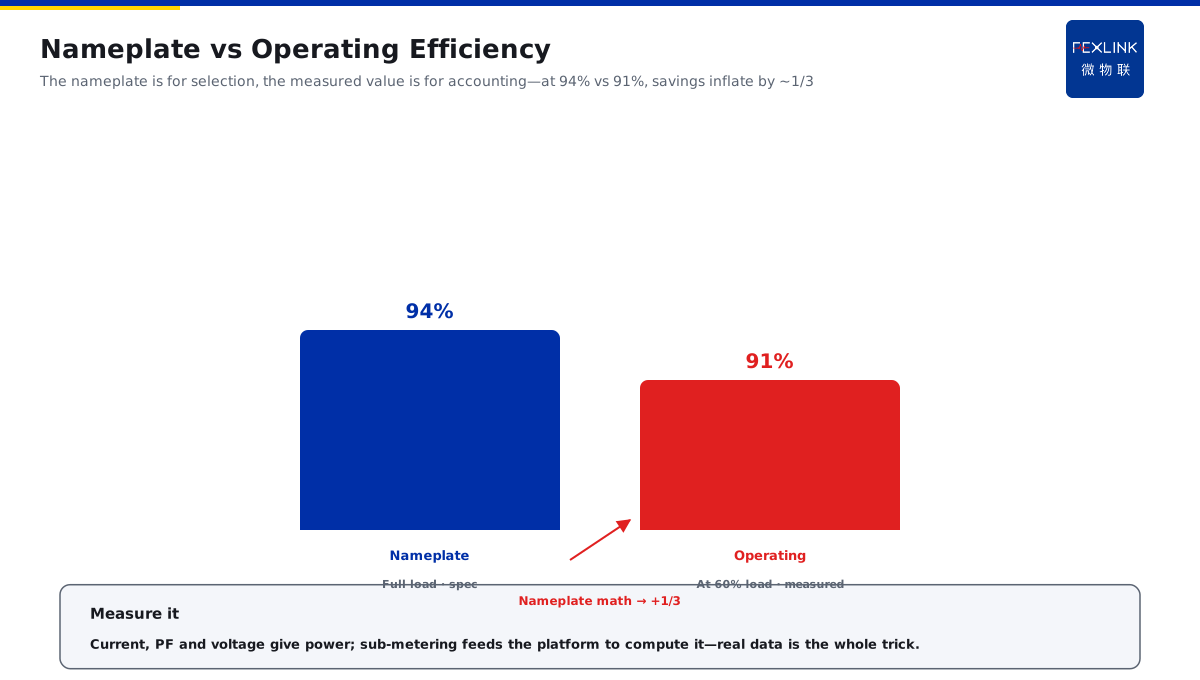
An example — The 94% nameplate and the 91% at 60% — the 94%, the third over.
The difference — the 3% the ratio: the savings the 30% less — the small difference, the large impact — the actual, the must. The logic is that the calculation the "running" — the nameplate the selection.
2. Pit 2: The Baseline Unstable
The baseline — the before: the reference — the same period; The trap — the un-locked: the different output and the season — the distorted;
The false conclusion — the "saving" the season: the summer the air — the baseline the winter, the wrong — the guard.
The stable — the 3-6 months same: the output, the weather and the condition — the comparable; The correction — the output the converted: the SEC — the weather the stated: the seasons — the corrected;
The season rule — the cooling and the heating separate: the air conditioning and the production — the baseline the comparable, the real.
The reference — the same month last year: the identical the calendar — the seasonal adjusted — the baseline the solid.
The avoid — the SEC the baseline: the more comparable — the stable, the real.
In one sentence: the baseline the "reference" — the unstable, the savings false — the same period and the SEC.
The table:
| Way | Problem | Correct |
|---|---|---|
| Total | Output | The SEC |
| Season | Weather | The same |
| Before/after | Condition | The recorded |
An example — The June (low) vs the November (high) — the output different, the misjudged. The logic is that the baseline the "comparable" — the output and the season changed, the distorted — the SEC, not the total.
3. Pit 3: The Load Rate Ignored
The load rate — the actual vs the rated: the efficiency and the consumption — the variable; The trap — the changed: the calculated at the same, the actual not — the deviation;
The magnitude — the 30% the load down: the efficiency the lower — the savings the halved — the ignored, the large error.
The change — the orders, the process and the shifts — the rate;
The tracking — the load rate monthly: the trend visible — the calculation by the tracked — the accurate.
The avoid — the segmented: the rates separately — the changed, the re-calculated.
In one sentence: the load rate the "variable" — the changed not counted, the biased — the segmented, not the single.
The table:
| Rate | Feature | Note |
|---|---|---|
| High | Efficient | The saving big |
| Low | Less | The saving small |
| Fluctuating | Hard | The segmented |
An example — The fan 90% before and 60% after the orders — the 90%, the less at the 60%.
The segmentation — the production hours and the idle hours: the load per segment — the weighted: the accurate. The logic is that the load the "mirror" — the changed the converted — the actual rate, the true.
4. Pit 4: The Idle Missed
The idle — the not producing: the motor running, the compressor unloaded and the lights on — the pure waste; The trap — the report the retrofit only: the idle unmanaged — the bill the idle; The share — the 10%-30%: the more than the retrofit; The check — the curve: the night and the break — the decomposition: the idle identified — the clear;
The list — the idle sources: the motors, the compressors and the lights — the inventory — the managed, the waste counted.
The measurement — the idle consumption: the metered or the estimated — the share of the total — the quantified, the action.
The avoid — the stop, the timing and the auto — the idle first, the retrofit after.
In one sentence: the idle the "invisible" — the retrofit before the idle, the wasted — the idle first.
The table:
| Scene | Waste | Action |
|---|---|---|
| Motor idle | Pure | Stop |
| Compressor unload | ~10% | Timing |
| Lights | Always | Auto |
An example — The compressor 6 h unloaded: 70k yearly — the timing, the more than the replacement.
The no-cost action — the schedule: the off at the break and the night — the zero investment, the immediate saving — the first. The logic is that the idle the "first account" — the checked before the retrofit — the controlled, the fast.
5. Pit 5: The Double-Counted
The double — the same saving twice: the motor and the efficiency and the idle — the same equipment; The trap — the inflated: the payback short — the actual far;
The inflated harm — the decision wrong: the storage over-invested — the payback the management — the real, the trusted.
The gate — the independent check: the bill and the load data — the third view — the gate, the inflated stopped.
The avoid — the per-source: each once — the cross: the no overlap;
The verification — the bill after: the actual vs the calculated — the gap the re-checked — the measured, the credible.
The reporting — the management the monthly: the saving per source and the payback — the visible, the sustained.
The check — the total first: the saving ≤ the actual difference — the repeated out, the real.
The consistency — the different sources the same pool: the power and the gas — the cross-checked — the one pool, the no double.
In one sentence: the saving "once per source" — the same twice, the false — the total, the repeated out.
The table:
| Scene | Problem | Action |
|---|---|---|
| Motor + efficiency | Repeated | Once |
| Idle + auto | Overlap | Per source |
| Total mismatch | Inflated | Remove |
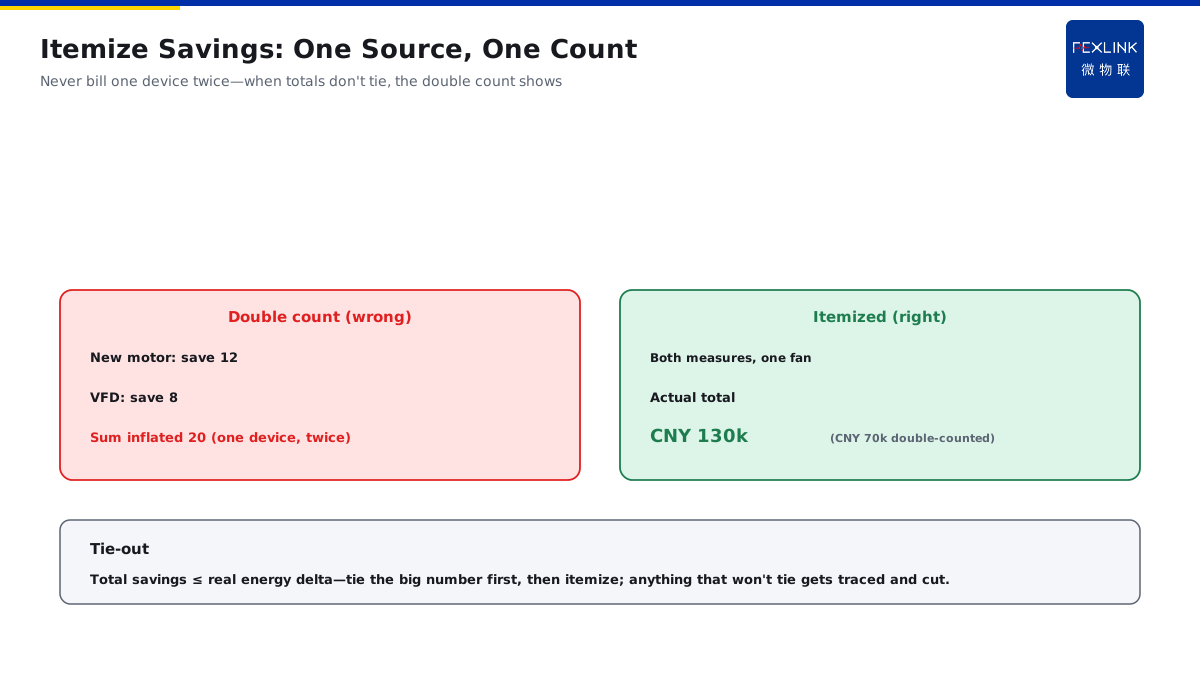
An example — The motor 120k and the VFD 80k: the 200k, the actual 130k — the 70k repeated. The logic is that the saving "no overlap" — the same pool, the not twice — the total checked, the repeated out.
Back to the ESA family — the landing: the Tianyan E-01 for the decomposition and the idle, the Tianyan C for the per-source and the 4×3×2 for the verification — from the pit to the proof, one line.
Scope and Limitations
- The conclusions in this article are intended for LV distribution and electrical-safety sites. Standard numbers (GB/T 13234) refer to their currently effective editions, and product parameters follow the latest FEXLINK selection handbook and product knowledge base.
- Quantitative criteria (protection zone, discharge and residual voltage, earth resistance, thresholds and grading) hold under the preconditions stated in this article. Where the site voltage level, earthing arrangement, environmental category or load profile differs, the figures must be recalculated. Specific configurations involving Tianyan E-01 (NILM load disaggregation), Tianyan C track (saving measures) should be verified against actual circuit parameters.
- Specific product models and parameters are subject to the latest selection handbook and product knowledge base; this article does not constitute selection or procurement advice.
- Standard numbers cited here refer to the currently effective editions; when a standard is revised, the related quantitative conclusions must be re-checked.
- Deployment and implementation for specific projects must be carried out by qualified engineers based on site survey and design drawings.
Frequently Asked Questions
Pitfalls in Energy Retrofits
The common pits: the rated efficiency for the running, the baseline unstable, the load rate ignored