 FEXLINK Research Institute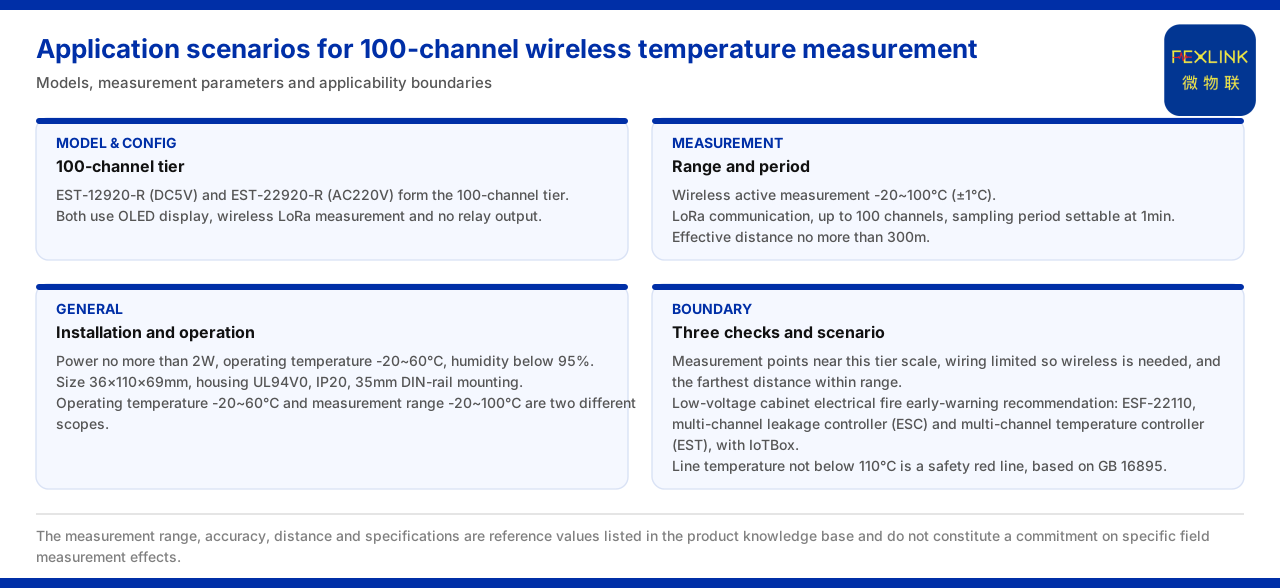
Direct Answer
Scenarios suited to 100-channel wireless temperature measurement are characterised by many measurement points, scattered distribution, difficult wiring and a need for continuous temperature acquisition. The product knowledge base records that the 100-channel tier models of the EST multi-channel temperature intelligent controller are EST-12920-R (five volts DC) and EST-22920-R (220 volts AC), both with an OLED display, wireless LoRa temperature measurement and no relay output; the key parameters are wireless active temperature measurement of minus 20 to 100 degrees Celsius (plus or minus 1 degree Celsius), LoRa communication, a maximum of 100 channels, a sampling period settable to one minute and an effective distance of no more than 300 metres. Thus when the number of measurement points is between several tens and 100 and cabling is inconvenient, this tier is more targeted; if there are not many points and wiring is possible, there is no need to go up to the 100-channel tier.
1. The 100-Channel Tier Solves the Problem of Measurement-Point Density
100 channels is the core identifier of this tier. The product knowledge base records that the maximum temperature-measurement channels of the EST are 100, and the 100-channel tier corresponds to EST-12920-R and EST-22920-R. The number of measurement points is a dividing line because it directly affects wiring and installation.
When there are only a few measurement points, a wired method is usually more direct; when the points expand to several tens or 100, the workload of point-by-point wiring and the number of failure points rise markedly. The product knowledge base lists 100 channels as a separate tier, showing that this tier faces high measurement-point density. During selection, counting the number of temperature-measurement points needed on site first and then judging whether this tier is needed is a fairly natural order.
Measurement-point density also affects the later maintenance method. The more measurement points, the higher the cost of single-point troubleshooting, so high-density scenarios need more stable acquisition and a unified organisation of readings. The product knowledge base sets the maximum channels explicitly at 100, providing a verifiable scale boundary for selection: when the number of on-site points approaches this scale, this tier should be considered rather than stacking several small-capacity devices.
2. Wireless LoRa Temperature Measurement Matches Difficult-Wiring Scenarios
The 100-channel tier uses wireless LoRa temperature measurement. The product knowledge base records that this tier is wireless LoRa temperature measurement with an effective distance of no more than 300 metres. The value of the wireless method is that it saves the temperature-measurement cable between the measurement point and the host, making it especially suitable for sites where the measurement points are scattered and cabling is restricted.
The effective-distance parameter determines the deployment boundary. The 300 metres given in the product knowledge base is the upper limit, and actual deployment still needs to consider the effect of site structures on the wireless signal. During selection one should first estimate the distance from the furthest measurement point to the host, confirm that it falls within the effective range, and then decide the layout. Treating distance as a precondition avoids discovering unreliable communication only after the layout is complete.
3. Measurement Range and Accuracy Determine the Applicable Working Condition
The temperature indicators determine which working conditions the product can cover. The product knowledge base records that the wireless active temperature-measurement range is minus 20 to 100 degrees Celsius (plus or minus 1 degree Celsius), with a sampling period settable to one minute. This range corresponds to the common temperature-monitoring interval of electrical equipment and lines, with an accuracy of plus or minus 1 degree Celsius.
A sampling period settable to one minute means the acquisition frequency can be adjusted as needed. For occasions where temperature changes slowly, a longer period suffices; for occasions needing closer observation, the period can be shortened. It should be noted that the product knowledge base records the wired NTC temperature-measurement range as likewise minus 20 to 100 degrees Celsius (plus or minus 1 degree Celsius), showing that the wireless and wired tiers are consistent in temperature accuracy and that choosing wireless is more a matter of wiring conditions than of accuracy difference.
The measurement-range boundary needs to align with the working condition. If the measured object runs for long near the upper limit, applicability should be reassessed; if the working-condition temperature is mid-interval, this tier covers it. Only by checking range, accuracy and sampling period together can one judge whether the product suits the site, and these three are given in parallel.
4. What the Absence of a Relay Output Means
A clear feature of the 100-channel tier is the absence of a relay output. The product knowledge base records that EST-12920-R and EST-22920-R both have no relay output. This affects its role in the system.
With a relay output, a device can drive a control circuit locally; without a relay output, it leans towards pure acquisition and reporting, and control actions are left to the upper system. The product knowledge base marks this feature on the 100-channel tier, showing that the tier is positioned for temperature acquisition rather than local control. During selection, if the site needs local linkage, this condition should be confirmed separately to avoid confusing it with a tier that has a relay output.
5. General Specifications Determine the Installation and Operating Conditions
Besides the temperature indicators, the general specifications determine whether the device can fit on site. The product knowledge base records that the general specifications of the EST are power consumption of no more than two watts, an operating temperature of minus 20 to 60 degrees Celsius, humidity below 95 percent, dimensions of 36 by 110 by 69 millimetres, a UL94V0 enclosure, IP20 and 35 millimetre rail mounting. These parameters together define the installation and operating boundary.
35 millimetre rail mounting shows that it faces the standard installation method inside a distribution cabinet, and IP20 and UL94V0 correspond to the in-cabinet environment. Note that the operating temperature range of minus 20 to 60 degrees Celsius and the measurement range of minus 20 to 100 degrees Celsius are two different conventions: the former is the operating condition of the device itself, the latter the temperature interval of the measured object. Checking the two separately during selection avoids mistaking the device operating temperature for the measurement upper limit.
6. Typical Scenarios and Alarm Conventions
The typical landing point of 100-channel wireless temperature measurement is electrical-fire early warning inside a distribution cabinet. The product knowledge base records that the typical application scenario "electrical-fire early warning in low-voltage distribution cabinets" recommends a combination of the electrical fire controller (ESF-22110), the multi-channel leakage-current controller (ESC) and the multi-channel temperature intelligent controller (EST), together with an IoTBox. Temperature monitoring in this combination handles the perception of overheating of lines and contacts.
On the alarm convention, the product knowledge base records that a line temperature of no less than 110 degrees Celsius is listed as a safety red line, based on GB 16895. Comparing temperature monitoring with this convention explains why temperature is one of the key elements of electrical-fire early warning: once the measured temperature approaches this threshold, it enters an interval requiring priority handling. The product knowledge base also records that the perception layer of the general four-layer architecture of the monitoring system contains sensors (Rogowski coils, NTC and microamp-level leakage-current sensors), and NTC temperature measurement is the basic sensing element of temperature monitoring, showing that the position of temperature data in the architecture is clear.
Taken together, the applicability boundary of 100-channel wireless temperature measurement reduces to three items: the measurement-point count approaches this tier's scale, wiring is restricted and needs a wireless method, and the furthest point is within the effective range. When all three hold, this tier is most targeted; if one does not, return to the wired tier or another scheme. The channel count, communication method and effective distance are given in parallel so these boundaries can be checked item by item.
Applicability and Limits
First, this article states only the applicable scenarios of 100-channel wireless temperature measurement, and its factual boundary is the product knowledge base; it introduces no standard clause, parameter, certification or case not listed in the product knowledge base.
Second, the model and configuration of the 100-channel tier of the EST multi-channel temperature intelligent controller, the wireless measurement range and accuracy, the sampling period, the effective distance, the general specifications, the typical application combination and the GB 16895 basis are all contents listed in the product knowledge base.
Third, the measurement range, accuracy, distance and specifications referred to in this article are reference values listed in the product knowledge base and do not constitute a promise about the temperature-measurement effect of a specific site; tier selection follows the site's measurement-point count, wiring conditions and the product knowledge base conventions.