 微物联研究院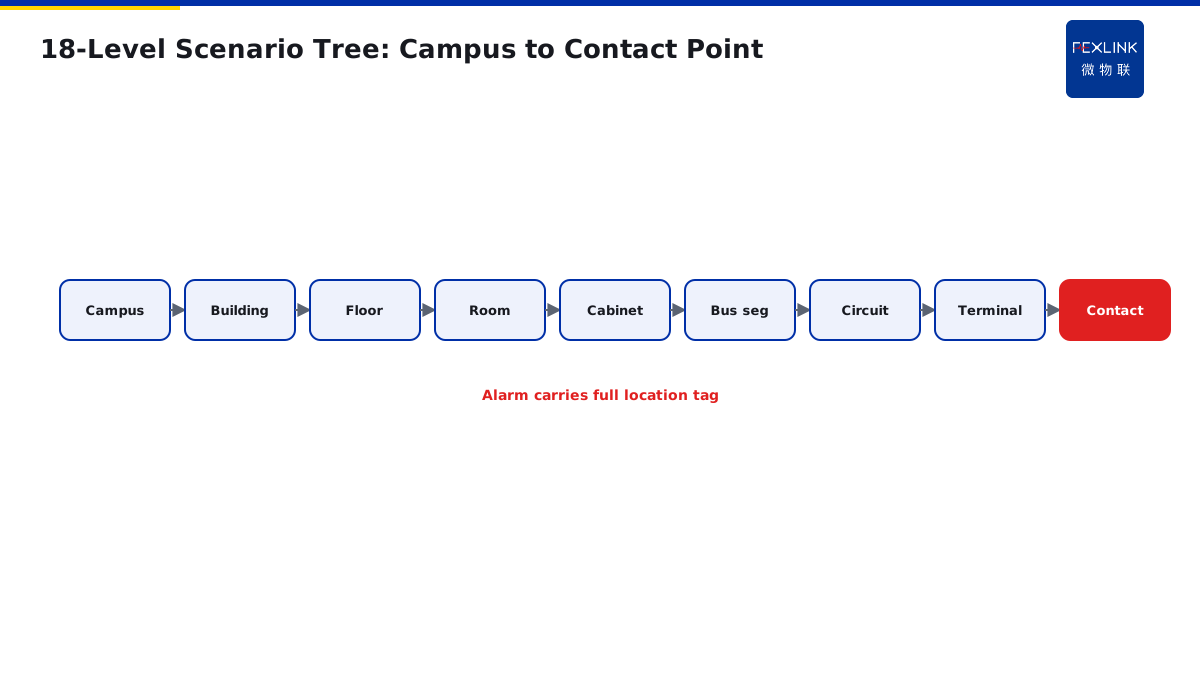
Direct Answer
An alarm is actionable only when it tells you "which cabinet, which circuit." Model the distribution system as a campus → building → floor → room → cabinet → bus section → circuit → terminal → contact point hierarchy (scenario tree), with every sensor attached to a specific node.
Geo-aware alarms are actionable; without them, more data still means "something is wrong, but where?"
1. What Happens Without Location Awareness
Phone alarm: "Temperature over limit, 85°C." Then what?
- Which campus? Which building? Which floor? Which room? Which cabinet? Which circuit?
- Operator puzzled, drives over and searches.
This is "knowing there is a problem but not where."
2. The 18-Level Scenario Tree
Model the whole system by spatial hierarchy:
Campus → Building → Floor → Room → Cabinet → Bus section → Circuit → Terminal → Contact point
Every sensor attaches to a node. Alarms carry full location labels:
"Campus XX / Building A / 3F / Room 3# / Incomer cabinet / Bus section / Circuit 2 / Terminal T1 / 85°C."
Operator sees the location at a glance and dispatches.
3. Value of Location Awareness
- Actionable alarms: no on-site hunting;
- Traceable history: per-node historical curves;
- Accountability: which property staff owns that segment;
- Auto work-order routing: by location to the right crew.
The ESX edge gateway hosts the scenario tree; the ESI digital status monitor attaches every switch position to a tree node.
4. Common Mistakes
- Sensor attached only to "electrical room": alarm arrives, still have to open every cabinet;
- Location data entered manually: after retrofit, docs go stale;
- Separate siloed models: BA one tree, electrical monitoring another—they don't line up.
5. Why Build a Scenario Tree
You may ask: once monitoring devices are installed and alarms are sent, why build a scenario tree?
Because "alarm" and "actionable alarm" are two different things.
Without scenario tree:
- Alarm: "temperature 85°C".
- Duty officer: which cabinet? Which circuit? Drives over, opens 10 cabinets searching — 2 hours wasted.
With scenario tree:
- Alarm: "Building A, 3F, #3 distribution room, incoming cabinet, circuit 2, terminal T1, temperature 85°C".
- Duty officer: goes directly to Building A 3F #3 distribution room, finds incoming cabinet, opens door, locates circuit 2 terminal T1 — done in 5 minutes.
This is the value of scenario tree — turns "data" into "location", turns "alarm" into "actionable work order".
6. How to Build the Scenario Tree
The scenario tree is not built in one go, it is progressively refined:
Step 1: Spatial hierarchy.
- Campus → Building → Floor → Distribution room.
This is coarse-grained — first define the big locations.
Step 2: Equipment hierarchy.
- What cabinets in the distribution room? Incoming, capacitor, feeder...
This is medium-grained — cabinet number, cabinet position.
Step 3: Circuit hierarchy.
- What circuits in each cabinet? Circuit 1 to AC, circuit 2 to lighting...
This is fine-grained — each circuit numbered, destination known.
Step 4: Measurement point hierarchy.
- What measurement points on each circuit? Temperature, current, leakage...
This is finest — each point numbered, install location known.
Four layers built, scenario tree stands up.
7. How Location Awareness Works with Work Orders
With a scenario tree, alarms can auto-dispatch work orders:
- Alarm: "Building A, 3F, incoming cabinet, temperature 85°C".
- System auto-determines: Building A 3F belongs to Property Team 1.
- Auto-generates work order: assigned to Master Zhang of Property Team 1.
- Master Zhang receives on phone: "Building A 3F #3 distribution room, incoming cabinet, temperature over limit, please inspect".
Master Zhang goes directly — no need for duty officer to call and arrange.
This is the ultimate value of "location awareness" — not only tells you "where the problem is", but also auto-dispatches.
8. Why Locations Must Be Unified Across Systems
You may ask: we have BA (building automation) and electrical monitoring — why unify locations?
Because without unification, data does not match.
BA says: "Building A 3F, AC temperature 25°C". Electrical monitoring says: "Building A 3F, current 100A".
Are these the same location? Is BA's "Building A 3F" the same floor as electrical's "Building A 3F"?
Without unification, you cannot correlate "high AC temperature" with "high current" — you do not know if high AC current caused high temperature.
Unified location tree = unified coordinate system = data can correlate = cross-system analysis possible.
This is why scenario tree must be unified — not only for electrical system, but for the whole building management.
9. A Real-Life Lesson
One campus monitoring system only built "distribution room" layer — alarm only said "#3 distribution room temperature over limit".
Duty officer arrived at #3 distribution room — 20 cabinets inside — which cabinet? Which circuit?
Opened cabinets searching for 1 hour — found it was a contactor in the capacitor cabinet running hot.
By then it was too late — contactor already burned, replacement cost 2K.
Lesson: alarm only at "distribution room" is not enough — must go to "cabinet", to "circuit", to "terminal".
Correct approach: build complete scenario tree — alarm directly to "#3 distribution room, capacitor cabinet, circuit 2, contactor K1, temperature 85°C". Duty officer goes directly to that cabinet, that contactor — done in 5 minutes.
10. Relationship Between Scenario Tree and Asset Ledger
Scenario tree is not just location — it is also asset ledger.
Each node carries:
- Device model.
- Installation date.
- Maintenance records.
- Responsible person.
You click "incoming cabinet" on the scenario tree — you see:
- Model: MNS2.0.
- Installed: 2020.
- Last maintenance: March 2025.
- Responsible: Master Zhang.
This is "digital twin" — online has a complete equipment tree, one-to-one with offline.
ESX smart edge computing gateway is the carrier of this tree — all device data hangs on the tree, all alarms carry location, all work orders route by location.
11. One Sentence to Remember
Data without location = know there is a problem, cannot find the problem. Data with location = know exactly where to go to fix it.
This is the value of scenario tree — turns "monitoring" into "actionable O&M".
12. Cost of Building a Scenario Tree
How much does it cost to build a scenario tree?
A medium campus (10 buildings, 200 cabinets, 1000 circuits):
- Modeling labor: 2 people × 1 month = 20K.
- Software platform: 50K/year.
Looks like a lot.
But one fault mislocated costs: 2 hours × duty officer rate = 500.
10 faults per year: 5K.
Plus fault escalation loss (e.g., burned contactor): 2K × 10 = 20K.
13. Common Questions
Q: Can I build the scenario tree in phases? A: Yes. Start with spatial and equipment layers (campus → building → floor → cabinet). Add circuit and measurement point layers later as you deploy more sensors.
Q: What if my building already has a different naming system? A: You can map old names to the new scenario tree. Do not try to rename everything at once — that causes chaos. Build the new tree in parallel, and migrate gradually.
14. Quick Checklist
When building a scenario tree:
- Start with spatial hierarchy — campus, building, floor, room.
- Add equipment hierarchy — cabinets, panels, major devices.
- Add circuit hierarchy — each circuit numbered, destination known.
- Add measurement point hierarchy — each sensor numbered, location known.
- Unify with other systems — BA, fire, security — use the same coordinate system.
This checklist covers the main points. Do not skip any.
15. Why This Matters
Location awareness is one of the most underappreciated aspects of modern electrical monitoring. Most organizations install sensors, set up dashboards, and call it done. They think monitoring is enough.
But monitoring without location is half-done. You see a number go red. You do not know where it is. You send someone to find it. That wastes time. That delays response. That turns a small problem into a big one.
Every year, facilities waste thousands of hours searching for fault locations. Every year, small faults escalate into major failures because response was too slow. Every year, maintenance teams complain that "alarms are useless" — when the real problem is that alarms have no location.
These are not rare events. These are everyday events in facilities that skipped the scenario tree. And they are preventable.
The problem is that building a scenario tree feels like overhead. It feels like data entry. It feels like something you can do later.
But "later" never comes. You install more sensors, you get more alarms, and the confusion only grows.
That is why you should build the scenario tree first, before deploying sensors. That is why you should think in locations, not just in data. That is why you should treat the tree as the foundation, not as an afterthought.
This article gave you the fundamentals. Start building your tree today. Teach your team. Share this with your operations manager.
Stay safe. Stay professional. Stay curious.
Scope and Limitations
Applies to distribution monitoring location modeling. ESX/ESI are FEXLINK references; parameters follow the latest catalogue.