 FEXLINK Research Institute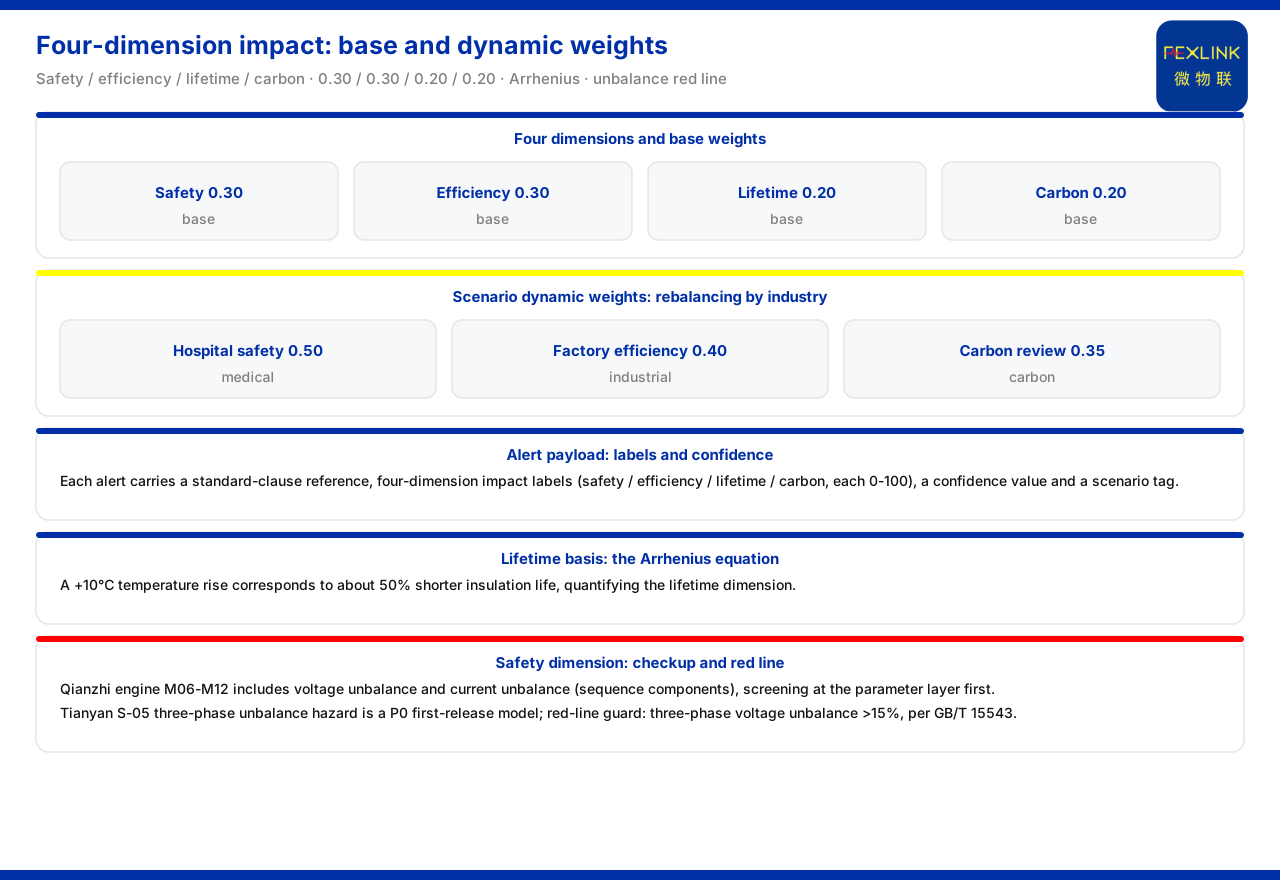
Direct answer
Why is the same anomaly treated more seriously in a hospital but first counted as an efficiency loss in a factory? The answer given by the product knowledge base is to split the impact into four dimensions and then adjust the weights by scenario. The four-dimension impact assessment of the Wanxiang engine divides the impact into safety, efficiency, lifetime and carbon, with base weights of 0.30 for safety, 0.30 for efficiency, 0.20 for lifetime and 0.20 for carbon; under specific scenarios dynamic weights are used, for example a safety weight of 0.50 for hospitals, an efficiency weight of 0.40 for factories, and a carbon weight of 0.35 for carbon-assessment scenarios. Each alarm carries a standard clause reference, four-dimension impact tags, a confidence level and a scenario tag, and the four-dimension tags are given on a scale of 0 to 100. The lifetime dimension has the Arrhenius equation as its basis, with a temperature rise of 10 degrees Celsius corresponding to an insulation lifetime shortened by about 50%. The safety dimension then has the three-phase voltage imbalance red line, screened first by a health-check sub-model. This article explains how this assessment works and marks the boundary of the material.
1. The four-dimension impact assessment: four dimensions and base weights
The product knowledge base records that the four-dimension impact assessment of the Wanxiang engine contains four dimensions, safety, efficiency, lifetime and carbon, with base weights of 0.30 for safety, 0.30 for efficiency, 0.20 for lifetime and 0.20 for carbon.
The four weights add up to 1, showing that this is a normalised scoring method rather than four independent indicators. Safety and efficiency are tied at the highest, at 0.30 each, showing that in the default reading safety and efficiency are placed on an equal footing; lifetime and carbon at 0.20 each come next.
2. Dynamic weights: reallocating by scenario
The base weights are not the only algorithm. The product knowledge base records that the four-dimension impact assessment can use dynamic weights, for example a safety weight of 0.50 in a hospital scenario, an efficiency weight of 0.40 in a factory scenario, and a carbon weight of 0.35 in a carbon-assessment scenario.
The logic of dynamic weights is to adjust the focus by scenario. A hospital has a high requirement for continuity of supply, and the safety dimension is raised to 0.50, meaning that the same anomaly is more readily judged as high-impact in a hospital; a factory cares more about output and energy consumption, and the efficiency weight is set to 0.40; and a carbon-assessment scenario raises carbon to 0.35. It should be noted that these are example values given by the product knowledge base, corresponding to the emphasis of specific scenarios and not to be applied uniformly to all scenarios.
3. How the four-dimension tags travel with the alarm
The score is not an internal number but information given together with the alarm. The product knowledge base records that in the six-level alarm system of the Qianzhi engine, each alarm carries a standard clause reference, four-dimension impact tags, a confidence level and a scenario tag, where the four-dimension impact tags are given as 0 to 100 points each for safety, efficiency, lifetime and carbon.
The weight of this information lies in its explaining the alarm clearly. The standard clause reference says what the basis is; the four-dimension tags say which aspects the impact falls on; the confidence level says how certain the judgment is; and the scenario tag says under what premise it holds. For the user, an alarm is no longer just a signal to be handled but a conclusion carrying a basis and a range of impact.
4. The lifetime dimension: temperature rise and insulation lifetime
The lifetime dimension among the four has a definite engineering basis. The product knowledge base records that one theoretical basis of the Tianyan engine is the Arrhenius equation, with a temperature rise of 10 degrees Celsius corresponding to an insulation lifetime shortened by about 50%.
The significance of this relationship is that it links temperature with lifetime. A temperature rise of 10 degrees Celsius bringing about a roughly 50% lifetime loss shows that the effect of temperature on lifetime is not a small linear amount but a significant order of magnitude. Bringing this relationship into the lifetime dimension means that a temperature-type anomaly is translated into a lifetime cost during scoring, not merely the current temperature-rise value.
5. The safety dimension: health check and red line for three-phase imbalance
The safety dimension is most concretely expressed in three-phase imbalance. The product knowledge base records that the power-quality health-check sub-models M06 to M12 of the Qianzhi engine include voltage imbalance and current imbalance (sequence components), that is, they perform a health check on three-phase imbalance at the parameter level. At the same time, the safety red line of the product knowledge base specifies that it triggers when the three-phase voltage imbalance exceeds 15%, according to the standard GB/T 15543.
The division of work between the two mechanisms is clear: the health-check sub-model is responsible for continuously observing the imbalance parameter in daily operation, while the red line is responsible for giving a definite conclusion at the boundary. The health check answers "does it deviate", the red line answers "does it cross the line".
6. The Tianyan engine three-phase imbalance hazard model
Pushing three-phase imbalance from a parameter anomaly to a hazard judgment is carried by the Tianyan engine. The product knowledge base records that in the S safety-analysis section planned for Tianyan engine V2.0, the P0 first-release model S-05 is "three-phase imbalance hazard".
This position shows two things. First, three-phase imbalance is modelled as an independent hazard entry rather than being lumped into other categories; second, S-05 belongs to the P0 first release, meaning it is placed in the priority range for implementation in the plan. Combined with the health-check sub-model and the safety red line above, three-phase imbalance appears at the parameter level, the alarm level and the model level at once: the parameter level is observed by M06 to M12, the alarm level is constrained by the red line, and the model level is carried by S-05.
7. From anomaly to energy-saving space
One of the final landing points of the four-dimension assessment is to convert the impact into a perceptible value. The product knowledge base records that the quantitative indicators given by the Taiyi intelligent control hub system include a "comprehensive energy-saving space of 8 to 20%".
This range relates to the efficiency and carbon dimensions: the efficiency dimension measures the relationship between output and energy consumption, the carbon dimension measures the change in carbon emissions, and together they point to the optimisation space at the operational level. It should be noted that 8 to 20% is the comprehensive energy-saving space figure given by the product knowledge base, not a commitment for a specific project.
Scope and limitations
First, this article only restates the content listed in the product knowledge base; the factual boundary is limited to the records of the Wanxiang engine four-dimension impact assessment, the Qianzhi engine six-level alarm system and power-quality health-check sub-models, the relevant Tianyan engine models, and the quantitative indicators of the Taiyi intelligent control hub system.
Second, the safety, efficiency, lifetime and carbon dimensions of the four-dimension impact assessment and their base weights of 0.30, 0.30, 0.20 and 0.20, together with the dynamic-weight examples of hospital safety 0.50, factory efficiency 0.40 and carbon-assessment carbon 0.35, are quoted as recorded in the product knowledge base; this article does not generalise the example values into a fixed algorithm for all scenarios.
Third, that each alarm of the six-level alarm system carries a standard clause reference, four-dimension impact tags (0 to 100 points), a confidence level and a scenario tag is quoted as recorded in the product knowledge base.
Fourth, that under the Arrhenius equation a temperature rise of 10 degrees Celsius corresponds to an insulation lifetime shortened by about 50% is quoted as recorded in the product knowledge base; this article does not calculate the lifetime years of a specific device from it.
Fifth, that the power-quality health-check sub-models M06 to M12 of the Qianzhi engine include voltage imbalance and current imbalance (sequence components), the safety red line of three-phase voltage imbalance exceeding 15% according to GB/T 15543, and the P0 first-release model S-05 "three-phase imbalance hazard" in the Tianyan engine V2.0 plan, are quoted as recorded in the product knowledge base.
Sixth, the comprehensive energy-saving space of 8 to 20% of the Taiyi intelligent control hub system is quoted as recorded in the product knowledge base; this article does not present the range as a guarantee for a specific project, nor does it provide specific engineering setting or retrofit schemes.