 FEXLINK Research Institute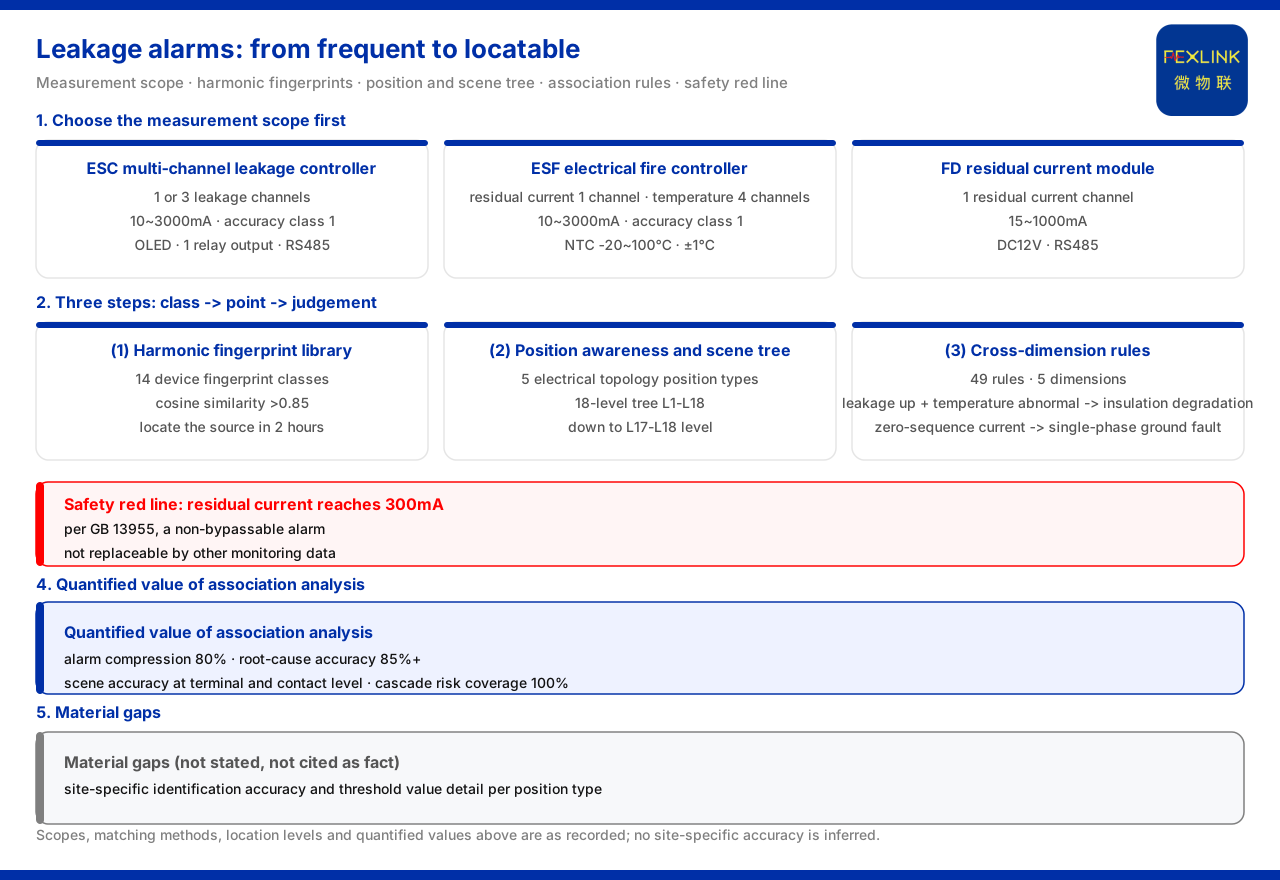
Direct answer
The positioning path given by the product material is layered: first use the harmonic fingerprint library to classify a disturbance to a device category, then use position awareness and the scenario positioning tree to land the alarm on a specific point, and finally use association rules to piece a single alarm into a comprehensive judgement. Specifically, the harmonic fingerprint library contains 14 device fingerprints, matched by cosine similarity greater than 0.85, and can lock the pollution source within 2 hours, whereas the traditional approach takes weeks; the position awareness of the Wanxiang engine maintains independent thresholds and risk models for 5 types of electrical topological positions, and the 18-level scenario positioning tree can locate to terminal-block level and contact-point level; its 49 cross-dimensional association rules are used to associate signals such as leakage, temperature and zero-sequence current. When leakage alarms are frequent, therefore, one should not rush to conclude "false alarm" but should return to the three steps of "which device class, which point, and which signals are abnormal at the same time".
1. Why false alarms deserve separate discussion
A real-world trouble of leakage monitoring is frequent alarms: if every alarm is treated equally, operation and maintenance fall into a state of constant reaction, and truly important alarms are instead submerged. The quantified value given by the product material is alarm compression 80%, which implies that alarms need to be filtered and classified rather than presented as they are.
Against this background, "locating the noise source" becomes key. Calling frequent alarms false alarms wholesale amounts to giving up on distinction: some alarms do correspond to real hazards, only the source is not on the device suspected; others are composite situations that require other signals to judge. The locating capability given by the material is precisely meant to give an executable answer to "where exactly the problem is", rather than remaining in a dispute over the number of alarms.
2. Measure leakage accurately first: the statements of three monitoring device classes
Locating requires measuring accurately first. The product material gives statements for three classes of device that handle residual-current monitoring. Several models of the ESC multi-channel leakage-current monitoring & control device (e.g. ESC-22310-R) provide 1 or 3 leakage-current channels, with different supply and phase configurations, all with an OLED display, 1 relay output and RS485 communication; the leakage measurement range is 10 to 3000mA with accuracy class 1.
The ESF electrical fire monitoring & control device (e.g. ESF-22110-R) combines residual-current and temperature monitoring: its models contain 1 residual current and 4 temperature channels, likewise with an OLED display, 1 relay output and RS485 communication; the residual-current measurement range is 10 to 3000mA (accuracy class 1), and temperature is measured by NTC with definite range and accuracy statements. In addition, the FD mains residual-current monitoring module (e.g. FD-01011-R) provides 1 residual current with a collection range of 15mA to 1000mA, supplied at DC12V and communicating over RS485.
Listing these statements side by side shows that the monitoring capability has a division of labour: use the multi-channel leakage-current monitoring & control device when multiple loops need monitoring, the electrical fire monitoring & control device when residual current and temperature must be measured together, and the residual-current monitoring module for single-point supplementation. Only after choosing the right monitoring statement for the site need can subsequent locating rest on reliable data.
3. Harmonic fingerprint library: classifying a disturbance to a device category
The product material records that the Qianzhi engine has a harmonic fingerprint library containing 14 device fingerprints, covering categories such as three-phase rectifiers, inverters, uninterruptible power supplies, charging piles and photovoltaic inverters, matched by cosine similarity greater than 0.85, and can lock the pollution source within 2 hours, whereas the traditional approach takes weeks.
The value of the fingerprint library is to turn "who the anomaly comes from" from guesswork into matching. The root of many leakage and power-quality disturbances is the operating characteristics of specific device types rather than random noise. The harmonic fingerprint library is exactly a characteristic baseline established by device category; when the harmonic characteristics monitored on site match a certain fingerprint highly, the type of pollution source can be identified. It should be noted that the material lists the matching method and the lock time statement, and this article does not infer the specific identification accuracy of any site on that basis.
4. Position awareness and scenario tree: landing an alarm on a point
After the device category is identified, one must still know where it is. The product material records that the position awareness of the Wanxiang engine maintains independent thresholds and risk models for 5 types of electrical topological positions, including the point of common coupling, main distribution panel, distribution panel, feeder line and load terminal; each position type has its own threshold and risk model rather than sharing one set.
At the same time, the Wanxiang engine uses an 18-level scenario positioning tree that can locate to terminal-block level and contact-point level. The meaning of position type is that "the threshold varies with position": the same leakage appearing at the main distribution panel and at the load terminal does not have the same judgement statement. The meaning of the scenario tree is that "the alarm lands on a specific point": the lower the level, the closer to an executable maintenance object. Combining the two, an alarm turns from "leakage somewhere" into "a certain terminal at a certain type of position", and the locating granularity improves markedly.
5. Association rules: from a single alarm to a comprehensive judgement
The product material records that the Wanxiang engine contains 49 cross-dimensional association rules covering 5 dimensions — for example, rising leakage superimposed on temperature anomaly points to comprehensive insulation degradation, and sustained zero-sequence current points to single-phase grounding traceability. Its quantified value includes alarm compression 80%, root-cause accuracy above 85%, scenario positioning precision falling at terminal-block level and contact-point level, and cascading risk coverage 100%.
Association rules answer "whether a single alarm should be taken seriously". Many hazards do not appear as only one signal: a leakage change is often accompanied by a change in temperature or current characteristics. Judging cross-dimensional signals together comes closer to the root cause than isolated alarms one by one. This is one source of alarm compression — related alarms are merged into one judgement rather than popping up separately. This article lists these statements only to explain the direction of association analysis.
6. Red line: the 300mA non-bypassable alarm
The product material records that, in the basic vital-sign sub-model of the Qianzhi engine, the leakage item uses a time-series trend and is placed before the red-line guard; the red line stipulates that a residual current reaching 300mA triggers a non-bypassable alarm, with GB 13955 as the basis.
Placing this red line at the end of the locating discussion is to draw a clear boundary: the purpose of locating and compression is by no means to let important alarms be "compressed away". The 300mA non-bypassable alarm shows that there exists a class of situation that must be responded to unconditionally. The value of the locating capability is to organise the remaining alarms more methodically while holding this bottom-line alarm, so that operation and maintenance handle the truly critical problems first. This article cites only this threshold and basis and does not infer the settings of other gradings on that basis.
Scope and limitations
First, the citations in this article are limited to the product material and the corresponding fact pack, and introduce no parameter, standard or case not listed.
Second, the monitoring channel counts, ranges, accuracies, display, output and communication statements of the multi-channel leakage-current monitoring & control device, the electrical fire monitoring & control device and the residual-current monitoring module are limited to the material entries.
Third, the 14 device fingerprints, the cosine-similarity-greater-than-0.85 matching method and the 2-hour lock statement of the harmonic fingerprint library are limited to the material; this article does not infer the specific identification accuracy of any site.
Fourth, the 5 electrical topological position types of position awareness and the locating levels of the 18-level scenario tree are limited to the material statement; this article does not infer the locating accuracy of a specific site.
Fifth, the 49 association rules and their quantified value (alarm compression 80%, root-cause accuracy above 85%, scenario positioning precision, cascading risk coverage 100%) are material statements, and this article does not treat them as a promise for any site.
Sixth, a residual current reaching 300mA triggering a non-bypassable alarm, with GB 13955 as the basis, is cited according to the material; this article lists no specific thresholds of other gradings.
Seventh, this article explains only the direction of the locating method, and provides no selection, threshold setting or configuration calculation for a specific project.