 FEXLINK Research Institute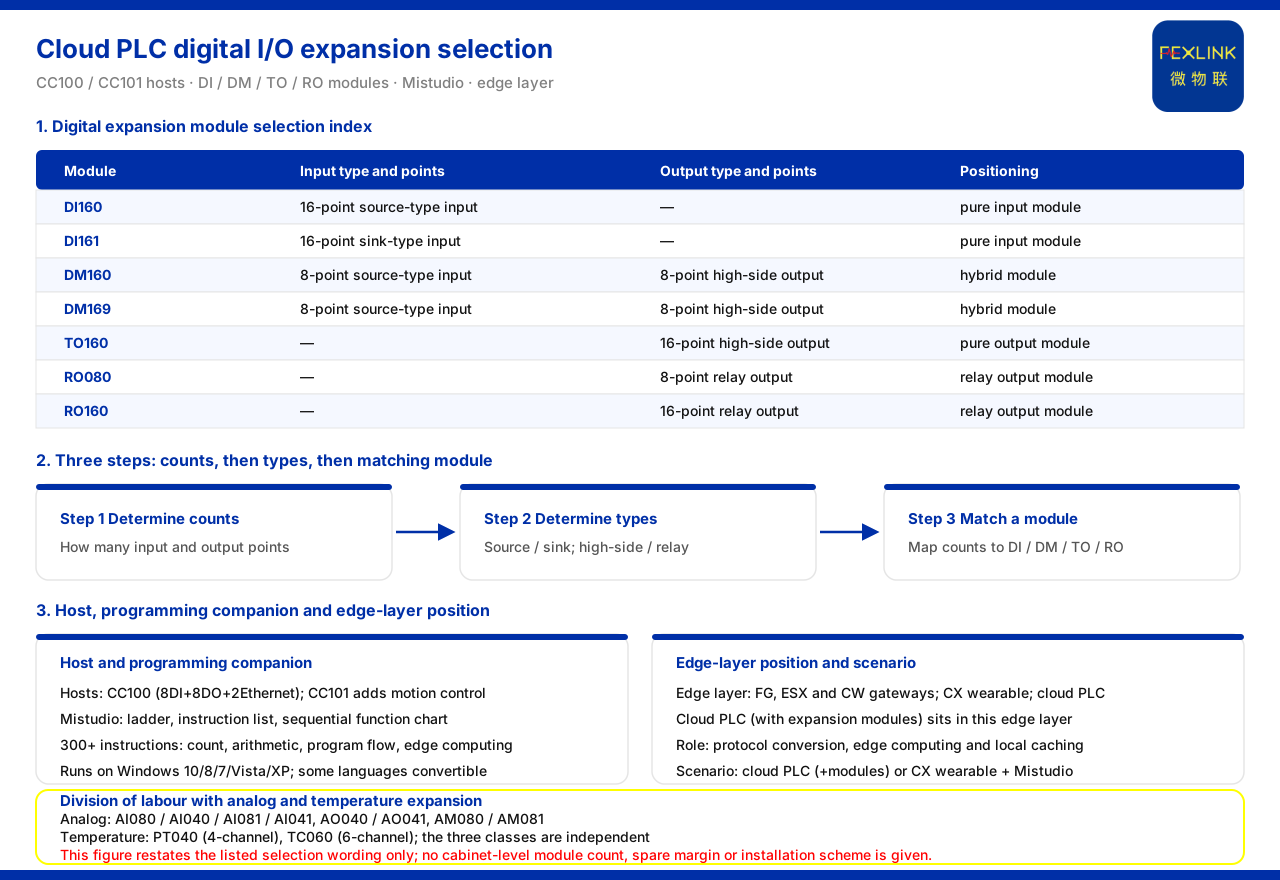
Direct answer
The digital input/output expansion of the cloud PLC (with expansion modules) (e.g. CC100/CC101) can be selected along three dimensions: input type, output type and point count. The knowledge base lists: the digital input modules (DI160, DI161) are 16-point, corresponding respectively to source-type and sink-type input; the digital input/output hybrid modules (DM160, DM169) are 8-point source-type input plus 8-point high-side output; the digital output module (TO160) is 16-point high-side output; and the relay output modules (RO080, RO160) are 8-point and 16-point relay output respectively. The basic approach: first determine how many points of input and output are needed, then whether the input is source-type or sink-type and whether the output is high-side or relay, and finally match the point count to a module. This article restates only the knowledge base's wording, with no configuration count for a cabinet.
1. The place of digital expansion in the cloud PLC system
The knowledge base records that the host models of the cloud PLC (with expansion modules), CC100 and CC101, are: CC100 provides 8 digital inputs, 8 digital outputs and 2 Ethernet ports; CC101 adds motion control on this basis. The system also includes a CR all-in-one slave and a slave adapter. The host carries some digital inputs and outputs by itself; when the on-site point count or type exceeds the host's built-in range, expansion modules fill the gap. The knowledge base divides them into three classes: digital input/output, analog input/output and temperature expansion. This article discusses the digital input/output expansion, independent in selection from the other two.
2. Input modules: 16 points, source-type and sink-type
The knowledge base records that the digital input modules (DI160, DI161) are 16-point digital input, corresponding to source-type and sink-type input respectively, the same point count with a difference only in input type. Source-type and sink-type correspond to the wiring difference of the field-signal common terminal; selection must match the field sensor or contact wiring, otherwise the same point count still cannot acquire correctly. On the input side, first determine how many points are needed, then whether source-type or sink-type wiring is used, and finally choose between DI160 and DI161. Below 16 points, a 16-point module can be configured with margin; how much margin to leave is an engineering design judgement the knowledge base does not specify, and this article does not infer it.
3. Hybrid modules: 8 points in plus 8 points out
The knowledge base records that the digital input/output hybrid modules (DM160, DM169) are 8-point source-type input plus 8-point high-side output. "Hybrid" means one module provides both: 8-point source-type input and 8-point high-side output. A hybrid module suits a loop needing a small amount of input and output at once. Compared with separate input and output modules, it merges the two classes of points onto one module. The knowledge base lists only this specification of DM160 and DM169, and this article infers no other difference between them.
4. Output modules: high-side output and relay output
The knowledge base records that the digital output module (TO160) is 16-point high-side output, and the relay output modules (RO080, RO160) provide 8-point and 16-point relay output respectively. The two output forms differ; in selection one determines the type by load nature and drive requirement, then the model by required point count: 16-point high-side output corresponds to TO160, and relay output to RO080 for 8 points and RO160 for 16 points. Considering output type and point count together clarifies selection and avoids confusion from similar names.
5. A selection index across the three dimensions
Arranging the digital expansion modules by input type, output type and point count yields a comparison index. Model names here are a normal use of a parameter and selection table.
| Module | Input type and points | Output type and points | Positioning |
|:--|:--|:--|:--|
| DI160 | 16-point source-type input | — | pure input module |
| DI161 | 16-point sink-type input | — | pure input module |
| DM160 | 8-point source-type input | 8-point high-side output | hybrid module |
| DM169 | 8-point source-type input | 8-point high-side output | hybrid module |
| TO160 | — | 16-point high-side output | pure output module |
| RO080 | — | 8-point relay output | relay output module |
| RO160 | — | 16-point relay output | relay output module |
Three steps can be seen: the first determines how many points of input and output are needed; the second determines whether the input is source-type or sink-type and the output high-side or relay; the third finds the matching module. If both point counts are small, with source-type input and high-side output, a hybrid module can cover both; if only one direction is needed, a pure input or output module is direct.
6. Host and programming-side companions
The expansion modules work together with the host and the programming software. The knowledge base records that the host models are CC100 and CC101, the former providing 8 digital inputs, 8 digital outputs and 2 Ethernet ports, and the latter adding motion control on this basis; there is also a CR all-in-one slave and a slave adapter. On the programming side, the knowledge base positions the Mistudio programmable logic control software system (compiler) as independently owned software, supporting languages such as ladder diagram, instruction list and sequential function chart, providing more than 300 instructions and able to run on Windows 10, 8, 7, Vista and XP, with some languages freely convertible. In the typical application scenarios, the recommended combination for industrial equipment intelligent upgrading (equipment brain) is the industrial wearable controller (programmable device wearable) or the cloud PLC (with expansion modules), plus the Mistudio software. Thus expansion modules, host and software form one programmable control solution.
7. Division of labour with analog and temperature expansion
Digital, analog and temperature expansion are three mutually independent classes. The knowledge base records that analog input/output expansion includes analog input modules (AI080, AI040, AI081, AI041; 8-channel or 4-channel, 12-bit or 16-bit analog input), analog output modules (AO040, AO041; 4-channel 12-bit or 16-bit analog output) and analog input/output modules (AM080, AM081; 4-channel 12-bit or 16-bit analog input plus output); temperature expansion includes thermal-resistor modules (PT040; 4-channel PT thermal resistor) and thermocouple modules (TC060; 6-channel TC thermocouple). Digital expansion selection does not change with whether analog or temperature expansion is also used, and vice versa. In cabinet design, one can determine the three channel classes separately, select each, then combine and count module quantity and installation space. The knowledge base gives no configuration rule for module quantity, and this article does not infer one.
8. The place in the overall monitoring architecture
The knowledge base records that the edge layer of the monitoring system's general four-layer architecture lists gateways such as the lightning-protection smart gateway (FG), the intelligent edge-computing gateway (ESX) and the industrial gateway (CW), as well as the industrial wearable controller (programmable device wearable) and the cloud PLC (with expansion modules); it undertakes protocol conversion, edge computing and local caching. The cloud PLC and its expansion modules sit in this layer, showing that digital expansion is part of the edge-side programmable control capability, not an isolated part.
Scope and limitations
First, this article restates only content listed in the product knowledge base, with its factual boundary limited to the cloud PLC host models, the input and output types and point counts of the digital expansion modules, the expansion-module classes, the programming software's capability, the edge-layer position and the typical-application selection combination; no unlisted parameter, certification or case is introduced.
Second, the 16-point and source-type/sink-type attribution of the digital input modules (DI160, DI161), the 8-point source-type input plus 8-point high-side output of the hybrid modules (DM160, DM169), the 16-point high-side output of the digital output module (TO160), and the 8-point and 16-point relay output of the relay output modules (RO080, RO160) are cited per the knowledge base's wording.
Third, the host models CC100 and CC101 share 8 digital inputs plus 8 digital outputs plus 2 Ethernet ports as a common basis, with CC101 additionally including motion control; this article infers no other host parameter.
Fourth, the models, channel counts and bit numbers of analog and temperature expansion are cited per the knowledge base's listing, and this article infers no unlisted accuracy, range or specific configuration.
Fifth, the independently owned positioning, supported languages, more than 300 instructions and runnable operating systems of the Mistudio programmable logic control software system (compiler) are cited per the knowledge base's listing, and this article expands no unmentioned platform or compatibility detail.
Sixth, this article provides no specific module configuration count, spare-point margin or installation scheme for any cabinet; the relevant judgement must be verified against actual channel requirements.
Seventh, this article does not constitute a commitment to the selection result or field performance of a specific project; actual conditions are subject to the latest product material and project scheme.