 FEXLINK Research Institute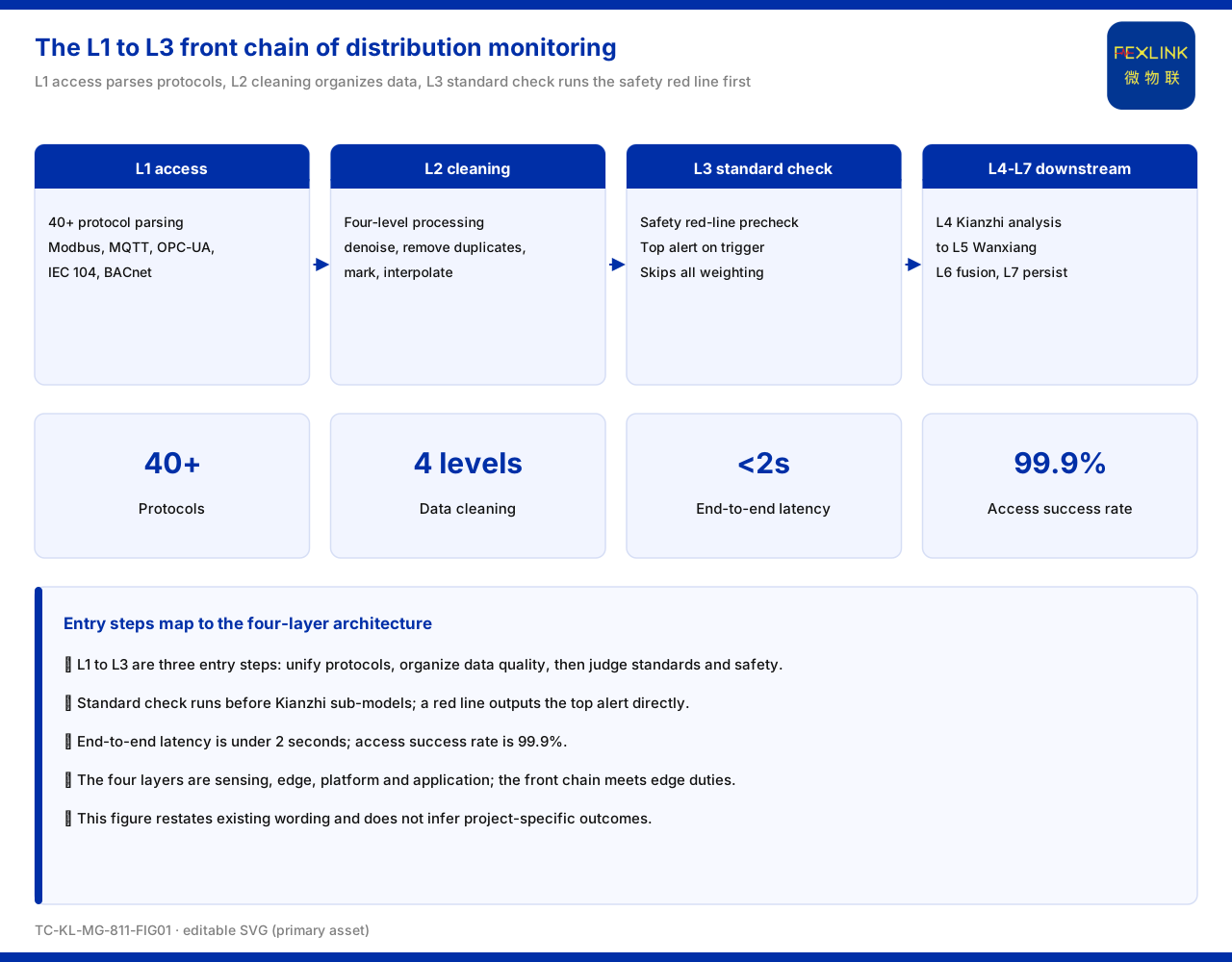
Direct Answer
Distribution-monitoring data does not enter the model in one step from field acquisition to analysis; it first passes through a definite front-end link. According to the existing product material, in the current V2.0 document system this link is carried by the first three stages of the Taiyi seven-stage pipeline: the first stage, access, handles the parsing of more than forty protocols; the second stage, cleaning, handles four-stage data-quality processing; the third stage, standard check, performs the safety red-line pre-check before the Qianzhi sub-model computation. Once the standard check triggers a red line, it directly outputs the highest-level alarm and skips all weighted computation. In other words, L1 to L3 are the "three entry processes" of distribution data: first turn multi-source protocols into unified data, then bring data quality to a usable state, and finally complete the compliance and safety judgement ahead of analysis. The end-to-end delay of the whole pipeline is less than two seconds, and the data-access success rate is ninety-nine point nine percent. This article restates these existing conventions only and does not infer the access scheme or alarm result of any specific project.
1. Why Distribution Monitoring Must Start With L1 to L3
Distribution monitoring is characterised by scattered measurement points, diverse protocols and uneven data quality. In the field there are protection and control devices from different vendors as well as various sensors and gateways, whose message formats, sampling periods and anomaly patterns are not consistent. If such data entered the analysis model directly, the analysis result would be polluted by protocol differences and data noise. The purpose of the front-end link is to complete three things before data enters analysis: unify multiple protocols into comparable data, handle anomalies and gaps clearly, and compare against standards and safety red lines in advance. Placing them on one link gives later analysis a stable input and makes problem localisation easier to layer: was data lost at access, was an anomaly misjudged at cleaning, or did the standard check trigger a red line.
2. The L1 Access Layer Handles Protocol Parsing
The product material records that, in the current V2.0 document system, the front-end layer is carried by L1 to L3 of the seven-stage pipeline, where the L1 access layer handles the parsing of more than forty protocols, covering Modbus, MQTT, OPC-UA, IEC 104, BACnet and others. Concentrating them in the access layer means the upper analysis need not adapt separately for each field device: whatever the channel, after the first three stages data is passed downward in a unified form. This matters especially in distribution monitoring, where the station-control and device layers often use several communication methods at once. The access layer carries exactly the duty of turning heterogeneous data into homogeneous data. It should be noted that the protocols listed are limited to the product material, and this article does not infer support for unlisted protocols.
3. The L2 Cleaning Layer Completes Four-Stage Processing
After access comes quality processing. The product material records that the L2 cleaning layer uses G5 four-stage data cleaning: denoising, duplicate removal, anomaly marking and interpolation completion. The order of the four stages reflects a line of thinking: denoise first, so the signal approaches the true one; then remove duplicates, so one event is not counted repeatedly; then mark anomalies, flagging suspicious values instead of discarding them; and finally interpolate, keeping the time series continuous at missing points. Traceability is preserved: anomalous values are marked rather than erased, and completed values have a clear source rather than an arbitrary fill. Data quality directly determines whether later alarms are trustworthy, so the cleaning layer is not an optional transition but the stage that qualifies data for analysis.
4. Why the L3 Standard Check Is Front-Loaded
The most distinctive part of the front-end link is L3. The product material records that the L3 standard check takes the form of a safety red-line pre-check and is performed before the Qianzhi sub-model computation; once the red line is triggered, it directly outputs the highest-level alarm and skips all weighted computation. Placing the standard check before analysis means the compliance and safety judgement is not decided by model scoring but occurs before scoring. Waiting for all sub-models to finish weighting before judging the red line would take time and might let a serious problem be diluted by the average score. By contrast, the family data link places the front-end layer explicitly before Qianzhi (discrimination) and after the Taiyi back-end cleaning, showing the standard check's position to be a fixed design arrangement.
5. The Position of L1 to L3 in the Seven-Stage Pipeline
Comparing the first three stages' duties with the whole pipeline clarifies the position. The product material records that the seven-stage pipeline of the Taiyi intelligent control hub system is: L1 access, L2 cleaning, L3 standard check (safety red-line pre-check), L4 Qianzhi analysis, L5 Wanxiang reasoning, L6 fusion decision, L7 persistence. The output of the first three stages is "clean and compliant data", and only from the fourth stage does analysis, reasoning, decision and persistence begin. This shows the first three stages solve "whether data can be used and is compliant", while from the fourth stage they solve "what the data says". Keeping the two duties separate makes it easier, when a problem appears, to judge whether to trace back to access and cleaning or to inspect the analysis model.
6. Correspondence With the General Four-Layer Architecture
The front-end link can also be cross-referenced with the general layering of a monitoring system. The product material records that the general four-layer architecture of a monitoring system is the perception layer, the edge layer, the platform layer and the application layer. Access and cleaning in the front-end link correspond mainly to data aggregation and organisation on the perception and edge sides, while the standard check spans the point before data enters platform analysis. The two frameworks do not conflict: the four-layer architecture describes the system's vertical layering from field to application, and the seven-stage pipeline describes the horizontal processes inside the platform from access to persistence. Understanding their correspondence avoids misattributing duties between layers and clarifies, during integration, who owns each data segment and where it converges.
7. End-to-End Indicators and Link Stability
The operating quality of the front-end link is ultimately reflected by the indicators of the whole pipeline. The product material records that the Taiyi intelligent control hub system has an end-to-end delay of less than two seconds and a data-access success rate of ninety-nine point nine percent. These two indicators relate directly to L1 to L3: the access success rate reflects how well L1 and L2 receive and order multi-source data, while the end-to-end delay requires that the first three stages not become a bottleneck. That is, protocol parsing, staged cleaning and standard pre-check must be efficient enough not to push up the delay. These values are the conventions listed in the product material; this article does not infer any site's actual delay or success rate, which are governed by site conditions and the project scheme.
8. Organising the Link Into a Reviewable Check Order
Combining the above sections, the L1 to L3 data link of distribution monitoring can be understood in the following order. First, confirm which protocols the data enters through, with L1 parsing more than forty protocols. Second, confirm the data undergoes denoising, duplicate removal, anomaly marking and interpolation completion at L2. Third, confirm L3 completes the safety red-line pre-check before the Qianzhi sub-models, outputting the highest-level alarm and skipping weighted computation when triggered. Fourth, connect the output of the first three stages with L4 to L7 analysis, reasoning, decision and persistence. Fifth, check the overall link performance with the two indicators of end-to-end delay and data-access success rate. This order separates "access, cleaning, verification, analysis, indicators" so each segment can be reviewed.
Applicability and Limits
- The content is limited to the existing wording of the product material on the front-end layer L1 to L3, the Taiyi seven-stage pipeline, the family data link, the general four-layer architecture of the monitoring system and the system-level indicators.
- The protocol count (more than forty), the cleaning, pipeline and architecture stage counts (four, seven and four), the end-to-end delay (less than two seconds) and the access success rate (ninety-nine point nine percent) are as listed and are not a commitment to any project's results.
- Protocol names are limited to those in the product material, and no unlisted protocol support is inferred; the standard check and safety red line are listed mechanisms whose criteria are not expanded here.
- The correspondence between the front-end layer and the general four-layer architecture is an organisation based on the existing wording of the two, and no unlisted correspondence is added.
- This article is not a commitment to any unlisted indicator; actual capability is governed by the latest product material and project scheme.