 FEXLINK Research Institute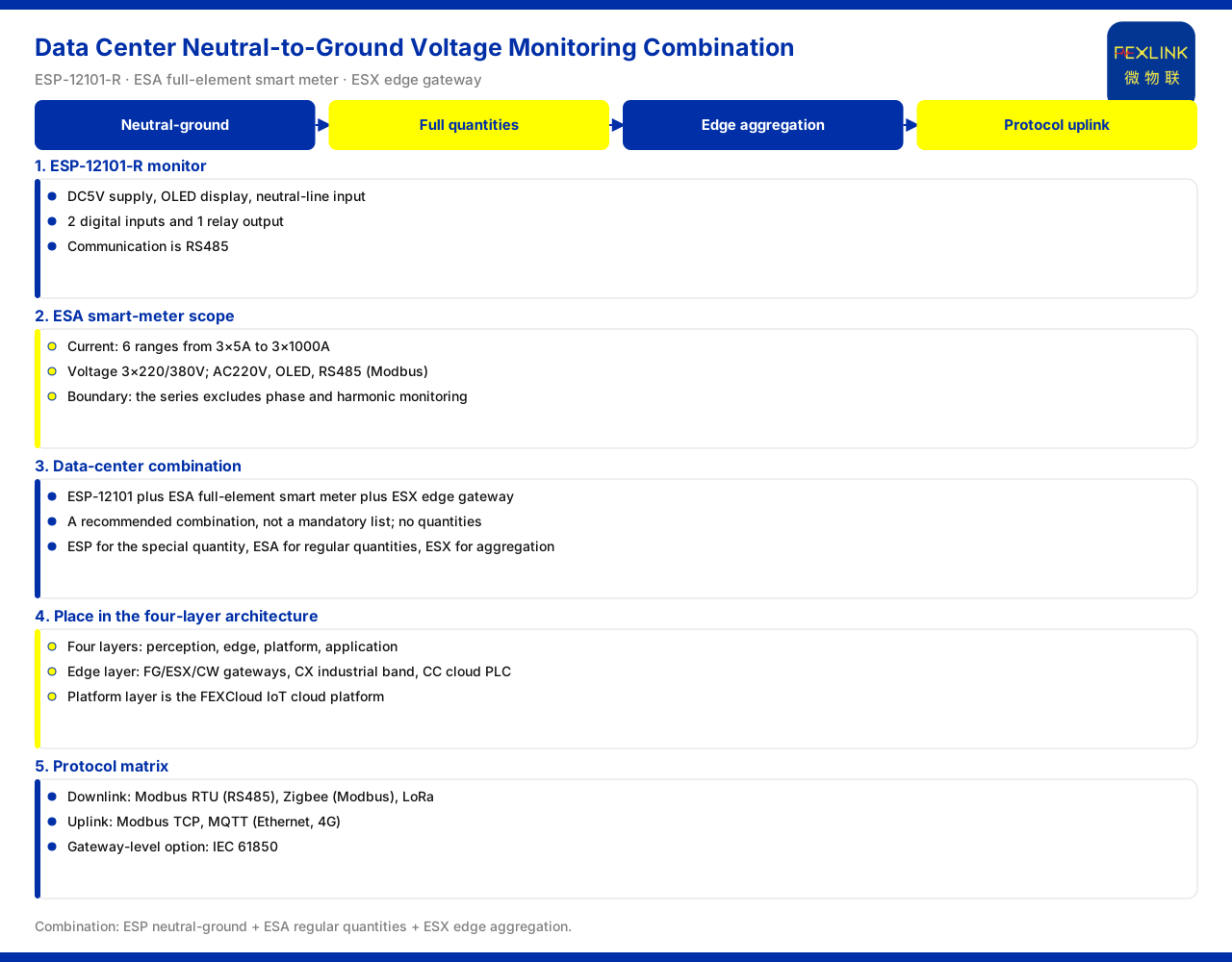
Direct answer
Neutral-to-ground voltage monitoring concerns not the voltage between phase conductors but the potential difference between the neutral conductor and the ground conductor. According to the product knowledge base, the representative model of the neutral-to-ground voltage monitor is ESP-12101-R, which uses DC5V supply and an OLED display, acquires the neutral-line input, and has 2 digital inputs, 1 relay output and RS485 communication. In the typical scenario of data-center neutral-to-ground voltage and distribution monitoring, the recommended combination the knowledge base gives is ESP-12101 together with the ESA all-parameter smart meter and the ESX edge gateway. The ESA all-parameter smart meter provides 6 current ranges and a voltage specification of 3×220/380V, with the whole series at AC220V, OLED and RS485 (Modbus), and it does not include phase or harmonic monitoring. The division of labour among the three is clear: ESP handles the dedicated neutral-to-ground voltage quantity, ESA handles conventional electrical quantities, and ESX handles edge aggregation. The following explains the knowledge-base entries.
1. The product scope of the neutral-to-ground voltage monitor
ESP-12101-R is the model of neutral-to-ground voltage monitor listed in the knowledge base. Its supply is DC5V, it has an OLED display, and its acquisition object is the neutral-line input. Besides the monitoring function, this model also provides 2 digital inputs and 1 relay output, and its communication method is RS485.
Together these parameters define the role of the device. On the input side, the 2 digital channels sit alongside the neutral-line input, showing that in addition to neutral-to-ground voltage it can receive a small number of switch states; on the output side, the 1 relay means it has one executable action outlet; RS485 connects it to the existing bus. This article states these as the knowledge base gives them and does not infer range, accuracy or alarm threshold.
From the product name, "neutral-to-ground voltage monitor" defines the quantity it measures. Neutral-to-ground voltage is the potential difference between the neutral conductor and the ground conductor, usually attended to separately in a distribution system rather than supplied incidentally by a conventional meter. This article only explains that the product takes on this dedicated quantity according to the knowledge base, and does not extend the cause analysis or mitigation recommendations behind it.
2. Specifications and boundaries of the ESA all-parameter smart meter
As the second product in the recommended combination, the ESA all-parameter smart meter has a relatively complete specification record in the knowledge base. There are 6 current ranges, covering 3×5A to 3×1000A; the voltage specification is 3×220/380V; and the whole series uses AC220V supply, an OLED display and RS485 (Modbus) communication.
Worth noting is a boundary the knowledge base also states: the ESA series does not include phase monitoring or harmonic monitoring. This is critical to selection. Neutral-to-ground voltage, phase and harmonics are three different quantities; ESA covers "all-parameter" conventional electrical quantities such as multiple current ranges and three-phase voltage, while phase and harmonics must be carried by other products. This article lists the boundary as it is, to avoid reading ESA as a device covering all power-quality quantities.
3. The recommended combination for data-center distribution monitoring
In typical application scenarios, the knowledge base gives the recommended product combination for data-center neutral-to-ground voltage and distribution monitoring as ESP-12101 plus the ESA all-parameter smart meter plus the ESX edge gateway. Comparing the division of labour among the three: ESP-12101 takes on the dedicated quantity of neutral-to-ground voltage, ESA takes on conventional electrical quantities such as current and voltage, and ESX acts as the edge gateway responsible for access and uplink.
Here it is necessary to distinguish two readings, "recommended combination" and "required bill of materials." The knowledge base lists it as the recommended combination for this scenario, showing that it is a set of arrangements for data-center neutral-to-ground voltage and distribution monitoring, not a mandatory configuration for any scenario. This article states it as a recommended combination and does not extend it into a general requirement. It should be noted that the recommended combination is only a product pairing and does not involve specific quantities. The knowledge base does not state how many units of each device are needed in this scenario, and this article makes no point-count estimate either.
4. The edge gateway and its place in the four-layer architecture
To understand the role of ESX in the combination, one must look at the general architecture of the monitoring system. The knowledge base records that the monitoring system uses a four-layer architecture: perception layer, edge layer, platform layer and application layer. The edge layer includes FG, ESX and CW gateways, the CX industrial wearable and the CC cloud PLC, and the platform layer is the FEXCloud IoT cloud platform.
Accordingly, the ESX edge gateway sits between the perception layer and the platform layer: it connects downward to perception-side devices such as ESP and ESA and aggregates upward to the platform layer. Listing ESX alongside ESP and ESA in the combination shows that the architecture of this scenario is "perception devices connect nearby to the edge gateway, which then aggregates upward." This article positions it accordingly and does not infer the gateway's computing or storage specifications.
5. Communication protocol matrix
Edge aggregation depends on specific protocols. The knowledge base records that the device downlink supports Modbus RTU (RS485), Zigbee (Modbus) and LoRa; the uplink supports Modbus TCP and MQTT (Ethernet, 4G); and at the gateway level IEC 61850 is optional.
Comparing this matrix with the preceding combination, the access path can be read out: ESP-12101-R and ESA are both marked RS485, corresponding to Modbus RTU (RS485) on the downlink side, while the ESX edge gateway undertakes the protocol conversion toward the uplink. The knowledge base marks IEC 61850 as gateway-level optional, showing that it is not a default item in every scenario. This article states the matrix as it is.
6. A supporting indication of applicable industries
Besides data centers, the knowledge base records that the applicable industries of the Taiyi intelligent control hub system include new-energy stations. This is not the same kind of record as neutral-to-ground voltage monitoring: the former is the industry coverage of the hub system, and the latter is a specific monitoring product combination. This article lists it to explain the industry range served by the related capabilities, and does not infer the specific configuration of ESP or ESA at a new-energy station from it. Stating industry coverage and product combination separately is to let the reader distinguish two levels of question: "in which industries can the hub be used" and "what equipment is recommended in a given scenario."
7. Selection and implementation order
The preceding entries can be drawn together into one order. First, clarify whether the monitoring object includes neutral-to-ground voltage; if so, choose the neutral-to-ground voltage monitor, representative model ESP-12101-R (DC5V, OLED, neutral-line input, 2 digital inputs, 1 relay output, RS485). Second, clarify the acquisition requirement for conventional electrical quantities, selecting the ESA all-parameter smart meter by the 6 current ranges (3×5A to 3×1000A) and 3×220/380V voltage, and noting that it does not include phase or harmonic monitoring. Third, confirm whether edge aggregation is needed according to the site and include the ESX edge gateway. Fourth, verify the protocols: ESP and ESA run over RS485, the uplink is converted by the gateway to Modbus TCP or MQTT, and IEC 61850 is optionally configured at the gateway level as needed.
Scope and limitations
- The content of this article is limited to the existing statements of the product knowledge base on entries related to the ESP neutral-to-ground voltage monitor, the ESA all-parameter smart meter, the ESX edge gateway and the data-center distribution-monitoring recommended combination, and does not extend to parameters, certifications or cases not listed in the knowledge base.
- The supply, display, inputs and outputs and communication of ESP-12101-R are knowledge-base scopes, and this article does not infer its range, accuracy or alarm threshold.
- The 6 current ranges, the 3×220/380V voltage specification and the boundary of not including phase or harmonic monitoring of the ESA all-parameter smart meter are cited as the knowledge base gives them.
- The data-center neutral-to-ground voltage and distribution-monitoring recommended combination (ESP-12101 plus the ESA all-parameter smart meter plus the ESX edge gateway) is limited to the knowledge-base entry, and this article does not extend it into a general mandatory configuration.
- The four-layer architecture and the communication protocol matrix are relayed as the knowledge base gives them, and this article does not infer the product list or deployment quantities of each layer.
- This article constitutes no commitment regarding any unlisted indicator; actual capability is subject to the latest product documentation and the project solution.