 FEXLINK Research Institute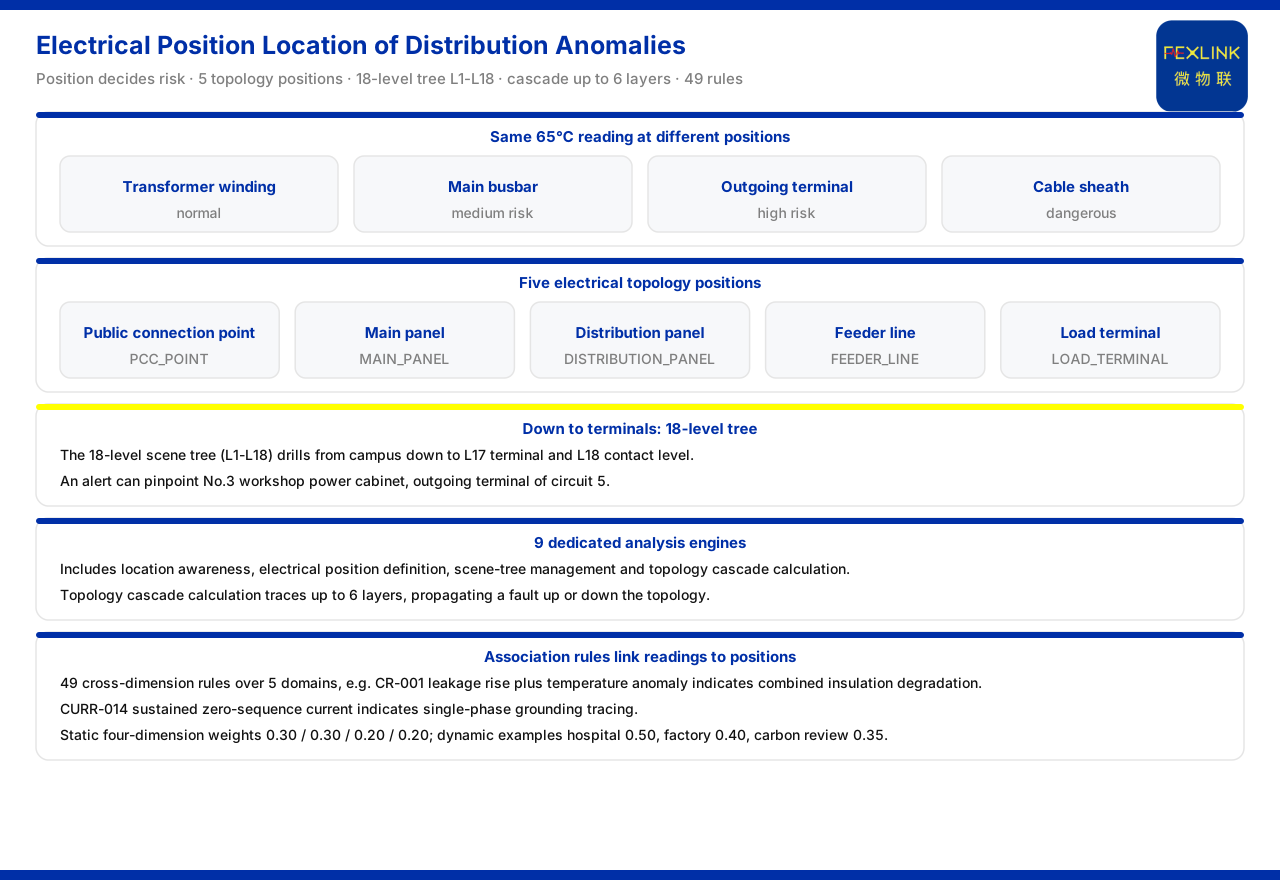
Direct answer
The core question in locating a distribution anomaly is not "what is the reading" but "where is this reading". The product knowledge base records that the Wanxiang engine maintains independent thresholds and risk models for 5 types of electrical topology position: the point of common coupling, the main distribution panel, the distribution panel, the feeder line and the load terminal. The same 65℃ reading is normal on a transformer winding, a medium risk on the main busbar, a high risk on an outgoing terminal and dangerous on the cable sheath. In other words, position determines the risk judgement. The hierarchical structure of positioning is the 18-level scene-positioning tree (L1 to L18), which can drill down level by level from the park to the wiring-terminal level and the contact level; on the analysis side it is supported by 9 dedicated analysis engines such as position awareness, electrical-position definition, scene-tree management and topological cascading-impact computation, with cascading impact tracing up to 6 layers; and on the association side, 49 cross-dimensional association rules link readings to a specific fault position. This article only restates the specifications above.
Why the same reading carries different risk at different positions
The absolute value of a reading such as temperature or current does not by itself indicate risk. The example given by the knowledge base makes this clearest: the same 65℃ is normal on a transformer winding, a medium risk on the main busbar, a high risk on an outgoing terminal and dangerous on the cable sheath. The same number spans several levels from normal to dangerous, and the difference comes only from position. The reason is that materials, insulation conditions, heat-dissipation environment and role differ from position to position, so the same temperature rise poses a different threat to each. Extending this logic, the location of a distribution anomaly cannot rest on a numerical threshold alone but must combine position. This also explains why position awareness is not an added label but a constituent condition of risk judgement: when position changes, the conclusion changes with it.
Position types: five electrical topology positions
For position to take part in judgement, positions must first be classified. The knowledge base records that Wanxiang position awareness maintains independent thresholds and risk models for 5 types of electrical topology position: the point of common coupling, the main distribution panel, the distribution panel, the feeder line and the load terminal. These 5 cover the main links from intake to terminal, each with its own independent threshold rather than a shared set of limits. An independent risk model means that the same class of reading entering different positions receives different risk conclusions. When locating an anomaly, the site should first be mapped onto these 5 positions and then judged by the threshold and model of the corresponding position; skipping this step and measuring all positions by one common standard may misjudge a normal state as risk, or treat a real risk as normal.
Positioning down to a terminal: the 18-level scene tree
Once the category is set, the position must be refined to a maintainable granularity. The knowledge base records that Wanxiang provides an 18-level scene-positioning tree (L1 to L18), drilling down from the park level to the L17 wiring-terminal level and the L18 contact level; an alarm can be located precisely to "the outgoing terminal of circuit 5 in the power cabinet of workshop 3". The purpose of this tree is to replace a coarse position description with an executable landing point: from the positioning result, maintenance staff can go directly to the corresponding cabinet, circuit and terminal without searching region by region. The deeper the level, the more specific the landing point, and the more actionable the positioning result. It should be noted that this positioning tree describes a position structure, and this article does not infer the details of its unlisted levels.
Following the topology: cascading traceback of up to 6 layers
An anomaly affects not only its own position but may propagate along the distribution topology. The knowledge base records that topological cascading-impact computation among the dedicated analysis engines of Wanxiang handles topological cascading-impact computation, traces up to 6 layers, and can locate an anomaly at one position as it propagates upward or downward along the distribution topology. The significance of this capability is that, when an anomaly appears at one position, the system can judge along the supply path which adjacent positions may be affected: tracing upward finds the source on the supply side, and tracing downward finds the affected nodes on the load side. The number of traced layers decides the depth of coverage, and 6 layers is the specification listed in the knowledge base. Combining this with the positioning tree above shows that position positioning is the precision of a "point" while cascading traceback is the extension of a "chain"; the two complement each other.
Linking readings to a fault position: 49 association rules
A single reading is often not enough to determine a fault position; several dimensions must be associated. The knowledge base records that Wanxiang provides 49 cross-dimensional association rules divided into 5 domains, including a continuous zero-sequence current pointing to single-phase grounding traceability, and a rise in leakage together with a temperature anomaly pointing to comprehensive insulation degradation. The role of these rules is to combine readings from different sensors into clues pointing to a specific fault position: a sustained zero-sequence current suggests a single-phase grounding problem, while synchronous leakage and temperature anomalies suggest the insulation state. The more association rules and the more dimensions covered, the more likely a reading is linked to a specific position. When understanding anomaly location, these rules should be seen as the bridge from "several readings" to "one position".
Weighted risk level: four-dimensional impact assessment
After the position is determined, a risk level must be given. The knowledge base records that the static weights of the four-dimensional impact assessment are safety 0.30, efficiency 0.30, lifetime 0.20 and carbon emission 0.20; in specific scenarios dynamic weights are enabled, with examples being safety 0.50 in the hospital scenario, efficiency 0.40 in the factory scenario and carbon emission 0.35 in the carbon-assessment scenario. On this basis, a distribution-position anomaly can be given a risk level in a weighted manner rather than judged roughly by numerical size. The dynamic weights show that the same anomaly may receive a different level in different scenarios, consistent with the logic that "position determines judgement": scenario and position together affect the final conclusion. Combining the four-dimensional assessment with position awareness lets the anomaly-location result be both definite and carry a comparable risk level.
Applicability and limits
First, the content of this article is limited to the product knowledge base's existing statements about the 5 types of electrical topology position of Wanxiang position awareness, the 18-level scene-positioning tree, the 9 dedicated analysis engines, the 49 cross-dimensional association rules and the four-dimensional impact assessment.
Second, the same 65℃ corresponding to normal, medium risk, high risk and dangerous at different positions, and the precise location to a specific outgoing terminal, are examples listed in the knowledge base; this article does not interpret them as a uniform judgement for any site.
Third, the topological cascading-impact tracing up to 6 layers and the 5 domains of the 49 association rules are restated according to the knowledge base; this article does not infer unlisted rules or level details.
Fourth, the static and dynamic weight examples of the four-dimensional impact assessment are limited to the knowledge base, and this article provides no risk-level conclusion for a specific project.
Fifth, the practical application of distribution anomaly location must be confirmed item by item together with the on-site topology, load and operating conditions; this article does not replace on-site verification.