 FEXLINK Research Institute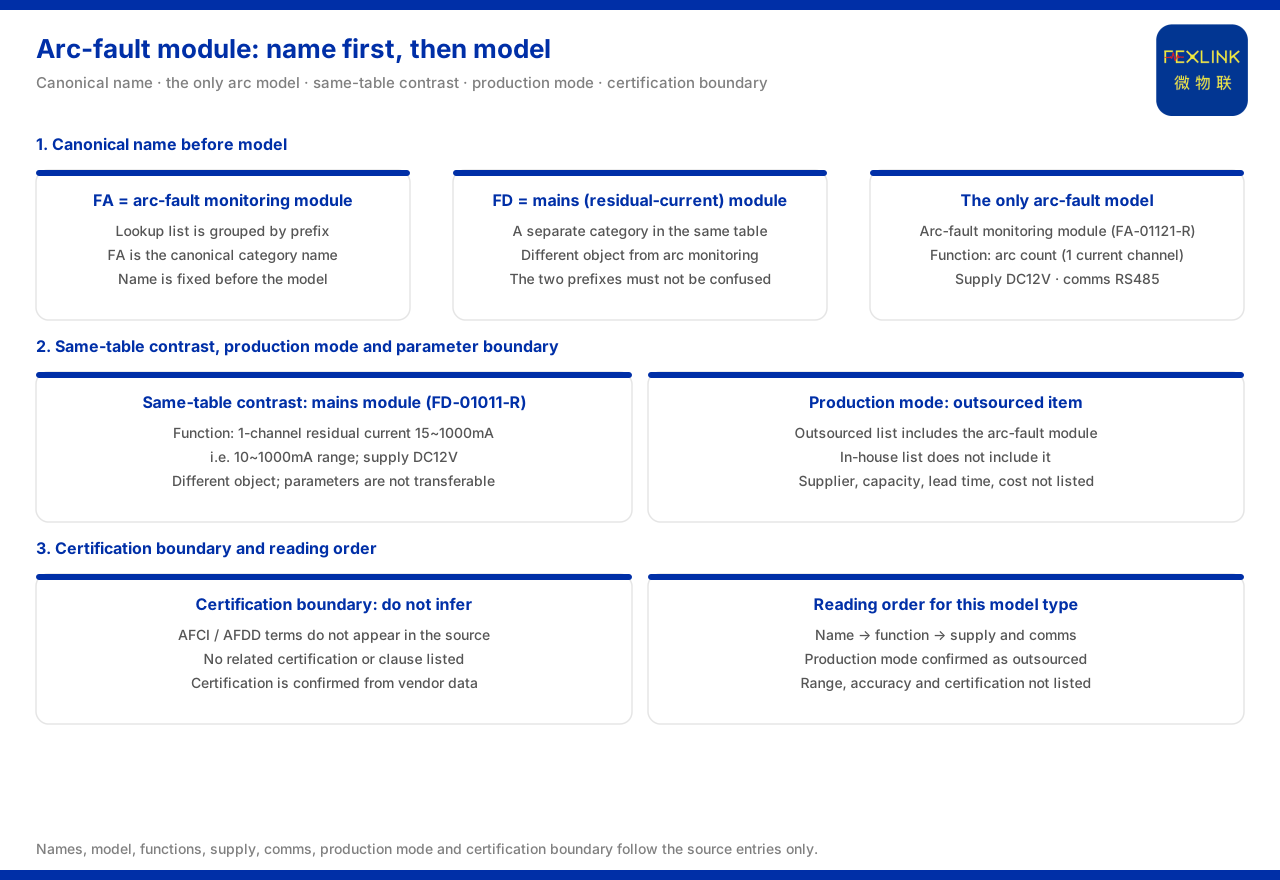
Direct answer
The arc-fault monitoring module is one class of module in the intelligent lightning-protection line of the product knowledge base. Its standard product name is "arc-fault monitoring module," and the model that carries the arc-fault monitoring function in the model table is the arc-fault monitoring module (FA-01121-R). According to the model table, this model's function field is "arc count (1 current channel)," its supply is DC12V, and its communication is RS485. Understanding the model requires seeing three boundaries at once. First, the same table contains a separate mains residual-current monitoring module (FD-01011-R) whose function is 1-channel residual-current measurement; the two rows belong to different products and must not be conflated. Second, in the known-information-gap appendix, the knowledge base lists the arc-fault monitoring module among the outsourced items of the production mode, while the self-produced list does not contain it. Third, the term AFCI or AFDD does not appear anywhere, nor does the knowledge base list any corresponding certification or standard clause. What can be confirmed is the name, function, supply, communication and production-mode attribution; capability, supply and certification beyond that scope cannot be inferred.
1. Standard name before model
The first step in discussing this class of product is to use the standard name, not to lead with a model. The product-model quick reference in the appendix is arranged by prefix, in which FA corresponds to "arc-fault monitoring module" and FD to "mains residual-current monitoring module," listed separately. This shows that the standard product name for the prefix FA is "arc-fault monitoring module," and that the model FA-01121-R is a specific model under this name. Once the name-model relationship is set straight, the function, supply and communication fields read later can be tied to the correct class of product rather than mixing up two entries with similar prefixes.
2. The arc-fault monitoring model in the model table
The model table lists arc-fault monitoring and mains residual-current monitoring together, and the row containing FA-01121-R is the only model whose function is arc-fault monitoring. The same table carries the mains residual-current monitoring module (FD-01011-R). Within this table only one model is findable for the arc-fault direction, the arc-fault monitoring module (FA-01121-R); the remaining entries belong to another functional class. Establishing this is the key to judging whether the model is indeed the arc-fault monitoring module and avoids mistaking other rows for arc-monitoring alternatives.
3. Function field: arc count (1 current channel)
The most central field is the function. According to the model table, the function of the arc-fault monitoring module (FA-01121-R) is "arc count (1 current channel)." This wording contains two points: "arc count" indicates that it records the number of arc occurrences, a counting-type quantity; and "1 current channel" indicates that the acquisition object is one current loop. The knowledge base gives no range, accuracy, decision threshold or statistical convention for this function, so these details remain unlisted. Reading the function field in full answers "what does it monitor": it performs arc-count statistics on one current loop.
4. Supply and communication: DC12V and RS485
Besides the function, the model table gives supply and communication. The supply of the arc-fault monitoring module (FA-01121-R) is DC12V and its communication is RS485. The knowledge base does not state this model's data protocol, address count or bus-mounting capacity, so the single item "RS485" cannot be used to infer its networking scale or protocol details. What can be established is that it combines DC12V and RS485 in the supply and communication fields, the same combination used by the mains residual-current monitoring module in the same table.
5. Difference from the mains residual-current monitoring module
The two entries sit side by side and are easily confused. The function of the mains residual-current monitoring module (FD-01011-R) is 1-channel residual current, with an acquisition range of 15mA to 1000mA, which the knowledge base notes is equivalent to the 10mA to 1000mA range; its supply is likewise DC12V and its communication likewise RS485. The supply and communication are therefore the same, and the difference lies in the functional object: one counts arcs, the other measures residual current. The knowledge base classifies the former as FA and the latter as FD and lists them separately in the appendix. Distinguishing the two rests on the function field and the product name, not on supply or communication, and this prevents the two classes of module from being substituted for each other.
6. Production mode: listed as an outsourced item
Item 1 of the known-information-gap appendix discusses production mode and gives a self-produced list and an outsourced list. The outsourced list explicitly includes power/signal surge protective devices, the arc-fault monitoring module, the smart air switch and the power-quality monitoring module; the self-produced list includes modules for monitoring lightning current, grounding resistance, arresters and surge protective devices, residual-current and transient-current monitoring modules, intelligent surge protective devices, and programmable wristbands, gateways and PLCs, while the arc-fault monitoring module does not appear there. It can therefore be confirmed that this module is classified as an outsourced item in production mode. The knowledge base does not expand on the outsourcing counterpart, supply terms, capacity or lead time, so these remain outside the listed scope.
7. Certification position: not to be inferred from the knowledge base
The term AFCI or AFDD does not appear anywhere in the knowledge base, nor does it list any certification or standard clause related to arc-fault monitoring. This is a negative fact, bounded by the text of the knowledge base. Its significance is to mark the boundary of description: because a product name contains the words "arc fault," one may not infer that the model complies with a particular arc-fault protection certification or that a particular standard applies. Any topic concerning certification, standards conformity or protection settings should be checked against the manufacturer's material and formal certificates, not back-inferred from the model table.
8. Check order for reading this class of model
The preceding content can be drawn into a reusable check order. First, confirm the object name: whether it is the arc-fault monitoring module or the mains residual-current monitoring module, aligning first by the product name and the FA and FD prefixes. Second, read the function field to determine whether it counts arcs or measures residual current, and how many channels. Third, read the supply and communication fields to confirm DC12V and RS485. Fourth, where supply, capacity or lead time is involved, return to the known-information-gap appendix, confirm that the matter is an outsourced item and is not expanded, and mark it truthfully as a gap. Fifth, where certification or standards are involved, state clearly that the knowledge base does not list them and do not infer from them. Read in this order, the result is the confirmed information within the knowledge base together with a clear scope of what is not listed.
Scope and limitations
First, this article restates only what the product knowledge base lists, and its factual boundary is limited to the product name of the arc-fault monitoring module, the function field and supply and communication in the model table, and the record of its production-mode attribution.
Second, the function "arc count (1 current channel)," the DC12V supply and the RS485 communication of the arc-fault monitoring module (FA-01121-R) are cited as the model table gives them; this article adds no range, accuracy, threshold or statistical convention.
Third, the 1-channel residual current of 15mA to 1000mA (that is, the 10mA to 1000mA range), DC12V and RS485 of the mains residual-current monitoring module (FD-01011-R) are cited as the knowledge base gives them, and this article does not apply those parameters to the arc-fault monitoring module.
Fourth, FA and FD are listed separately in the appendix quick reference, and on that basis this article explains the distinction between the two product names without inferring other meanings of the naming rule.
Fifth, production mode follows item 1 of the known-information-gap appendix, under which the module is an outsourced item; the knowledge base gives no supplier, capacity, lead time or cost, and this article does not supply them in its place.
Sixth, the term AFCI or AFDD and related certification or standard clauses do not appear anywhere in the knowledge base, and on that basis this article does not infer certification or standards applicability.
Seventh, this article explains only the information within the knowledge base and the order in which to read it, and constitutes no commitment regarding selection, supply or compliance conclusions for a specific project; actual results are subject to the latest product documentation and formal documents.