 FEXLINK Research Institute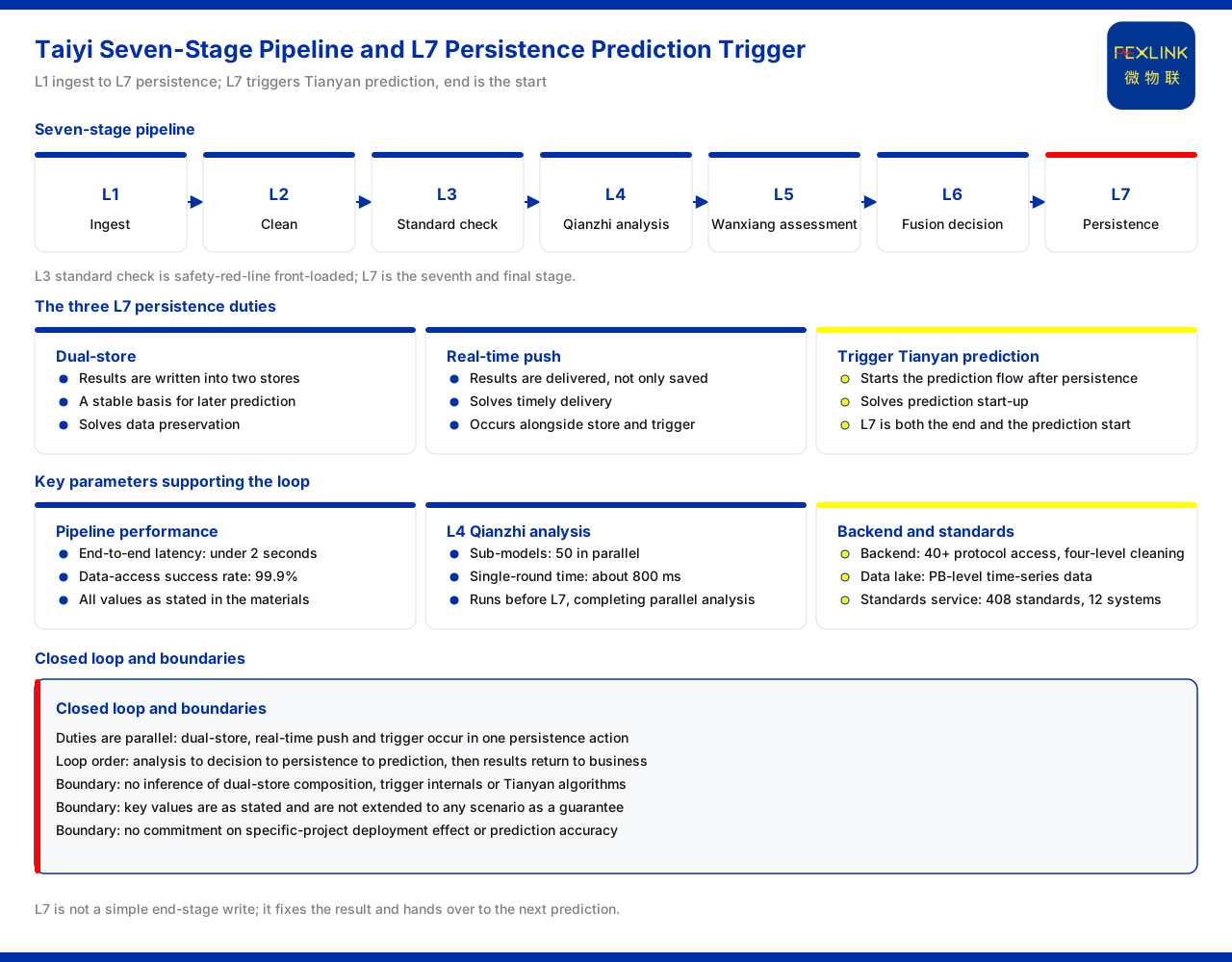
Direct answer
L7 persistence does trigger Tianyan prediction. The product knowledge base records that the seven-level pipeline of the Taiyi intelligent control hub system is L1 access, L2 cleaning, L3 standard verification (red-line pre-position), L4 Qianzhi analysis, L5 Wanxiang study, L6 fusion decision and L7 persistence; among them the duty of L7 persistence is defined as "dual-database storage plus real-time push plus triggering Tianyan prediction". That is, L7 is not a simple write to the database at the end of the chain but a combination of three duties: writing the result into the dual database, pushing the result out in real time, and thereby triggering the prediction of the Tianyan engine (large model). The end-to-end latency of this pipeline is under 2 seconds, and the data access success rate is 99.9%. The key to understanding L7 lies in its before-and-after relations: it is the last level in the seven-level pipeline, receiving the results of all levels above, and at the same time the starting point of the prediction stage. This article restates only the existing specifications above and infers neither the specific composition of the dual database nor the internal mechanism of the prediction trigger.
1. The position of L7 in the seven-level pipeline
The product knowledge base lists the seven-level pipeline in full: L1 access, L2 cleaning, L3 standard verification (red-line pre-position), L4 Qianzhi analysis, L5 Wanxiang study, L6 fusion decision and L7 persistence. L7 is the seventh and last level of this chain. Its position determines its duty: the preceding six levels complete all processing from access to decision, and L7 is responsible for fixing the processing result and advancing it. Placing it last does not mean it is merely a wrap-up — on the contrary, because the knowledge base writes "triggering Tianyan prediction" into the duty of L7, it simultaneously serves as the entry that passes the result to the next round of prediction. This dual identity of "end is also the start" is the key to answering whether L7 triggers Tianyan prediction.
2. The three duties of L7
The product knowledge base gives three duties for L7: dual-database storage, real-time push and triggering Tianyan prediction. The three duties are listed in parallel, showing that they occur simultaneously in one persistence action rather than substituting for each other. Dual-database storage solves the preservation of the data, real-time push solves the timely delivery of the result, and triggering Tianyan prediction solves the starting of the prediction flow. Placing the three together makes the positioning of L7 clear: it takes "storing it" as its base and at the same time completes the two things of "sending it out" and "starting the prediction". The answer in the product knowledge base to the question "does L7 persistence trigger Tianyan prediction" is therefore affirmative — triggering Tianyan prediction is itself one of the duties listed for L7.
3. Why persistence triggers prediction
From the logic of the data flow, there is an inherent reason for L7 to trigger prediction. What L4 Qianzhi analysis and L5 Wanxiang study produce are analysis results, and what L6 fusion decision produces is a comprehensive decision; only after these results are persisted do they have a stable foundation to be referenced by subsequent prediction. The product knowledge base records that L4 Qianzhi analysis runs 50 sub-models in parallel with a single round of about 800 milliseconds; this shows that before L7 the chain has already completed a large amount of parallel analysis and study. At L7 the result is written into the dual database and pushed in real time, and the prediction then starts, forming the closed loop of "analysis—decision—persistence—prediction". Grasping this order explains why persistence is not an isolated wrap-up action but the trigger point of prediction.
4. What the upstream has completed before the trigger
To understand the triggering role of L7, one must first see clearly what it receives. The product knowledge base records that L2 cleaning undertakes data-quality processing, L3 is standard verification with the safety red line pre-positioned, L4 Qianzhi analysis runs 50 sub-models in parallel with a single round of about 800 milliseconds, and L5 Wanxiang study and L6 fusion decision complete the study and the synthesis in turn. The results of these stages converge at L7. In other words, when L7 triggers prediction, the basis of the prediction is not the raw data but the finished result after access, cleaning, standard verification, analysis, study and fusion. This also explains why L7 can bear storage, push and trigger at the same time: it stands on the results of the whole chain.
5. The division between dual-database storage and real-time push
The product knowledge base records the storage mode of L7 as "dual-database storage" and the output mode as "real-time push". Dual-database storage means the result is not landed in only one place but enters two databases separately; real-time push means the result is not only preserved but also delivered actively. The two, listed in parallel with "triggering Tianyan prediction", constitute the complete action of L7. For the question of this article, what is worth stressing is that triggering Tianyan prediction is the third duty of L7, in parallel with push and storage, rather than an incidental result of the first two. This parallel relation is the direct statement of the product knowledge base on the positioning of L7.
6. The foundation supporting this closed loop
The reason L7 can complete storage, push and trigger at the same time cannot be separated from the foundation capability of the whole system. The product knowledge base records that the Taiyi back end is called "data blood", with capabilities including access for more than 40 protocols, four-level cleaning, a PB-scale time-series data lake and an intelligent data bus; the standard service is a 408-standard library covering 12 systems such as GB, GB-T, DL, IEC and UL, supports automatic clause matching, and its red lines cannot be relaxed. In addition, the end-to-end latency of the whole pipeline is under 2 seconds, and the data access success rate is 99.9%. These are the system capabilities supporting the operation of the seven-level pipeline; the dual-database storage and real-time push of L7 are likewise built on this back end and standard service. It should be noted that the values above are all specifications listed by the product knowledge base, and this article infers no performance of any site on that basis.
7. Looking beyond L7: how the closed loop closes
After answering whether L7 triggers Tianyan prediction, it is also appropriate to see clearly its position in the closed loop. The product knowledge base records the duties of L7 as dual-database storage, real-time push and triggering Tianyan prediction, and these three exactly correspond to the three directions of the loop: toward storage is "leaving a trace", toward push is "delivery", and toward prediction is "setting off again". After the trigger, the new judgement produced by the prediction returns to the business side and becomes the input of the next round of access, cleaning, analysis and decision. L7 is therefore not the rightmost box on the chain diagram but the handover point that fixes the result of one processing run while starting the next judgement. Understanding this prevents "persistence" from being misread as pure data archiving; it has a definite triggering relation with prediction rather than being parallel or unrelated. The above judgement is limited to the L7 duties listed by the product knowledge base.
Scope and limitations
First, this article restates only what the product knowledge base lists, with the factual boundary limited to existing entries such as the names of the levels of the Taiyi intelligent control hub system seven-level pipeline, the three duties of L7, the end-to-end latency and data access success rate, the number of parallel sub-models and single-round time of L4, and the Taiyi back end and standard service.
Second, the statement that L7 triggers Tianyan prediction comes from the knowledge base record of the L7 duties; this article does not unfold the specific composition of dual-database storage, the internal mechanism of the prediction trigger or the algorithm details of the Tianyan model.
Third, "dual-database storage" is the term listed by the knowledge base, and this article does not infer what type of data the two databases each store.
Fourth, the end-to-end under 2 seconds, the data access success rate of 99.9%, the 50 parallel sub-models and about 800 milliseconds of L4, and the 408-standard library and 12 systems are all knowledge-base specifications, and this article does not expand them into a guarantee for any scenario.
Fifth, this article constitutes no commitment to the deployment effect or prediction accuracy of a specific project; actual capability is subject to the latest product material and project solution.