 FEXLINK Research Institute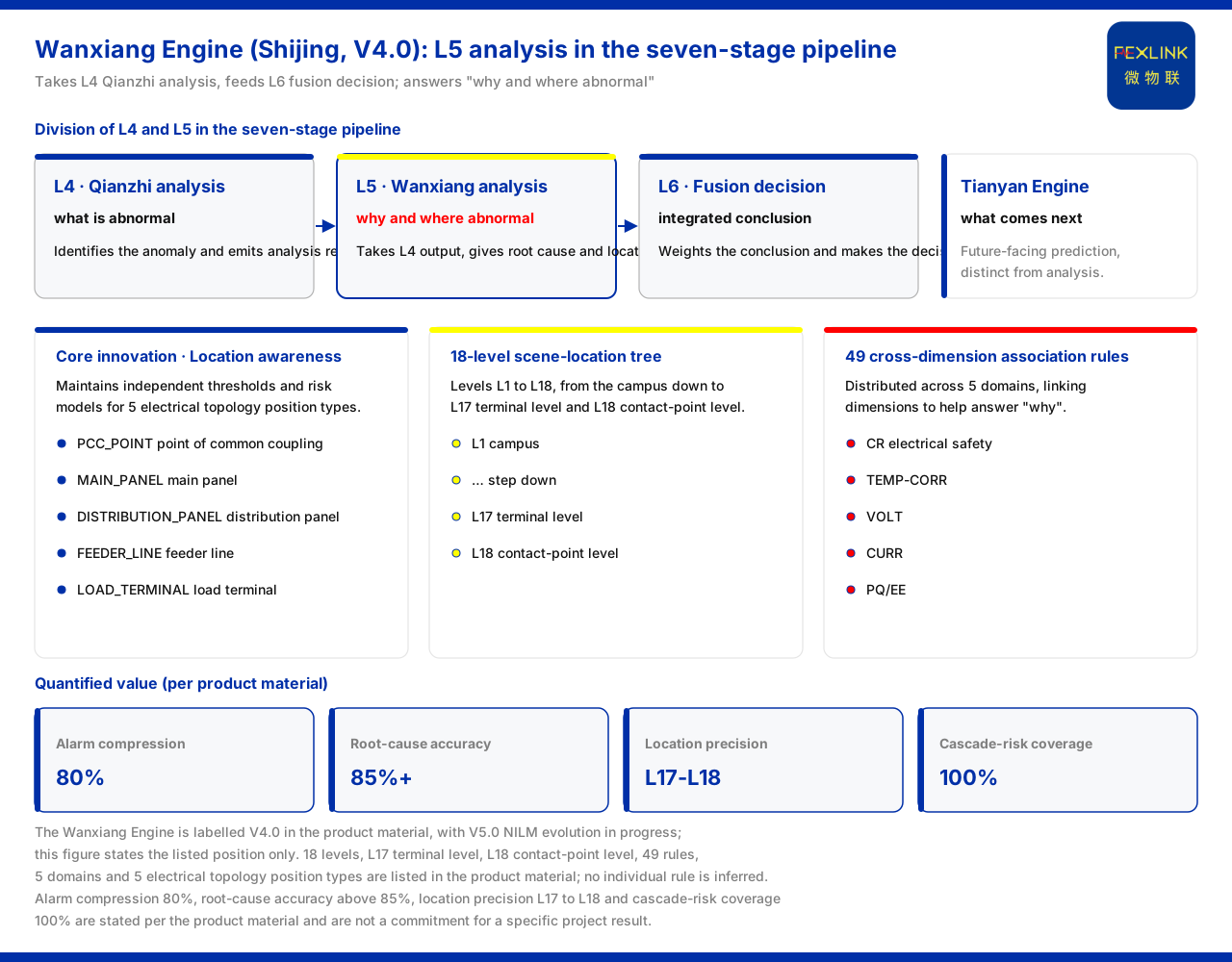
Direct answer
What the Wanxiang engine (Shijing, V4.0) undertakes is "diagnosis" — answering "why the anomaly occurred and where it is". In the seven-level pipeline of the Taiyi intelligent control hub system given by the product knowledge base, L5 is precisely Wanxiang diagnosis: it takes over the output of L4 Qianzhi analysis and then passes the diagnostic result to L6 fusion decision. The two adjacent engines have different divisions of labour — the Qianzhi engine answers "what is abnormal", the Wanxiang engine answers "why and where it is abnormal", and the Tianyan engine answers "what will happen in the future". L5 therefore does not address "whether there is an anomaly" but advances an already identified anomaly to its root cause and location: by maintaining an 18-level scenario positioning tree, it locates a problem level by level from the campus down to terminal-block level and even contact-point level, and it uses 49 cross-dimensional association rules to associate across multiple dimensions. This is exactly the key leap from a parameter anomaly to a scenario root cause.
Positioning of the Wanxiang engine in the family
The family overview of the product knowledge base marks the Wanxiang engine as V4.0 and notes that the V5.0 NILM evolution is in progress; its positioning is expressed as "Shijing brain · diagnosis layer". This positioning states two things: first, the Wanxiang engine belongs to the diagnosis layer in the family, not the acquisition layer, the analysis layer or the decision layer; second, its current knowledge-base version statement is V4.0, and its subsequent evolution direction is V5.0 NILM. This article states matters according to the versions listed by the knowledge base and does not treat the V5.0 direction as an already available capability.
Placing the "diagnosis layer" back into the seven-level pipeline reveals its position. In the pipeline, L4 is Qianzhi analysis, L5 is Wanxiang diagnosis and L6 is fusion decision. The Wanxiang engine sits between analysis and decision: it receives the analysis result in front and sends the diagnostic conclusion behind. Without this layer, the analysis result would only say "where an abnormal parameter appeared" and could not answer "why this is so and exactly where the problem lies".
Division of labour between L4 and L5: from "what is abnormal" to "why and where"
The knowledge base draws a clear distinction between the questioning styles of the two engines. The Qianzhi engine answers "what is abnormal", that is, it identifies the anomaly itself; the Wanxiang engine answers "why and where it is abnormal", that is, after the anomaly is identified, it further gives the cause and the location. The two are in a sequential relationship: only after "what is abnormal" can there be "why and where it is abnormal". This also explains why L5 must take over the output of L4 — the input to diagnosis is precisely the anomaly already identified by analysis.
Turning to the Tianyan engine, it answers "what will happen in the future" and belongs to forward-looking prediction. Together, the three engines form a division-of-labour chain of "what it is now, why and where it is, and what will happen in the future". The irreplaceability of the Wanxiang engine in this chain lies in its dedicated handling of the two questions of "root cause and location"; this is the core value of the diagnosis layer and the reason L5 exists.
The 18-level scenario positioning tree: from campus to terminal-block level
The Wanxiang engine maintains an 18-level scenario positioning tree, with levels from L1 to L18. According to the knowledge base, this tree can locate level by level downward from the campus, all the way to L17 terminal-block level and L18 contact-point level. The lower the level, the more specific the location it points to; the higher the level, the more macroscopic the coverage.
This positioning tree addresses the granularity issue of "where the anomaly is". If it stopped at a higher level, the conclusion might only be "some area has a problem"; with the 18-level structure subdivided level by level, one can follow the tree downward and narrow the scope to a terminal block or even a contact point. Location granularity directly affects maintenance action: the more specific the location, the smaller the scope of investigation and the more definite the points to be checked on site. The 18 levels, the L17 terminal-block level and the L18 contact-point level are all statements listed by the knowledge base, and this article does not extrapolate the time or workload required for positioning on that basis.
The 49 cross-dimensional association rules: distributed across five domains
Besides the positioning tree, the Wanxiang engine also contains 49 cross-dimensional association rules. The knowledge base states that these rules are distributed across five domains, namely electrical safety CR, TEMP-CORR, VOLT, CURR and PQ/EE. "Cross-dimensional" means that the rules establish associations between different dimensions rather than examining a single indicator.
These 49 rules and the positioning tree are complementary: the positioning tree answers "where", while the association rules help answer "why". When the data of several dimensions shows a certain relationship at the same time, the association rules can link them and provide a basis for diagnosis. The fact that the rules are distributed across five domains also shows that the dimensions covered are not single — temperature, voltage, current and power quality are all included. The number of rules and the domain division are listed according to the knowledge base, and this article does not infer the specific content of each rule.
Core innovation: position awareness and five topological position types
The knowledge base lists "position awareness" as the core innovation of the Wanxiang engine. It maintains independent thresholds and risk models for five types of electrical topological positions, namely PCC_POINT (point of common coupling), MAIN_PANEL (main distribution panel), DISTRIBUTION_PANEL (distribution panel), FEEDER_LINE (feeder line) and LOAD_TERMINAL (load terminal).
The significance of position awareness is that the same electrical quantity has a different normal range and risk meaning at different topological positions. By setting independent thresholds and risk models for the five position types, the Wanxiang engine effectively acknowledges that "different positions have different criteria". This is consistent in approach with the 18-level scenario positioning tree — both emphasise the role of position in diagnosis: the positioning tree keeps subdividing the position, while position awareness lets the criteria vary with position. The specific names and number of the five position types are stated according to the knowledge base.
Quantified value
The quantified value of the Wanxiang engine listed by the knowledge base includes: alarm compression 80%, root-cause accuracy above 85%, scenario positioning precision reaching L17 to L18, and cascading risk coverage 100%. These four indicators correspond to different aspects: alarm compression shows that it can converge a large number of alarms; root-cause accuracy states the capability in pointing to the cause; scenario positioning precision corresponds to the depth reachable by the 18-level positioning tree; and cascading risk coverage corresponds to the degree to which association analysis covers chain risks.
These figures are limited to the statements listed by the knowledge base. This article relays them as existing statements of the knowledge base, does not read them as a commitment for any site or working condition, and does not derive unlisted indicators on that basis.
Scope and limitations
- This article is limited to the existing statements of the product knowledge base on the positioning of the Wanxiang engine (Shijing, V4.0), its place in the seven-level pipeline, the L4 and L5 division of labour, the 18-level scenario positioning tree, the 49 cross-dimensional association rules, position awareness and quantified value.
- The version statement in the text is V4.0, and the V5.0 NILM evolution is marked by the knowledge base as "in progress"; this article does not present it as an already available capability.
- The 18 levels, the L17 terminal-block level, the L18 contact-point level, the 49 rules, the five domains and the five electrical topological position types are all quantities and names listed by the knowledge base; this article does not infer their specific implementation or individual content.
- Alarm compression 80%, root-cause accuracy above 85%, scenario positioning precision L17 to L18 and cascading risk coverage 100% are all statements listed by the knowledge base and do not constitute a commitment to results for any specific project.
- This article does not constitute a commitment to any indicator not listed; actual capability is subject to the latest product materials and project solution.