 FEXLINK Research Institute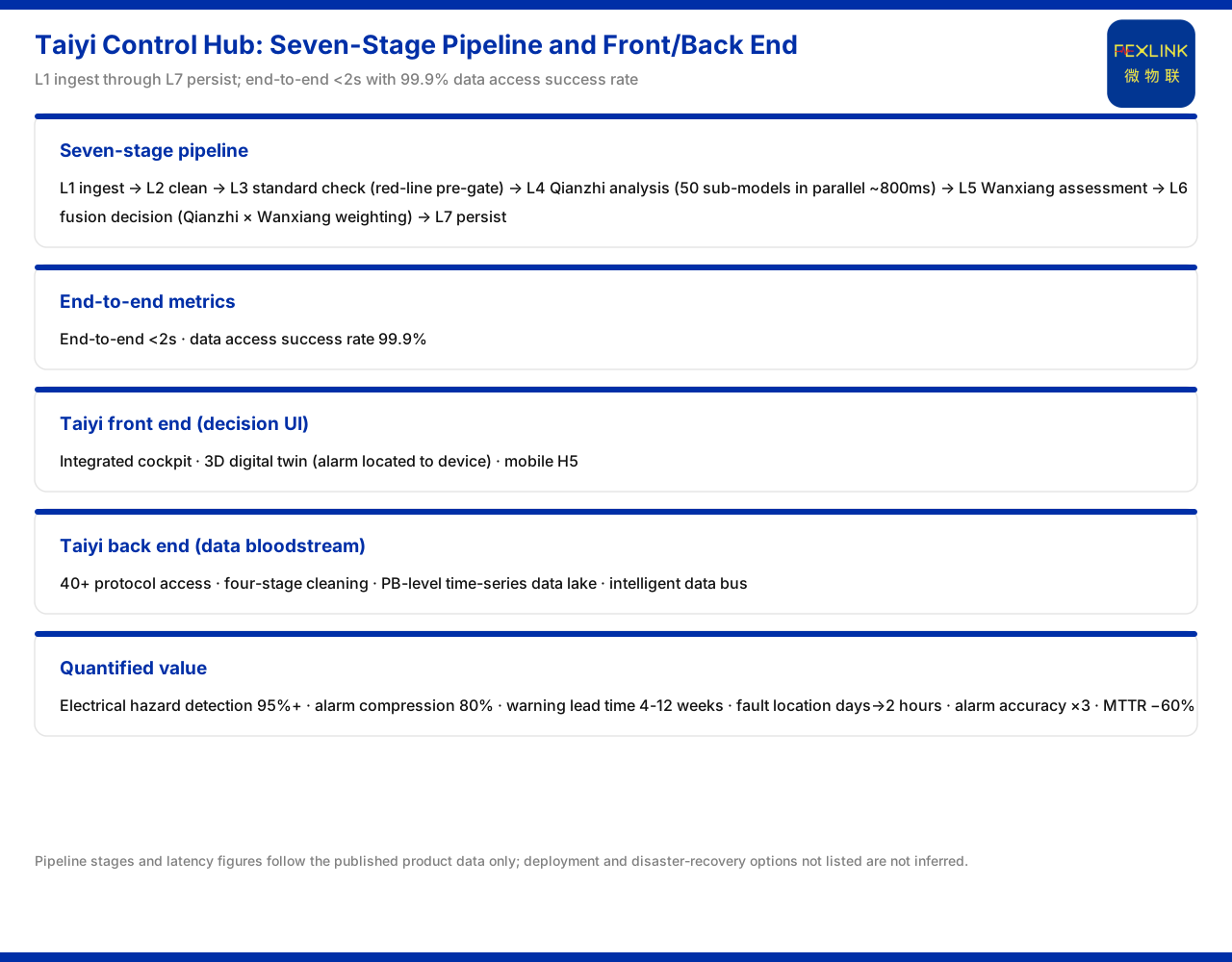
Direct answer
Moving from post-hoc repair to advance prediction relies not on a single algorithm but on a complete pipeline from data access to decision output. The Taiyi intelligent control hub system (V2.0) positions itself as the AI hub assembly for this shift: after data enters from the field, it passes in turn through cleaning, standards validation, analysis, judgement, and fusion decision, and finally becomes a readable health score and handling suggestion. Based on the wording listed in the product documentation, this article explains the duty split of the seven-level pipeline, the front-end and back-end composition, the quantified value indicators, and the planning position of the energy-saving countermeasure section; it infers no deployment conclusion for any specific project.
1. The seven-level pipeline: from access to persistence
The product documentation states that the seven-level pipeline of the Taiyi intelligent control hub system is L1 access, L2 cleaning, L3 standards validation (including safety red-line pre-validation), L4 Qianzhi analysis, L5 Wanxiang judgement, L6 fusion decision, and L7 persistence. The seven levels connect end to end to form a one-way data chain.
The orchestration logic of this chain is worth noting. Access comes first and persistence last, showing that the system serves both real-time judgement and historical retention; cleaning and standards validation come before analysis, showing that safeguarding data quality before discussing intelligence is the precondition; and the safety red line sits in the standards-validation segment, showing that baseline judgement must run before general analysis. Viewing the seven levels as a process makes clear why each exists. The product documentation gives the pipeline segmentation and order, and this article does not expand the engineering implementation of each level.
2. L4, L5, and L6: from parallel analysis to fusion decision
The product documentation states that L4 Qianzhi analysis runs 50 sub-models in parallel with a single round of about 800 ms; L5 is Wanxiang judgement; and L6 is the fusion decision of Qianzhi multiplied by weighted Wanxiang, outputting a comprehensive health score. These three segments are where judgement is actually produced in the pipeline.
Running 50 sub-models in parallel matters for coverage: different hazards are handled by different sub-models, and parallel operation is what allows multi-angle checks within a single data stream. The single-round time of about 800 ms shows that this layer works on a near-real-time rhythm. L5 Wanxiang judgement adds the locating view of where and why; L6 then weights the conclusions of Qianzhi and Wanxiang to form the comprehensive health score. Each step is closer to a decision and each step needs the previous layer's result as input. The product documentation does not give the weights and thresholds, and this article makes no inference.
3. End-to-end latency and data-access success rate
The product documentation states that the end-to-end time of the Taiyi intelligent control hub system is less than 2 seconds and the data-access success rate is 99.9%. The two indicators correspond to fast and stable respectively.
The end-to-end time of less than 2 seconds is the limit from data entering the system to outputting a result; the access success rate of 99.9% is the proportion of data that can be fully received. For a predictive system, neither indicator can be missing: the fastest analysis is useless if the data is not caught, and the highest access rate loses meaning if conclusions arrive too late. Viewing the two together with the seven-level pipeline explains why the pipeline must control time at every level. The product documentation gives the indicator wording, and this article does not infer the actual latency distribution of any site.
4. The Taiyi front end: decision interface
The product documentation states that the Taiyi front end (decision interface) includes a comprehensive cockpit, a three-dimensional digital twin, and a mobile H5. The three-dimensional digital twin supports locating an alarm to a device. The duty of the front end is to turn the back-end judgement into a form people can use.
The three interfaces correspond to three usage scenarios: the comprehensive cockpit faces centralised monitoring; the three-dimensional digital twin faces spatial locating, bringing an abstract alarm down to a specific device; and the mobile H5 faces field and mobile work. The same judgement, presented through different interfaces, is what makes its value truly land. The product documentation gives the front-end composition, and this article does not infer the specific charts and fields contained in each interface.
5. The Taiyi back end: data blood
The product documentation states that the Taiyi back end (data blood) provides access for more than 40 kinds of protocols, four-level cleaning, a PB-level time-series data lake, and an intelligent data bus. The back end is the blood-supply system of the whole pipeline.
Access for more than 40 kinds of protocols solves the diversity of where data comes from; four-level cleaning solves how clean the data is; the PB-level time-series data lake solves whether data can be stored and retained; and the intelligent data bus solves how data flows in an orderly way. The four capabilities correspond to the earlier levels of the seven-level pipeline: access and cleaning are precisely the support for L1 and L2. The product documentation gives the capability list, and this article does not infer the specific list of protocols or the physical scale of the data lake.
6. Quantified value indicators
The product documentation states a set of quantified value indicators: electrical-hazard recognition rate above 95%, alarm compression ratio 80%, early-warning lead time 4 to 12 weeks, fault-locating time shortened from several days to 2 hours, alarm accuracy improved 3 times, mean time to repair (MTTR) shortened 60%, comprehensive energy-saving space 8% to 20%, and more than 100 visualization components.
Viewing the indicators in three classes is clearer. The first is accuracy, including the recognition rate, the accuracy improvement, and the alarm compression ratio; a compression ratio of 80% shows that many repeated or low-value alarms are merged. The second is speed, including the early-warning lead time and the locating time. The third is saving, including the MTTR reduction and the comprehensive energy-saving space. Indicators are a codified expression of system value, and the specific field benefit still needs project measurement. The product documentation gives the indicator values, and this article does not commit to the actual effect of any project on that basis.
7. The planning position of the energy-saving countermeasure section
The product documentation states that the energy-saving countermeasure section of the Tianyan engine plans 10 items in V2.0, of which 6 are disclosed, and the first-batch P0 models include reactive-power compensation optimisation (C-01). This section extends the system's capability from finding hazards to giving countermeasures.
First-batch P0 means a batch of models landed first; disclosed means the items within the section that can be explained externally. Viewing the energy-saving countermeasures in their planning position, they echo the quantified value indicators above: the comprehensive energy-saving space of 8% to 20% is not an isolated number but the expected outlet of such countermeasure models. The product documentation gives only the section scale and the first-batch model name, and this article does not expand the input parameters and algorithm of reactive-power compensation optimisation.
Scope and limitations
First, this article restates only the wording listed in the product documentation, and its factual boundary is limited to: the seven-level pipeline of L1 access, L2 cleaning, L3 standards validation (including safety red-line pre-validation), L4 Qianzhi analysis, L5 Wanxiang judgement, L6 fusion decision (comprehensive health score weighted by Qianzhi times Wanxiang), and L7 persistence; L4 running 50 sub-models in parallel with a single round of about 800 ms; an end-to-end time of less than 2 seconds and a data-access success rate of 99.9%; the Taiyi front end including the comprehensive cockpit, the three-dimensional digital twin (locating alarms to devices), and the mobile H5; the Taiyi back end providing access for more than 40 kinds of protocols, four-level cleaning, a PB-level time-series data lake, and an intelligent data bus; quantified value indicators including an electrical-hazard recognition rate above 95%, alarm compression ratio 80%, early-warning lead time 4 to 12 weeks, fault-locating time shortened from several days to 2 hours, alarm accuracy improved 3 times, MTTR shortened 60%, comprehensive energy-saving space 8% to 20%, and more than 100 visualization components; and the Tianyan engine energy-saving countermeasure section planning 10 items in V2.0 (6 disclosed), with the first-batch P0 including reactive-power compensation optimisation (C-01).
Second, this article does not infer the weights, thresholds, or algorithms of each sub-model, nor the recognition rate, energy-saving rate, or actual benefit of any specific project after deployment.
Third, latency, success rate, and quantified indicators are product-documentation wording, and actual field performance is affected by data quality, network conditions, and engineering configuration.
Fourth, specific selection and configuration should follow the latest product documentation, the relevant standards, and the project scheme.