 FEXLINK Research Institute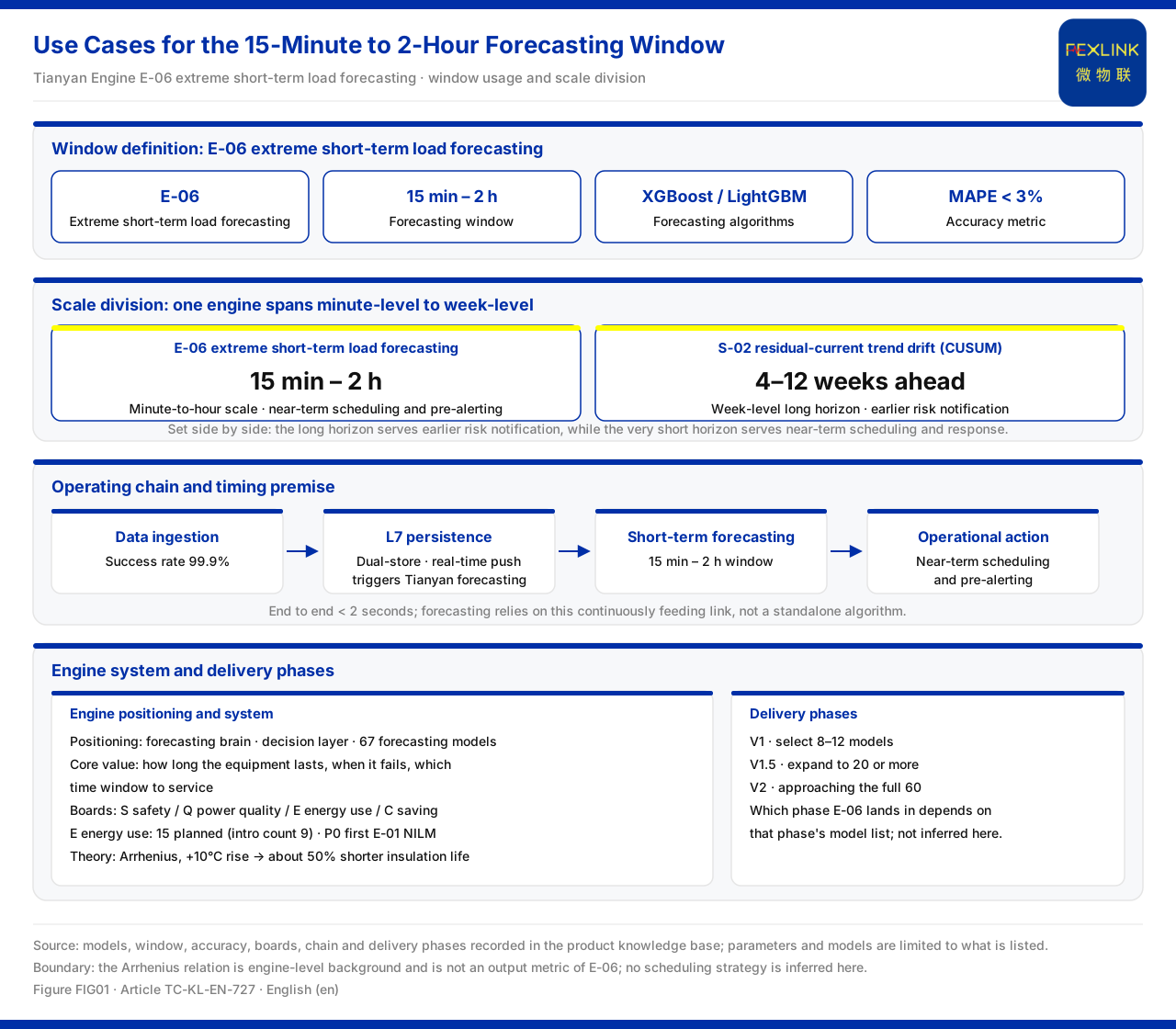
Purpose of the 15-minute to 2-hour forecast window
Direct answer
The E-06 very-short-term load forecast of the Tianyan engine (prediction, V1.0 to V2.0) has a forecast window of 15 minutes to 2 hours, uses XGBoost and LightGBM, and has a mean absolute percentage error (MAPE) of less than 3%. The purpose of this window is to support device-level operational actions in the near term, not to replace medium- and long-term planning. In the product knowledge base the Tianyan engine is positioned as the "forecasting brain · decision layer", whose responsibility is to answer "what will happen and when to act"; 15 minutes to 2 hours is one concrete value of that answer on the time scale. Understanding the window therefore turns not on treating 15 minutes to 2 hours as an isolated number, but on seeing which operational decisions it matches.
What class of operational action the window defines
The lower end of the E-06 window is at the minute level and the upper end at the hour level. This interval differs in scale from medium- and long-term planning: it concerns how the load changes over the very next short period, and is therefore closer to device-side, short-cycle scheduling and to bringing alarms forward. A window of this size is matched to actions that can be taken within the same period — inspection, switching, load transfer — rather than to actions whose lead time is measured in weeks or months.
It should be noted that the product knowledge base lists "how much longer this device can last, when it will fail, which time window to maintain it in" as the core value of the Tianyan engine, whose theoretical basis includes the Arrhenius equation, that is, for every 10°C rise in temperature, insulation life shortens by about 50%. This basis belongs to the knowledge background of the engine and is used to explain why the time window matters to operations; it is not equivalent to an output commitment of E-06 itself. The distinction matters when citing: the equation explains the significance of time in equipment operation, while E-06 states its own window and error basis separately.
Division of work with other forecast scales
What the Tianyan engine covers is not only the very short term. Within the same engine system, S-02 residual-current trend drift uses the CUSUM method and can give warning 4 to 12 weeks in advance. The 4 to 12 weeks is at the weekly long-cycle scale, while the 15 minutes to 2 hours of E-06 is at the minute-to-hour scale. Placed side by side, the two show that the Tianyan engine simultaneously carries different forecast time scales from the weekly to the minute level: the long cycle is used for earlier risk indication, and the very short term is used for scheduling and handling at the near moment. The two do not compete for the same decision; they feed decisions with different lead times. Only by putting E-06 back into this scale spectrum is it clear that 15 minutes to 2 hours addresses near-term operational decisions rather than medium- and long-term planning arrangements.
Operating chain and timeliness premise
The very-short-term forecast of E-06 does not operate in isolation. The seven-stage pipeline of the Taiyi intelligent control hub system closes at L7 persistence, whose actions include dual-database storage, real-time push and triggering the Tianyan forecast, with an end-to-end time below 2 seconds and a data-access success rate of 99.9%. This shows that very-short-term load forecasting sits at the end of a near-real-time chain: data first completes access and processing, and then triggers the forecast. For the 15-minute-to-2-hour window to land in operations, it depends precisely on this continuously data-supplying chain rather than on the algorithm alone. The data-access success rate of 99.9% also shows that the chain provides the forecast with a relatively stable data input premise. In other words, the window describes when the forecast applies, while the chain describes whether the forecast arrives in time to be used within that window.
Position in the model system and delivery phases
In the family overview, the Tianyan engine is positioned as the "forecasting brain · decision layer", with the responsibility of 67 forecasting models. Its V2.0 is divided into four blocks: S safety analysis, Q power quality, E energy analysis and C energy-saving countermeasures; the E energy-analysis block is planned at 15 items, while the documentation introduction basis is 9, and the two bases coexist, so the source of the basis should be noted when citing. E-06 sits inside this block, and the P0 first-release model of the same block is E-01 NILM non-intrusive load disaggregation. Block assignment and release order are separate pieces of information: the block states which section of the engine the model belongs to, while the P0 designation states its order of release within that block. The delivery of the Tianyan engine is divided into three phases: V1 selects 8 to 12 models, V1.5 expands to more than 20, and V2 approaches the full count of 60. Whether E-06 lands in a given phase therefore depends on the model list selected for that phase, and this article does not infer the phase to which it belongs.
Scope and limitations
This article answers only "the purpose of the 15-minute to 2-hour forecast window", and its content is limited to the forecast window, error basis, engine positioning, block division, scale division of work, operating chain and delivery phases already recorded in the product knowledge base.
The window purpose points to near-term device-level operational actions and does not constitute a commitment regarding a specific on-site scheduling strategy, maintenance plan or forecast accuracy.
"15 items" and "9" are two coexisting bases for the E energy-analysis block; this article presents both and does not substitute one for the other.
The Arrhenius relation is a theoretical basis recorded in the product knowledge base and belongs to the engine-level background; it is not equivalent to an output indicator of E-06.
This article does not infer scheduling strategies not listed in the product knowledge base; actual application must be confirmed item by item in conjunction with data quality, sampling conditions and the latest product documentation.