An oil and gas tank farm is not an ordinary electrical site: tanks, pipelines, loading racks, pumps, instruments and distribution share one grounding grid, and lightning current, surges and static discharge all travel that path. The answer is not another probe but one readable data chain: separate the objects, select by the explosion-proof boundary, network across a four-layer architecture, and close the loop with red lines and graded alarms. Product Knowledge Base v1.1 capability is verifiable: the FR grounding resistance monitor (FR-01311) turns grid resistance into an uploadable reading; the FRP explosion-proof grounding resistance monitor serves hazardous areas; the FL lightning-current/transient-current monitor records lightning events; the FS surge protective device monitor reads surge-protection status; and the FG lightning-protection smart gateway converges them. Boundary first: object partitioning and implementation order are this article's editorial frame, not a product data factual proposition; all product, model, parameter, protocol and scenario facts come from verifiable product data entries.
1. Separate Two Things First: Grounding Online Monitoring and Intelligent Lightning Protection
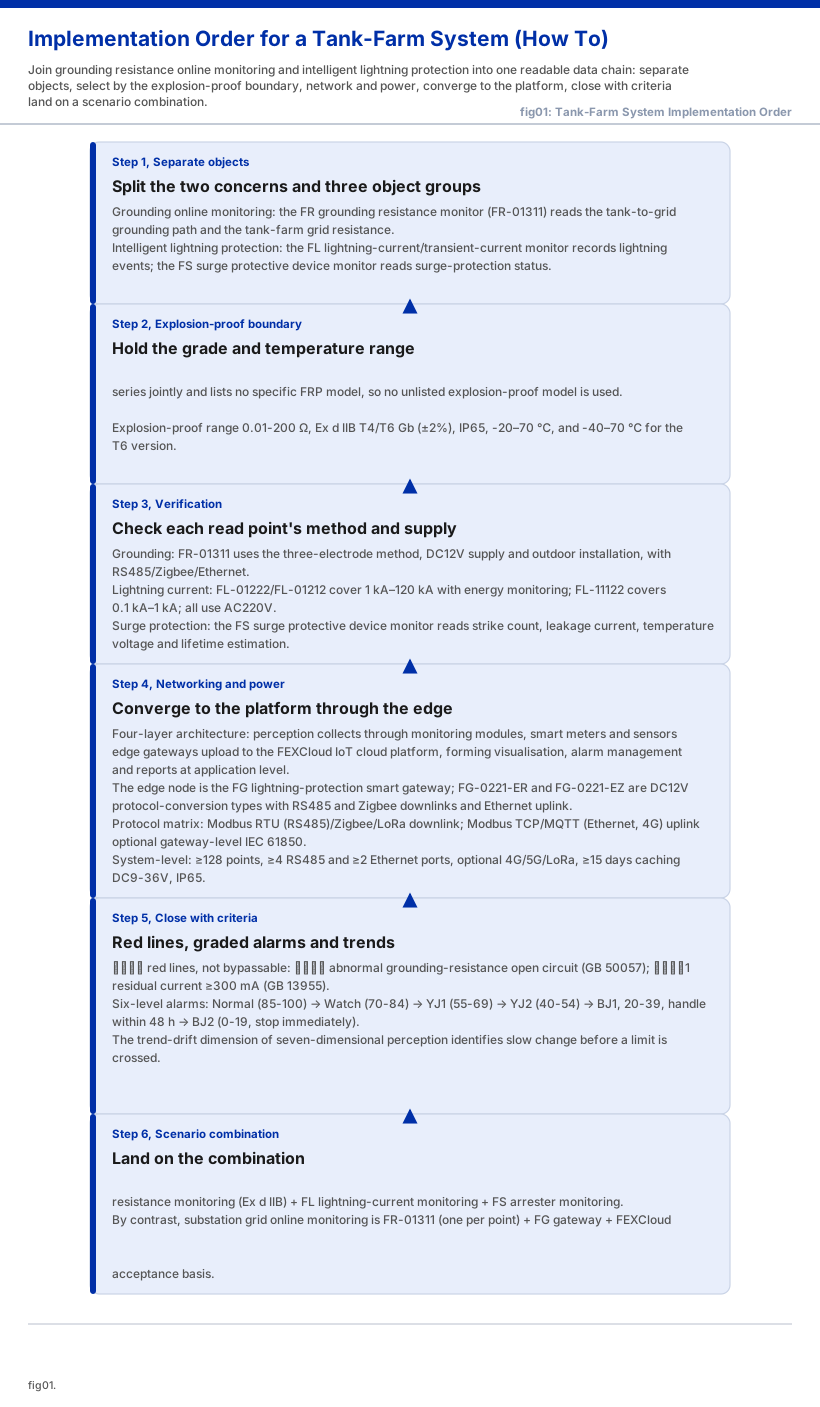
Tank farms conflate two things. Grounding resistance online monitoring answers "is the grid still connected, and has resistance drifted?" It maps to the FR grounding resistance monitor, named by "signal acquisition – detection principle – installation – supply – communication", with loop and three-point principles and grid resistance as the acquired signal. Intelligent lightning protection answers "did lightning and surge events occur, and is the arrester still effective?" It maps to the FL lightning-current/transient-current monitor recording peak and energy, and the FS surge protective device monitor reading strike count, leakage current, temperature, voltage and lifetime estimation. Different objects, one chain — the first design step. This editorial "identify separately, merge into a chain" frame is not a product data proposition.
2. Which Objects and Quantities Need Monitoring
Three object groups matter. The grounding path — tank-to-grid connections and overall grid resistance — is acquired by the FR grounding resistance monitor, which uses the three-electrode method, DC12V supply and outdoor installation with RS485/Zigbee/Ethernet; product data also records FR/FRP applications at railway traction-substation grids and the Jinzhou Port oil-tank area, ten units per tank, an internal, independently note cited only as capability evidence. Lightning-current events: the FL lightning-current/transient-current monitor covers 1 kA–120 kA (FL-01222 indoor, FL-01212 outdoor) and 0.1 kA–1 kA (FL-11122 indoor), supports energy monitoring and uses AC220V, answering how strong a strike was. Surge-protection status: the FS surge protective device monitor covers remote signalling, air-switch status, grounding status, strike count, leakage current, temperature, voltage and lifetime estimation, with leakage 50.0–1200.0 μA (±10 μA), voltage 0–400.0 V (±0.1 V), temperature -20–100 ℃ (±1 ℃), strike count 0–9999 with a 0.1 kA minimum trigger, and lifetime 0–100%. This three-group partition is editorial; product data gives no tank-farm-specific scheme.
3. The Explosion-Proof Boundary: Why Standard Models Do Not Fit
Selection is bounded by explosion-proof requirements. product data system-level parameters split grounding units into 0-200 Ω standard (±1%), 0-500 Ω high-precision (±0.5%) and 0.01-200 Ω explosion-proof — Ex d IIB T4/T6 Gb (±2%), IP65, -20–70 ℃, and -40–70 ℃ for the T6 version. The product is the FRP explosion-proof grounding resistance monitor; because names the "FR/FRP series" jointly without expanding FRP models, this article uses no unlisted model. The first hard constraint is that the unit fall inside the grade and temperature range; product data gives no tank-farm-specific construction method, and none is inferred.
4. On-Site Networking and Power: From Tank-Farm Perception to Platform
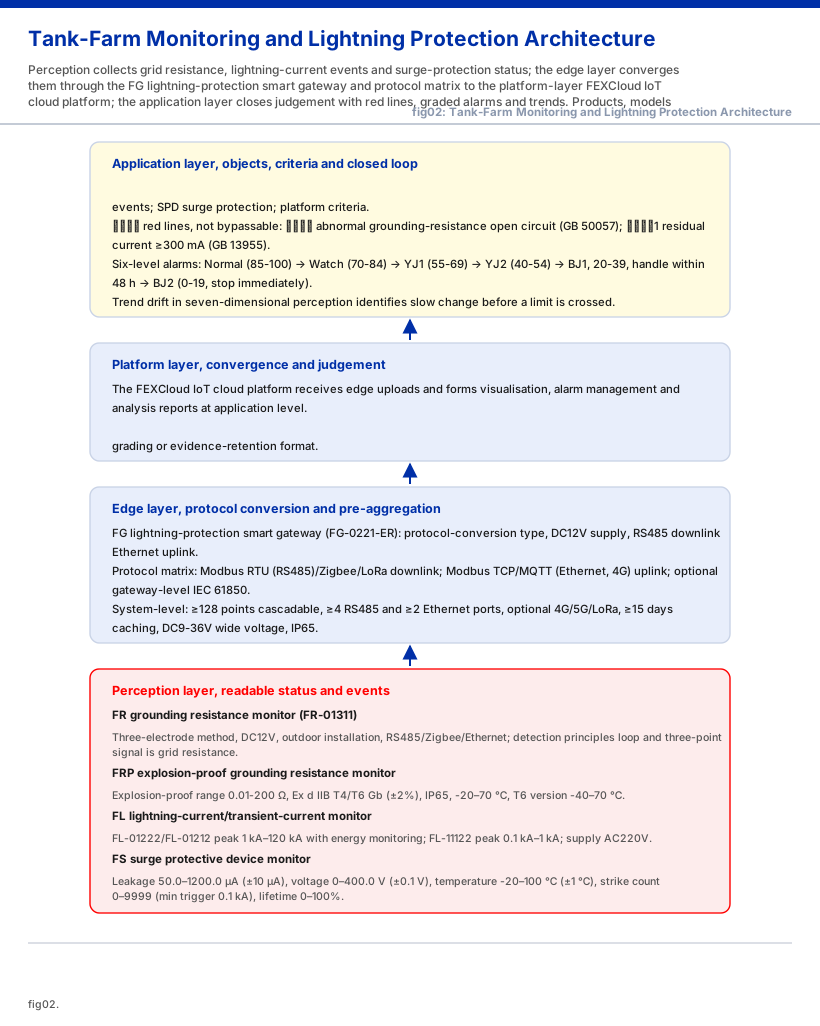
Reading data is only the start. product data defines a four-layer architecture — perception, edge, platform, application: perception collects from monitoring modules, smart meters and sensors, uploads via edge gateways to the FEXCloud IoT cloud platform, and forms visualisation, alarm management and reports at application level. Tank-farm grounding, lightning-current and surge-protection data enter through the grounding resistance monitor, the lightning-current/transient-current monitor and the surge protective device monitor. The edge node is the FG lightning-protection smart gateway: FG-0221-ER and FG-0221-EZ are DC12V protocol-conversion types with RS485 and Zigbee downlinks and Ethernet uplink. Transport supports Modbus RTU (RS485), Zigbee (Modbus) and LoRa downlink, Modbus TCP/MQTT (Ethernet, 4G) uplink, and optional gateway-level IEC 61850. System-level parameters show "online" is a link with margin: ≥128 points cascadable, ≥4 RS485 and ≥2 Ethernet ports, optional 4G/5G/LoRa, ≥15 days caching, DC9-36V and IP65. Carrying capacity fixes point count and caching protects data across a break — but product data gives no tank-farm sampling or reporting frequency, so none is inferred.
5. Judgement and Closed Loop: Red Lines, Graded Alarms and Trends
Data needs judgement. product data's Qianzhi engine lists two tank-farm-relevant non-bypassable safety red lines: safety red line "abnormal grounding-resistance open circuit" (GB 50057) and safety red line1 "residual current ≥300 mA" (GB 13955) — grounding and residual current are underlying safety constraints, not optional indicators. Above them, six-level alarms run Normal (85-100) → Watch (70-84) → YJ1 (55-69) → YJ2 (40-54) → BJ1 (20-39, handle within 48 h) → BJ2 (0-19, stop immediately); the trend-drift dimension of seven-dimensional perception detects slow change before a limit is crossed, filling the "single-point pass but continuous drift" gap. product data gives no tank-farm work-order grading or evidence-retention format, so no response-process assertion is made.
6. Implementation Order and Reference Scenario Combination
The tank-farm "how to" can be an order: identify grounding-path monitoring points; confirm lightning-event record points and surge-protection read points; select by explosion-proof grade and temperature range; converge perception data to FEXCloud through the FG gateway; then connect red lines and graded alarms for judgement and a closed loop. This order is editorial, not a construction sequence or quantity basis. lists "oil-tank area / petrochemical lightning and explosion protection" as "explosion-proof grounding resistance monitoring (Ex d IIB) + FL lightning-current monitoring + FS arrester monitoring"; a tank farm puts grounding, lightning events and surge protection on the same combination. By contrast the same table lists "substation grid online monitoring" as "FR-01311, one per point, + FG gateway + FEXCloud"; product data gives no tank-farm grounding-point density, so no substation basis is applied.
7. Boundaries: What This Article Does Not Claim
First, the "grounding online monitoring + intelligent lightning protection" method and order are editorial, not a product data factual proposition, and not a design specification, construction plan or acceptance basis. Second, product data gives no tank-farm-specific topology, explosion-proof construction method, grounding-point density, equipotential bonding, sampling or reporting frequency, offline caching or backfill, work-order grading, evidence-retention format, retrofit procedure, quantity or benefit; none is asserted. Third, GB 50057 and GB 13955 are cited only as listed, with no clause inferred, no unlisted conformity claimed and no standard absent from product data cited. Fourth, the FR/FRP application note is an internal, independently record, not a case or performance commitment. This article answers only how the tank-farm system is built; it does not take on annual grounding testing (036), arrester lifetime (037), machine-room carrier upgrade (031) or distribution-cabinet and weak-current-room necessity (014), and does not reuse the legacy 42nd draft, whose old PASS is revoked, as a rewrite base.
Conclusion
The answer is not piling up devices but fixing objects, boundaries, links and criteria: hold the grounding path with the FR grounding resistance monitor and the FRP explosion-proof grounding resistance monitor; record lightning events with the FL lightning-current/transient-current monitor; read surge status with the FS surge protective device monitor; converge through the FG lightning-protection smart gateway across the four-layer architecture, protocol matrix and system-level parameters to FEXCloud; and land on the "Ex d IIB + FL + FS" combination, closing with the safety red line and safety red line1 red lines and six-level alarms. Terminology and models follow product data locked conventions; the method remains editorial, awaiting independent verification.
Need to make electrical-safety status readable?
Explore intelligent lightning protection and electrical-safety online monitoring that keep hazards visible and traceable.
Book a demo View the electrical-safety monitoring solution