 FEXLINK Research Institute
Direct Answer
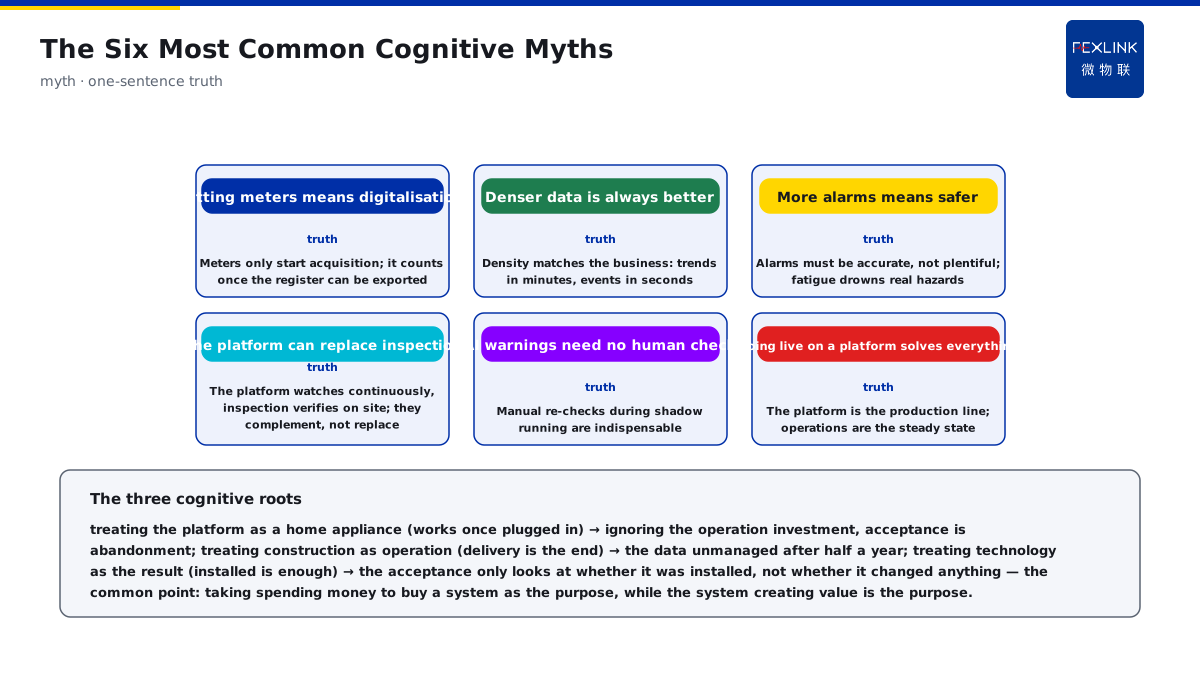
Many parks spend money on smart energy platforms, the acceptance is grand and impressive, and half a year later the data is abandoned and manual meter reading is back. The problem is not the platform itself, but six cognitive myths — installing meters is not digitalisation, denser data is not better, more alarms do not mean safer, the platform cannot replace inspections, AI warnings cannot go without human confirmation, and getting the platform up is not the end of everything. A platform is not a home appliance that "works once plugged in"; it needs point planning, data governance, an alarm closed loop and organisational support to be continuously operated. Treating the platform as a dashboard to buy instead of a data production line to operate is the common cause of most project failures (in fact, most projects do not "fail", they just become abandoned).
A scene: a park spent 3 million yuan on a smart energy platform. On the acceptance day, the big-screen data jumped and the leaders nodded. Six months later, the review found: 400 meters were installed, but the measurement points were not bound to devices, and the sub-metering ledger could not be exported; the collection interval was 1 minute, the data volume was huge, but little of it was truly usable; dozens of alarms came every day, and the duty officers were already numb; AI warning pop-ups were confirmed by no one and became decoration; the inspection system stayed the same, and no one looked at the platform data. In the end, the electricity bill still relied on manual meter reading, and the platform became a display screen. This park was not trapped by the platform, but by six myths.
1. Myth 1: Installing Meters Is Digitalisation
How the myth shows: believing that once smart meters are installed and the gateway is connected, the digitalisation project is complete.
The truth: installing meters is only collecting electrical signals; it is far from "data usable." Without an object model (measurement points not bound to devices or circuits), the data is isolated numbers; without cleaning and tuning, dirty data goes straight into the database; without analysis, the data lies in the database unused. Installing meters is the beginning of collection, not the completion of digitalisation.
Counter-example: an enterprise installed 400 meters, and during sub-metering accounting it was found that all the points were a mess — the meter of workshop A hung under the circuit of workshop B, and no matter how the ledger was exported, it never matched. Judgement standard: after installing the meters, can you export a "by workshop, by time segment, traceable" ledger? If not, you only installed meters.
2. Myth 2: Denser Data Is Better
How the myth shows: believing that the shorter the collection interval and the more points, the more advanced the system — as if collecting every second and covering every point is better.
The truth: data density must match the business need, otherwise it is a triple waste — storage cost, bandwidth cost and noise cost. Trend data (energy consumption, temperature) at the minute level is enough; event data (trips, transients) needs the second level. Blindly densifying stores a huge amount of unconsumed data and lets noise into the analysis.
Counter-example: a project densified the energy data from 15 minutes to 1 minute, stored several extra terabytes in a year, and the analysis results were no different from before, only adding a pile of glitch noise. Judgement standard: define the business problem first, then the data density — "what judgement is this data supporting? what density is enough?"
3. Myth 3: More Alarms Mean Safer
How the myth shows: believing that the more alarms, the more sensitive the system, the safer it is.
The truth: alarm fatigue is a real risk. With dozens or hundreds of alarms a day, the duty officers go from "checking every one" to "a glance" to "numb", and the real hidden-hazard alarms are drowned in the noise. A good system does not mean many alarms, but accurate alarms — what should alarm must alarm, what should not must not, so the duty officers can "keep up with them and trust them."
Counter-example: a park set the alarm thresholds too low, with 60 alarms a day, most of them false; after three months, the duty officers ignored the alarms, a real high-temperature alarm was missed once, and the distribution cabinet burned. Judgement standard: ask the duty officers "how many of yesterday's alarms do you still remember?" If they remember none, alarm fatigue has already happened.
4. Myth 4: The Platform Can Replace Inspections
How the myth shows: believing that once the platform is up, manual inspections can be cancelled, or even the inspectors laid off.
The truth: online monitoring and manual inspection are complementary, not replacement. The platform is responsible for "keeping watch continuously, reporting in advance"; the inspection is responsible for "verifying on site, checking by hand" — the platform finds a trend anomaly, the inspection goes to the site to verify and handle, forming a closed loop. Especially for one-off, occasional hidden hazards, the platform can only point out the risk; it cannot go to the site for you.
Counter-example: an enterprise cancelled the monthly inspection after the platform was up, and a problem occurred in a blind-spot device the platform did not cover, with no one finding it. Judgement standard: does the platform's alarm have a "site re-verification" line? If not, only monitoring was built, not a closed loop.
5. Myth 5: AI Warnings Can Go Without Human Confirmation
How the myth shows: believing that the AI warning accuracy is high enough that the pop-ups need no human attention and everything is handled automatically.
The truth: in the early period after go-live, AI warnings must run in "shadow mode" — the AI produces conclusions as usual, but every conclusion needs human re-verification; only after accumulating real samples can the share of automatic handling gradually increase. Skipping the shadow period and going straight to full automation means using production safety as a test set. The value of AI is "helping people see more and judge faster", not "making decisions for people."
Counter-example: a project connected automatic linkage on the very first day of AI go-live; a misjudgement triggered a power cut, and the production line stopped for two hours. Judgement standard: does every AI warning have a human re-verification record? If not, the shadow period was skipped.
6. Myth 6: Getting the Platform Up Is the End of Everything
How the myth shows: believing that the platform is a "one-off deal" — once it goes live and passes acceptance, the work is done.
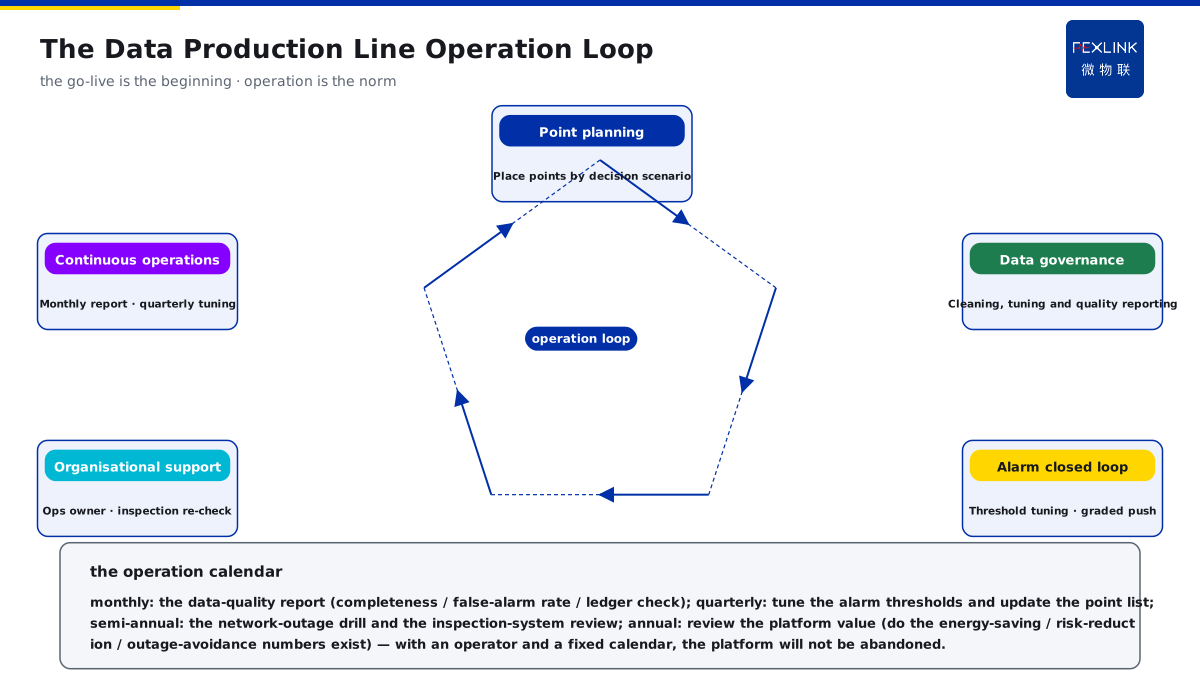
The truth: the platform is a "data production line" that needs continuous operation — point planning must adjust with the business, data governance needs sustained investment, alarm thresholds need periodic tuning, and the organisation needs someone responsible for watching the platform. Going live is just the beginning; operation is the norm. Buying the platform as a dashboard, with no one operating it after the one-time acceptance, makes data abandonment a certainty.
Counter-example: after acceptance, only two people could access the platform account, and no one opened it after half a year. Judgement standard: does the platform have a full-time or part-time operation owner? Is there a monthly data-quality report? If not, it was "buying a dashboard."
7. Three Cognitive Roots: How the Myths Form
Behind the six myths are actually three deeper cognitive roots; change the roots and the myths will not recur:
Root 1: treating the platform as a "home appliance" — believing that, like a fridge or an air conditioner, it works once plugged in, and the after-sales service fixes it when broken. The truth: the platform is a "production line" that needs fuel (data), operation (operating) and maintenance (governance). Treating the platform as a home appliance leads to ignoring the operation investment, and acceptance is abandonment.
Root 2: treating construction as operation — believing that project delivery and acceptance passing are the end. The truth: construction is the investment period; operation is the normal period. The value of the platform is delivered in the operation period — point adjustment, threshold tuning, data governance and personnel training are all sustained actions of the operation period. Treating construction as operation, the data is unmanaged half a year later.
Root 3: treating technology as the result — believing that installing advanced equipment and putting up AI algorithms automatically brings the result. The truth: technology is only a tool; the result is the business change — how much energy was saved, how much risk was reduced, how much outage was avoided, measured by business indicators. Treating technology as the result, acceptance only looks at "whether it was installed", not "whether it changed anything."
The common point of the three roots: taking "spending money to buy a system" as the purpose, while "the system creating value" is the purpose.
8. The Go-Live Acceptance Checklist: Turning "Being Used" into Verifiable
Whether the six myths can be avoided is most practically verified with a checklist — tick item by item three months after go-live:
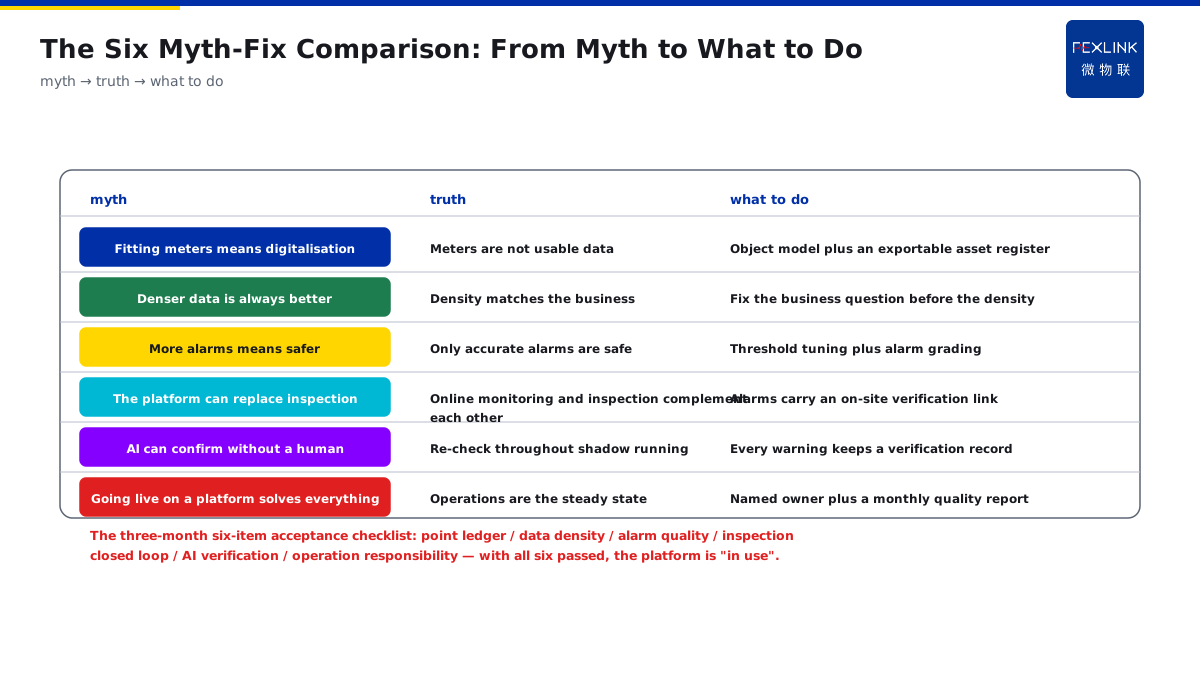
Points and model: are the measurement points bound to devices and circuits? Can the sub-metering ledger be exported? — corresponds to Myth 1; Density and cost: does the data density match the business? Are the storage and bandwidth costs controllable? — corresponds to Myth 2; Alarm quality: is the alarm volume something the duty officers can keep up with? Is the false-alarm rate up to standard? — corresponds to Myth 3; Inspection closed loop: do the platform alarms have on-site re-verification records? Is the inspection system retained? — corresponds to Myth 4; AI verification: does every AI warning have a verification record? Is the shadow-running period compliant? — corresponds to Myth 5; Operation responsibility: is there a dedicated operation owner? Is there a monthly data-quality report? — corresponds to Myth 6.
With all six passed, the platform is truly "being used"; if any item fails, the corresponding myth is still latent in the project.
9. A "Buying a Car" Analogy: A Car Must Be Driven, and Even More Maintained
Think of the smart energy platform as a car: buying the car (getting the platform) is just the beginning; the car must be driven (used), maintained (operated) and repaired (governed) — no fuel and the car does not move (no operation and the platform is abandoned), no maintenance and the car breaks down (poor data quality and the analysis distorts), and reckless driving causes accidents (messy alarm configuration and false/missed alarms).
Many people buy a car and only park it in the garage as decoration — the same as getting a platform and only using it as a display screen: the car is not done when bought, and the platform is not done when live. Driving this car well needs a driver (the operation team), fuel (sustained investment) and regular maintenance (data governance and threshold tuning). In one sentence: the car must be driven, maintained and repaired; the platform must be built, operated and governed — both rely on "being used", not "being bought."
10. The Smart Energy Platform Iron Rule
The platform is not a home appliance that "works once plugged in"; it is a data production line that needs continuous operation — point planning, data governance, alarm closed loop and organisational support; missing one link and it is abandoned.
Four sentences to land it:
- Installing meters is not digitalisation; the ledger being exportable is what counts;
- Data density matches the business; denser is not better;
- Alarms must be accurate, not numerous; what should alarm must alarm, what should not must not;
- Platform plus inspection, AI plus human re-verification, and the shadow-running period cannot be skipped.
How to schedule the operation calendar: after the platform goes live, arrange the operation actions in a fixed rhythm — a monthly data-quality report (data completeness, false-alarm rate, ledger check), a quarterly alarm-threshold tuning and point-list update, a semi-annual network-outage drill and inspection-system review, and an annual review of the platform value (how much energy was saved, how much risk was reduced, how much outage was avoided — do the numbers exist). With an operator and a fixed calendar, the platform will not be abandoned after half a year.
Next time someone says "once the platform is up, everything is fine" — lay out the six myths and ask: can the ledger be exported after the meters are installed? Is the data density enough? Can the alarms be kept up with? Are the inspections still there? Does anyone verify the AI? Does anyone operate continuously? With all six questions passed, the platform is truly "in use."
11. Back to FEXLINK: How the Platform Is Operated as a Data Production Line
To land this understanding on a product: FEXLINK's digital electrical intelligent supervision system delivers not a "dashboard" but an operable data production line — points planned by decision scenario, measurement points bound to the object model, data quality with cleaning and tuning, alarms tuned by business level, AI warnings with a human re-verification shadow-running mechanism, and operation with a monthly data-quality report. The platform go-live is the beginning of the cooperation; the continuous operation of the data production line is where the project value is delivered. During selection you can also directly require: write the "three-month six-item acceptance checklist" into the contract — point ledger, data density, alarm quality, inspection closed loop, AI verification and operation responsibility, verified item by item, making "being used" a contractual obligation.
Scope and Limitations
- The conclusions in this article are intended for LV distribution and electrical-safety sites. Criteria are compiled from public codes and FEXLINK product documentation, and product parameters follow the latest selection handbook and product knowledge base.
- Quantitative criteria (protection zone, discharge and residual voltage, earth resistance, thresholds and grading) hold under the preconditions stated in this article. Where the site voltage level, earthing arrangement, environmental category or load profile differs, the figures must be recalculated.
- Specific product models and parameters are subject to the latest selection handbook and product knowledge base; this article does not constitute selection or procurement advice.
- Standard numbers cited here refer to the currently effective editions; when a standard is revised, the related quantitative conclusions must be re-checked.
- Deployment and implementation for specific projects must be carried out by qualified engineers based on site survey and design drawings.
Frequently Asked Questions
Six Persistent Myths About Smart Energy Platforms—Debunked
Many parks spend money on smart energy platforms, the acceptance is grand and impressive