 FEXLINK Research Institute
Direct Answer
On how to divide the work across device-edge-cloud, two extreme opinions are common in the industry: some say "put all the computing in the cloud, the simpler the terminal the better," and others say "compute everything locally, the cloud is only for viewing." Both are wrong. The basis of the division is not "whoever is more advanced gets the work," but four engineering constraints — latency, reliability, computing power and operation cost: the device side does microsecond/millisecond-level capture and hard interlocking, the edge side does protocol conversion, local caching and fast judgement, and the cloud side does historical storage, cross-domain correlation and AI reasoning. Any layer that is missing or overstepping will be exposed during network outages, expansion or sudden events.
A scene: during the acceptance of a park project, it was found that the gateway was only transparently forwarding — all data was relayed to the cloud as is, with no local caching and no local judgement. Then one day, a network jitter lasted 40 minutes, and the cloud platform went completely dark, with no local alarm at all. Worse, one workshop had put the transformer protection interlocking logic in the cloud: during the outage, the equipment became abnormal, and the interlock could only act after the network recovered. Another project went to the other extreme: all data-cleaning rules were written into the on-site devices, which ended up with insufficient computing power on site, hard-to-maintain rules, and every change of one cleaning rule requiring running through dozens of devices. The first disease is "the edge layer is missing"; the second is "the device layer oversteps" — both are the result of not dividing the work by the four constraints.
1. First Set the Yardstick: Four Constraints Decide "Who Does What"
The three layers of device-edge-cloud are not "piling up configuration"; what each layer should take on is jointly decided by four engineering constraints:
Constraint 1: latency — millisecond-level events (fault trips, partial-discharge transients, interlock actions) must close the loop locally; waiting for one round trip to the cloud is too late. Minute-level data (energy consumption, temperature trends) is what is allowed to go to the cloud for processing.
Constraint 2: reliability — the on-site network can go down and the cloud platform can jitter. A function that depends on the cloud to act fails the moment the network is down; safety-critical functions must be self-contained locally.
Constraint 3: computing power — the device side and the edge side have limited, cost-sensitive computing power; they can run fast judgement but not large-scale AI reasoning; heavy computation belongs to the cloud.
Constraint 4: operation cost — whether a rule is changed on the edge or in the cloud decides how many sites a change takes to visit; where the historical data is stored decides whether expansion means adding a disk or adding a server.
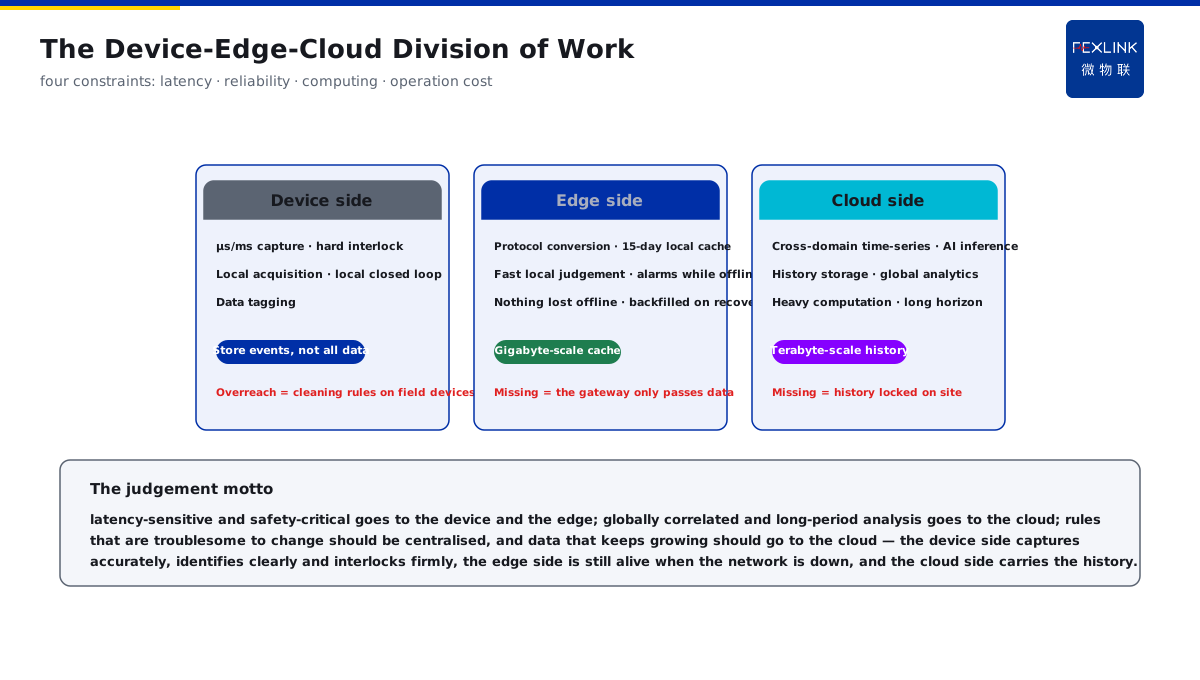
The judgement motto: latency-sensitive and safety-critical goes to the device and the edge; globally correlated and long-period analysis goes to the cloud; rules that are troublesome to change should be centralised as much as possible, and data that keeps growing should be stored in the cloud.
2. Device Side: Microsecond/Millisecond-Level Capture and Hard Interlocking
The boundary of the device side (sensors, monitoring terminals) is "the first gate of the physical quantity":
- Microsecond/millisecond-level capture: Rogowski coils capture current waveforms, NTCs capture temperature transients, microampere-level leakage sensors capture insulation degradation — these physical quantities vanish in an instant and must be collected on site, without upload and without relay;
- Hard interlocking: protection actions, interlock logic and emergency cut-off — safety-critical functions must close the loop locally on the device side, not depending on the network and not waiting for cloud instructions;
- Data annotation: stamp every piece of data with a timestamp and an object identifier, ensuring that "the data knows the device."
The typical overstep of the device side: writing data cleaning and complex rule judgement into the on-site devices — the on-site computing power cannot hold it, the rules are hard to maintain, and upgrades require site visits. What the device side should do is "capture accurately, identify clearly, interlock firmly", not "think a lot."
3. Edge Side: Protocol Conversion, Local Caching and Fast Judgement
The edge side (edge computing gateway) is the "bridgehead" between the device and the cloud, with three responsibilities:
- Protocol conversion: the protocols of different vendors' equipment, such as Modbus, IEC 104 and MQTT, are unified at the gateway, so the cloud only faces one standard format;
- Local caching: data is not lost during network outages — it is retained as agreed (for example, 15 days), and automatically back-filled after the network recovers, keeping the history complete;
- Local fast judgement: millisecond-to-second-level local alarms, limit-crossing judgement and operating-condition recognition are completed at the gateway, so the site still has alarm capability when the network is down.
The typical absence of the edge side: the gateway only transparently forwards, without protocol conversion, without caching and without judgement — the screen goes black on outage, the protocols differ table by table, and the cloud is forced to face dirty data. The value of the gateway is not "fast transmission" but "still alive when the network is down" and "judge first, then upload."
4. Cloud Side: Historical Storage, Cross-Domain Correlation and AI Reasoning
The cloud side (platform) takes the heavy work that the device and edge cannot or should not do:
- Historical storage: the time-series database carries multi-year data, supporting year-on-year, month-on-month and long-period trend analysis;
- Cross-domain correlation: data from multiple sites, devices and systems is gathered — history-vs-current comparison of the same device, horizontal comparison of energy consumption across sites, cascade analysis across the supply chain;
- AI reasoning: models that need global samples and heavy computing power (such as multi-device correlation diagnosis, energy-consumption prediction and carbon accounting) are trained and run in the cloud.
The typical absence of the cloud side: keeping all the historical data on site and doing cross-domain analysis on a single machine — expansion becomes difficult, there is a single point of risk, and cross-site collaboration is entirely disabled.
5. The Data-Volume View: How Much Data Each Layer Should Carry
The division is not only about function, but also about the data volume — how much data each layer can carry decides how much storage and computing power it should be configured with:
- Device side: transient waveforms, megabit-level bursts — the current and voltage waveforms and partial-discharge pulses at the moment of a fault are bursty high-frequency data, captured at the millisecond level and recorded by event, not retained long-term; the device side stores "events", not "full volume";
- Edge side: gateway cache, gigabyte-level — the trend data and event records cached locally for 15 days sit in the gateway, with capacity planned at the gigabyte level, enough for the outage buffer and local queries, without multi-year accumulation;
- Cloud side: time-series history, terabyte-level — the platform time-series database carries multi-year full-volume data, with capacity expansion planned at the terabyte level, supporting year-on-year, month-on-month, long-period trends and cross-site aggregation; the AI engine handles cross-device correlation analysis in the cloud, with computing power configured by the model scale.
The typical mismatch of data volume: pressing multi-year history entirely into the on-site devices, with disks blowing up and expansion relying on replacing disks one by one; or sending all second-level full-volume waveforms to the cloud, with bandwidth and storage costs running out of control. The test of volume matching: the device side only stores events, the edge side is enough for the buffer, and the cloud carries the history — whichever layer carries what it should not carry is a misplacement.
6. Three Common Architecture Misplacements: Recognition and Cost
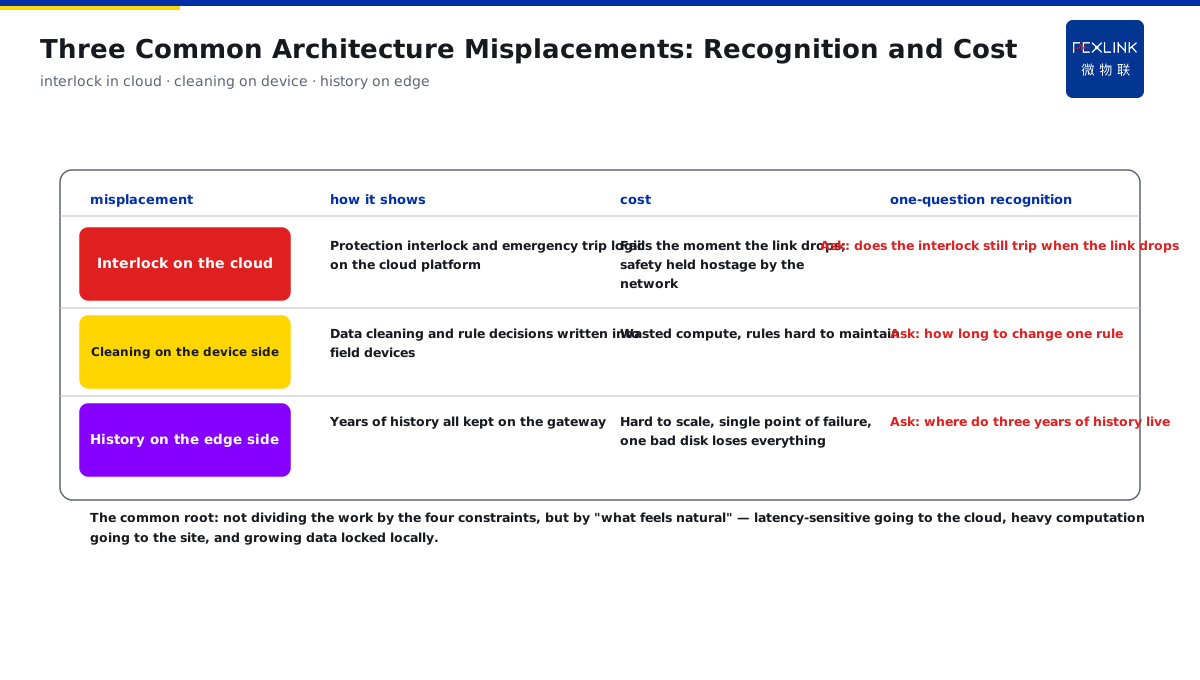
Misplacement 1: interlocking in the cloud — putting the protection interlock and emergency cut-off logic on the cloud platform. Cost: on network jitter or outage it fails immediately, and the safety-critical function is held hostage by the "network." Recognition feature: ask "does the interlock still act when the network is down"; whoever cannot answer has the misplacement.
Misplacement 2: cleaning on the device side — writing all the data cleaning and rule judgement into the on-site devices. Cost: on-site computing power wasted, rules hard to maintain, upgrades requiring site visits, and the on-site capability is "written dead." Recognition feature: ask "how long does it take to change one cleaning rule"; whoever says "run to the site and change dozens of devices" has the misplacement.
Misplacement 3: history on the edge side — storing all the historical data in the gateway locally. Cost: difficult expansion, single-point risk, cross-site analysis impossible, and a failed disk means the history is all lost. Recognition feature: ask "where is the three-year historical data"; whoever answers "in the on-site gateway" has the misplacement.
The common root of the three misplacements: not dividing the work by the four constraints, but by "what feels natural."
7. The Network-Outage Drill: The Touchstone of the Three-Layer Division
To judge whether an architecture is right, you do not need to listen to the PPT; one network-outage drill exposes it:
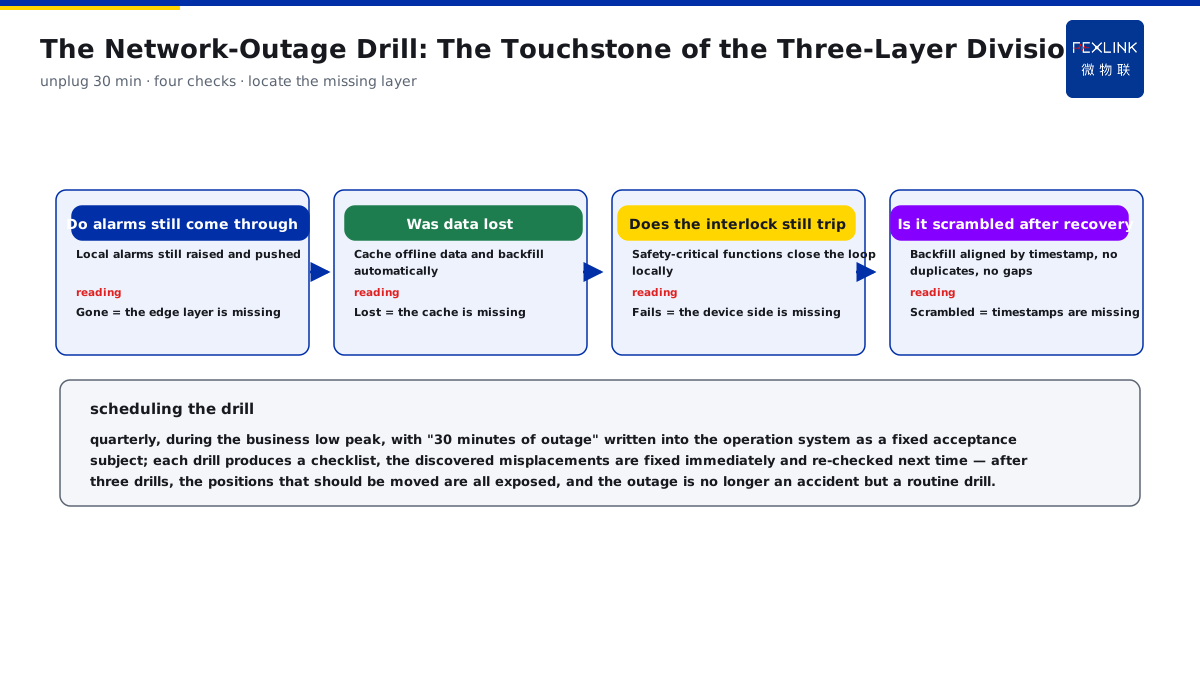
Drill steps: pick a business period, unplug the gateway's uplink cable (or disconnect the cloud connection) for 30 minutes, then check item by item:
- Are the alarms still there — do local alarms still arise and push as usual during the outage (is the edge-side local judgement there);
- Is the data lost — is the data of the outage period cached in the gateway and automatically back-filled after recovery (is the local cache there);
- Does the interlock act — do the safety-critical functions close the loop locally (is the device-side hard interlocking there);
- Is the cloud messy after recovery — are the back-filled data timestamps aligned, without duplication and loss (is the three-layer timestamp system there).
Reading the drill results: no alarms = the edge side is missing; data lost = the cache is missing; interlock failing = the device side is missing; messy back-fill = the timestamp system is missing. Unplugging the network cable once verifies the division better than reading ten pages of architecture diagrams.
How to schedule the drill: it is recommended to do it quarterly, during the business low-peak period, and to write "30 minutes of outage" into the operation system as a fixed acceptance subject. Each drill produces a checklist: whether the alarms act as usual, whether the cache fills up, whether the interlock acts locally, whether the back-fill is lossless — fix the discovered misplacements immediately and re-check in the next drill. After three drills, the positions that should be moved in the architecture are basically all exposed; from then on, the outage is no longer an "accident" but a "routine drill."
8. A "Factory Assembly Line" Analogy: Emergency Stop, the Shift Leader and the General Dispatch
Think of the three-layer architecture as a factory: the device side is the emergency-stop button and the sensors on the machine tool — if the equipment is about to explode it must stop locally, not wait for a phone call from the head office (latency-sensitive and safety-critical, it must be local); the edge side is the workshop shift leader — when a problem happens on site, judge and handle it locally first, keep the workshop's own ledger (cache) first, and only report after leaving the workshop (decide on site, manage even when the network is down); the cloud side is the general dispatch centre of the head office — aggregate the output, energy consumption and anomalies of all workshops, and do global production planning and long-term planning (cross-domain correlation, global analysis).
If the emergency-stop button is wired to the head office, the machine tool can only wait for a phone call when something happens — that is interlocking in the cloud; if every machine tool calculates the whole factory's production plan itself — that is heavy computation on the device side; if the factory-wide ledger is locked in one workshop — that is history on the edge side. The workshop manages the workshop's affairs, and the head office manages the head office's affairs; only then will the factory not be in chaos.
9. The Device-Edge-Cloud Division Iron Rule
Latency-sensitive actions go to the device and the edge, globally correlated analysis goes to the cloud — the network-outage drill is the touchstone of the three-layer division.
Four sentences to land it:
- Microsecond/millisecond-level capture and hard interlocking are on the device side; safety-critical functions never depend on the network;
- Protocol conversion, 15-day local caching and local alarms are on the edge side; the value of the gateway is "still alive when the network is down";
- Historical storage, cross-domain correlation and AI reasoning are on the cloud side; heavy computation and long-period analysis not going to the cloud is a waste;
- The three misplacements (interlocking in the cloud / cleaning on the device side / history on the edge side) can be recognised with one network-outage drill.
Next time someone tells you "all in the cloud" or "all local" — do not take sides in a hurry; ask three questions first: are the alarms still there when the network is down? Can the safety interlock act locally? Can three years of historical data fit? After the three questions are answered, the architectural division naturally becomes clear.
10. Back to FEXLINK: How Device-Edge-Cloud Lands
To land this division on products: FEXLINK's ESX intelligent edge computing gateway takes the edge-side responsibility — protocol conversion, 15-day local caching and local alarms during outages, making the gateway not a "transparent box" but a bridgehead that is "still alive when the network is down"; the FEXCloud IoT cloud platform takes the cloud-side responsibility — time-series historical storage, cross-site aggregation and AI correlation diagnosis; the device-side monitoring terminals capture on site by the physical-quantity characteristics and interlock locally. With the three layers each in their own place, plus one network-outage drill for verification, your system architecture stands firm.
Scope and Limitations
- The conclusions in this article are intended for LV distribution and electrical-safety sites. Criteria are compiled from public codes and FEXLINK product documentation, and product parameters follow the latest selection handbook and product knowledge base.
- Quantitative criteria (protection zone, discharge and residual voltage, earth resistance, thresholds and grading) hold under the preconditions stated in this article. Where the site voltage level, earthing arrangement, environmental category or load profile differs, the figures must be recalculated. Specific configurations involving ESX intelligent edge computing gateway, FEXCloud IoT cloud platform should be verified against actual circuit parameters.
- Specific product models and parameters are subject to the latest selection handbook and product knowledge base; this article does not constitute selection or procurement advice.
- Standard numbers cited here refer to the currently effective editions; when a standard is revised, the related quantitative conclusions must be re-checked.
- Deployment and implementation for specific projects must be carried out by qualified engineers based on site survey and design drawings.
Frequently Asked Questions
Device-Edge-Cloud
On how to divide the work across device-edge-cloud, two extreme opinions are common in the industry: some say "put all the computing in the cloud