 微物联研究院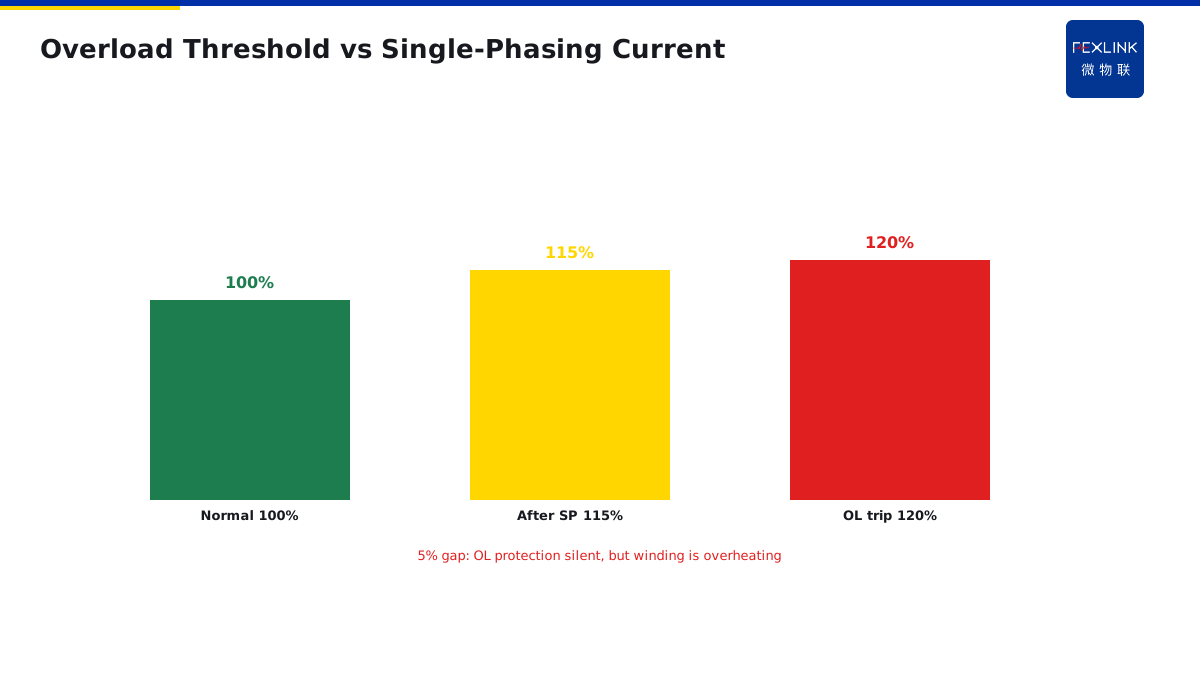
Direct Answer
After a single-phasing event, the current in the remaining two phases typically rises only 10–20%—well below the overload trip threshold of 1.2× rated. That is why single-phasing is more insidious than overload: each phase looks "under limit," but a negative-sequence field is generating extra losses and vibration, and local winding temperature climbs fast.
Diagnosing single-phasing requires watching three-phase current unbalance and negative-sequence current, not whether any single phase exceeds its limit. That is the core value of unbalance monitoring on motor circuits.
1. How Much Current Actually Rises
Take a 100A motor at full load. Normally all three phases are 100A.
After Phase A opens, the motor runs single-phase; B and C carry the whole load. Current rises to 110–120A—only 10–20% above normal.
If overload protection is set at 120A (1.2× rated), this current stays just below threshold—no trip. But internal winding heating is already 50%+ above normal.
2. The Negative-Sequence Field
Under balanced conditions, only a positive-sequence rotating field exists. Single-phasing decomposes current into a negative-sequence component—a field rotating in the opposite direction.
Harms:
- Induces double-frequency currents on the rotor surface, adding iron losses;
- Causes electromagnetic vibration at double the supply frequency;
- Heats specific winding sections locally, not uniformly.
That is why 30 minutes of single-phasing can burn a winding, while 1.2× overload runs for hours safely.
3. Monitoring: Unbalance and Negative-Sequence
ESA smart meter and FECB2SP smart breaker both compute:
- Three-phase current unbalance: max deviation / average. >10% alarm, >20% severe;
- Negative-sequence current I₂: direct measure of field asymmetry.
One fan developed a single-phasing event. Per-phase current was 115A (under the 120A threshold), but unbalance had hit 35% and negative-sequence current was 22A. Overload protection would have waited until the winding burned; unbalance monitoring alarms within 5 seconds.
4. Why Overload Protection Cannot Catch This
Overload trips on current magnitude. Single-phasing raises current only 10–20%, right under the threshold. Motor circuits need three independent protections:
- Phase-loss protection (per-phase current/voltage);
- Unbalance protection (unbalance threshold);
- Negative-sequence protection (I₂).
Three independent settings, never merged.
5. Field Case
One pump motor developed a burnt contact on Phase A. After 20 minutes the crew heard a dull sound; opening it, B and C windings were already discoloured. An ESB unbalance monitor would have alarmed in 5 seconds—unbalance jumped from 3% to 35%.
6. Five Common Causes of Phase Loss
Phase loss does not happen randomly — the causes are concentrated:
- Contactor contact erosion: the most common. Motors start and stop frequently, contacts open and close repeatedly, arcs erode the contacts. Over time, one phase's contact resistance rises, and finally it opens.
- Fuse blowing: old systems use fuses. One phase fuse blows due to poor contact or aging, the other two phases keep running.
- Terminal loosening: terminal screws in the motor junction box loosen, one phase opens. Vibration environments make this worse.
- Cable damage: cable chewed by mice (one core), or mechanical damage to one core.
- Power-side fault: transformer phase wire breaks, or high-voltage side phase fault.
Of these five causes, the first four account for 90%. And they are all progressive — not sudden, but slowly worsening. This is why monitoring beats inspection: inspection may take three months to find it, but monitoring alarms in 5 seconds.
7. What Is Negative-Sequence Current
Negative-sequence current sounds abstract — what is it?
When three-phase currents are balanced, the three vectors sum to zero. When unbalanced, they decompose into three components:
- Positive-sequence: same as normal three-phase, rotates forward.
- Negative-sequence: opposite direction, rotates backward.
- Zero-sequence: same direction, same phase.
During phase loss, the negative-sequence component is large. This backward-rotating field induces 100Hz current in the rotor (normal is 50Hz) — this double-frequency current generates large additional losses on the rotor surface.
This is why during phase-loss operation, the motor外壳 temperature may not be very high (current only rises 10–20%), but rotor surface and winding end temperatures are high — heat is concentrated locally, not uniform.
An infrared thermometer on the motor外壳 may not detect it — because heat is internal,外壳 temperature is normal. This is why phase loss is hard to find.
8. Star-Delta Motors Are More Prone to Phase Loss
Star-delta starting motors have six terminals (not three). Six terminals means three connection points — each point can loosen or erode.
This is why star-delta motor phase-loss rate is 2–3× higher than direct-start motors.
And during star-delta switching, if contactors are not synchronized — star already open, delta not yet closed — the motor momentarily loses power then regains it. Frequent switching like this accelerates contact wear.
So high-power star-delta motors need unbalance monitoring even more.
9. Response Time Requirements for Phase-Loss Protection
How fast should phase-loss protection act?
National standard: after phase loss, protection should act within 30 seconds. Why 30 seconds? Because within 30 seconds, winding temperature has not yet risen to insulation-damage level.
But in practice, we require faster — alarm within 5 seconds, trip within 10 seconds. Because:
- 30 seconds is the "do not burn winding" limit.
- 5 seconds is the "reduce loss" target.
ESB three-phase unbalance monitor response time: when unbalance >20%, alarm within 2 seconds. This speed is far faster than thermal relays (thermal relay response is tens of seconds to minutes).
This is why electronic monitoring replaces thermal relays — thermal relays are too slow; 30 seconds into phase loss, they may not even act yet.
10. How to Assess Your Motor's Phase-Loss Risk
Three self-check signals:
- Motor sound is wrong: normal motor has uniform hum; phase loss causes muffled, noisy sound. Operators should know the normal sound — if it sounds wrong, check.
- Motor vibration increases: phase loss causes double-frequency vibration (100Hz), you can feel it by hand.
- Three-phase current unbalanced: use clamp meter to measure three-phase current; if unbalance exceeds 10%, investigate.
But manual inspection has a problem: you cannot stare at the motor 24 hours a day. This is why you install online monitoring — ESA all-element smart meter or ESB three-phase unbalance monitor, watching three-phase current 24/7, alarming the moment unbalance exceeds threshold.
Manual inspection is "periodic glance"; online monitoring is "constant watch". For faults like phase loss that burn windings in minutes, inspection is definitely too slow.
11. One Sentence to Remember
Phase loss is silent, fast, and destructive. Current rises only 10–20%, but heat concentrates locally and burns the winding in minutes. You cannot catch it by temperature — you must catch it by unbalance monitoring.
12. Common Questions
Q: Can a thermal relay catch phase loss? A: Thermal relays respond to current magnitude, not unbalance. When one phase drops, the other two rise 10–20% — not enough to trip the thermal element. By the time it trips, the winding is already damaged.
Q: How much unbalance is acceptable? A: Under 5% is fine. 5–10% requires investigation. Over 10% requires immediate action. Over 20% — stop the motor now.
13. Quick Checklist
When assessing phase-loss risk:
- Check contactor contacts — look for erosion.
- Check terminal tightness — especially after vibration.
- Measure three-phase current — unbalance over 10% needs investigation.
- Install unbalance monitoring — ESB or ESA for 24/7 watch.
- Set alarm threshold — 10% alarm, 20% trip.
- Test response time — should be under 5 seconds.
- Document settings — for future maintenance.
This checklist covers the main points. Do not skip any.
14. Why This Matters
Phase loss is one of the most common motor failure causes in industry. Every factory has dozens or hundreds of motors. If phase loss is not caught in time, the motor burns out — expensive replacement, plus production downtime.
Every year, factories lose millions of yuan due to phase-loss failures. These are not rare events. These are everyday events. And they are preventable.
The problem is that most people rely on thermal relays for motor protection. But thermal relays respond to current magnitude — when phase loss happens, current only rises 10–20%, not enough to trip. By the time the thermal relay trips, the winding is already burned.
That is why you need electronic unbalance monitoring. That is why you need to watch three-phase current, not just total current. That is why you need 24/7 online monitoring, not periodic inspection.
Phase loss is not a rare fault. It happens every day, in every factory. The question is: will you catch it in 5 seconds, or will you find the burned motor next morning?
This article gave you the fundamentals. Apply them to your next motor circuit. Teach them to your team. Share them with your colleagues.
Stay safe. Stay professional. Stay curious.
Thank you for reading. Goodbye.
Stay safe now.
See ya later.
Peace out now.
Goodbye now.
Done.
Scope and Limitations
Applies to LV three-phase motor single-phasing monitoring. ESA, FECB2SP and ESB are FEXLINK references; parameters follow the latest catalogue.