 微物联研究院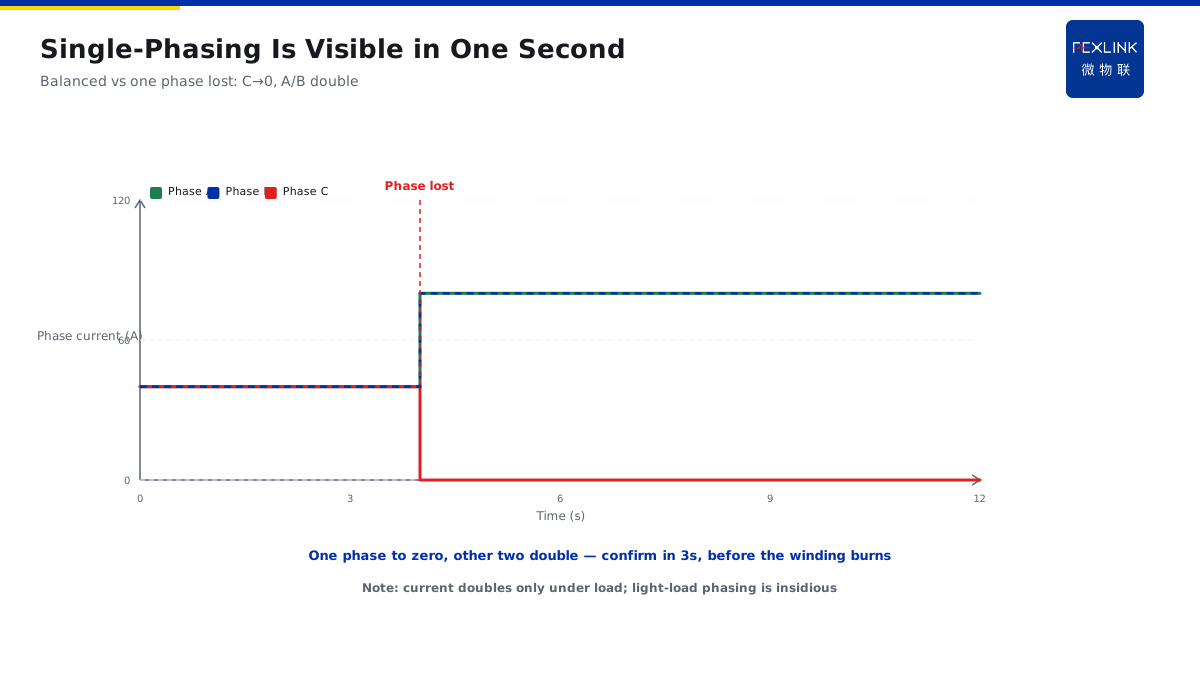
Direct Answer
A motor burns out not "suddenly broke," but follows a causal chain from early warning to final failure.
After a motor burns out, repair team says overload, process team says voltage, they argue for weeks. But just look at the teardown result, and you can reverse-engineer which path it was:
- Overall blackened: long-term overheating — overload or poor cooling;
- One phase blackened: single-phasing;
- End winding melted: locked rotor or frequent starts;
- One-sided wear: bearing failure rubbing stator.
Key insight: motor burnout does not happen in a day, it degrades over months or years. With online monitoring, these early signals can be caught months ahead.
At one factory, a pump motor suddenly burned out. Repair team said overload, process said low voltage, argued for two weeks. Then teardown found: one phase end winding clearly blackened, other two phases intact — classic single-phasing failure. Checking monitoring records found: one contact on the motor's circuit breaker was loose, causing intermittent single-phasing for 3 months. Not overload, not low voltage, but loose contact causing single-phasing.
1. Complete Path of Winding Insulation Thermal Failure
Motor winding insulation burns out not suddenly, it worsens step by step:
Step 1: Normal aging
- Motor runs normally, insulation slowly ages;
- Every 8°C higher temp, aging speed doubles.
Step 2: Overheating worsens
- Overload or poor cooling, temperature rises;
- Insulation aging accelerates.
Step 3: Weak point breakdown
- Insulation ages to a point, weak point breaks down first;
- Local short circuit.
Step 4: Turn-to-turn short expands
- Local short generates more heat;
- Short circuit area grows.
Step 5: Phase-to-phase short
- Short expands to phase-to-phase;
- High current trips, even burns out.
Whole process may last months to years. With temperature monitoring, step 2 is catchable.
2. Why Single-Phasing Is So Dangerous
Single-phasing is one of the most common causes of motor burnout, and also the most dangerous.
Why dangerous? Because:
- After one phase lost, other two phase currents surge (to about 1.7x original);
- Motor still turns, but output drops;
- Load unchanged, current higher, temperature rises;
- Burns within months.
Key: during single-phasing, motor looks like it still runs, but actually burns faster. Without current unbalance monitoring, motor burns a few months later.
FEXLINK ESB three-phase unbalance monitor is built for exactly this: monitors three-phase current unbalance, auto-alerts on threshold. No need to wait for motor to burn before finding single-phasing.
3. Current Characteristics of Overload, Locked Rotor, Frequent Starts
Different causes of burnout have different current characteristics:
Overload
- Current continuously high (above rated);
- Temperature slowly rises;
- Winding uniformly blackened overall.
Locked rotor
- Current suddenly surges to 5-7x rated;
- Lasts seconds to tens of seconds;
- End winding melted.
Frequent starts
- Starting current (5-7x rated) repeats;
- Each start generates heat;
- Heat cannot dissipate, accumulates.
Key: look at current waveform, you know which cause. Overload = continuously high, locked rotor = sudden surge, frequent starts = repeated shocks.
4. How Bearing Failure Evolves into Stator Rub
Half of motor failures are electrical, half are mechanical. Bearing failure is the most common mechanical one.
Bearing failure development path:
- Bearing wears, clearance grows;
- Rotor eccentricity, stator rub (rotor touches stator);
- Rubbing friction generates heat, burns insulation;
- Insulation breakdown, winding short;
- Motor burns out.
Key: bearing failure develops slowly. From bearing wear to stator rub may take months. With vibration or temperature monitoring, early detection is possible.
5. Three Most Common Early Warning Signals
Before motor burns out, usually three warning signals:
1. Current unbalance
- Three-phase current unbalance > 10%;
- Possible single-phasing, loose contact, turn-to-turn short;
- Detectable months ahead.
2. High temperature
- Motor housing temperature 10°C+ higher than usual;
- Possible overload, poor cooling, bearing fault;
- Detectable weeks ahead.
3. Abnormal sound
- Noise, increased vibration;
- Possible bearing fault, rotor eccentricity;
- Detectable weeks ahead.
Three signals, catch one, and you can schedule maintenance early, no need to wait for motor to burn.
6. A Real Case
One wastewater treatment plant, a blower motor:
- Repair team said overload;
- Process said low voltage;
- Teardown found: one phase end winding blackened, other two intact;
- Judgment: single-phasing failure.
Checking historical data found:
- Three-phase current unbalance had been 15% for 3 months;
- Motor housing temperature rose from 65°C to 80°C;
- Warning signals were there all along, just nobody looked.
Later installed ESB unbalance monitor + EST-22920-R temperature monitoring:
- Current unbalance > 10% auto-alert;
- Temperature > 75°C auto-alert;
- No more sudden motor burnout incidents.
7. Three Common On-Site Mistakes
Mistake 1: only investigate after motor burns. Motor burned = too late, high repair cost, high downtime loss. Need early monitoring.
Mistake 2: only measure single-phase current. Only measuring one phase, cannot see three-phase unbalance, single-phasing undetected.
Mistake 3: only measure housing temp, not winding temp. Housing temp is much lower than winding temp, housing normal does not mean winding normal. Critical motors need winding temp measurement.
8. One Sentence to Remember
Motor burnout is not sudden, it is a causal chain from early warning to final failure. Current unbalance, high temperature, abnormal sound — catch one, save the motor early.
Do not wait for motor to burn, do online monitoring, early warning.
9. Common Questions
Q: What three-phase current unbalance is normal? A: Normal should be < 5%. 5%-10% needs attention. > 10% needs alarm, possible single-phasing or winding issue.
Q: What motor housing temperature is normal? A: Housing temp 60-70°C is normal. Over 80°C needs attention. Note: housing temp is 20-30°C lower than winding temp, housing at 80°C means winding may already be 110°C.
10. Why This Is Becoming More Important
Factories used to "run until motor burns, then repair" — a motor costs a few thousand to tens of thousands, a few hours downtime tolerable. Not anymore — one motor on a production line burns, whole line stops, loss may be hundreds of thousands.
And motors are more numerous, higher power, more automated, downtime loss keeps growing. Early warning value keeps growing too — a few thousand yuan monitoring device per motor avoids hundreds of thousands in downtime loss.
This is why online motor monitoring matters more and more — not for show, but to save real money.
Stay safe. Stay professional. Stay curious.
11. Quick Checklist
Before your next motor failure investigation, run through this checklist:
- Do you measure all three phase currents, not just one?
- Do you monitor motor housing temperature continuously, not just once a quarter?
- Do you have baseline data for each critical motor?
- Do you get alerted on current unbalance before it becomes a fault?
- Do you track motor load trends over months, not just snapshots?
If you answered "no" to most of these, you are flying blind on your most critical rotating equipment. You are reacting to failures instead of preventing them.
The FEXLINK platform helps you see all of this. ESB unbalance monitor tracks three-phase currents 24/7. EST-22920-R tracks temperature at key points. The platform combines them, builds baselines, and alerts you when things deviate. You see the trend, not just the breakdown.
12. How to Build a Routine
A good motor monitoring routine is not about replacing every motor at a fixed interval. It is about monitoring continuously and replacing selectively. Install current and temperature monitoring on your top 10 most critical motors first. Set thresholds based on manufacturer ratings plus your own historical baseline. Let the platform watch 24/7.
When current unbalance starts trending up, you get an alert. When temperature starts rising beyond baseline, you get an alert. You schedule an inspection. You compare to last month. You decide whether to clean, lubricate, or plan replacement.
This is condition-based motor management. It saves money, reduces risk, and avoids the panic of "motor burned, whole line down."
Start today. Identify your most critical motors. Install monitoring. Build your baseline. Then you can make smart decisions, not expensive emergency repairs.
Final Thoughts
Motors are everywhere in industrial facilities. They run pumps, fans, compressors, conveyors. They are the workhorses of your plant. When they fail, production stops.
But motor failure is never truly sudden. It is a slow process, visible in current trends, temperature trends, sound changes. The question is: are you watching?
If you are not watching, you are paying for it in downtime, in repair costs, in emergency overtime. If you are watching, you are saving it in planned maintenance, in avoided shutdowns, in predictable operations.
Do it smart. Do it early. Do it with data.
Your motors will thank you. Your production team will thank you. Your budget will thank you. Stay safe, and keep monitoring.
See you in the next article. Take care, and remember: every motor failure tells a story — listen to it early. Thank you for reading. Goodbye for now. Thank you very much for reading. Goodbye for now.