 微物联研究院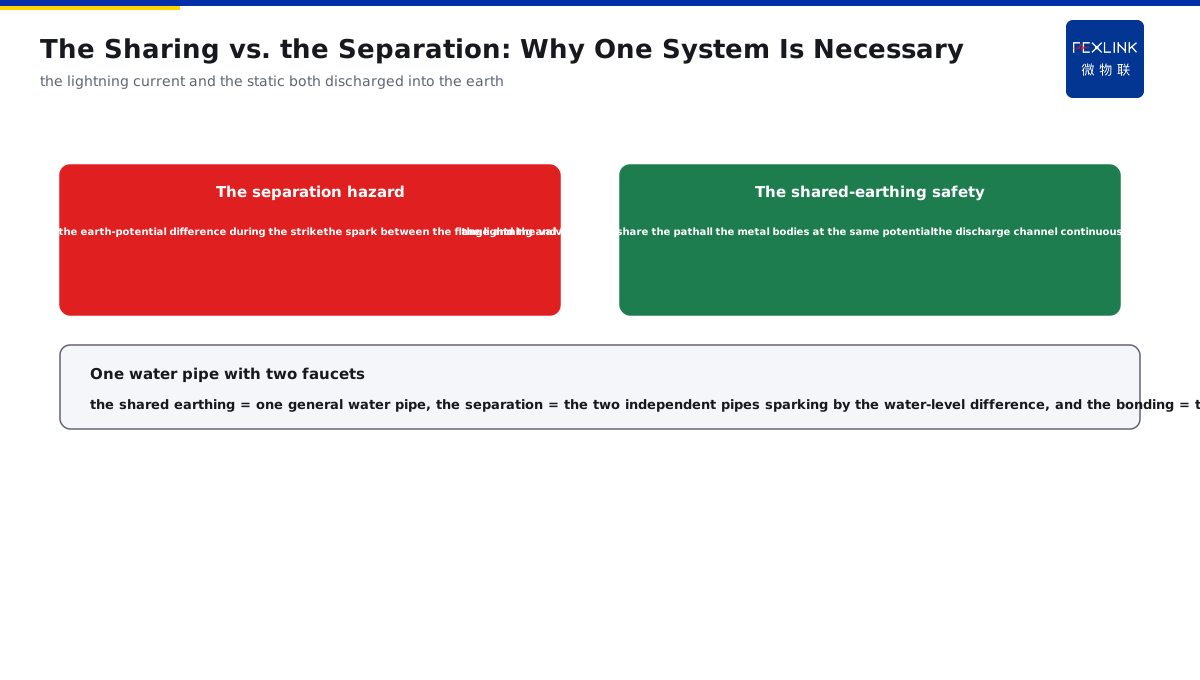
Direct Answer
The tank farm needs both the lightning protection and the static protection — can these two earthing systems be done separately, and how is the sharing safe? The answer: the tank-farm lightning and static earthing must share one earthing network and be fully equipotentially bonded — the lightning current into the earth and the static discharge both need the earth; if separated, a dangerous earth-potential difference will appear during the strike, forming the spark between the flange, the valve, the floating roof and the tank wall; the shared earthing plus the bonding pulls all the metal bodies to the same potential and satisfies the resistance requirements of both earthing types.
At a tank farm where the lightning earthing and the static earthing were laid separately, a discharge trace was found at the flange after one strike, and the investigation confirmed the earth-potential difference between the two systems. After the shared-earthing retrofit: all the metal bodies connected into the same earth network, the flanges and the valves equipotentially bonded, and the floating roof and the tank wall connected by the multiple flexible bonds; no discharge trace was found in the lightning-season patrol after that. The design core: the shared earthing + the full bonding — the lightning current and the static both discharge into the earth, and all the metal bodies pulled to the same potential — the separation causes the spark, and the sharing is safe.
Why:
- The lightning current must enter the earth: the shared earthing network;
- The static must be discharged: the same discharge path;
- The separation causes the spark: the earth-potential-difference spark;
- The bonding pulls the same potential: the flange, the valve and the floating roof.
Key insight: "The shared earthing is inevitable — the lightning current into the earth and the static discharge share the same path, the separation produces the dangerous earth-potential difference (the spark at the flange/valve/floating roof), and the full bonding pulls all the metal bodies to the same potential, satisfying both earthing requirements."
At a tank farm with the two earthing systems laid separately, a discharge trace appeared at the flange in the lightning season; after the shared earthing + the full bonding, no discharge trace was found in the lightning-season patrol, and the earthing resistance satisfied both the lightning and the static requirements. Lesson: the separation is the hazard — the lightning current and the static both discharge into the earth, and the separation sparks; only the shared earthing plus the bonding is safe.
Overview: run "why the sharing is necessary → what the bonding requirements are → how the earthing resistance is valued → how the explosion-proof monitoring is configured" as one tank-farm shared-earthing design. The tank-farm lightning and static earthing must share one earthing network and be fully equipotentially bonded: the lightning current into the earth and the static discharge both need the earth; if separated, a dangerous earth-potential difference will appear during the strike, forming the spark between the flange, the valve, the floating roof and the tank wall. The four layers are unfolded below.
A "one water pipe with two faucets" analogy: think of the tank-farm earthing as one water pipe with two faucets. The lightning current and the static are both "water", and both must finally be discharged into the earth — the general water pipe — to drain away. If the lightning earthing and the static earthing each connect their own pipes, it is like two independent pipes draining separately — when the lightning current enters the earth from one pipe, it instantly raises the water level (the earth potential) of this path, while the water level of the other pipe has not caught up, and a water-level difference (the earth-potential difference) appears between the two faucets (the flange and the valve); when the difference is large, "water sprays and sparks" (the discharge spark) at the interface. With the shared earthing network, it is like all the faucets connected to the same general water pipe — the water level rises and falls together, and no water-level difference exists between any two interfaces, so no spark. The bonding is then connecting each joint of the pipeline (the flange, the valve and the floating roof) with the flexible hose, guaranteeing that the water level is absolutely consistent. The water-pipe analogy: one general water pipe = the shared earthing network, the two faucets = the lightning/static earthing, the water-level difference = the earth-potential-difference spark, and the joint hoses = the flange/valve/floating-roof bonding — the sharing plus the bonding, the potential all flat and no spark.
1. The Sharing Principle: Why One System Is Necessary
Step one: first look at why the lightning earthing and the static earthing must share one system.
The lightning current into the earth:
- The lightning current must be discharged into the earth;
- The earthing network provides the path;
- The path must be low-resistance;
- The dissipation must be quick.
The static discharge:
- The static accumulation must be discharged;
- The same discharge path;
- The discharge channel must be continuous;
- Against the accumulation igniting.
The separation hazard:
- The two earthing potentials differ;
- The earth-potential difference during the strike;
- The spark between the flange and the valve;
- The oil-gas environment igniting.
Key insight: "The sharing is inevitable — the lightning current into the earth and the static discharge share the same path, the separation produces the dangerous earth-potential difference (the spark at the flange/valve/floating roof), and only the shared earthing pulls all the metal bodies to the same potential for safety."
2. The Bonding Requirements: How the Flange, the Valve and the Floating Roof Connect
Step two: the equipotential bonding requirements of the flange, the valve, the floating roof and the tank wall.
The flange bonding:
- The flange joint bonded;
- The bonding-wire specification met;
- The bolted connection reliable;
- The equipotential continuous.
The valve bonding:
- The two ends of the valve bonded;
- Against the spark at the break;
- The bonding checked regularly;
- The loosening handled in time.
The floating-roof bonding:
- The floating roof and the tank wall bonded;
- The multiple flexible connections;
- Rising and falling with the floating roof;
- The static continuously discharged.
Key insight: "The bonding has three places — the flange joint bonded (the equipotential continuous at the joint), the two valve ends bonded (against the break spark), and the floating roof and the tank wall bonded by the multiple flexible connections (the continuous discharge with the rise and fall) — with the full bonding, the potential all flat."
3. The Resistance Value: The Lightning and Static Both Strict
Step three: the shared-earthing resistance value (the lightning and static both strict).
The lightning requirement:
- The resistance per the lightning standard;
- The impulse earthing resistance met;
- The discharge capability satisfied;
- Designed per GB 50057.
The static requirement:
- The resistance per the static standard;
- The static discharge channel continuous;
- The resistance upper limit;
- Designed per GB/T 50065.
The strict value-taking:
- The two requirements both strict;
- One shared system satisfying both;
- The target value verified;
- The online monitoring validated.
Key insight: "The value-taking is strict — both the lightning and the static requirements satisfied (per GB 50057 and GB/T 50065), one shared system meeting both, and the target value verified plus the online validation."
4. The Explosion-Proof Monitoring: How the FR Explosion-Proof Is Configured
Step four: the explosion-proof monitoring equipment configuration (Ex d).
The explosion-proof adaptation:
- The hazardous-area equipment explosion-proof;
- The Ex d flameproof type;
- The IIB gas group adapted;
- Usable in the tank farm.
The FR monitoring role:
- The shared-earthing trend;
- The bonding state corroborated;
- The earthing degradation found early;
- The discharge capability verified.
The monitoring layout:
- The tank-farm earthing monitoring;
- The bonding key points covered;
- The trend continuously recorded;
- The lightning season confident.
Key insight: "The explosion-proof monitoring — the hazardous area uses the Ex d flameproof type (the IIB adapted), the FR watches the shared-earthing trend and the bonding state, and the layout covers the key points; the earthing degradation is found early."
5. Product Implementation: The Tank-Farm Shared-Earthing Closed Loop
WeiWuLian products make the tank-farm shared earthing "verifiable and sustainable":
- FR explosion-proof earthing-resistance monitor (Ex d IIB): the shared-earthing trend continuously watched;
- The bonding check list: the flange, the valve and the floating roof verified point by point;
- The online data closed loop: the earthing and the bonding state fully visible.
The design principle in one sentence: "The shared earthing is the foundation, the full bonding is the key, and the explosion-proof monitoring is the eye — the FR watches the earthing trend, and the bonding is verified point by point; the tank-farm lightning-season spark has zero tolerance."
6. Common Understanding Misjudgments
- "The lightning and the static earthing can be done separately": wrong. The separation sparks at the earth-potential-difference point.
- "The flange installed needs no care": wrong. The bonding must be checked regularly and the loosening handled in time.
- "The floating-roof tank needs no bonding": wrong. The floating roof and the tank wall need the multiple flexible bonds.
- "The lightning resistance is enough": wrong. The lightning and the static requirements are both strict.
- "The monitoring cannot be installed in the hazardous area": wrong. The Ex d explosion-proof equipment can adapt.
Scope and Limitations
This article explains the petrochemical tank-farm lightning and static shared-earthing design (the sharing principle, the bonding requirements, the resistance value and the explosion-proof monitoring), applicable to the hazardous tank-farm earthing design. The specific design follows GB 50057-2010 and GB/T 50065-2011; this article explains only the design logic. All cases are anonymized (a petrochemical tank farm) and do not refer to any specific customer.