 微物联研究院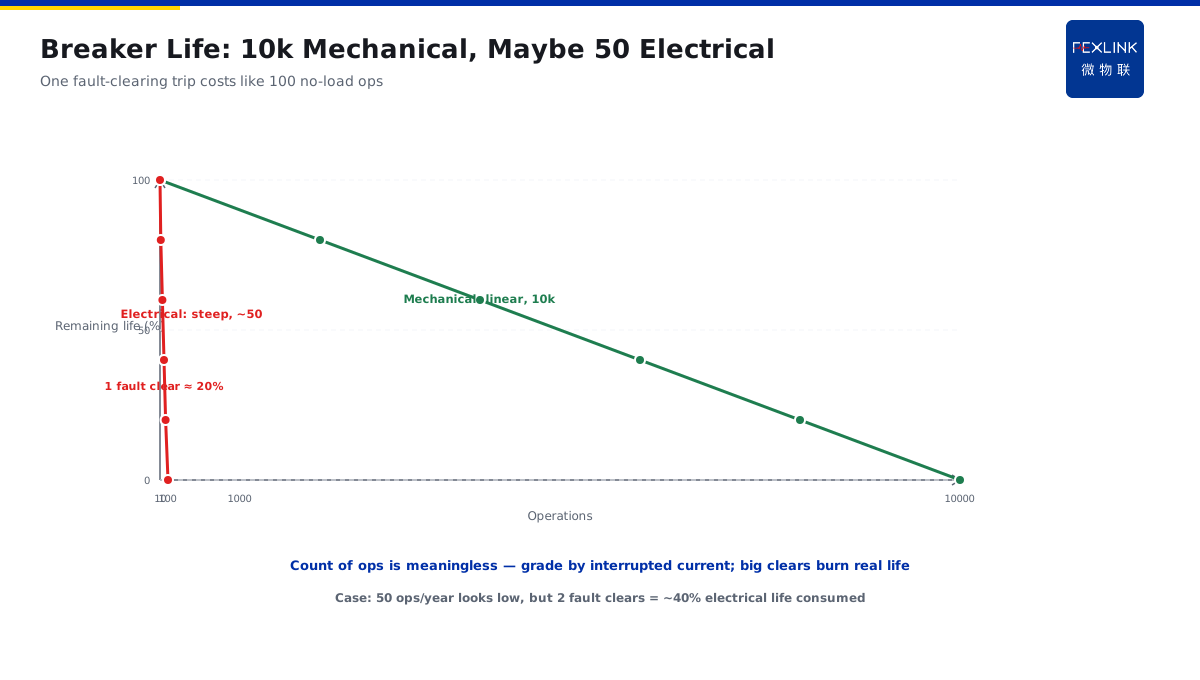
Direct Answer
A circuit breaker that passes all periodic tests still fails to operate at the critical moment — not because the tests are wrong, but because the tests cannot see mechanism wear and electrical life degradation.
Many factories have this problem: circuit breakers pass annual preventive tests, all qualified. Then at the critical moment, they do not trip when needed, or trip when they should not. Why? Because:
- Mechanical life degradation: mechanism wear, spring fatigue, pin loosening, slowly accumulating;
- Electrical life degradation: every current break erodes contacts, accumulates by square of breaking current;
- Operating time drift: mechanical performance declines, opening/closing time slowly lengthens;
- Tests cannot see this: periodic tests are "static tests," cannot see dynamic degradation.
Key insight: circuit breakers are not "fine until broken," they slowly degrade. Periodic test pass does not mean reliable operation at the critical moment. Online monitoring catches early degradation signs.
One substation, a breaker passed all annual tests. Then during a short circuit fault, it failed to trip, and backup trip cascaded, expanding the accident. Later disassembly inspection: mechanism spring was already fatigued, opening time was 30% slower than factory spec. If online monitoring had caught the time drift, scheduled maintenance earlier, this would not have happened.
1. Mechanical Life vs Electrical Life Degradation
Circuit breakers have two kinds of life:
Mechanical life
- No current carried, just mechanism operation;
- Usually 10k~100k operations;
- Degradation causes: mechanism wear, spring fatigue, pin loosening.
Electrical life
- Carries current, breaks fault current;
- Usually thousands of rated breaking operations;
- Degradation causes: contact erosion, arc chute wear.
Key: mechanical life and electrical life are two different things. Mechanical life is long, electrical life is short. Many people think "mechanical operations many times no problem" equals "breaks many times no problem" — wrong.
2. Why Electrical Life Accumulates by I²
Why does electrical life accumulate by square of breaking current?
Because:
- Higher breaking current = bigger arc energy;
- Arc energy proportional to square of current;
- Erosion amount proportional to arc energy;
- So erosion ∝ I².
Example:
- Break 10kA, erosion ×1;
- Break 20kA, erosion ×4;
- Break 40kA, erosion ×16.
Key: one big current break equals many small current breaks. Do not look at "number of breaks," look at "equivalent breaking current accumulation."
3. What Opening/Closing Current Waveforms Tell Us
How to read breaker condition from opening/closing current waveforms?
Normal waveform
- Opening current: smooth, stable time;
- Closing current: smooth, stable time.
Abnormal waveform
- Opening time lengthens → mechanism sticking;
- Closing current fluctuates → spring fatigue;
- Operating time drifts → mechanical performance declining.
Key: opening/closing current waveform is the breaker's "ECG". When the waveform changes, internal state has changed.
4. Why Operating Time Drift Is an Early Signal
Why is operating time drift an early signal?
Because:
- Mechanism wear slowly accumulates;
- Wear causes friction changes;
- Friction changes cause operating time to lengthen;
- This is the earliest measurable degradation sign;
- If you wait until failure to find out, it is too late.
Operating time drift:
- Factory new: 40ms;
- After a few years: 45ms;
- A few more years: 50ms;
- Finally fails to operate.
Key: operating time drift is the "canary in the coal mine" for breaker degradation. Once you see the drift trend, schedule maintenance, do not wait until failure.
5. What Online Monitoring Can Catch
What degradation signs can online monitoring catch?
Can catch:
- Operating time drift;
- Opening/closing current waveform changes;
- Contact erosion level (calculated from breaking current accumulation);
- Abnormal mechanism temperature.
Cannot catch:
- Internal tiny cracks (need disassembly);
- Internal insulation defects (need withstand voltage test).
FEXLINK ESI digital status monitor monitors breaker opening/closing state, records operating time and count. Combined with FSE edge computing gateway, analyzes operating time drift trend, early warning.
6. A Real Case
One factory, a 10kV breaker:
- Annual preventive tests all passed;
- Online monitoring found: opening time drifted from 40ms to 48ms;
- Scheduled planned maintenance: mechanism spring fatigued, pins worn;
- Replaced spring and pins, back to normal.
Without online monitoring, maybe in another half year it would have failed to operate. Then when a short circuit fault came, it would not trip, backup trip cascades, millions in losses.
7. Three Common On-Site Mistakes
Mistake 1: only periodic tests, no online monitoring. Periodic tests are "snapshots," online monitoring is "trends." Snapshot normal does not mean trend normal.
Mistake 2: only look at operation count, not breaking current. More operations does not mean shorter electrical life. Look at equivalent breaking current accumulation.
Mistake 3: wait until failure to maintain. Failure to operate is "end-stage symptom," not early signal. Maintain when you see time drift.
8. One Sentence to Remember
Breaker degradation slowly accumulates: mechanism wear + electrical life decay. Operating time drift is the early signal, only online monitoring catches it.
Do not wait until failure to find out, schedule maintenance when you see drift.
9. Common Questions
Q: Breaker periodic tests pass, why does it still fail to operate? A: Periodic tests are static tests, cannot see dynamic degradation. Mechanism wear, spring fatigue, operating time drift — these dynamic degradations are not caught by periodic tests. Need online monitoring.
Q: Can online monitoring predict when breaker will fail? A: Yes. Through operating time drift trend, breaking current accumulation, opening/closing waveform changes, can predict degradation speed. Not exact to the day, but tells you "how much longer until maintenance."
10. Why This Is Becoming More Important
As grids get more complex and fault currents get higher, breaker reliability becomes more critical. A single failure to operate can cascade into a major outage. That is why condition-based breaker management is replacing fixed-interval maintenance.
But condition-based management requires knowing actual breaker condition. Which requires online monitoring. Which is exactly what FEXLINK provides.
Stay safe. Stay professional. Stay curious.
11. Quick Checklist
Before you trust your next breaker to work at the critical moment, run through this checklist:
- Do you only have periodic tests, or do you also have online monitoring?
- Do you track operating time drift, or just whether it works today?
- Do you count equivalent breaking current accumulation, or just operation count?
- Have you established a baseline for your critical breakers?
- Do you know which breakers are most critical, and monitored first?
If you answered "no" to most of these, your breakers may look fine on paper, but you are gambling on whether they will work when you need them. That is not a good bet.
The FEXLINK platform helps you make this a science, not a gamble. ESI monitors breaker status. FSE edge gateway analyzes trends. Together, they show you which breakers are aging, which are still healthy, and which need maintenance before they fail.
12. How to Build a Routine
A good breaker monitoring routine starts with the critical few. Not every breaker needs online monitoring. Start with the most critical ones — incoming feeders, bus ties, important load feeders. These are the ones whose failure causes the biggest problems.
Measure the core parameters. Operating time, opening/closing current waveform, breaking current accumulation. Three parameters is enough. More than that and you lose focus.
Build a baseline. When a new breaker is commissioned, record its operating time and waveform. That is your baseline. Then compare every operation to baseline. See how much it has drifted.
Set warning thresholds. For example, operating time drift over 10% = warning. Over 20% = alarm, schedule maintenance. Thresholds are not guesses, they are tuned over time with manufacturer data and field experience.
Start today. Identify your most critical breaker. Install monitoring. Build your baseline. Then you can make smart maintenance decisions, not expensive emergency ones.
Final Thoughts
Circuit breakers are the last line of defense for electrical systems. When a fault happens, they need to work. Every time. Without exception.
But they are not indestructible. They wear out. Slowly, quietly, and usually without warning — unless you are watching. With online monitoring, you can watch. You can see the drift. You can schedule maintenance before failure.
Do it smart. Do it early. Do it with data.
Your breakers will thank you. Your production team will thank you. Your budget will thank you. Stay safe, and keep monitoring.
See you in the next article. Take care, and remember: breaker degradation tells a story — read it early, read it right.
That is all for this article. If you have breakers that have been running for more than a decade without online monitoring, it is time to think about it. Good luck, and stay breaker-safe. Until next time. Keep your breakers healthy, keep your grid reliable, and keep your production running without unexpected outages. Thank you for reading. We will see you again soon with another article on electrical equipment health monitoring. Take care, and stay safe out there.